
Customer feedback is the information customers share about their experience with your product, service or brand, through surveys, reviews, support chats, social comments and conversations. It tells you what people like, what frustrates them and what they wish you offered. It matters because it shows you what to fix and what to promote, so your marketing and products match what customers actually want.
Key Takeaways
- Feedback can be asked for, such as surveys, or unprompted, such as reviews and social comments.
- Common survey types are Net Promoter Score (NPS), customer satisfaction (CSAT) and customer effort score (CES).
- Google says replying to reviews shows customers “that you value their feedback.”
- The value comes from acting on feedback, then telling customers what changed.
- Marketers use it for messaging, testimonials, product ideas and fixing weak points in the journey.
What Is Customer Feedback?
Every time a customer fills in a survey, writes a review or complains in a chat, they give you feedback. Some of it is direct, such as a score out of ten. Some of it is hidden in comments, support tickets or even the questions people ask before buying.
Good teams collect it from several places, then look for patterns. For example, if many people say delivery was slow, that is a clear signal. If several reviews praise one feature, that’s a strong message for your next ad.
Customer feedback is also a key part of the wider customer experience, because it shows how each step feels from the customer’s side.
How Customer Feedback Works
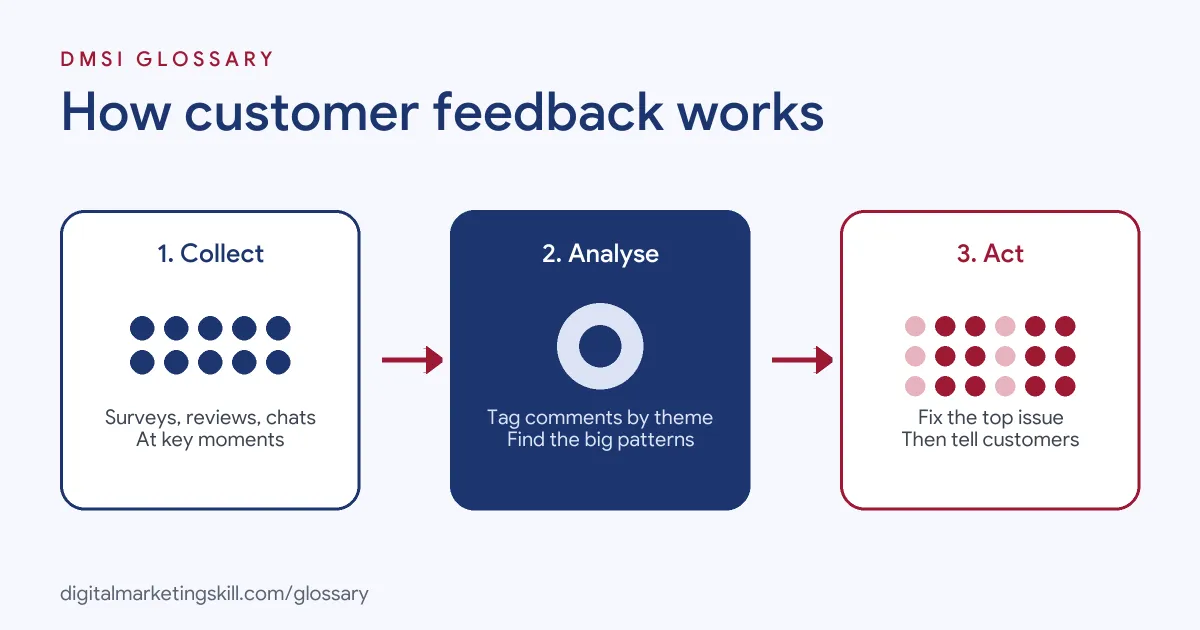
Most feedback programmes follow a simple loop. First, you collect feedback at key moments. Next, you analyse it to find themes. Finally, you act on what you learn and close the loop by telling customers what you changed.
Ways to Collect Feedback
Surveys are the most common tool. HubSpot’s feedback software, for instance, offers “pre-built net promoter score (NPS), customer effort score (CES), and customer satisfaction (CSAT) surveys.” It also lets you send surveys “via web link or email, in multiple languages.”
Reviews are another source. Google’s Business Profile help says: “Customer reviews can give helpful feedback about your business.” To get more of them, Google suggests you “share a review request link or QR code.” In addition, support chats, social comments and sales calls all hold useful feedback.
Analysing Feedback
Scores tell you where you stand. Comments tell you why. So read the comments and tag them by theme, such as price, delivery or ease of use. Tools can help here. HubSpot says its feedback dashboards let you “view survey scores, sentiment, and volume of responses.”
Acting and Closing the Loop
Feedback only matters if something changes. Pick the most common issue, fix it, then tell customers you listened. For public reviews, Google notes that “when you reply to their reviews, you show them that you value their feedback.” That simple step builds trust with the reviewer and with everyone who reads the reply.
Customer Feedback Examples
Here are three made-up examples of feedback turned into action:
- Online shop: Post-purchase surveys show many people are unsure about sizing. The shop adds a size guide and fit notes, and returns fall.
- Software company: Support chats reveal that users can’t find one key setting. As a result, the team adds a help article and a short welcome email that points to it.
- Café: Several reviews praise the homemade cakes. The owner makes them the star of the next social campaign.
In each case, the business listens, then changes something that customers notice.
Types of Customer Feedback Surveys
Here is how the three most common survey types compare:
| Survey | What it asks | Best used |
|---|---|---|
| Net Promoter Score (NPS) | How likely are you to recommend us to a friend or colleague, from 0 to 10? | To track overall loyalty over time |
| Customer satisfaction (CSAT) | How satisfied were you with a specific interaction or purchase? | Straight after a purchase or support case |
| Customer effort score (CES) | How easy was it to get what you needed? | After tasks such as setup, returns or support |
For the full method behind the first one, see our glossary entry on the Net Promoter Score.
How to Collect Customer Feedback
- Decide what you want to learn, such as why people don’t buy or how support feels.
- Pick the right moments, such as after checkout, after delivery or after a support chat.
- Choose the format: a short survey, a review request or a quick interview.
- Keep it short. One score question and one open question are often enough.
- Collect replies in one place, so you can see patterns across channels.
- Tag the comments by theme and count how often each one appears.
- Act on the biggest theme first, then tell customers what you changed.
Best Practices
- Ask at the right time. Feedback is clearest soon after the experience.
- Keep surveys short. Fewer questions usually mean more replies.
- Reply to reviews. Thank happy customers and respond calmly to unhappy ones.
- Share it widely. Send key themes to product, sales and support, not just marketing.
- Use the customer’s words. Real phrases from feedback often make the best ad copy.
Using Feedback in Marketing
Feedback is a goldmine for marketers. First, it gives you real language for headlines and ads. Second, positive comments can become testimonials, with permission. Third, common questions can become FAQ pages or blog posts. Finally, complaints show which objections your landing pages need to answer. So a regular feedback review can feed your whole content plan, from ads and emails to blog posts and landing pages.
A Simple Feedback Survey
Here is a made-up three-question survey that an online shop could send a few days after delivery:
- How satisfied are you with your order, from 1 to 5?
- What is one thing we could do better?
- Can we share your comment on our website? (Yes or no)
It is short, so more people finish it. The open question gives you the reasons behind the score. Finally, the last question gets permission to use good comments as testimonials.
How to Measure Your Feedback Programme
Track the programme itself, not just the scores. Here are four simple checks:
- Response rate: the share of people who answer. A low rate may mean the survey is too long or badly timed.
- Score trend: whether NPS or CSAT rises after you make changes.
- Top themes: the issues people mention most, and whether they shrink over time.
- Time to act: how long it takes to fix a common complaint once you spot it.
For example, imagine “slow delivery” appears in 30% of comments one month and 10% two months later. In that case, your fix is working, and you can move to the next theme.
Common Mistakes to Avoid
Many businesses collect feedback and then do nothing with it, which tells customers their views don’t matter. Others ask too many questions, so few people finish the survey. Some only ask happy customers, which hides real problems. Finally, many ignore negative reviews instead of replying. A calm, helpful reply can win back trust and shows future customers that you care.
Where You’ll Use Customer Feedback at Work
Feedback work appears in many client, community and marketing roles. For example, recent remote job listings ask candidates to:
- “Gather customer feedback to ensure satisfaction and foster repeat business.” (Senior Virtual Assistant).
- “Collect product feedback and deliver it to the Product group so we keep improving” (Client Executive).
- “Partner with Support, Product, Education, and Paid so feedback gets to the right team and gets closed out.” (Community Manager).
So as a Digital Marketing Manager or Growth Marketer, you will use feedback to shape campaigns, landing pages and retention emails.
Learn It in the Full Stack Programme
Feedback touches social, email, search and web, so it fits the Full Stack (all four tracks) option. It covers all ten courses, with one portfolio project from each track. Every track is about 90% hands-on, with unlimited 1-on-1 mentoring and a U.S. Project Internship from day one.
For more on reviews, read our guide to customer reviews.
Frequently Asked Questions
What is customer feedback in simple terms?
It is what customers tell you about their experience, through surveys, reviews, chats or comments.
What are the main types of customer feedback surveys?
The most common are Net Promoter Score (NPS), customer satisfaction (CSAT) and customer effort score (CES).
How do you collect customer feedback?
Send short surveys at key moments, ask for reviews, and gather comments from support chats, social media and sales calls.
Should I reply to negative reviews?
Yes. A calm, helpful reply shows you take feedback seriously. Google notes that replies show customers you value their feedback.
What do you do with feedback once you have it?
Group it into themes, fix the most common problems first and tell customers what you changed.
Sources: HubSpot: Customer feedback software; Google Business Profile Help: Manage customer reviews; Bain: Measuring your Net Promoter Score; remote job listings on Himalayas.