
Customer reviews decide more sales than most business owners realize. A Pew Research Center survey found 82% of US adults read reviews before a first-time purchase. This guide shows how to earn more reviews, respond the right way, and avoid the one mistake that can now trigger a federal penalty.
Key Takeaways
- Most buyers check reviews first. Pew Research Center found 82% of US adults read reviews before buying something new. 40% almost always do it.
- Paying for good reviews is now illegal, not just risky. The FTC’s rule bans compensating customers for reviews that must express a given sentiment. Civil penalties apply.
- Google bans review incentives outright. Google’s own policy calls incentivized reviews “fake and misleading content.” It strictly prohibits them, separate from the FTC rule.
- Responding beats ignoring. ReviewTrackers found 44.6% of consumers are more likely to visit a local business if the owner responds to negative reviews.
- Speed matters too. Over half of consumers, 53%, expect a response to a negative review within a week. A third expect one within three days, per ReviewTrackers.
In this guide
- The Real Gap: Most Review Advice Is Now Out of Date
- Why Customer Reviews Drive Sales: Mechanism, Not Magic
- Three Review Situations Need Three Different Strategies
- The Right Move for Each Situation
- Measure Customer Reviews Like a Funnel
- The One Decision Rule: Ask Consistently, Respond Fast, Never Pay for Sentiment
- A Real Case: Reviews Built Into the Business Itself
- Frequently Asked Questions About Customer Reviews
- Turn Customer Reviews Into a Repeatable System
The Real Gap: Most Review Advice Is Now Out of Date
Most articles on customer reviews still suggest offering a discount or a small gift for a review. That advice used to be common. It is now against both Google’s policy and US federal law.
A few ground rules first. The FTC rule is US law. If you operate elsewhere, check your own country’s advertising standards body for an equivalent.
The percentages below come from named surveys, each with its own scope and sample. Treat them as a snapshot, not a universal constant.
Why Customer Reviews Drive Sales: Mechanism, Not Magic
Customer reviews work because they replace a stranger’s claim with a peer’s account. A business says its product is great. A customer review says whether that was actually true for someone like the reader.
That’s why Pew Research Center found 82% of US adults read reviews before buying something for the first time. 40% do it almost every time. Younger adults rely on reviews most: 53% of 18 to 29 year olds read them nearly every time, against 23% of adults 65 and older.
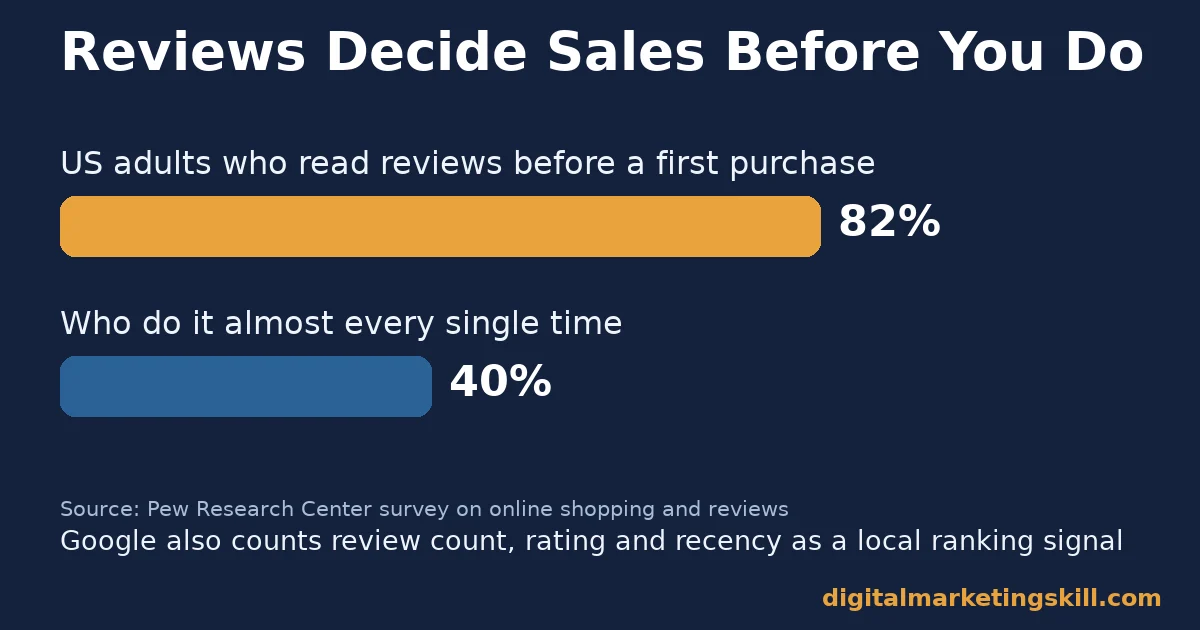
Reviews also feed local search rankings directly. Local SEO depends partly on review signals. Google’s own guidance names “prominence” as one of three ranking factors, based partly on “how many reviews you have,” and says more reviews and positive ratings can help local ranking. A thin or stale review profile can quietly cost visibility, even with a strong website.
Three Review Situations Need Three Different Strategies
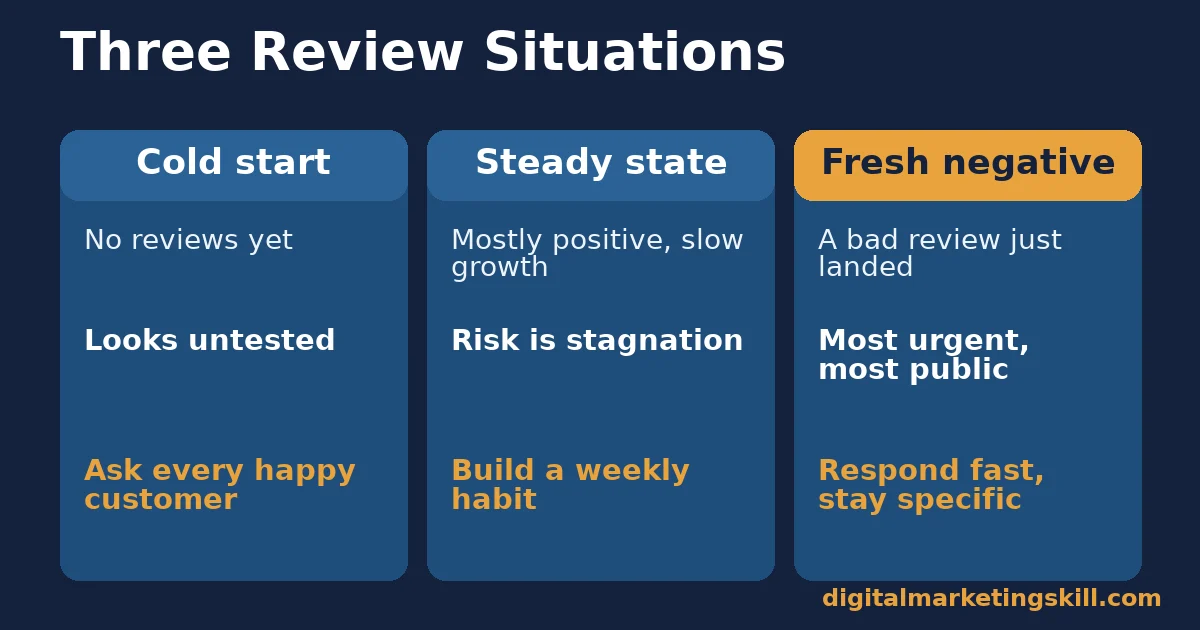
Not every business faces the same review problem. A brand-new shop, a business with mostly positive reviews, and a business handling a fresh negative review each need a different first move.
The Cold Start: No Reviews Yet
A business with zero or very few customer reviews looks untested to a buyer comparing options, because most buyers want a real pattern before they trust a rating, not just one or two reviews.
The cold-start problem is about volume and trust, not quality. Even a handful of honest, specific reviews beats silence. Silence reads as new or unproven, not reliable.
Pairing early review requests with the follow-up steps in our guide on post-purchase engagement builds both loyalty and reviews from the same customer touchpoint.
The Steady State: Mostly Positive, Growing Slowly
A business with a decent rating and a trickle of new reviews is in the most common position. The risk here isn’t a crisis, it’s stagnation. Competitors with faster review growth can out-rank a business that was ahead a year ago.
This is where consistency matters more than any single tactic. A steady request process, applied to every satisfied customer, outperforms occasional bursts of effort.
The Fresh Negative Review
A new one- or two-star review is the most urgent of the three situations. Other buyers are reading it in real time. How a business responds becomes part of the public record, visible to every future visitor, not just the unhappy customer.
This is also the situation with the clearest wrong move: deleting, hiding, or pressuring the reviewer to take it down. The FTC’s rule treats review suppression by threats or intimidation as a banned practice, not just bad etiquette.
The Right Move for Each Situation
The sections below mirror the three situations above, with the specific action that fits each one.
Cold Start: Ask Every Satisfied Customer, Without Incentives
Build a simple habit. After every positive interaction, ask for a review with a direct link. Keep the request short and specific about where to leave it, because friction is the main reason customers skip it.
Do not offer a discount, gift, or entry into a drawing in exchange. Google’s own review policy calls incentivized reviews “fake and misleading content” and bans them outright. The FTC rule adds a separate legal layer on top of that.
What to Say When You Ask
Keep the actual wording simple. Thank the customer, name the specific thing they bought or booked, and give one direct link. A message like “Thanks for choosing us for your website redesign, we’d love to hear how it went” performs better than a generic “please review us” blast sent to everyone at once.
Avoid vague prompts that ask for a rating without context, since customers write thinner reviews when they aren’t sure what to cover. A short template, such as “what you needed, what we did, and how it turned out,” gives people a structure without putting words in their mouth.
Steady State: Build a Weekly Request Habit
Pick one moment in your customer journey, such as right after delivery or project completion. Request a review at that exact point every time. A fixed trigger beats remembering to ask occasionally.
Spread requests across more than one platform where customers genuinely use more than one service. A single-platform profile is more fragile if that platform’s policies or visibility change. Our guide on getting customers online covers where different audiences actually spend time if you need to pick new platforms.
Fresh Negative Review: Respond Fast and Specifically
Respond within a few days at most. ReviewTrackers found that 53% of consumers expect a response to a negative review within a week. A third expect one within three days.
Acknowledge the specific issue. Avoid generic language, and offer a real next step, such as a direct contact method. The same research found 44.6% of consumers become more likely to visit a business after seeing the owner respond to a negative review. The response itself becomes a trust signal for everyone else reading it later.
Don’t expect a good response to always turn an unhappy customer into your biggest fan. Research on the service recovery paradox looks at this exact idea: a well-handled failure can sometimes leave a customer more satisfied than if nothing went wrong.
But the effect is real and narrow, not large. A meta-analysis found it raises satisfaction on average, with no significant effect on repurchase intent or word of mouth. So a strong response helps the public record, even when it doesn’t fully win back that one customer.
Measure Customer Reviews Like a Funnel
Treat customer reviews as a pipeline with inputs and outputs, not a single static number. Three figures matter more than your overall star rating alone.
Three Numbers Worth Tracking Monthly
- Review velocity. New reviews earned per month. A flat or falling trend often means your request habit has slipped, not that customers stopped being satisfied.
- Response rate. The share of reviews, positive and negative, that get any reply from the business within a week. This is fully within your control, unlike the rating itself.
- Rating trend. Your average rating over the trailing three months, compared with the three months before. A slow decline is easier to fix early than after it compounds.
Reading the Three Numbers Together
If velocity is low but your response rate and rating are both strong, the fix is simple: ask more often. If velocity is fine but the rating trend is slipping, look for a real operational issue behind the recent reviews, not just a few unlucky customers.
Review the three numbers together once a month. A single bad review rarely matters on its own. A pattern across a month does.
Keep a simple log instead of relying on memory. A spreadsheet with the date, platform, star rating, and whether you responded takes a few minutes a week to update, and it turns three months of scattered reviews into a trend you can actually see.
The One Decision Rule: Ask Consistently, Respond Fast, Never Pay for Sentiment
If you remember one rule about customer reviews, make it this one. Build a consistent, unpaid request habit. Respond to every review within a few days. Never make an incentive conditional on what the review says.
Here’s an illustrative example, with invented numbers. A small studio earns 2 new reviews a month with no consistent request process. After adding a single post-service text message asking for a review, that climbs to 11 a month, without spending anything on incentives. The habit, not a reward, drove the change.
A Real Case: Reviews Built Into the Business Itself
Digital Marketing Skill Institute’s own student reviews page treats customer reviews as a strategic asset, not an afterthought. Named, specific outcomes are published directly, including checkable claims like Olajire Jacob’s growth to roughly $5,000 a month in freelance revenue after training.
The limits of this case matter. These are one organization’s own student reviews, not an independent third-party audit. Results like these are not typical or guaranteed; see the earnings disclaimer for that context.
What the page shows well is the mechanism this guide describes. Specific, named, checkable reviews build more trust than a generic star rating alone.
Frequently Asked Questions About Customer Reviews
Is it illegal to offer a discount for a review?
It’s illegal under the FTC’s rule if the incentive is conditioned on the review expressing a particular sentiment, positive or negative. An unconditional incentive, open to any honest review and clearly disclosed, is treated differently. The safest and simplest path is not to incentivize reviews at all.
How many customer reviews does a business actually need?
There’s no fixed number, but a thin profile with only one or two reviews looks untested next to competitors with dozens. Consistency in earning new reviews over time matters more than hitting any specific total.
Should I respond to positive reviews, or only negative ones?
Respond to both. A short, specific thank-you on a positive review costs little and reinforces the relationship. A prompt, specific response to a negative review is the single highest-leverage move in this guide.
Can I ask a customer to remove a negative review?
You can ask once you’ve resolved their issue. But pressuring or threatening a reviewer to remove or change a review is explicitly banned under the FTC’s rule. Fix the underlying problem first, then make a polite, one-time request.
What’s the biggest mistake businesses make with customer reviews?
Treating a request process as optional rather than routine. Businesses that ask every satisfied customer, every time, consistently out-earn competitors who only think about reviews after a slow month.
Do customer reviews actually affect search rankings?
Yes, though not as the only factor. Google names review count, rating, and recency as part of “prominence,” one of three signals it uses for local ranking, alongside relevance and distance. More reviews alone won’t outrank a closer, more relevant competitor, but a thin review profile can hold a business back.
Turn Customer Reviews Into a Repeatable System
Customer reviews reward consistency more than cleverness. Ask every satisfied customer the same way, every time. Respond to what comes back quickly, and skip the incentives entirely now that both Google and the FTC treat them as a violation rather than a growth hack.
If building a repeatable system like this is part of a bigger skill gap, Digital Marketing Skill Institute’s Master Diploma in Digital & AI Marketing covers reputation and local visibility inside its AI-powered tracks. The program is built from ten courses across four tracks, with a Full Stack option covering all four.
Every track includes unlimited one-on-one mentoring and a U.S. Project Internship with a verified Work Reference Letter, so you build real, checkable experience, not just a certificate. The program is dual US and UK accredited, recognised in more than 100 countries, and entirely online, so you can study from anywhere in your country, and digitalmarketingskill.com is the best place to start exploring it.
Explore the program and apply at digitalmarketingskill.com/apply/, browse more guides on the blog, or start at digitalmarketingskill.com to see what’s covered, wherever you live right now.
Every figure in this guide was checked against its original source before publication. Figures marked as illustrative are invented examples, not real results.
