
Account-based marketing (ABM) is a B2B strategy where marketing and sales pick a set list of target companies and run campaigns made just for them. Instead of casting a wide net for leads, you treat each chosen company, or account, as a market of one. It matters because big business deals involve many people, and ABM lets you reach the whole group with the right message.
Key Takeaways
- ABM starts with a list of named accounts, not a broad audience.
- Marketing and sales plan and run it together, with shared goals.
- Gartner says a typical buying group for a complex B2B purchase has six to ten decision makers, so ABM aims at all of them.
- LinkedIn lets you target an uploaded list of companies. The list must have at least 300 rows.
- Success is judged on account progress and revenue, not on lead volume.
What Is Account-Based Marketing?
Most marketing works like fishing with a net. You reach lots of people, then sort out the good leads. ABM flips this. First you choose the fish. Then you design the bait for each one.
For example, a software firm might pick 50 retail chains it would love to win. It then builds ads, emails, content and sales outreach around those 50 firms and the people who work there. Nobody else needs to see the campaign.
This approach suits B2B marketing with high deal values and long sales cycles. When one customer is worth a lot, it makes sense to spend more time and money on winning that customer.
How Account-Based Marketing Works
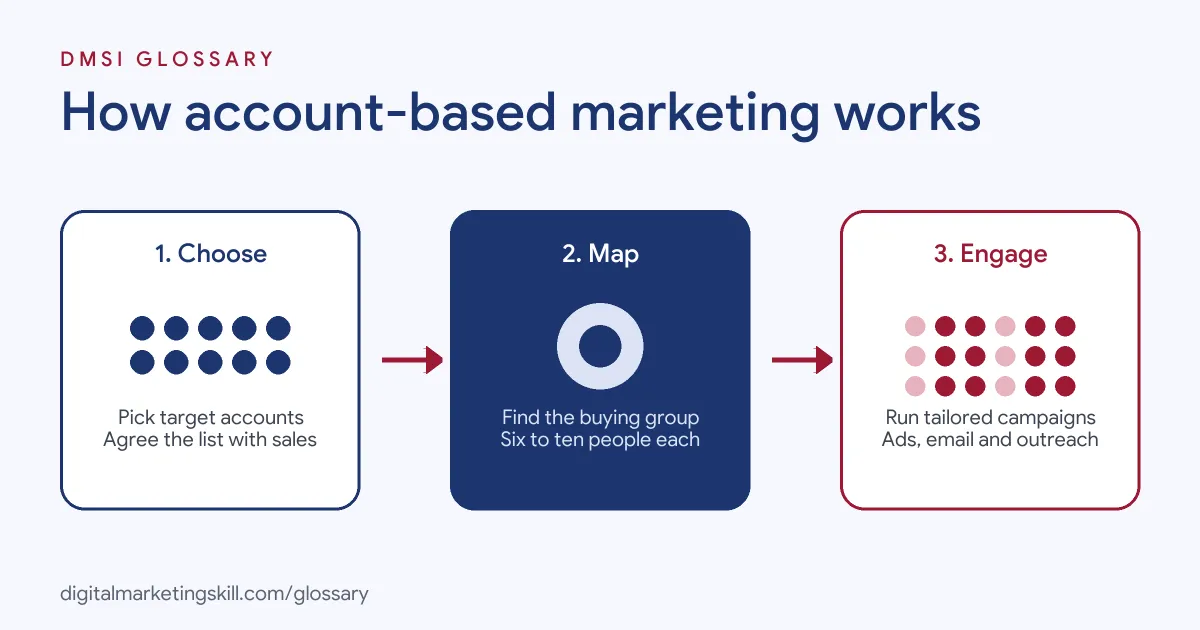
Every ABM programme follows three broad steps. First, you pick the accounts. Next, you learn who matters inside each one. Finally, you run joined-up campaigns and sales outreach to that group.
Choose the Accounts
Sales and marketing agree on an ideal customer profile. This covers things like industry, company size, location and the problem you solve. They then build a list of companies that fit. Often, they rank the list into tiers, so the top accounts get the most personal treatment.
Map the Buying Group
One contact is rarely enough. Gartner states that “the typical buying group for a complex B2B solution involves six to 10 decision makers.” Each person cares about something different. For instance, a user wants ease of use, IT wants security, and finance wants a clear return.
Gartner also found that buyers spend “only 17% of that time meeting with potential suppliers.” So most of your influence happens through content, ads and your website, well before a sales call.
Run Tailored Campaigns
Finally, you reach the group across several channels at once. That might mean LinkedIn ads shown only to staff at target firms, personal emails from sales, and a landing page made for one industry.
LinkedIn supports this through company list targeting. According to LinkedIn’s help centre, your list must have at least 300 rows, and the maximum is 300,000 companies. It recommends 1,000 or more for best results. You can match firms by name, website, email domain, LinkedIn Page URL or stock symbol.
Account-Based Marketing Examples
Here are three made-up examples that show the range of approaches:
- One-to-one: A cyber-security firm targets five banks. For each one, it writes a short report on that bank’s risks and sends it with a personal note from a senior leader.
- One-to-few: A payroll tool picks 40 hospital groups. It runs one campaign for the whole cluster, with a case study from another hospital.
- One-to-many: A data platform uploads 1,500 target firms to LinkedIn. It then shows industry-specific ads and tracks which firms engage.
In each case, the list of accounts comes first, and the content is shaped around it.
Account-Based Marketing vs Traditional Lead Generation
| Factor | Traditional lead generation | ABM |
|---|---|---|
| Starting point | A broad audience | A named list of companies |
| Who it targets | Anyone who fits a profile | The buying group inside each account |
| Content | General, for many readers | Tailored to an industry or one company |
| Sales role | Takes leads after marketing | Plans and runs it with marketing |
| Main metric | Number of leads | Account engagement, pipeline and revenue |
Most firms use both. Broad lead generation fills the top of the funnel. Meanwhile, ABM focuses effort on the deals that matter most.
How to Start Account-Based Marketing
- Agree the goal with sales. Decide what success looks like, such as meetings booked or deals won.
- Define your ideal customer. Use data from your best current customers.
- Build and tier the list. Start small, with perhaps 20 to 50 accounts in the top tier.
- Map the people. List the roles in each buying group and what each one needs.
- Create the content. Write case studies, landing pages and ads for each tier or industry.
- Launch across channels. Combine targeted ads, email and sales outreach in the same weeks.
- Review every month. Look at which accounts engage, then adjust the plan.
The Data You Need
Good ABM runs on good data. Before you launch, gather three kinds of information:
- Company details: industry, size, location and the tools each firm already uses. This helps you pick and tier accounts.
- Contact details: the names and roles of people in each buying group, kept up to date in your CRM.
- Engagement signals: who visits your site, opens your emails, clicks your ads or attends your webinars.
Together, these show which accounts are warming up. As a result, sales can call the right firms at the right time, instead of guessing.
Best Practices for Account-Based Marketing
- Keep the list short at first. A smaller list lets you go deeper and learn faster.
- Share one plan with sales. Both teams should see the same list, goals and notes.
- Speak to the account’s problem. Mention their industry, their goals and their challenges.
- Use your CRM. Track every contact and touch in your CRM, so nothing slips.
- Keep LinkedIn lists in use. LinkedIn notes that a company list audience expires if it is not used in an active or draft ad set within 90 days.
Common Mistakes to Avoid
First, teams pick accounts that are too big or a poor fit, so nothing moves. Second, marketing runs ABM alone, and sales never follows up. Third, the content is generic, with only the company name swapped in. Finally, teams judge ABM on lead counts. Since the list is small by design, lead counts will look low even when deals are moving. Instead, track meetings, pipeline and revenue from the target accounts.
How to Measure Account-Based Marketing
Measure at the account level. Useful questions include: how many target accounts have engaged? How many have a meeting booked? How many have an open deal, and what is it worth? Finally, how many have signed? Compare these numbers with a similar group of firms you did not target. If the ABM group moves faster or wins more often, the programme is working.
Where You’ll Use Account-Based Marketing at Work
ABM skills appear in many B2B marketing roles. For example, remote job listings ask for:
- “Experience of Account-Based Marketing.” (Senior Digital Marketing Executive).
- The ability to “Develop targeted account-based marketing programs for strategic accounts, named-account lists, high-value verticals, and partner-led opportunities.” (Demand Generation Manager).
- Campaigns across channels including “social media, and account-based marketing.” (Director of Marketing).
So if you aim to be a Digital Marketing Manager, Growth Marketer or agency owner serving B2B clients, ABM is a valuable skill. Employers will also want to see how you worked with sales.
Learn It in the Full Stack Programme
ABM combines paid social, email, landing pages and analytics, so the best fit is the Full Stack programme (all four tracks). You take all ten courses and complete one portfolio project from each track. You also get unlimited 1-on-1 mentoring and a U.S. Project Internship from day one.
For more on finding business buyers, read our guide to B2B lead generation.
Frequently Asked Questions
What is account-based marketing in simple terms?
It is a way of marketing to a chosen list of companies, rather than to a broad audience. You shape your ads, emails and sales outreach around each company.
Is ABM only for large companies?
No. Small firms and agencies can run it with a short list of accounts. What matters is that each customer is valuable enough to justify the effort.
What channels does ABM use?
Common channels include LinkedIn ads, email, direct mail, events, tailored landing pages and sales calls. The mix depends on where your buyers spend time.
How many companies should be on an ABM list?
It depends on your team. Many start with a short top tier for personal work. For LinkedIn company targeting, the list must have at least 300 rows.
How is ABM different from lead generation?
Lead generation attracts many people, then filters them. ABM picks the companies first, then works to engage the people inside them.
Sources: Gartner: The B2B buying journey; LinkedIn Help: Company list targeting in Campaign Manager; LinkedIn Marketing API: Account based targeting; remote job listings on Himalayas.