
Scarcity marketing is a persuasion technique that highlights when a product, place or offer is genuinely limited, so people value it more and decide sooner. Common forms include limited stock, limited editions, small class sizes and members-only access. It works because people tend to want things more when they might miss out, but it only builds trust when the limit is real.
Key Takeaways
- Scarcity is one of Robert Cialdini’s principles of persuasion: “people want more of those things they can have less of.”
- It covers limits on quantity, access or availability. Limits on time are usually called urgency.
- Honesty is not optional. In the UK, falsely claiming an offer is available only for a limited time is a banned practice.
- The ASA says countdown clocks “should not start back up once they have finished.”
- Used well, scarcity helps people act on something they already want. Used badly, it destroys trust.
What Is Scarcity Marketing?
Imagine two bakeries. One has trays of croissants all day. The other bakes one batch each morning, and when they are gone, they are gone. Many people will rush to the second bakery early. The croissants may taste the same, but the limit makes them feel special.
That is the scarcity effect. Cialdini’s team at Influence at Work puts it simply: “people want more of those things they can have less of.” It shares the classic example of British Airways. When the airline announced it would stop its twice-daily London to New York Concorde flight, sales “the very next day took off.” The plane had not changed. It had “simply become a scarce resource.”
Marketers use this idea to highlight real limits. For example, a course may have only 20 places, or a print may come in an edition of 100. Telling people about those limits helps them decide.
How Scarcity Marketing Works
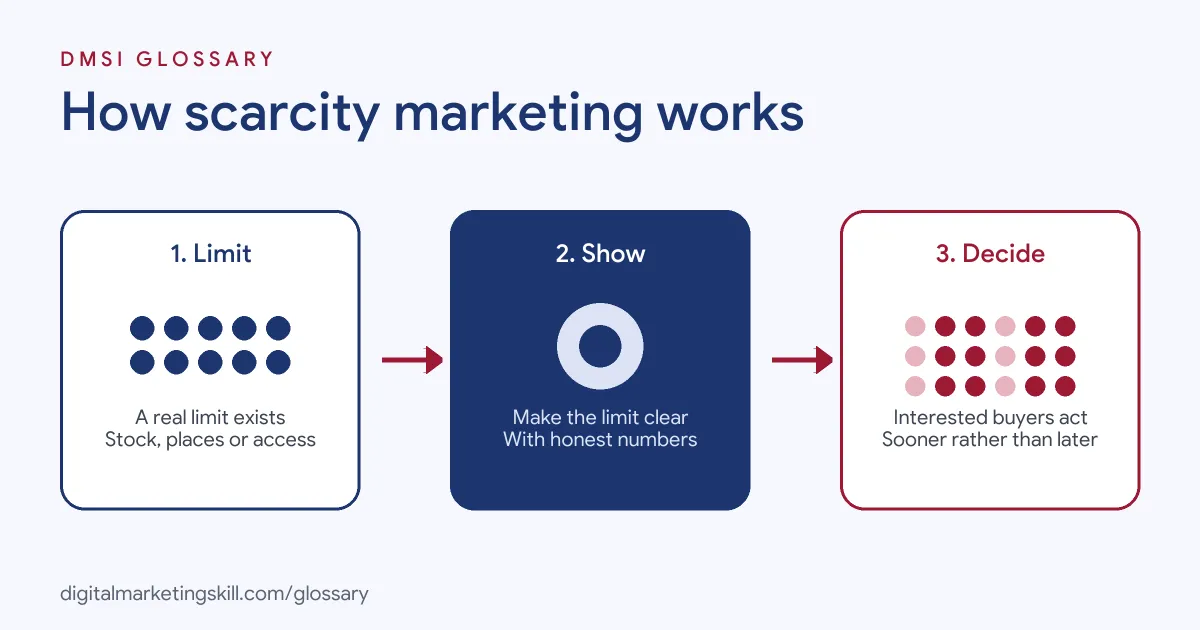
Scarcity works in three steps. First, there is a genuine limit. Next, you make that limit clear and visible. Finally, people who already want the product feel a reason to act now rather than later.
Types of Scarcity
There are a few common forms:
- Limited quantity: only a set number of items, seats or places exist.
- Special edition: a version made once, such as a colour or collaboration.
- Limited access: only members, past customers or a waiting list can buy.
- Capacity limits: a service provider can only take on so many clients.
Time limits, such as a sale ending at midnight, are closely related. However, they are usually called urgency. The two often appear together.
Why It Works
Scarcity helps people focus. When a choice is always available, it is easy to put it off. When it might disappear, the cost of waiting becomes clear. It also signals value. If something is in short supply, people often assume others want it, which links scarcity to social proof.
The Legal Line
Fake scarcity is not just bad practice. In the UK, the Digital Markets, Competition and Consumers Act lists banned practices. One is “Falsely stating that a product will only be available for a limited time, or that it will only be available on particular terms for a limited time, in order to elicit an immediate decision.” Similarly, the CAP Code’s section on misleading advertising covers claims about the availability of products. So every limit you state must be true, and you must be able to prove it.
Scarcity Marketing Examples
Here are three made-up examples of honest scarcity:
- Training cohort: A coding bootcamp caps each class at 25 students, so mentors can give feedback. The sign-up page shows how many places are left, updated live.
- Limited print run: An illustrator sells 50 signed prints of a new design. Each print is numbered, and the shop page shows when the run is sold out.
- Consultancy: A freelance designer takes on three new clients a month. Her website says so and offers a waiting list when she is full.
In each case, the limit is real, clear and easy to check. Because buyers can verify it, the message builds trust instead of suspicion.
Scarcity vs Urgency
| Factor | Scarcity | Urgency |
|---|---|---|
| What is limited | Quantity, access or capacity | Time |
| Typical message | Only 10 places left | Offer ends tonight |
| Common use | Limited editions, small classes, waiting lists | Sales, launches, early-bird prices |
| Main risk | Fake low-stock claims | Fake or restarting deadlines |
Both can be powerful. However, both rely on honesty to work over time.
How to Use Scarcity Marketing Ethically
- Start with a real limit. Base it on stock, capacity or a planned edition, never on invented numbers.
- Explain why. Say why the limit exists, such as small class sizes or handmade stock.
- Show the facts clearly. Display the number left or the edition size, and keep it accurate.
- Keep your word. When the stock or places are gone, stop selling or open a waiting list.
- Keep records. Be able to show how many items or places existed.
- Combine with value. Make sure the offer is worth having in the first place.
- Measure trust as well as sales. Watch complaints, refunds and repeat purchases.
Best Practices for Scarcity Marketing
- Use it sparingly. If every product is “almost gone”, nothing feels scarce any more.
- Pair it with a clear call to action. A strong call to action tells people exactly what to do next.
- Offer a fair alternative. A waiting list or restock alert keeps interested people close.
- Write plainly. State the limit without pressure words, capitals or exaggeration.
- Check the rules. Review claims against the CAP Code and consumer law before launch.
Common Mistakes to Avoid
First, brands show “only 2 left” messages that never change. Second, they relaunch a “limited edition” a few weeks later. Third, they apply scarcity to everything, so customers stop believing it. Finally, they rely on pressure instead of value. Each of these can break advertising rules and damage the brand for years, long after the sale is forgotten.
Writing Honest Scarcity Messages
Good wording makes a real limit clear without adding pressure. Compare two made-up messages for the same course. The first says: “Hurry! Almost gone! Don’t miss out!” The second says: “We keep classes to 25 so every student gets feedback. 6 places are left.” The second message is calmer, but it is also more convincing. It gives a reason for the limit and a number people can trust.
So follow a simple pattern. First, state the limit. Next, explain why it exists. Then show the current number, if you have one. Finally, tell people what happens when it runs out, such as a waiting list or the next intake. This approach respects the reader, and it keeps you on the right side of advertising rules.
Why It Matters for Marketing
Many people delay decisions, even when they want something. Honest scarcity gives them a fair reason to act. That can lift conversion rates on launch pages, events and limited products. At the same time, customers now spot fake tactics quickly. So the brands that win long term use scarcity only when it is true, and explain it clearly.
Where You’ll Use Scarcity Marketing at Work
We did not find current remote job listings that name this technique directly. However, it shows up in the daily work of several roles. A Digital Marketing Manager plans launches and limited offers. A Growth Marketer tests how stock or capacity messages affect conversion. Meanwhile, a Freelance Digital Marketer writes landing pages and emails for clients’ product drops, events and courses. In each role, you will need to balance persuasion with honesty and the rules on misleading claims.
Learn It in the Full Stack Programme
Scarcity touches copywriting, landing pages, email and paid social, so the best fit is the Full Stack programme (all four tracks). You take all ten courses and complete one portfolio project from each track. You also get unlimited 1-on-1 mentoring and a U.S. Project Internship from day one.
To understand what drives buyers, read our guide to the buying decision.
Frequently Asked Questions
What is scarcity marketing in simple terms?
It means telling people when something is genuinely limited, such as a small stock or a few places, so they value it and decide sooner.
Is scarcity marketing legal?
Yes, when the limit is real. False claims about limited availability can break UK consumer law and advertising rules.
What is the difference between scarcity and urgency?
Scarcity limits quantity or access. Urgency limits time, such as a sale that ends soon.
Does scarcity marketing work?
It can, because people tend to want what they might miss. However, it only works long term if customers believe your claims.
What is an example of scarcity marketing?
A numbered limited edition of 100 prints, with a live count of how many remain, is a classic honest example.
Sources: Influence at Work: Principles of persuasion; legislation.gov.uk: DMCC Act, Schedule 20 (banned practices); ASA: The CAP Code; ASA: Countdown clocks.