
A buying decision rarely turns on price or features alone. It turns on how you frame the request, whether the buyer feels free to choose, and how many other people still need convincing. Four well-documented patterns explain most of what moves a prospect from maybe to yes: concession framing, scarcity, social proof, and the size of the buying group. Understanding each one lets you sell honestly, without manipulation.
Key Takeaways
- A direct, small request got about 17% compliance in Cialdini’s classic study. Asking a large favor first, then the small one, raised compliance to about 50%.
- Worchel, Lee and Adewole found identical cookies in a near-empty jar rated more desirable than the same cookies in a full jar. A sudden drop in supply rated highest of all.
- 74% of participants conformed to an incorrect group answer at least once in Asch’s classic conformity experiments. A buyer’s peers shape their decision the same way.
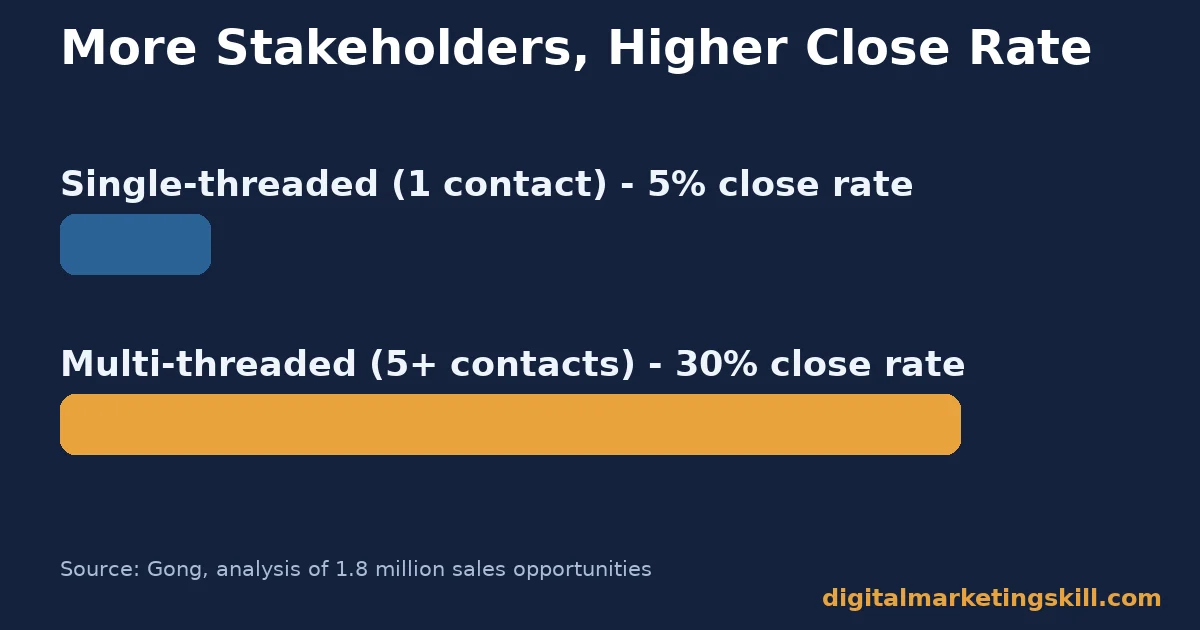
- Single-threaded B2B deals close at about 5%, per Gong’s analysis of 1.8 million sales opportunities. Deals with five or more stakeholders engaged close at about 30%.
- The average B2B buying group has grown from roughly 5 stakeholders to 8 or more over the past decade, according to Gartner’s research. A buying decision is rarely made by one person anymore.
In this guide
- Most Sales Advice Skips the Mechanism Behind “Yes”
- The Mechanism: A Buying Decision Is a Series of Small Permissions
- What Differs By Pattern: Four Forces Behind a Buying Decision
- Lead With the Pattern That Matches Your Stalled Step
- Measuring These Patterns: Four Numbers to Track in Your Pipeline
- The One Decision Rule: Diagnose the Stalled Permission, Not the Whole Deal
- A Four-Week Plan to Apply These Patterns Without Guessing
- Common Mistakes That Undo These Patterns
- Does This Change By Industry or Deal Size?
- What This Looks Like in Practice
- Frequently Asked Questions About the Buying Decision
- Next Step: Diagnose the Missing Permission in Your Next Stalled Deal
Most Sales Advice Skips the Mechanism Behind “Yes”
Sales advice often lists tactics: use urgency, build rapport, ask for referrals. It rarely explains why any of them work. That gap matters, because a tactic used without its mechanism often backfires.
This guide explains four well-replicated psychology findings and one modern sales dataset. It shows how each one applies to a real buying decision. The classic studies are old, but researchers have replicated their core findings many times, including recently. Where a figure comes from one company’s own data, that limit is stated plainly. None of the four patterns below require pressure or deception; each one simply describes how people already decide, with or without a salesperson in the room.
The Mechanism: A Buying Decision Is a Series of Small Permissions
A prospect grants permission to keep talking. Then permission to see a proposal. Then permission to sign. Each step either lowers or raises their guard for the next one. Framing, scarcity, social proof and the buying group all change how much guard remains when you ask for the final yes.
This is why one clever line rarely closes a deal. It is also why a badly timed tactic can lose one. The tactic has to match the stage of permission the buyer is actually at. A scarcity line aimed at someone who has not yet granted the first permission, simply agreeing to keep talking, usually reads as pressure rather than persuasion.
What Differs By Pattern: Four Forces Behind a Buying Decision
These four patterns work independently. A deal can suffer from a problem in one without the others being at fault.
Concession Framing: The Order of Your Asks Changes the Answer
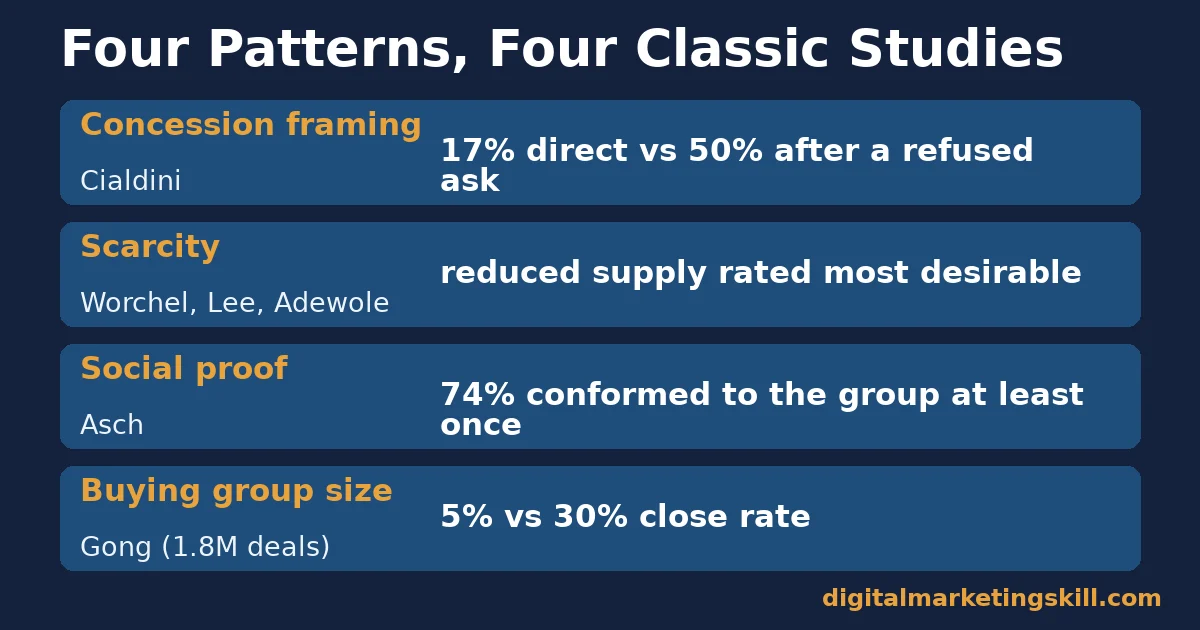
In Cialdini’s original study, researchers asked people to volunteer as an unpaid counselor for two years. Everyone refused. The researchers then asked the same people to chaperone a single two-hour trip. 50% agreed. Only 17% of a separate group agreed when asked that small favor directly. A later replication with 391 participants found a similar gap: 34% against 51%.
The mechanism is reciprocity. Refusing the first request creates a small social debt, and agreeing to the smaller one repays it. This only works when the first ask is a genuine, reasonable version of the same request, not an absurd anchor meant purely to manipulate.
Scarcity: Limited Supply Changes Perceived Value, Not Actual Value
In Worchel, Lee and Adewole’s classic experiment, participants rated identical cookies as more desirable when the jar held only two instead of ten. A separate group watched their own supply drop from ten cookies to two right before tasting them. That group rated the cookies as the most desirable of everyone tested.
The lesson for a buying decision is specific. Scarcity raises perceived value most sharply when the buyer directly experiences a drop in availability, not when scarcity is only claimed in the abstract. A vague “limited spots” line does far less than a buyer watching real availability shrink in front of them.
Social Proof: People Follow the Group, Even When the Group Is Wrong
In Asch’s classic experiments, 74% of participants gave at least one incorrect answer that matched an obviously wrong group consensus, across 12 trials. About a third of all individual answers conformed to the group, even when the correct answer was visually obvious.
A buyer who hears that peers, competitors or respected figures already made a similar decision feels a milder version of the same pull. This is why named references and visible adoption often move a stalled deal more than another round of feature comparison.
The Buying Group: You Are Rarely Persuading Just One Person
Gartner’s research, cited by industry analysts, found the average B2B buying group has grown from roughly 5 stakeholders to 8 or more over the past decade. Gong’s analysis of 1.8 million sales opportunities found single-threaded deals, where only one contact is engaged, close at about 5%. Deals with five or more stakeholders engaged close at about 30%.
A buying decision this size cannot rest on one champion. Every pattern above has to work across several people, not only the one you talk to most. A concession frame that lands well with a technical evaluator may mean nothing to a finance stakeholder who never heard it. The same pattern often needs repeating, in its own context, for each person in the group.
Lead With the Pattern That Matches Your Stalled Step
Match the pattern to where a deal is actually stuck. Applying all four to every conversation turns honest persuasion into pressure.
Concession Framing: Lead With a Genuine, Larger Ask First
Say you want a smaller commitment, like a short pilot or a scoped trial. Describe the full engagement honestly first, then offer the smaller version as the practical next step. The large option must be real and relevant, not a prop. Otherwise the framing reads as a trick and damages trust instead of building it.
Scarcity: Lead With Real, Visible Limits
Show a buyer an actual constraint: a cohort start date, a limited onboarding capacity, a real stock count. Do not just assert urgency in a headline. Worchel’s experiment suggests the effect is strongest when the buyer perceives the change in availability directly, not when someone simply tells them something is scarce.
Social Proof: Lead With Specific, Named References
Share a result from a company the buyer recognises or resembles, with real numbers attached. Skip the generic “trusted by many” claim. Asch’s result suggests the pull of the group is strongest when the comparison feels close to the buyer’s own situation, not a distant one. Our guide on copywriting that converts covers how to phrase a named result so it reads as evidence, not a boast.
The Buying Group: Lead With Multiple Contacts, Early
Identify the likely stakeholders: finance, technical evaluation, end users. Build a relationship with more than one before the final decision point. Gong’s data on multi-threaded deals suggests this single habit explains a large part of the gap between deals that close and deals that stall. Ask your champion directly for an introduction rather than waiting for one to happen naturally. Most champions agree once you explain why the extra contact helps move the decision forward. Our guide on lead conversion strategies covers how to keep each contact engaged without diluting your message.
Measuring These Patterns: Four Numbers to Track in Your Pipeline
You cannot judge these patterns from a single deal. Track them across your pipeline over time.
- Stakeholders engaged per deal: the count of distinct contacts who interacted with your team before close. Compare this between won and lost deals in your own CRM data.
- Close rate by thread count: win rate split by how many stakeholders were engaged. A wide gap, similar to Gong’s 5% versus 30%, confirms the pattern holds in your own pipeline.
- Reference usage rate: the share of deals where your team shared a named, relevant customer reference. Compare close rates for deals with and without one.
- Time to second contact: how long it takes to engage a second stakeholder after the first conversation. A shorter time here often predicts a healthier, faster-closing deal.
The One Decision Rule: Diagnose the Stalled Permission, Not the Whole Deal
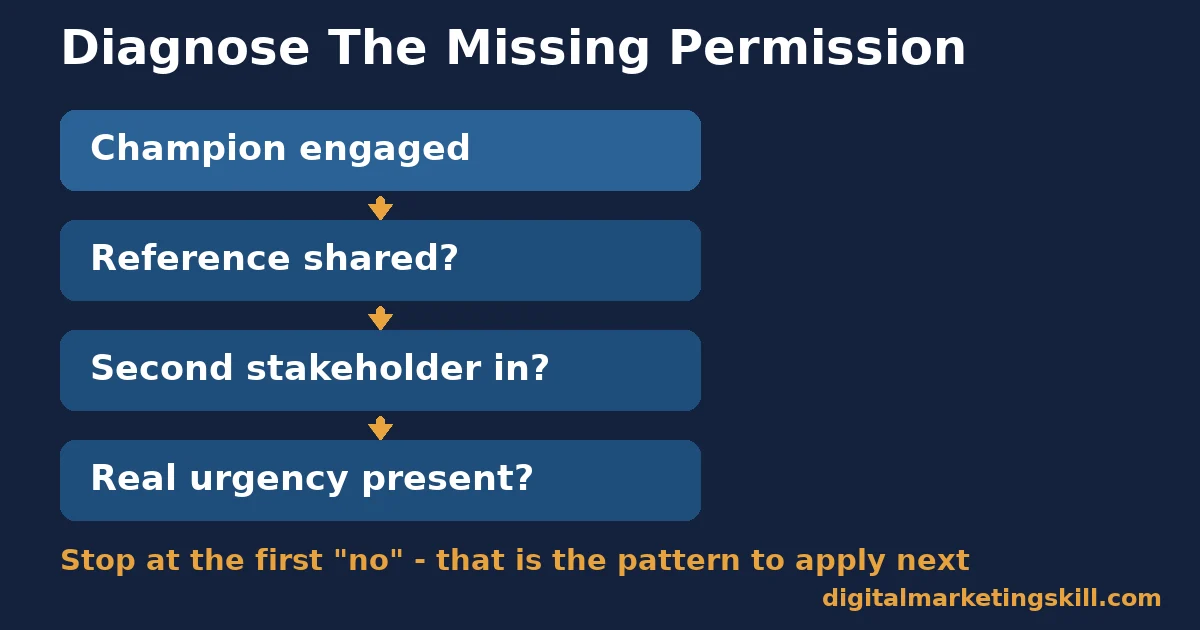
When a deal stalls, the instinct is to apply pressure everywhere at once: a bigger discount, a harder deadline, more calls. The better rule is to find the single missing permission and address only that one.
Illustrative, invented numbers: a deal has had six calls with one enthusiastic champion, but no contact with finance or procurement. The buying-group pattern is the gap here, not scarcity or social proof. A countdown timer on the proposal would not fix a problem that was never about urgency. Introducing the champion to a finance-approved reference customer addresses the actual missing permission.
A Four-Week Plan to Apply These Patterns Without Guessing
You do not need all four patterns in every conversation. This plan spreads them across a month, matched to where most stalled deals actually sit.
- Week one: map your buying group. For your five most active deals, list every stakeholder who has engaged so far. Compare this against Gartner’s 8-or-more benchmark to see how exposed each deal really is.
- Week two: add one real reference per deal. Pick a customer reference close to each buyer’s own size or industry, with a real, specific number attached, and share it directly with the stalled stakeholder.
- Week three: introduce a second contact. For any deal still resting on one champion, ask that champion to introduce you to someone in finance, technical evaluation or procurement.
- Week four: review what moved and what did not. Compare close rates and stakeholder counts against the month before. Keep whichever pattern produced a real shift, and apply it to the next batch of deals.
Repeating this cycle, instead of pushing every pattern into one call, is what turns four psychology findings into a steadier flow of buying decisions in your favor.
Common Mistakes That Undo These Patterns
Four mistakes turn honest use of these patterns into pressure tactics that damage trust instead of earning a buying decision.
- Faking the large ask or the scarcity. An invented deadline or a fabricated “only two spots left” is detectable. Once a buyer notices one dishonest claim, they discount every other claim you make.
- Using a reference that does not resemble the buyer. Asch’s effect depends on relevance. A reference from an unrelated industry or a very different company size does far less work than a close, specific comparison.
- Treating the champion as the whole buying group. A single enthusiastic contact can feel like real progress while the deal quietly stalls, because finance, legal or end users never got engaged.
- Applying every pattern in a single call. A concession frame, a scarcity line and a named reference all in one conversation reads as a script, not a conversation, and buyers notice the difference between genuine persuasion and a rehearsed sequence.
Does This Change By Industry or Deal Size?
The four patterns describe human psychology, so the mechanism does not change by industry. What changes is which pattern carries the most weight. A small, low-risk purchase leans more on scarcity and social proof. The buyer can decide quickly, with less at stake. A large, multi-year contract leans more on the buying-group pattern. More people share the risk of a wrong decision, and each one wants a say before it closes.
Deal size also changes how many stakeholders you should expect. Gong’s research on buying groups found that larger, higher-value deals typically involve many more contacts than smaller ones. Treating every deal as if it needs only one champion gets riskier as the contract value rises.
What This Looks Like in Practice
Gong’s analysis of 1.8 million sales opportunities is useful here because it measures real outcomes across many companies, not one case study with its own quirks. The core finding, that close rates roughly sextuple between single-threaded and multi-threaded deals, lines up with Gartner’s separate research showing buying groups have grown to 8 or more stakeholders.
Put together, the two findings describe the same shift from different angles. Deals increasingly require consensus across a group. So a sales approach built around persuading one champion works against a structural change in how buying decisions actually get made. The honest limit: Gong’s data shows correlation across many deals, not a controlled experiment. Other factors, like deal size or buyer sophistication, likely contribute to the gap too.
The practical takeaway survives that limit. Whatever the exact cause, a seller who waits until late in the process to find a second or third stakeholder is working against the grain of how most B2B buying decisions now get made, not with it.
Frequently Asked Questions About the Buying Decision
What is the single biggest factor in a buying decision?
There is no single factor, but the size of the buying group shapes nearly everything else. Gong’s data shows a sixfold difference in close rates between single-threaded and multi-threaded deals, so engaging multiple stakeholders early is usually the highest-leverage fix.
Is using scarcity to influence a buying decision manipulative?
Not when the scarcity is real. Worchel’s research found the effect comes from a buyer directly experiencing reduced availability. A genuine limit is honest persuasion; inventing a fake deadline is not, and buyers increasingly notice the difference.
Does social proof work in B2B sales the same way it works in consumer buying?
The underlying mechanism, shown in Asch’s experiments, is the same pull toward group consensus. In B2B, the reference needs to be specific and relevant to the buyer’s own situation to carry the weight a visible crowd carries in consumer settings.
How many stakeholders should I try to engage in a deal?
Gartner’s research puts the average B2B buying group at 8 or more stakeholders. Engaging at least the obvious few, finance, technical evaluation and end users, early is a reasonable starting target, rather than relying on one champion.
Why did the “but you are free” style of language get left out of this guide?
Several meta-analyses describe it as effective in principle. But published reports vary widely on the size of the effect, and raise real concerns about publication bias. Rather than cite a number we could not verify at the primary source, this guide leaves that pattern out.
Can these patterns backfire?
Yes. Faking a large first ask, inventing scarcity, or using an irrelevant reference tends to backfire once a buyer notices. Detecting one dishonest claim makes them discount every other claim that follows.
How do I measure whether these patterns are working for my own sales?
Track stakeholders engaged per deal, close rate by thread count, reference usage rate, and time to a second contact. Compare these across your own won and lost deals, rather than assuming a published figure applies directly to your pipeline.
Do these patterns apply to consumer sales as well as B2B?
Concession framing, scarcity and social proof all come from research on individual decisions, so they apply to consumer buying too. The buying-group pattern is specific to B2B, since most consumer purchases involve only one decision-maker.
How long does it take to see a difference after applying these patterns?
Expect to see early signals, like a faster second-contact time or more references shared, within a few weeks. A measurable shift in close rate needs a larger sample of deals, since any single deal can close or stall for reasons unrelated to these patterns.
Next Step: Diagnose the Missing Permission in Your Next Stalled Deal
Pick a deal that has stalled. Check how many real stakeholders are engaged, whether your team shared a relevant reference, and whether any urgency in play is genuine. That diagnosis points to one of the four patterns above. Apply it honestly, measure the four numbers, and let the pattern do the work instead of generic pressure. A buying decision rarely moves because of one dramatic pitch; it moves because each stakeholder, in turn, got the one piece of evidence or permission they were actually missing.
If you want structured practice turning buyer psychology into a repeatable sales process, consider the Master Diploma in Digital & AI Marketing from Digital Marketing Skill Institute. It covers nine practical courses, including sales and conversion-focused modules, with unlimited 1-on-1 coaching and mentoring and real project work inside a U.S. company. The diploma is dual US and UK accredited, recognised in more than 100 countries, and delivered 100% online, so you can study and apply it anywhere in your country.
Explore the curriculum on digitalmarketingskill.com, or go straight to the application page to get started wherever you live. For the diagnostic approach behind this guide applied to a full pipeline, see our guide on building a conversion funnel. For the same thinking applied to a website, see our guide on online sales tactics. You can also read verified outcomes on the reviews page, or come back to digitalmarketingskill.com any time you need the next guide in this series.
Every figure in this guide was checked against its original source before publication. Figures marked as illustrative are invented examples, not real results.
![9 Amazing Digital Marketing Skills to Make Money Online [With Proof]](https://digitalmarketingskill.com/wp-content/uploads/2019/07/9-Amazing-Digital-Marketing-Skills-to-Make-Money-Online-With-Proof-17.png)