
Journey Mapping is the process of drawing out, step by step, what a person does, thinks and feels while they try to reach a goal with your brand. It turns scattered data into one clear picture of the whole experience. As a result, you can see where people get stuck, where they leave and where you can help them more. It also gives every team the same view of the customer.
Key Takeaways
- Journey mapping shows the steps a person takes to reach a goal, from first contact to the end.
- A good map covers actions, thoughts and feelings, not just clicks.
- Most maps share five parts: an actor, a scenario, phases, actions and emotions, and opportunities.
- Maps should come from real research, such as interviews, surveys and analytics.
- The main output is a list of problems to fix and ideas to test.
What Is Journey Mapping?
Journey mapping is a way to see your business through the customer’s eyes. Instead of looking at one page or one email, you look at the full path. For example, that path might start with a social post and end with a repeat order. So the map links every step into one story.
The result is called a journey map. Nielsen Norman Group defines it as “a visualization of the process that a person goes through in order to accomplish a goal.” In other words, it is a picture of a task from the person’s side, not the company’s side.
For instance, think about booking a holiday. First you search for ideas. Then you compare prices, read reviews and ask a friend. Finally you book, pay and wait for a confirmation email. Along the way you may feel excited, then confused, then relieved. A journey map captures all of that, including the moods.
Journey mapping is closely linked to the customer journey. The journey is what really happens. By contrast, the map is your model of it. Also, it sits inside wider customer experience work.
Why It Matters
Why should you care? Because each team usually sees only its own part. For instance, marketing sees the ads, sales sees the calls and support sees the complaints. Nobody sees the whole thing. As a result, small problems between teams go unnoticed. However, a shared map makes those gaps visible. The GOV.UK Service Manual puts it simply: “Collaborating on journey mapping is the easiest way to make this happen.”
Current-State and Future-State Maps
There are two common kinds of map. First, a current-state map shows the journey as it is today. So it is the best place to start, because it shows real problems. Next, a future-state map shows the journey you want to build. For example, it might show a shorter checkout or a faster reply from support. Then the gap between the two maps becomes your plan. In addition, some teams build a “day in the life” map. This one follows a person through a whole day, not just through your brand. As a result, it shows where your product fits into their routine. Also, it can reveal needs that a simple sales path would miss.
How Journey Mapping Works
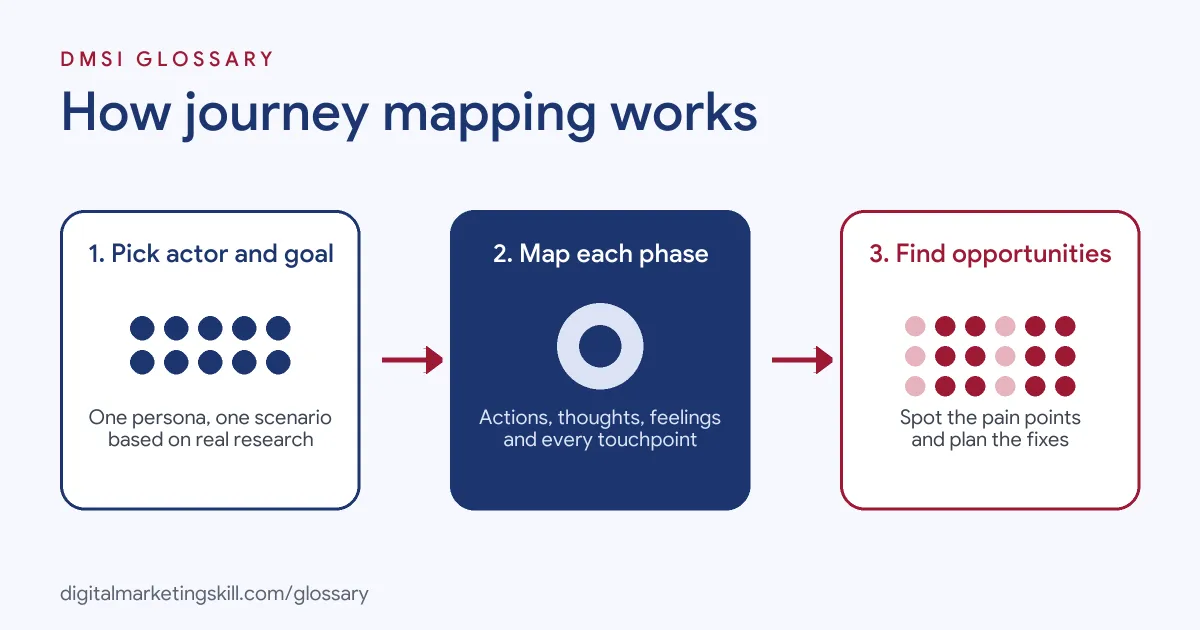
Journey mapping works by turning research into a timeline. First, you choose one person and one goal. Then you split the experience into phases and fill each phase with what the person does, thinks and feels. Finally, you mark the moments that need work.
The Actor and the Scenario
Every map starts with an actor. This is the person whose journey you follow. Often you base the actor on a buyer persona. Next, you set the scenario. This is the goal they want to reach and what they expect along the way. So a map for “first-time buyer orders online” will look very different from one for “existing client renews a contract”.
Phases and Touchpoints
Then you break the journey into phases. For example, a simple shop journey might run from awareness to research, purchase, delivery and support. Inside each phase you list the touchpoints. These are the places where the person meets your brand, such as an ad, a landing page, a chat window or a parcel at the door.
Actions, Thoughts and Feelings
After that, you fill in what happens in each phase. You note what the person does and what questions they have. In addition, you track how they feel. Many maps show this as a line that rises and falls. A dip in that line often points to a real problem, such as a confusing form or a slow reply.
Opportunities
Last of all, you add opportunities. These are the ideas that come out of the map. For instance, you might add a clearer price page, a reminder email or a faster refund. Nielsen Norman Group lists “Opportunities” as one of the five core parts of any map. Without them, a map is just a nice poster.
Examples of Journey Mapping
- An online clothing shop. The team maps the path from a social ad to a first order. They find that many people drop off at delivery costs. So they show the costs earlier, on the product page.
- A software company with a free trial. The map shows that new users feel lost after sign-up. As a result, the team adds a short welcome email series that explains the first three tasks.
- A local dental clinic. The clinic maps how new patients book. Interviews show that people call after hours and reach no one. Then the clinic adds online booking and a clear answer on its Google profile.
Journey Mapping vs Related Maps
| Point | Journey map | Experience map | Service blueprint |
|---|---|---|---|
| Focus | One person, one goal, one brand | A general human experience | The business side behind each step |
| Point of view | The customer | People in general | Staff, systems and processes |
| Main use | Find and fix pain points | Understand behaviour before a product exists | Plan how teams deliver each step |
| Typical owner | Marketing, CX or UX teams | Research or strategy teams | Operations and service design teams |
How to Create a Journey Map
- Set a clear goal. Decide what you want to learn. For example, “Why do trial users not upgrade?”
- Pick one actor. Choose a single persona. As a result, the map stays focused and easy to read.
- Gather real data. Then use interviews, surveys, support tickets, analytics and customer feedback. Avoid guessing.
- List the phases. Write the big stages from start to finish. Keep it to about four to seven.
- Add touchpoints and actions. Under each phase, note where the person meets you and what they do.
- Add thoughts and feelings. Use real quotes from research where you can. Then draw the emotional highs and lows.
- Mark the pain points. Highlight the steps where people get stuck, confused or leave.
- Agree the next steps. Turn each pain point into an idea, give it an owner and test it.
Best Practices for Journey Mapping
- Start with research. A map built on opinions only shows what the team already believes.
- Keep it to one journey. One actor and one scenario per map keeps the story clear.
- Map with other teams. Invite sales, support and product people, so the map reflects every part of the path.
- Use the customer’s words. Real quotes make the map more honest and more convincing.
- Link it to numbers. Pair each phase with data, such as drop-off or conversion rate, so you can measure change.
- Update it often. Products and habits change. So review the map after big launches or new research.
Common Mistakes to Avoid
- Mapping the ideal journey. Show what really happens, not what you hope happens.
- Making it too broad. A map that covers every customer type ends up helping nobody.
- Skipping emotions. Clicks alone don’t explain why people leave. However, feelings often do.
- Leaving out offline steps. Phone calls, store visits and deliveries are part of the journey too.
- Treating the map as the goal. The map is a tool. Instead, the real result is the changes you make.
- Never sharing it. A map that sits in one folder can’t align anyone.
Where You’ll Use Journey Mapping at Work
Journey mapping shows up in customer experience, UX research and service design roles. It also helps marketers who plan campaigns across many channels. For example, real remote job listings ask for:
- “Strong understanding of Customer Experience, journey ownership, journey mapping, and continuous improvement.” (FBS – CX Journey Owner).
- “Practical experience working on qualitative and quantitative research, online and in person, using methods such as usability testing, journey mapping, concept and prototype testing” (UX Researcher).
- “Demonstrated experience using service blueprinting, journey mapping, and ecosystem mapping to connect customer experience with operational and technical realities.” (Senior Service Designer/Innovation Lead).
Learn It in the Full Stack Track
You can learn journey mapping alongside funnels, ads, email and SEO in the Full Stack programme, which covers all four tracks. Every track includes a U.S. Project Internship from day one, with unlimited 1-on-1 mentoring.
Frequently Asked Questions
What is the difference between a customer journey and a journey map?
The customer journey is the real path a person takes. A journey map is a visual model of that path, built from research.
What tools can I use for journey mapping?
You can start with sticky notes or a spreadsheet. Also, online whiteboards and CX platforms offer ready templates.
How many phases should a journey map have?
There is no fixed number. However, four to seven phases usually keep a map clear and easy to read.
Who should take part in journey mapping?
Invite people from every team that touches the customer. For example, that can include marketing, sales, support and product.
How often should I update a journey map?
Review it after major changes, such as a new product, a new channel or fresh research. Then update the parts that no longer match reality.
Sources: Nielsen Norman Group: Journey Mapping 101; GOV.UK Service Manual: Map and understand a user’s whole problem; Inside GOV.UK: Improving content through journey mapping; remote job listings on Himalayas, Himalayas and Himalayas.