
A Digital Marketing Specialist is a marketer who plans, runs and measures online campaigns across channels such as search, social media, email and websites to help a business reach customers and grow sales. The role mixes creative work, like writing ads and posts, with data work, like tracking results and testing ideas. So it suits people who enjoy both words and numbers. It is also one of the most common entry and mid-level roles in online marketing, in-house and at agencies.
Key Takeaways
- A digital marketing specialist runs and improves online campaigns across several channels.
- Typical tasks include content, ads, email, SEO, social media and reporting.
- The job blends creative skills with analysis and testing.
- Some specialists cover many channels, while others focus deeply on one.
- Many roles can be done remotely, for brands, agencies or as a freelancer.
What Is a Digital Marketing Specialist?
A digital marketing specialist is the person who makes online marketing happen day to day. They take a goal, such as more leads or more sales, and turn it into campaigns. Then they launch those campaigns, watch the numbers and improve them.
Official career guides describe the work in similar terms. For example, a UK apprenticeship standard for digital marketers (since replaced by the Multi-channel Marketer standard) described the role as being to “Use online and social media platforms to design, build and implement campaigns and drive customer sales.” Likewise, Prospects explains that “Digital marketers use a variety of methods to communicate with customers and promote sales and activities.”
In simple terms, think of a specialist as the hands-on driver of a business’s digital marketing. The manager may set the route. However, the specialist steers, checks the mirrors and adjusts speed along the way.
Job titles vary a lot. That standard listed titles such as “Digital Marketing Assistant, Digital Marketing Executive, Digital Marketing Co-ordinator, Campaign Executive.” In practice, you will also see “Digital Marketing Specialist” used for very similar work.
Why the Role Matters
Why do businesses hire for this role? Because online channels change fast and need steady attention. For instance, ad costs shift, search results change and social platforms update their features. A specialist keeps campaigns working through all of that. In addition, they turn data into decisions, so budgets go where they work best. As a result, even small teams often need at least one person in this seat.
Skills You Need
So what makes a good specialist? First, you need clear writing. Ads, emails and posts all depend on it. Prospects lists “excellent written communication skills for producing high-quality content” as a key skill. Next, you need to be at ease with numbers. You will read reports, spot trends and explain what they mean. In addition, you need basic tech skills, such as editing web pages and setting up tracking. Also, you need to stay curious. Tools and rules change, so the best people keep learning. Finally, you need good teamwork. You will work with designers, sales staff and managers, often across time zones.
How a Digital Marketing Specialist Works
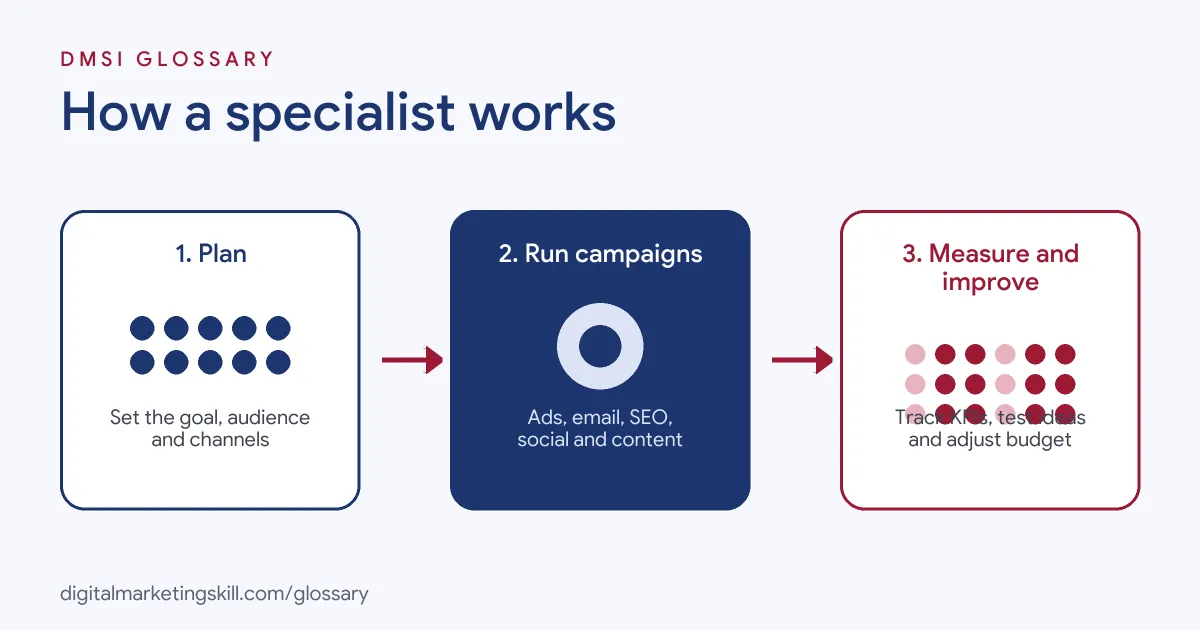
Most specialists work in a repeating cycle. First, they plan a campaign around a clear goal. Next, they launch it across the right channels. Finally, they measure results and use what they learn to improve the next round.
Planning
Planning starts with the audience and the goal. The specialist decides which channels fit, what message to use and how to measure success. O*NET, the US occupation database, lists tasks such as “Participate in the development or implementation of online marketing strategy.” So even junior specialists help shape the plan.
Running Campaigns
Then comes the hands-on work. This might mean writing posts, building emails, setting up Google Ads campaigns or updating web pages. Prospects lists duties such as “write and dispatch email marketing campaigns” and “conduct keyword research and web statistics reporting.” In other words, the work covers both content and technical set-up.
Measuring and Reporting
After that, the specialist tracks results. They watch clicks, leads, sales and costs. O*NET includes the task “Identify appropriate Key Performance Indicators (KPIs) and report key metrics from digital campaigns.” So you need to be comfortable with each key performance indicator and the tools that report them.
Testing and Improving
Finally, the specialist uses the data to make changes. For example, they might test two subject lines, pause a weak ad or move budget to a stronger channel. Then the cycle starts again. Over time, these small gains add up.
Generalist or Specialist?
The title can hide two very different jobs. On one hand, a generalist covers many channels at once, often in a small business. On the other hand, some specialists focus on one area, such as SEO, paid social or email. Both paths are valid. However, many people start broad and then choose a focus they enjoy. As a result, a “T-shaped” profile is common: wide basic skills plus one deep strength.
Where Specialists Work
Specialists work in many settings. For example, in-house roles focus on one brand, so you get to know its customers well. By contrast, a digital marketing agency gives you many clients and fast variety. Also, some specialists work freelance and choose their own projects. In addition, much of the work can be done from home, which is why many listings are remote. Each path builds the same core skills. So pick the one that fits how you like to work.
Examples of the Role in Practice
- At an online shop. The specialist runs product ads, sends weekly emails and checks which products sell best from each channel. Then they shift budget towards the top performers.
- At a B2B software firm. The specialist writes blog content, manages LinkedIn posts and builds landing pages for webinars. Also, they hand qualified leads to the sales team.
- At a small agency. The specialist manages several client accounts at once. As a result, they juggle different goals, budgets and reports each week.
Digital Marketing Specialist vs Related Roles
| Point | Digital marketing specialist | Digital marketing manager | Social media manager |
|---|---|---|---|
| Main focus | Running and improving campaigns | Strategy, budget and team | Social channels and community |
| Channels | Several, or one deep area | All channels at a high level | Mostly social platforms |
| Typical tasks | Ads, email, SEO, content, reports | Planning, hiring, reporting to leaders | Posts, replies, social ads, trends |
| Usual level | Entry to mid-level | Mid to senior level | Entry to mid-level |
How to Become a Digital Marketing Specialist
- Learn the core channels. Study search engine optimisation, paid ads, email marketing and social media.
- Get comfortable with data. Learn an analytics tool and practise reading reports.
- Practise on real projects. Help a local business, a charity or your own site. Then record what you did and what changed.
- Build a simple portfolio. Show a few campaigns, your role and the results, using honest numbers.
- Pick a focus. After that, go deeper in one channel you enjoy, while keeping broad basics.
- Earn recognised certificates. Free platform certificates, such as those from Google, can show your skills.
- Apply widely. Look at in-house, agency and remote roles, and tailor each application.
Best Practices for Digital Marketing Specialists
- Start with the goal. Tie every campaign to a clear business result.
- Measure before you change. Set a baseline, so you can prove what worked.
- Test one thing at a time. Clean tests give clear answers.
- Write clear reports. Explain what happened, why it matters and what you will do next.
- Keep learning. Platforms change often, so follow official help pages and updates.
- Talk to sales and support. They hear what customers really say.
Common Mistakes to Avoid
- Chasing vanity metrics. Likes and views matter less than leads and sales.
- Spreading too thin. Trying every channel at once often means doing none of them well.
- Skipping tracking. Without proper tracking, you can’t show your impact.
- Copying competitors blindly. What works for them may not suit your audience.
- Ignoring the basics. Fast pages, clear offers and good copy still beat clever tricks.
Where You’ll Use These Skills at Work
Digital marketing specialist roles appear at brands, agencies and outsourcing firms, and many are remote. If you prefer independence, the same skills also suit a freelance digital marketer. For example, real remote job listings say:
- “NeoWork is hiring Digital Marketing Specialists to plan, launch, and optimize campaigns” (Digital Marketing Specialist).
- “We are looking for a creative and results-driven Digital Marketing Specialist to join our growing marketing team.” (Digital Marketing Specialist).
- “We are seeking a contract Digital Marketing Specialist to own and optimize our presence across the full ecosystem of third-party websites, portals, and partner platforms.” (Digital Marketing Specialist).
Learn It in the Full Stack Track
You can build the full set of specialist skills, from social and email to Google Ads and SEO, in the Full Stack programme, which covers all four tracks. Every track includes a U.S. Project Internship from day one, with unlimited 1-on-1 mentoring.
Frequently Asked Questions
What does a digital marketing specialist do each day?
They create and manage campaigns, check performance data and make improvements. Also, they often write reports and work with other teams.
Do I need a degree to become one?
Not always. Many employers care more about skills, practical projects and a clear portfolio.
Can a digital marketing specialist work remotely?
Many can, because most of the work happens online. However, each employer sets its own rules on location.
What tools do specialists use?
Common tools include analytics platforms, ad managers, email software, SEO tools and a website CMS. The exact mix depends on the role.
Is it better to be a generalist or a specialist?
Both work. Still, many people start broad, then build one deep skill that sets them apart.
Sources: Skills England: Digital marketer apprenticeship standard (retired); Prospects: Digital marketer job profile; O*NET OnLine: Search Marketing Strategists; remote job listings on Himalayas, Himalayas and Himalayas.