
Day rate is the fixed fee a freelancer or contractor charges a client for one full day of work. It is one of the most common ways to price freelance and contract work in digital marketing. As a result, knowing how to set and explain your day rate helps you win work and get paid fairly. It also makes it easier for clients to budget for your time.
Key Takeaways
- A day rate is the price you charge for one full working day.
- It sits between an hourly rate and a fixed project fee.
- A good day rate covers your income, tax, expenses and unpaid days.
- You should agree what “a day” means, such as how many hours it includes.
- In the UK, contractors working through their own company may also face IR35 rules.
What Is a Day Rate?
When you work for yourself, you have to decide how to charge. For example, you can charge by the hour, by the project or by the day. A day rate means the client pays you a set amount for each day you work for them.
Day rates are common for contract roles. For instance, a business might hire a paid search expert for ten days to rebuild its campaigns. So instead of tracking every hour, both sides simply count the days.
Think of hiring a builder. Some charge per job, while others charge per day on site. In the same way, a freelance digital marketer might quote a day rate for an audit, a launch or a short-term cover role.
A day rate is not the same as your take-home pay. Instead, it has to cover tax, pension, software, equipment and the days you don’t bill. That is why day rates are often much higher than an employee’s daily salary.
Why It Matters
Why does your day rate matter so much? Because it shapes your income and how clients see you. If you price too low, you may work long hours and still struggle. On the other hand, if you price too high without proof, clients may go elsewhere. In addition, a clear day rate makes proposals faster to write. It also helps clients compare your quote with other options. Finally, it gives you a simple way to price extra work when a project grows.
So a day rate is more than a number. Instead, it is a key part of how you run your business.
How a Day Rate Works
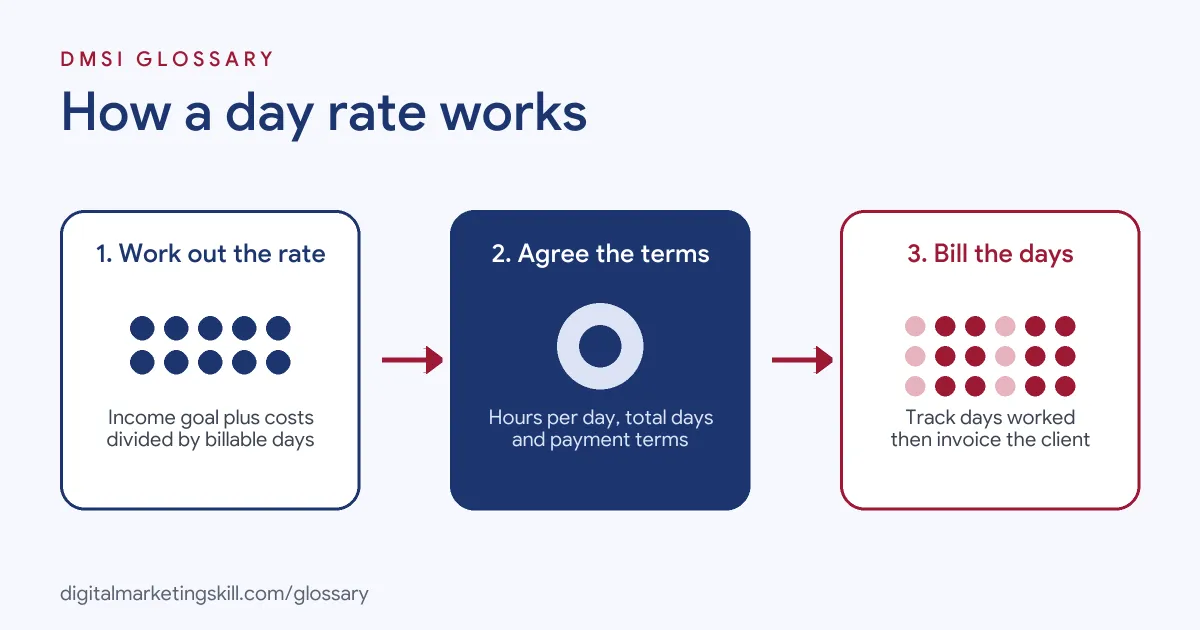
A day rate works in three simple steps. First you work out the rate you need, then you agree the terms with the client, and finally you bill for the days you work. Each step needs clear thinking.
Working Out Your Rate
First, start with how much you need to earn in a year. Then add your business costs, such as software, insurance and equipment. Next, work out how many days you can really bill. Remember to remove holidays, sick days, admin time and gaps between clients. Finally, divide your total by those billable days. For example, if you need £45,000 and expect to bill 150 days, that works out at £300 a day. This is only an illustration. However, it shows why billable days matter so much.
Agreeing the Terms
Next, agree what a day includes. For instance, is it seven hours or eight? Also, decide what happens if a day runs long, or if you work half a day. In addition, agree how many days the project needs and when you will invoice. So you and the client share the same picture from the start.
Billing and Tax
Then you track the days you work and invoice the client. As a self-employed person, you also handle your own tax. GOV.UK explains that you can deduct business costs “to work out your taxable profit before paying Income Tax as long as they’re allowable expenses.” So keep good records of every cost.
IR35 in the UK
Also, some UK contractors work through their own limited company. In that case, the off-payroll working rules, known as IR35, may apply. GOV.UK says these rules aim to make sure such a worker pays “broadly the same Income Tax and National Insurance as an employee would.” For medium and large clients, “In most cases, the client will be responsible for determining the employment status of the worker.” HMRC’s CEST tool “gives HMRC’s view of a worker’s employment status, based on the information you provide.” So check the official guidance, or speak to an accountant, before you sign a contract.
Examples of a Day Rate
- An SEO freelancer running an audit. She quotes five days at her day rate for a full technical audit. Then she adds two extra days later, at the same rate, when the client asks for help with fixes.
- A paid social contractor covering leave. A brand needs cover while its ads manager is away. So it hires a contractor for three days a week on a day rate.
- An email specialist on a launch. A software firm books a specialist for ten days to set up flows. As a result, the firm knows its full cost up front.
Day Rate vs Hourly Rate vs Retainer
| Point | Day Rate | Hourly Rate | Retainer |
|---|---|---|---|
| How you charge | Per full day | Per hour worked | A set fee each month |
| Best for | Projects and contract roles | Small or unclear tasks | Ongoing work |
| Tracking needed | Low, count the days | High, log every hour | Low, but track scope |
| Income stability | Medium | Low | High |
| Main risk | Days running long | Clients watching the clock | Scope creep |
Many freelancers mix these. For example, they might start with a day rate, then move a client to a retainer once the work becomes ongoing.
How to Set Your Day Rate
- Set your income goal. Decide what you need to earn in a year before tax.
- Add your costs. Include software, insurance, equipment, training and pension.
- Count real billable days. Remove holidays, sick days, admin and sales time.
- Do the maths. Divide your income goal plus costs by your billable days.
- Check the market. Look at what similar freelancers and contract roles in your field charge.
- Adjust for value. If you have strong results and niche skills, price higher.
- Write it into your proposal. State the rate, what a day includes and your payment terms.
- Review it often. Raise your rate as your skills and results grow.
Best Practices for Day Rates
- Define a day. State the hours in a day, so there is no confusion later.
- Quote in days, not hours. This keeps the focus on outcomes rather than the clock.
- Show your value. Use case studies and a clear value proposition to back up your price.
- Put it in writing. Add the rate and terms to every marketing proposal and contract.
- Charge for extra days. If the scope grows, agree new days before you start them.
- Know your tax position. Check GOV.UK guidance, or the official guidance where you live.
Common Mistakes to Avoid
- Copying your old salary. A salary divided by working days ignores tax, costs and unpaid time.
- Assuming you’ll bill every day. Most freelancers spend time on sales and admin too.
- Leaving “a day” vague. Without clear hours, days can stretch into evenings.
- Never raising your rate. Your skills grow. So your price should too.
- Ignoring IR35. In the UK, the wrong status can lead to unexpected tax bills.
- Discounting too fast. Instead, cut the scope rather than your rate when a client pushes back.
Where You’ll Use a Day Rate at Work
You’ll use a day rate as a freelancer, contractor or consultant, and when you hire them. Day-rate contracts are common across digital roles, including tech jobs. For example, one remote listing says:
- “On offer is a 6 Month Daily Rate Contract, with a view to a further 12 month extension.” (.Net – Senior Developer).
In marketing, you’ll see day rates for SEO audits, ad account builds, interim roles and launch support. Also, agencies use day rates to price extra work for clients. In addition, day rates suit remote work for clients in other countries, because both sides simply count the days.
Learn It in the Full Stack Programme
You can build the skills clients pay day rates for in the Full Stack option, which covers all four tracks. Every track includes a U.S. Project Internship from day one, with unlimited 1-on-1 mentoring.
Frequently Asked Questions
What is a day rate?
It is the fee a freelancer or contractor charges for one full day of work. It usually covers a set number of hours agreed with the client.
Is a day rate better than an hourly rate?
It depends on the work. Day rates suit projects and contract roles. However, hourly rates can suit small or unclear tasks.
How do I work out my day rate?
Add your income goal and business costs. Then divide the total by the number of days you can realistically bill.
Should my day rate include tax?
Your rate should be high enough to cover your tax. In the UK, you pay Income Tax on your profit after allowable expenses.
Does IR35 affect my day rate?
It can, if you work through your own company in the UK. So check GOV.UK guidance or ask an accountant before you agree a rate.
Sources: GOV.UK: Understanding off-payroll working (IR35); GOV.UK: Check employment status for tax (CEST); GOV.UK: Expenses if you’re self-employed; remote job listings on Himalayas.