
Remote work is a way of working where you do your job away from a central office, usually from home or another location, and stay in touch with your team online. Some roles are fully remote, while others mix office and home days. For marketers, remote work is common because most of the job happens on a laptop, but it still comes with rules about location, hours and communication that you need to understand.
Key Takeaways
- Working remotely ranges from the odd day at home to fully remote companies with no office at all.
- GitLab’s handbook describes ten models, from “no remote” to “strictly remote.”
- Many remote jobs still have limits on where you live, your right to work and your working hours.
- In the UK, all employees have the legal right to request flexible working, including working from home, from their first day.
- Strong written communication and documentation matter more when your team isn’t in the same room.
What Is Remote Work?
At its simplest, it means doing your job somewhere other than your employer’s office. You might work from home, a co-working space or a café, as long as you have the tools and connection you need.
The details vary a lot. GitLab, a company known for its fully remote set-up, lists ten models in its public handbook. At one end is “no remote.” As GitLab puts it, “Some companies do not allow for any remote work.” At the other end is “all-remote,” which “describes organizations that do not maintain offices and work globally across many time zones.”
In between sit options such as hybrid-remote, where “some employees — but not all — are allowed to work remotely 100% of the time,” and remote-first, where organisations “optimize their workplaces for remote.” So when you see a job ad that says “remote,” it is worth checking which model it really means.
How Remote Work Works
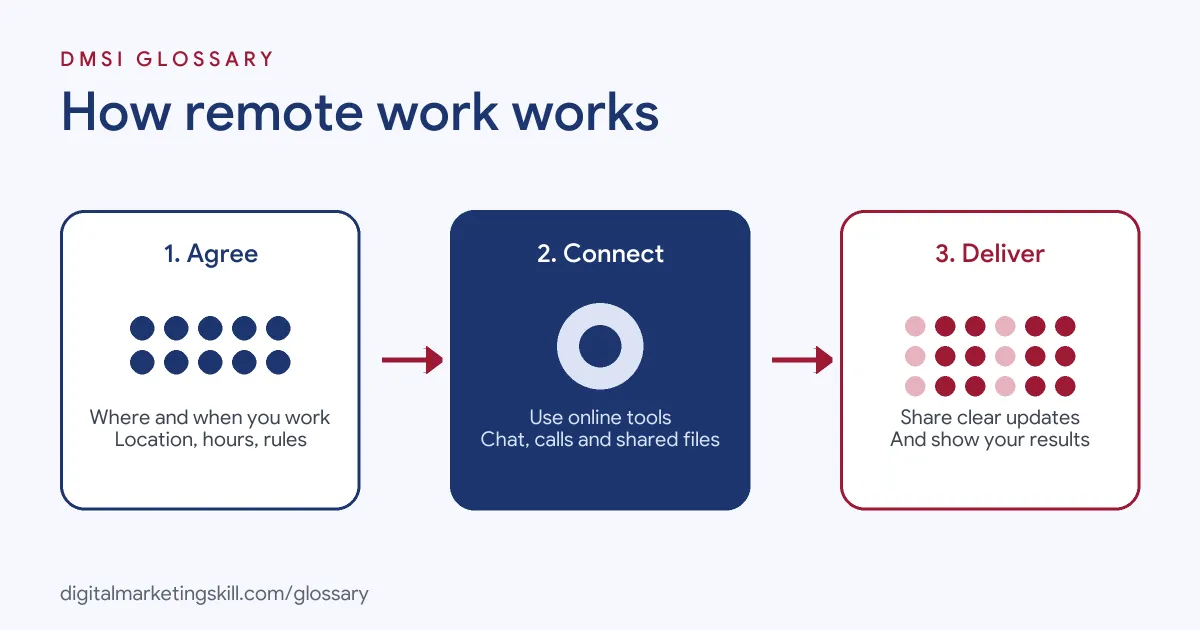
Most set-ups follow three basic rules. First, you and your employer agree where and when you’ll work. Next, you use online tools to communicate, share files and track tasks. Finally, results and clear updates replace being seen at a desk.
Location and Hours
Remote doesn’t always mean “anywhere.” Many employers need you to live in a particular country, hold the right to work there or overlap with certain business hours. Check these details in every job ad before you apply.
Communication
Teams that don’t share an office rely on writing. GitLab’s guide to asynchronous work says, “You can’t do async communication without strong documentation.” In other words, decisions, plans and updates need to be written down, so colleagues in other time zones can keep working without waiting for a reply.
Your Rights at Work
Rules depend on where you work. In the UK, the government says flexible working can include working from home, and that all employees have the legal right to request it from their first day in a job. Employers must handle requests in a reasonable manner, but they can refuse if they have a good business reason. The rules differ in Northern Ireland and in other countries.
Remote Work Examples
Here are three made-up examples of how remote set-ups look in marketing:
- Fully remote agency: A small team spread across four countries uses a shared project board, written briefs and one weekly video call.
- Hybrid in-house role: A social media manager works from home three days a week and joins the office for planning and shoots.
- Freelancer: An email marketer works with clients in different time zones, agreeing a few hours of overlap for calls.
Each one works because everyone knows the rules for where, when and how they communicate.
Remote Work Models Compared
GitLab describes several models. Here are five common ones, in its own words:
| Model | How GitLab describes it |
|---|---|
| Remote allowed | Remote work “is allowed for anyone at the company” |
| Hybrid-remote | Some employees, but not all, can work remotely all of the time |
| Remote-first | Organisations “optimize their workplaces for remote” |
| Remote-only | “No physical office, and all work is done remotely” |
| All-remote | No offices, working “globally across many time zones” |
The model affects your daily life far more than the word “remote” in a job title.
How to Succeed in a Remote Marketing Role
- Check the terms. Confirm location rules, right to work, hours and the remote model before you accept.
- Set up your space. Make sure you have a reliable connection, a quiet place for calls and the tools you need.
- Agree how you’ll communicate. Next, ask which channels to use for quick questions, updates and urgent issues.
- Write things down. Share plans, decisions and progress in writing, so others can follow without a meeting.
- Show your results. Send short, regular updates with numbers, such as leads, clicks or sales.
- Protect your time. Set working hours and stick to them, so work doesn’t spill into every evening.
- Stay connected. Finally, join team calls and ask for feedback, because it’s easy to feel cut off.
A Worked Example: Reading a Remote Job Ad
Here is a made-up job ad, followed by what each line really tells you:
- “Remote (EMEA)”: you probably need to live in Europe, the Middle East or Africa.
- “Core hours 10:00 to 14:00 UK time”: you must be online for those four hours, wherever you are.
- “Must have the right to work in the UK”: the employer won’t sponsor a visa for this role.
- “Quarterly team meet-ups”: you may need to travel a few times a year.
So this “remote” role is really remote within limits. Reading every line like this saves you from applying for jobs you can’t take, and it helps you ask the right questions at interview.
Best Practices
- Overlap where it matters. Agree a few shared hours for live discussion, even across time zones.
- Use one source of truth. For instance, keep tasks and files in one shared place, not scattered across chats.
- Be clear in writing. Short, specific messages save hours of back-and-forth.
- Know your rights. Check the employment rules where you live, because they differ between countries.
- Build a portfolio. Remote employers can’t watch you work, so proof of results matters even more.
Common Mistakes
A common mistake is assuming “remote” means you can live anywhere, then finding the role requires a specific country. Another is going quiet for days, which makes managers worry even when the work is on track. Some people also never switch off, so long hours lead to burnout. Others forget about time zones when they agree deadlines, so a Friday delivery lands on a Saturday for the client. Finally, many rely on calls for everything, instead of writing things down for colleagues in other time zones.
Where You’ll Use Remote Work Skills
Remote roles are common in digital marketing, but the ads often include important conditions. For example, real remote job listings include lines like these:
- “Remote Work: Flexibility to work from anywhere!” (Lead Generation Specialist).
- “Fully remote work environment working in CET business hours.” (Social Media Manager).
- “The role is fully remote; however, the candidate must have the right to work and be located in the UK during employment.” (Digital Events and Social Media Executive).
So whether you aim to be a Freelance Digital Marketer, a Growth Marketer or a Digital Marketing Manager, read each ad’s location and hours carefully, and show strong written communication in your application.
Learn It in the Full Stack Programme
The Full Stack (all four tracks) programme covers all ten courses, with one portfolio project from each track. The programme is about 90% hands-on, with unlimited 1-on-1 mentoring and a U.S. Project Internship from day one, so you practise working with a team online and build proof of your results.
For job-hunting advice, read our guide to remote digital marketing jobs. To set up your day, see our guide to remote work tools.
Frequently Asked Questions
What is remote work in simple terms?
It means doing your job away from your employer’s office, usually from home, and staying in touch with your team online.
What is the difference between remote and hybrid work?
In a fully remote job, you work away from the office all the time. In a hybrid set-up, you split time between home and the office, or only some staff work remotely.
Can I work remotely from any country?
Not always. Many remote roles require you to live in a certain country, hold the right to work there or work set hours.
Do I have a right to work from home in the UK?
You have the right to request flexible working, including working from home, from your first day. However, your employer can refuse for a good business reason.
What skills matter most for remote marketing jobs?
Clear writing, self-management, comfort with online tools and a portfolio of real results all help you stand out.
Sources: GitLab Handbook: The models of remote and hybrid work; GitLab Handbook: Asynchronous work; GOV.UK: Flexible working; remote job listings on Himalayas.