
A value proposition is a clear statement of the value a product or service delivers and why the right customer should choose it over the alternatives. A good one explains what problem you solve, what benefit the customer gets and what makes you different. It matters because visitors decide in moments whether to stay or leave, and a vague message loses them to a competitor who is easier to understand.
Key Takeaways
- Think of it as a promise of value, not a slogan or a tagline.
- A strong one shows relevance, specific benefits and a clear difference from rivals.
- It should be the first thing people see on your homepage and key landing pages.
- Strategyzer’s canvas tool helps you match your offer to customer jobs, pains and gains.
- Test it with real prospects, not just your own team.
What Is a Value Proposition?
CXL, a marketing training company, defines it as “a promise of value to be delivered: the primary reason a prospect should buy from you instead of a competitor.” In other words, it answers the customer’s silent question: “Why should I pick you?”
Think about a meal-kit service. Its message might read: “Healthy dinners in 20 minutes, with every ingredient measured for you.” That tells a busy parent exactly what they get. By contrast, “Passion for food” tells them almost nothing.
So a good one is specific and easy to repeat. CXL puts it bluntly: “If a reader can’t explain your offer back to a friend in one sentence,” it has failed.
How a Value Proposition Works
It works by connecting three things. First, you understand what the customer needs. Next, you show how your offer meets that need. Then you state the result as a clear promise that a competitor can’t easily copy.
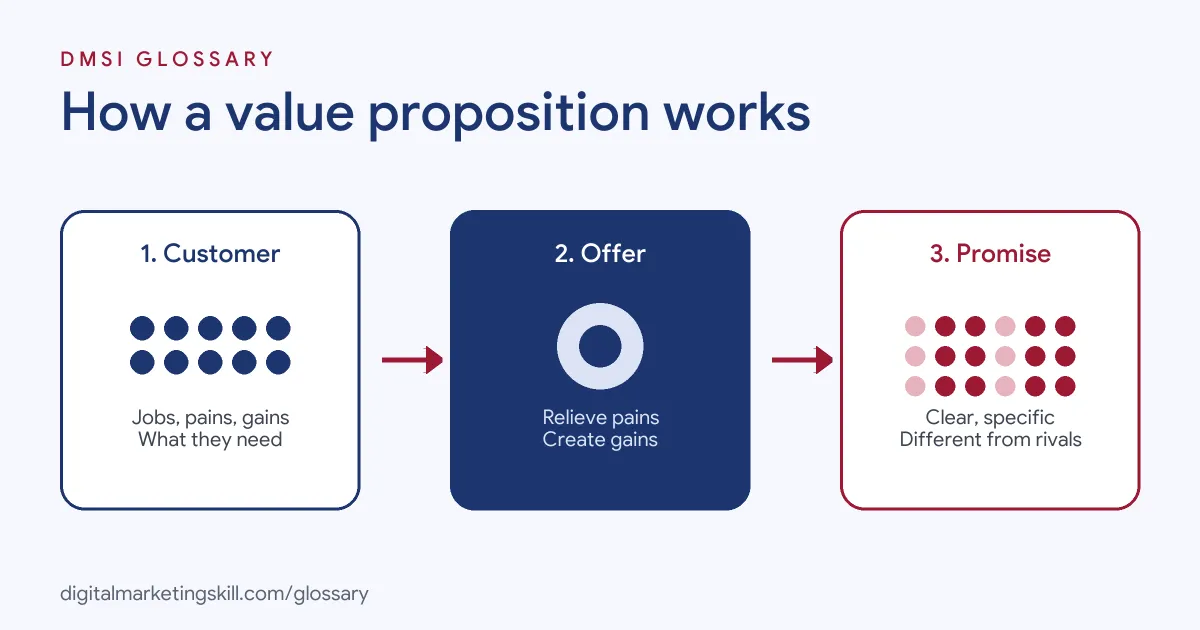
The Three Ingredients
According to CXL, an ideal version shows three things:
- Relevance: how your product solves the customer’s problem or improves their situation.
- Quantified value: the specific benefits they get.
- Differentiation: why they should buy from you rather than a competitor.
The Value Proposition Canvas
This canvas, created by Strategyzer, is a popular tool for this work. It has two sides. On the customer side, you describe one segment: the jobs they are trying to get done, the pains they hit along the way and the gains they are after. On the offer side, you list what you provide, then name the pains it relieves and the gains it creates.
Fit is the goal. However, Strategyzer warns that fit “is a claim until customers confirm it.” So you test your matches against evidence, then adjust.
Types of Gains
HubSpot breaks gains into levels. Required gains are must-haves, such as accurate tax figures in accounting software. Expected gains are basics customers assume, such as the ability to save documents. Desired gains are extras that make customers happy but don’t make or break the deal. As a result, you can see which benefits to lead with.
Where It Appears
CXL says your main promise has to be the first thing visitors see on your homepage. It should also be visible at the other main entry points to your site. In practice, that means the top of each key landing page, the first lines of your ads and the opening of your sales emails. The wording can change slightly by channel. However, the core idea should stay the same everywhere, so customers hear one consistent message.
Value Proposition Examples
Here are three made-up examples that follow the formula:
- Accounting app for freelancers: “Send invoices and track tax in one place, so you spend less time on admin.” It is relevant, gives a clear benefit and targets one group.
- Local dog walker: “Small-group walks with GPS updates after every visit.” The updates set it apart from rivals.
- Online language course: “Speak everyday Spanish with short daily lessons and live practice.” It names the outcome and how you get there.
In each case, a customer could repeat the message to a friend after reading it once. Notice, too, what is missing. None of them says “best quality” or “great service,” because every rival claims the same. Instead, each one names a real outcome for a specific person.
Value Proposition vs Slogan vs Positioning Statement
CXL stresses that this kind of statement is not a slogan, a tagline or a positioning statement. Here is how they differ:
| Item | What it does | Who sees it |
|---|---|---|
| Value proposition | States the specific value and why to choose you | Customers, on your homepage, landing pages and ads |
| Slogan or tagline | A short, memorable brand line | Customers, often in brand advertising |
| Positioning statement | Describes your target market and place in it | Mostly internal teams |
In short, a slogan aims to be remembered, while your promise of value aims to be understood.
How to Write a Value Proposition
Use these steps to draft and test your own:
- Pick one customer segment. Trying to speak to everyone makes the message vague.
- List their jobs, pains and gains. Use interviews, reviews and sales calls, not guesses.
- Match your offer. For each pain or gain, note the feature that addresses it.
- Write a headline. State the main benefit in plain words.
- Add support. CXL suggests a sub-headline or short paragraph, three bullet points and a supporting visual.
- Test it with real prospects. CXL notes that message testing tells you why something isn’t working, while split testing only tells you whether it worked.
After that, place the final version where it counts most: above the fold on your homepage and on every main landing page.
Best Practices for a Value Proposition
- Choose clarity over cleverness. CXL says “Clarity beats cleverness every time.”
- Use the customer’s words. Above all, borrow phrases from reviews and interviews.
- Be specific. Numbers, time saved and clear outcomes beat general claims.
- Keep it consistent. Use the same core message in ads, emails and landing pages.
- Work harder if you are unknown. CXL points out that the less known your company is, the better your message needs to be.
Common Mistakes to Avoid
The most common mistake is writing a slogan instead of a promise. Another is listing features without saying why they matter. Many teams also use jargon that customers never use. Some copy a competitor’s message, so nothing sets them apart. Finally, many never test their wording with real buyers. HubSpot warns that unclear or generic messaging leads to lost sales and poor conversion rates. So treat your message as something to improve, not something to write once.
Where You’ll Use a Value Proposition at Work
This skill shows up in marketing, product and sales roles. For example, recent remote job listings ask candidates to:
- “Develop and maintain product positioning, messaging, value propositions, and key differentiators across assigned products and solutions” (Specialist, Product Marketing).
- Show the “Ability to translate customers’ needs into a value proposition” (Sales Account Manager).
- “Translate complex clinical and technology capabilities into compelling value propositions” (Head of Product and Partner Marketing).
So whether you aim to be a Digital Marketing Manager, Growth Marketer, Freelance Digital Marketer or Agency Owner, you will write and test value propositions for clients or your own business.
In practice, the work often starts with research. You read reviews, sit in on sales calls and study rival websites. Then you draft a few versions, test them in ads or on a landing page and report which one wins.
Learn It in the Full Stack Programme
You use this skill across every channel, so it fits the Full Stack programme. It includes all four DMSI tracks and all ten courses. You build one portfolio project from each track, from a paid social campaign to an SEO content plan. You also join a U.S. Project Internship from day one, with unlimited 1-on-1 mentoring.
To go further, read our guide to landing page conversion and our glossary entry on digital marketing.
Frequently Asked Questions
What is a value proposition in simple terms?
It is a short statement that tells customers what you offer, how it helps them and why they should choose you over others.
How long should it be?
The core message is usually one headline. CXL suggests supporting it with a sub-headline or short paragraph, three bullet points and a visual.
Is a value proposition the same as a slogan?
No. A slogan is a short brand line. By contrast, your core message is a specific promise of value that customers can understand and repeat.
Where should I put my value proposition?
Put it at the top of your homepage and on key landing pages. Then repeat the same core message in your ads and emails.
How do I test my message?
Show it to real prospects and ask them to explain it back. Then run A/B tests on headlines to see which version converts better.
Sources: CXL: How to write a unique value proposition; Strategyzer: The canvas tool; HubSpot: How to write a great value proposition; remote job listings on Himalayas.