Agile marketing is a way of running marketing work in short, focused cycles, often called sprints, where teams prioritise the most valuable tasks, release work early, measure results and adjust quickly instead of following a fixed plan for months. It borrows ideas from agile software development, such as backlogs, stand-ups and retrospectives, and adapts them to campaigns, content, social media and other marketing work. This guide explains what agile marketing is, the values behind it, how it compares with traditional marketing, the main frameworks (Scrum, Kanban and Scrumban), what a sprint looks like in practice, how to get started and the mistakes to avoid.
Key Takeaways
- The Agile Marketing Manifesto values customer value and business outcomes over activity, delivering early and often over waiting for perfection, learning through experiments and data over opinions, cross-functional collaboration over silos, and responding to change over following a static plan.
- Atlassian describes the three most common agile marketing frameworks as Scrum, Kanban and Scrumban.
- AgileSherpas stresses that agile marketing is not anti-planning and not just about speed; it connects to strategy and aims for sustainable, visible work.
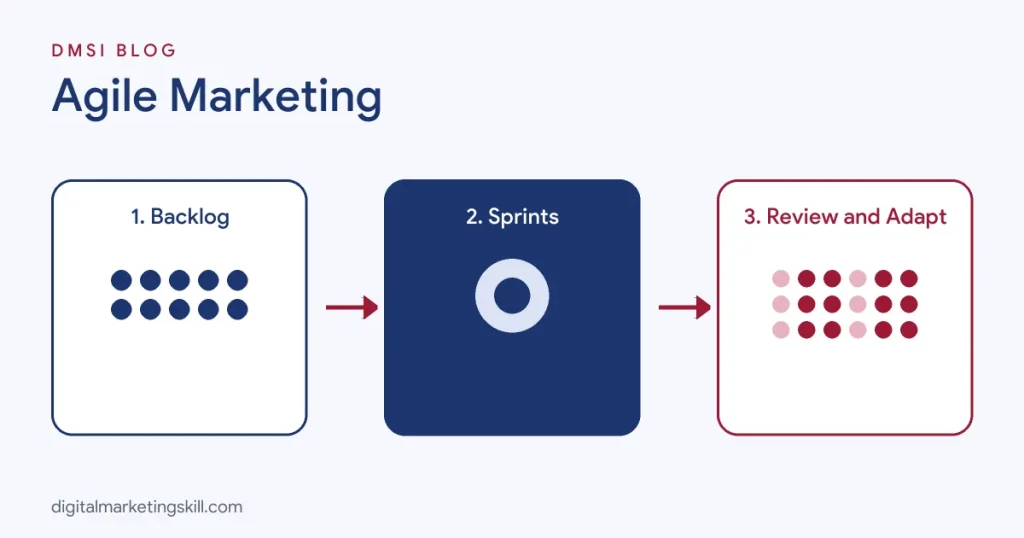
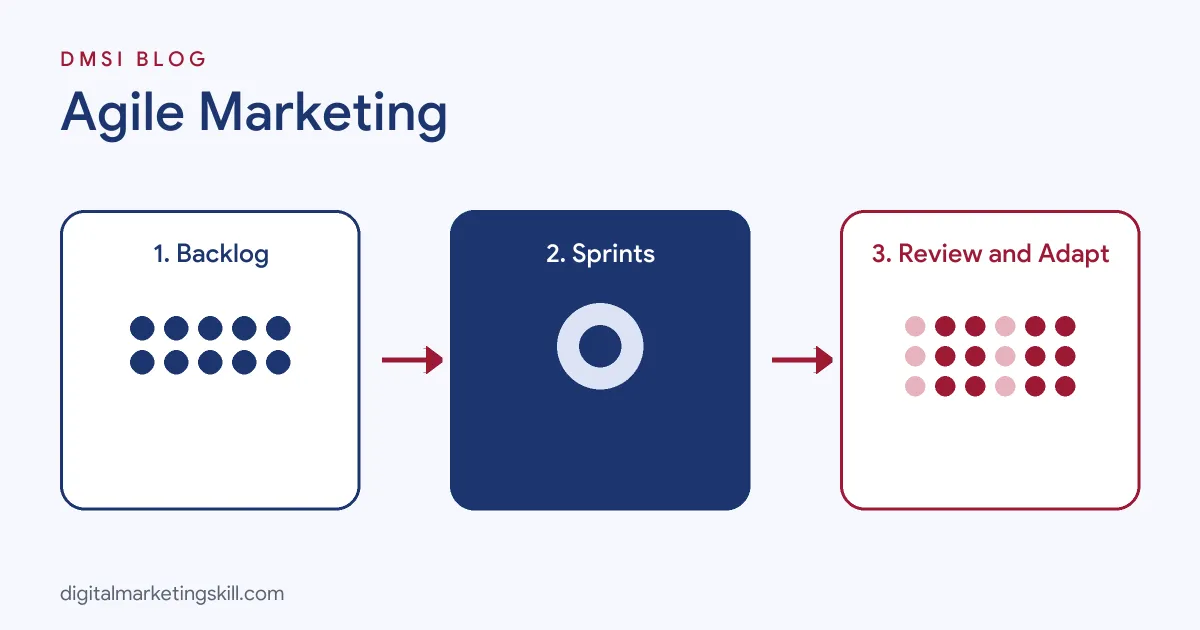
- Core practices include a prioritised backlog, short work cycles, regular stand-ups, reviews of results and retrospectives on how the team works.
- Teams can start small, with one team and a simple visual board, before scaling.
- What Is Agile Marketing?
- Agile Marketing Values
- Agile vs Traditional Marketing
- Agile Marketing Frameworks
- What an Agile Marketing Sprint Looks Like
- How to Implement Agile Marketing
- Agile Marketing Metrics
- FAQ
What Is Agile Marketing?
In a traditional approach, a marketing team might plan an entire quarter or year of campaigns in advance, build each one fully, launch it and only then see how it performs. If the market shifts or the results disappoint, much of the effort is already spent. Agile marketing breaks work into smaller pieces delivered in short cycles, so the team can learn from real results and change direction quickly.
The idea came from software development, where the Manifesto for Agile Software Development set out a new way of building software in small, frequent increments. Marketers noticed similar problems in their own work, such as long planning cycles, unclear priorities and too many projects at once, and adapted agile principles to marketing. The Agile Marketing Manifesto was first drafted by marketers in the early 2010s and later updated.
Agile marketing is both a mindset and a set of practices. The mindset focuses on customer value, learning and collaboration. The practices include visual task boards, prioritised backlogs, short sprints, daily check-ins and regular reviews. Teams adopt the practices that suit their work rather than following a rigid rulebook.
What Most Agile Marketing Guides Miss
Many guides present agile marketing as “working faster”. Three points are often missed:
- Agile is about focus, not speed. The main benefit usually comes from doing fewer things at once and finishing them, which makes work faster as a side effect.
- Strategy still matters. Short cycles only help if the team knows its goals. Agile teams plan around clear objectives and adjust tactics, not purpose, every sprint.
- Not all marketing fits sprints. Big brand campaigns, events and regulated content may need longer planning. Many teams use agile practices for most work while keeping longer timelines where needed.
Agile Marketing Values
The Agile Marketing Manifesto sets out five values. Each statement means that while the second item has value, the first matters more.
Customer value and business outcomes over activity and outputs
Success is measured by results, such as leads, revenue or customer satisfaction, not by how many blog posts or emails were produced.
Delivering value early and often over waiting for perfection
Release a useful first version, learn from it and improve, rather than polishing for months before launch.
Learning through experiments and data over opinions and conventions
Test ideas and let evidence guide decisions, rather than relying on the loudest voice or “how we have always done it”.
Cross-functional collaboration over silos and hierarchies
Bring together the skills needed, such as content, design, analytics and paid media, so work flows without constant handovers and approvals.
Responding to change over following a static plan
Plans are useful, but teams should adapt them when customers, competitors or data change.
Agile vs Traditional Marketing
| Traditional marketing | Agile marketing | |
|---|---|---|
| Planning | Long, detailed plans fixed in advance | Clear goals, with tactics planned in short cycles |
| Delivery | Big launches after long preparation | Small, frequent releases |
| Decisions | Often based on experience and opinion | Based on tests and data |
| Team structure | Separate specialist teams and handovers | Cross-functional teams working together |
| Response to change | Slow; plans are hard to change | Fast; priorities reviewed every cycle |
| Visibility | Status updates in meetings and reports | Shared boards showing all work in progress |
Traditional approaches still have strengths, such as long-term brand consistency and coordination for big launches. Many teams combine the two: a clear annual strategy and budget, with agile execution of campaigns and content within it.
Benefits of Agile Marketing
Faster learning
Short cycles mean you see results sooner and can double down on what works or stop what does not.
Better focus
A prioritised backlog and limits on work in progress stop teams from juggling too many projects, which reduces stress and improves quality.
Transparency
Visual boards show what everyone is working on, what is blocked and what is done, so managers and stakeholders do not need constant status meetings.
Flexibility
When priorities change, the team can adjust the next sprint rather than abandoning months of work.
Stronger collaboration
Daily check-ins and shared goals break down silos between writers, designers, analysts and channel specialists.
Clearer results
Regular reviews tie work to outcomes, helping teams show their impact and make the case for resources.
Agile Marketing Frameworks
Scrum
Scrum organises work into fixed-length sprints, commonly one to four weeks in marketing. Each sprint starts with planning, where the team selects work from the backlog. A short daily stand-up keeps everyone aligned. At the end, a sprint review shows what was delivered and what the results were, and a retrospective looks at how the team can work better. Scrum suits teams with project-style work, such as campaigns and content production, that can be planned in chunks.
Kanban
Kanban uses a visual board with columns such as To do, In progress, In review and Done. Tasks move across as they progress. Instead of fixed sprints, Kanban limits how many items can be in each column at once, which helps work flow smoothly and exposes bottlenecks. It suits teams with a continuous stream of requests, such as social media, design or marketing operations.
Scrumban
Scrumban combines elements of both: the visual board and work-in-progress limits of Kanban with some of the regular planning and review rhythms of Scrum. Many marketing teams end up here, because it offers structure without forcing all work into fixed sprints.
Choosing a framework
If most of your work is planned projects, start with Scrum. If you handle many unpredictable requests, start with Kanban. If you have a mix, try Scrumban. The framework matters less than consistently applying the core practices: a single prioritised backlog, visible work, short feedback loops and regular improvement.
What an Agile Marketing Sprint Looks Like
Here is a typical two-week sprint for a small marketing team.
Day 1, sprint planning. The team reviews goals, such as increasing webinar sign-ups, and selects the highest-priority items from the backlog: a landing page update, two promotional emails, three social posts, a short video and a paid social test. Each item has a clear definition of done and an owner.
Daily stand-ups. Each morning, team members spend about fifteen minutes sharing what they did yesterday, what they will do today and anything blocking them. Blockers are solved after the meeting.
During the sprint. Work moves across the board. The landing page goes live early so it can collect data. The email and social posts are released as soon as they are ready.
Sprint review. At the end, the team shows what was delivered and looks at results: sign-up rate, email clicks and ad performance. Stakeholders give feedback.
Retrospective. The team discusses what went well, what did not and one or two changes to try next sprint, such as getting design input earlier.
Backlog refinement. New ideas and requests are added to the backlog and prioritised for the next sprint, informed by what was learned.
How to Implement Agile Marketing in 7 Steps
Step 1: Get buy-in and set goals
Explain to the team and leadership why you want to try agile marketing, such as reducing overload, improving results or responding faster. Agree on clear marketing goals for the next quarter, so the team knows what to prioritise.
Step 2: Map current work
List everything the team is currently doing and has been asked to do. Most teams discover far more work in progress than they realised. This is the starting point for your backlog.
Step 3: Build and prioritise a backlog
Turn work into clear, small items, sometimes written as user stories, such as “As a small business owner, I want a checklist so I can prepare for tax season”. Rank items by value and effort. A single, visible backlog prevents competing priorities from different stakeholders.
Step 4: Choose a framework and tools
Pick Scrum, Kanban or Scrumban based on your work. Set up a simple board, physical or digital, using a project management tool such as Trello, Asana, Jira, Monday or Wrike. We have no connection with these tools; choose one your team will actually use.
Step 5: Run your first cycle
Start with a short sprint, such as two weeks, or a Kanban board with work-in-progress limits. Hold brief daily stand-ups. Keep the scope small enough to finish.
Step 6: Review and reflect
At the end of the cycle, review both results and process. What did customers respond to? What slowed the team down? Agree one or two improvements.
Step 7: Improve and scale
Repeat, refining your process each time. Once one team is working well, share what you learned and expand to other teams. Some larger organisations use scaled agile frameworks to coordinate many teams.
Agile Marketing Metrics
Agile marketing teams track two kinds of metrics. Outcome metrics show whether marketing is working: leads, conversions, revenue, customer acquisition cost, engagement and retention. Process metrics show whether the team is working well: how many items are completed per sprint, how long items take from start to finish, how much work is in progress at once and how often plans change mid-sprint. Leading indicators, such as click-through rate or trial starts, help teams adjust quickly, while lagging indicators, such as revenue or retention, confirm longer-term impact. Our guide to digital marketing KPIs lists useful outcome measures.
Avoid measuring busyness. A team that ships many items but does not move outcome metrics is not succeeding. Review both types of metrics in sprint reviews and adjust priorities accordingly.
Agile Marketing for Small Teams and Freelancers
Agile is not only for large organisations. A single marketer or a team of two can benefit from a simple Kanban board, a prioritised list of tasks, weekly planning and a short end-of-week review of what worked. Freelancers can use the same approach to manage several clients, showing each client a clear backlog and agreeing priorities together. The key ideas, focusing on the most valuable work, finishing before starting new tasks and learning from results, apply at any scale.
Agile Roles in a Marketing Team
Agile teams usually define a few roles, though titles vary. A marketing owner, similar to a product owner in software, is responsible for the backlog: gathering requests, setting priorities with stakeholders and making sure the team works on what matters most. A team lead or agile coach, similar to a scrum master, helps the team follow its process, runs meetings efficiently and removes blockers. Team members, such as writers, designers, analysts and channel specialists, decide how to deliver the work and share responsibility for results. Stakeholders, such as sales leaders or executives, contribute ideas and feedback through the backlog and reviews rather than by sending ad hoc requests to individuals. In small teams one person may hold several roles; what matters is that someone owns priorities and someone protects the process.
Handling Requests and Stakeholders
One of the biggest changes agile brings is how requests are handled. Instead of every manager asking individuals for work directly, all requests go into the shared backlog, where they are prioritised against goals. This can feel strange at first, but it protects the team from overload and makes trade-offs visible. A short regular meeting with key stakeholders to review the backlog helps them see why some requests are scheduled sooner than others. Urgent work can still be handled, but it should replace something else in the current cycle rather than being added on top. Clear rules like these are often what makes agile marketing succeed or fail.
Agile Marketing and AI
AI tools fit naturally into agile ways of working. Because agile teams release smaller pieces of work and learn from results, AI can help speed up drafting variations to test, summarising campaign data before sprint reviews, suggesting backlog items from customer feedback and automating routine reporting. The agile habit of reviewing results regularly also helps teams check AI-assisted work for quality and accuracy before scaling it. Keep humans responsible for priorities, brand voice and final approval, and treat AI as a way to shorten cycles, not to skip the learning that makes agile valuable.
Agile also helps teams adopt new tools safely. Instead of rolling out a new AI tool across all marketing at once, a team can test it on one workflow during a sprint, measure the effect and decide whether to expand, adjust or drop it at the next review.
Common Mistakes
- Copying software practices exactly. Adapt agile to marketing work rather than following developer rules rigidly.
- No clear goals. Without objectives, sprints become busy work.
- Too much in progress. Starting everything at once defeats the purpose.
- Skipping retrospectives. Improvement depends on reflecting regularly.
- Treating stand-ups as status reports to managers. They are for the team to coordinate.
- Constantly changing sprint priorities. Protect the sprint where possible; change priorities between cycles.
- Measuring output instead of outcomes. Focus on results, not volume.
One Rule to Remember
Stop starting, start finishing. Agile marketing works best when teams focus on the most valuable work, complete it and learn from the results before moving on.
An Illustrative Example
This example is illustrative and not a real business. A five-person marketing team at a software company was juggling over forty open tasks from different managers, and campaigns often launched late. The team leader introduced a single backlog, a Kanban board with a limit of two tasks in progress per person and a weekly planning meeting with stakeholders to agree priorities. They also began two-week reviews of campaign results. Within a couple of months, the team was finishing work faster, managers could see progress on the board instead of chasing updates, and the team used review insights to shift budget from a low-performing ad channel to email nurturing, which produced more qualified leads.
The lesson: visible priorities and limits on work in progress often deliver the biggest early gains from agile marketing.
Agile Marketing as a Career Skill
Many marketing teams now use agile ways of working, so familiarity with backlogs, sprints, Kanban boards and retrospectives is a useful skill for marketers at every level. If you are building marketing skills in your country or anywhere else, practise by managing your own projects on a simple Kanban board, running weekly reviews of what you completed and learned, and describing that process in interviews. Experience with common project management tools is also valued by employers.
Frequently Asked Questions
What is agile marketing?
A way of managing marketing work in short cycles, prioritising the most valuable tasks, releasing early, measuring results and adapting quickly.
What are the principles of agile marketing?
Focus on customer value and outcomes, deliver early and often, learn through experiments and data, collaborate across functions and respond to change.
What is an example of agile marketing?
A team running two-week sprints to improve webinar sign-ups, releasing a new landing page, emails and social posts, then reviewing results and adjusting the next sprint.
What is the difference between agile and traditional marketing?
Traditional marketing relies on long fixed plans and big launches. Agile marketing plans in short cycles, releases smaller pieces and adapts based on data.
What frameworks do agile marketing teams use?
Mainly Scrum, Kanban and Scrumban, a hybrid of the two.
How long is an agile marketing sprint?
Commonly one to four weeks, with two weeks being a popular choice.
What is a marketing backlog?
A single prioritised list of all the marketing work the team could do, from which items are selected for each cycle.
Is agile marketing suitable for small teams?
Yes. Simple boards, weekly planning and regular reviews help small teams and freelancers focus and improve.
What tools support agile marketing?
Project management tools such as Trello, Asana, Jira, Monday and Wrike, or a physical board with sticky notes.
What is agility versus agile?
Agility is the general ability to respond quickly to change. Agile refers to specific values and practices for achieving it.
Your Next Step
Want to learn how modern marketing teams plan, run and measure campaigns? The Master Diploma in Digital & AI Marketing at Digital Marketing Skill Institute covers AI-powered Social Media Management and Advertising, Lead Generation and Email Automation, Google, and a WordPress and SEO track where you build and rank a real website.
From day one, you work on a real U.S. company’s project through the U.S. Project Internship, so you finish with real results and a verified U.S. work reference letter. You also get unlimited one-on-one coaching. The program carries dual US and UK accreditation, is recognised in more than 100 countries, and runs 100% online over three months.
You can build those skills wherever you live, anywhere in your country. Read student reviews, then apply for the 65% partial scholarship to see if you qualify.
Sources checked November 2026: The Agile Marketing Manifesto; Atlassian, “What is Agile marketing?”; AgileSherpas, “A Complete Agile Marketing Definition”; Wrike, “What is Agile marketing?”; Wikipedia, “Agile marketing”. Top-ranking pages read for coverage only.