
toc items: 20
How to create a blog comes down to four choices made in order: a focus narrow enough to rank for, a platform and host that will not fight you later, a first batch of content built to answer real questions, and a simple way to measure what is working. Get the order right, and how to create a blog that lasts becomes a short, manageable list rather than a mystery.
Key Takeaways
- WordPress is still the default choice. W3Techs reports WordPress runs 40.2% of all websites, and 58.7% of sites with a detectable content management system.
- A domain is a small, predictable cost. Standard registrar pricing puts a .com domain at roughly $10 to $15 a year, with renewal usually higher than the first-year rate.
- Ranking takes longer than most new bloggers expect. Ahrefs tracked 1 million URLs and found only 1.74% of new pages reached Google’s top 10 within a year.
- Useful posts tend to run longer than a quick note. Orbit Media’s annual survey puts the average blog post at 1,312 words, and bloggers publishing 2,000+ word posts report strong results nearly twice as often.
- Consistency compounds. Buffer grew its own blog from zero to 1.5 million monthly readers over about six years by publishing on a steady schedule and building on what worked.
In this guide
- What Most “How to Create a Blog” Guides Skip
- How a New Blog Actually Starts Earning Attention
- Three Foundations You Set Once
- How to Strengthen Each Foundation
- Five Mistakes That Quietly Stall a New Blog
- How to Measure a New Blog’s Progress
- The Most Useful Rule: Judge the First Three Months by Output, Not Traffic
- A Four-Week Plan for How to Create a Blog
- A Real Case: How Buffer Grew a Blog From Zero
- Frequently Asked Questions About How to Create a Blog
- Start With One Sentence, Then Build
What Most “How to Create a Blog” Guides Skip
Most guides on how to create a blog jump straight to buttons: pick a host, install WordPress, choose a theme. None of that is wrong, but it treats the blog as a piece of software, not a publication with a reader to serve.
This guide puts the decision that matters most first: who the blog is for and what it answers that nobody else does well. The technical steps come after, because a fast, well-built blog with no clear focus still gets no readers.
Here are the ground rules. W3Techs, Ahrefs and Orbit Media figures come from named, ongoing studies; read them as snapshots of the wider web, not a promise about your own blog. The Buffer case is one company’s documented result, not a guarantee. This guide works the same way everywhere, so skip anything that assumes one country’s currency, hosting market or audience.
One more ground rule matters for how to create a blog specifically: the order of decisions matters more than the speed of any single step. A focus chosen in an afternoon but never tested costs more time later than a focus tested properly over a week.
How a New Blog Actually Starts Earning Attention
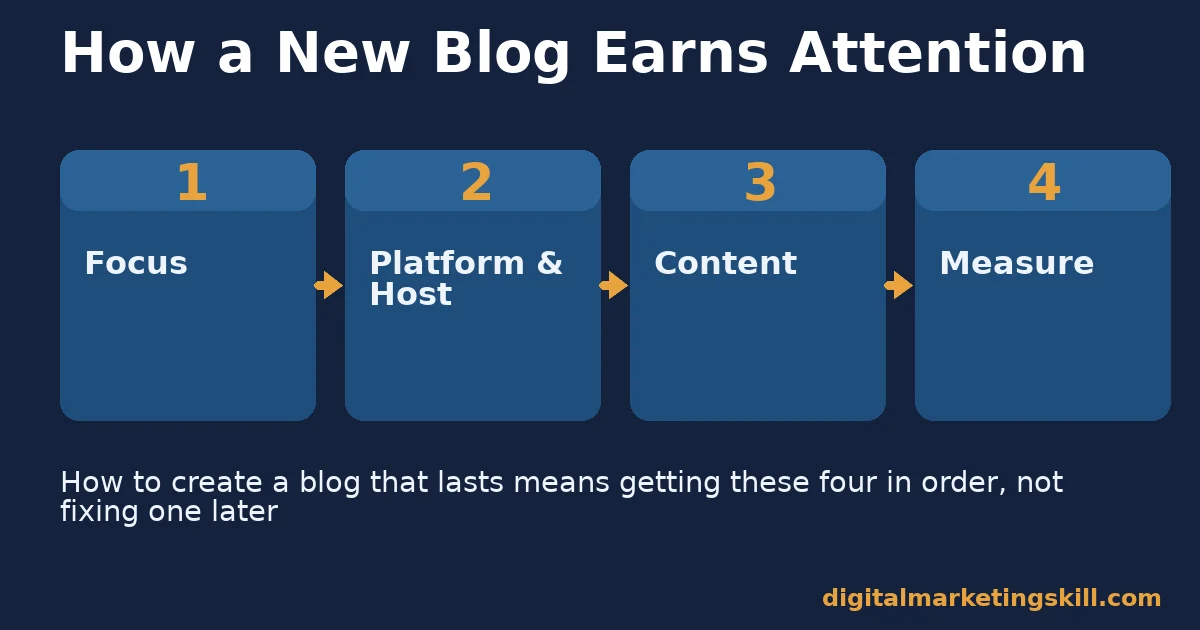
A blog earns its first readers through a short, predictable chain. First, you choose a focus narrow enough that a search engine can tell what the blog is about. Next, a domain and host give that focus a stable home. Then content answers real questions in that focus, one at a time. Finally, a way to measure tells you which posts are working, so later posts build on them.
Most new blogs break at the first link, not the technical ones. A vague focus, such as “lifestyle” or “my thoughts,” gives search engines and readers nothing to match against. A narrow focus, even a small one, gives every later step something to aim at.
Every gate in that chain depends on the one before it. A fast, well-installed platform cannot save a blog with no clear focus. A long, well-written post cannot save a domain nobody can find. This is why how to create a blog succeeds or fails as a chain of decisions, not as one clever trick.
Three Foundations You Set Once
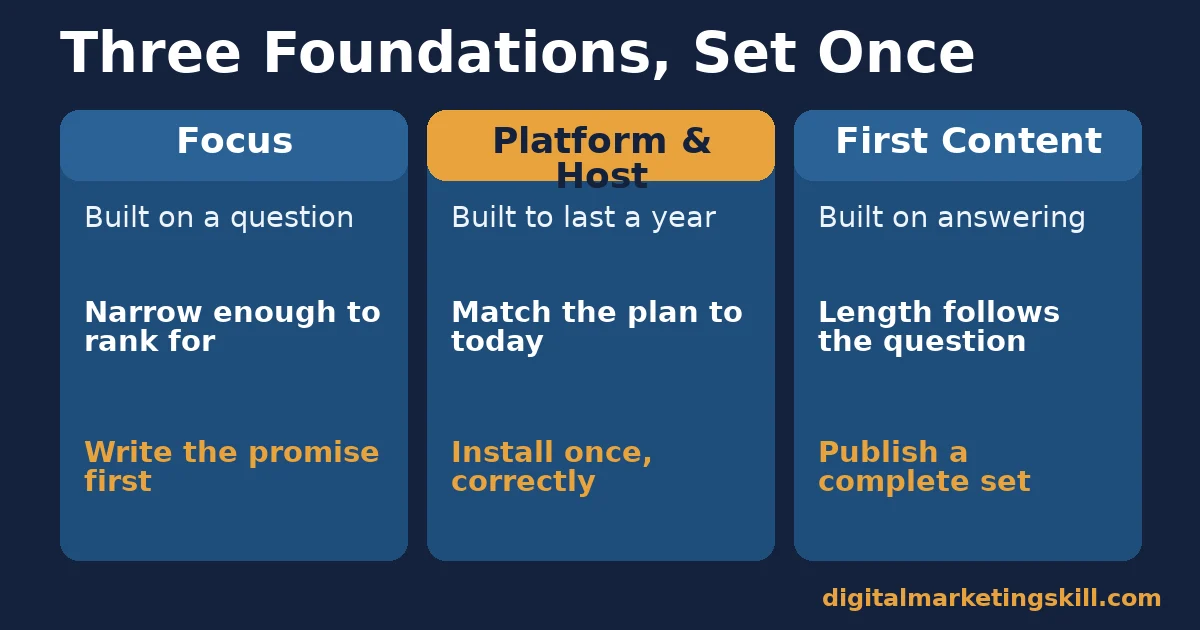
Three choices get made early and then mostly left alone. Each is worth slowing down for, because changing any of them later costs real time.
Focus: Built on a Question You Can Answer Better Than Most
A workable focus sits at the overlap of three things: a topic you can keep writing about, a problem real people search for, and an angle you can support with evidence or experience. Skip any one of the three, and the blog runs out of ideas or readers within months. This overlap is the real answer to how to create a blog that lasts past the first few posts.
Test a focus before committing to it. Search a handful of questions in that topic and look at what already ranks. If every result is thin or outdated, that is room for a better answer, not proof nobody wants it. This single test, repeated across your first ten post ideas, is the cheapest insurance in how to create a blog that lasts.
Platform and Hosting: Built on What You Will Still Want in a Year
WordPress remains the default for a reason: it is free, widely documented and works with almost any host. W3Techs puts its share of all websites at 40.2%, far ahead of any competitor.
Hosting and a domain are where new bloggers either overspend or under-plan. A domain costs roughly $10 to $15 a year at standard rates. Hosting varies far more by traffic and support needs, so match the plan to where the blog is now, not where you hope it will be.
First Content: Built on Answering, Not Announcing
The first posts set the tone for everything after. Posts that answer a specific question tend to earn more return visits than posts that simply announce the blog exists or share personal updates with no clear reader in mind.
Length follows the question, not a rule. Orbit Media’s survey shows the average post running 1,312 words, with longer, more thorough posts reporting stronger results more often. Write to fully answer the question, then stop.
How to Strengthen Each Foundation
The sections below mirror the three foundations above. Work through them in order, because each one supports the next.
Focus: Write the One-Sentence Promise First
Before writing a single post, write one sentence: “This blog helps [specific reader] do [specific thing].” If the sentence is too broad to picture a real reader, narrow it until you can.
Keep that sentence visible while you plan your first ten post ideas. If an idea does not clearly serve the promise, save it for later or drop it, rather than letting the blog drift in its first months. This is the single habit that separates a focused blog from the thousands that start strong and go quiet within a year.
Platform and Hosting: Install Once, Correctly
Register a domain that matches your focus and is easy to say aloud. Choose a host with a plan that fits your current traffic, not a guess at future success. Confirm it includes backups and basic security before you commit a year of payments.
Install WordPress through your host’s setup tool, then choose a simple, fast theme over a feature-heavy one. A slow, cluttered theme costs you readers before they see a single word. This single technical step, done carefully once, saves a painful migration later in the life of the blog.
First Content: Publish a Small, Complete Set
Write five to ten posts that each fully answer one question inside your focus. Avoid one long post trying to cover everything. This gives search engines and readers several doors into the blog instead of one.
Link these early posts to each other where it is natural. This signals which topics matter most on the blog, and it keeps a reader who finishes one post moving to the next instead of leaving. Anyone researching how to create a blog that keeps readers, rather than one that gets a single visit, should treat this linking habit as part of writing, not an afterthought.
Five Mistakes That Quietly Stall a New Blog
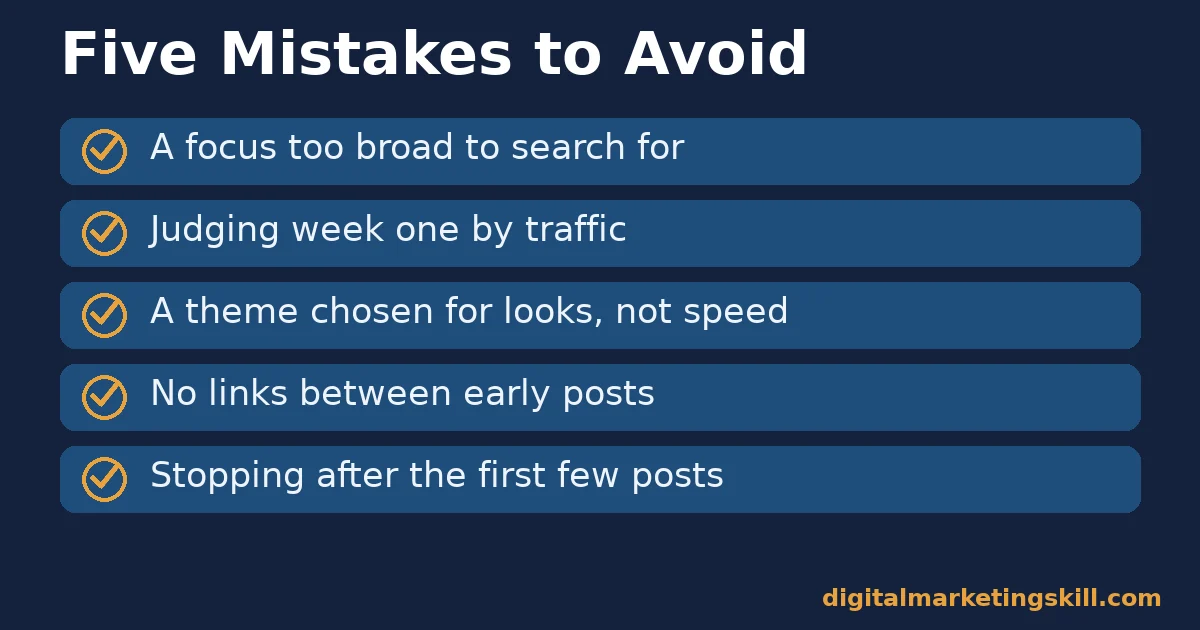
When a new blog stops gaining readers, the cause is usually one of five habits. Check your own blog against this list before changing anything else.
- A focus too broad to search for. “Lifestyle” or “random thoughts” gives nobody a reason to find you. Narrow it to a specific reader and problem.
- Judging week one by traffic. Ahrefs found most new pages take months to rank at all. Early weeks should be judged by output and quality, not visits.
- A theme chosen for looks, not speed. A slow blog loses readers before the content loads. Pick function first.
- No internal links between early posts. Posts that stand alone waste the chance to keep a reader moving through the blog.
- Stopping after the first few posts. Buffer’s growth took years of steady publishing, not a single strong week. Plan for months, not days.
Which Mistake to Fix First
If you have published but gained no readers, check the focus first. If you have a clear focus but posts stand alone, fix internal linking next. And if you are judging a two-week-old blog as a failure, the problem may simply be time.
Match the fix to the actual symptom. A blog with a sound focus, fast theme and connected posts just needs the months that search engines take to notice it. Guessing at the mistake wastes weeks that a five-minute audit against this list would have saved.
How to Measure a New Blog’s Progress
In the first months, traffic alone will not tell you much. Track the signals below instead, and watch for direction, not size.
- Indexed pages. The share of your published posts that a search engine has indexed. A gap between published and indexed posts points to a technical problem worth fixing early.
- Search impressions. How often your pages appeared in Search Console results, even without a click. Rising impressions show a search engine is starting to understand your focus.
- Average position. Where your pages tend to rank for the terms they appear for. A slowly improving average position is a healthier early sign than a single post briefly ranking well.
- Returning visitors. The share of readers who come back. Even a small, loyal readership early on suggests the focus and content are working.
- Posts published on schedule. How consistently you are publishing against your own plan. This is the one metric fully in your control from day one.
How to Read These Signals Together
Early on, consistency and indexing matter more than traffic. If posts are indexed and impressions are slowly rising, the mechanics are working and traffic will follow on its own schedule.
If impressions stay flat for months despite steady publishing, revisit the focus rather than the content quality. A well-written post about the wrong question still will not find readers. Reviewing these five signals monthly keeps how to create a blog honest, instead of relying on a traffic number that stays near zero for good reasons in the early months.
The Most Useful Rule: Judge the First Three Months by Output, Not Traffic
If you remember one decision rule from this guide, make it this one. In the first three months, judge your blog by whether you published what you planned, on the focus you chose, with posts linked together. Traffic is the wrong early scoreboard, because search engines take time to notice a new site at all.
Here is an illustrative example, with invented numbers. A new blog publishes two posts a week on a narrow focus for twelve weeks, gaining almost no search traffic the entire time. By month five, several of those early posts begin ranking together, and monthly visits grow from under 50 to several hundred without a single new post added that month.
The lesson is about where the real work happens. The growth showed up months after the writing did, which is why output, not traffic, is the right early measure.
A Four-Week Plan for How to Create a Blog
You do not need every decision finished before you start. This plan takes about an hour a day and follows the same order as the foundations above.
- Week one: write the one-sentence promise. Name the reader and the problem your blog will help with. Test it against a handful of real search results in that topic.
- Week two: register and install. Buy a domain that matches your focus, choose a host sized to your current traffic, and install WordPress with a fast, simple theme.
- Week three: write and publish five posts. Each post should fully answer one question inside your focus. Link them to each other as you go.
- Week four: set up measurement. Connect Search Console and analytics, confirm your posts are indexed, and note your starting impressions as a baseline.
At the end of the month, you will not have much traffic yet, and that is expected. What you will have is a working blog with a clear focus, a handful of complete answers, and a way to see progress over the months ahead. Repeat the plan’s publishing and measuring habits into month two and three, and the slow climb described in the decision rule above tends to follow.
A Real Case: How Buffer Grew a Blog From Zero
Buffer, the social media scheduling company, started its blog with no readers and a small team. Rather than treating the blog as an afterthought, it became a core part of how the company grew, built on a steady publishing schedule and a clear focus on one audience’s questions.
According to Buffer’s own account of the blog’s growth, monthly readership grew from zero to over one million, and later to 1.5 million, over roughly six years of consistent publishing and refinement. The company has also written publicly about the broader growth strategy behind those numbers.
Treat this as a model for the approach, not a guaranteed timeline. Buffer had a dedicated team and years to compound small gains, so the specific numbers belong to one company. The mechanism, consistent focus and steady publishing, is what transfers to anyone working through how to create a blog on a smaller scale.
Frequently Asked Questions About How to Create a Blog
What is the first step in how to create a blog?
Choose a focus narrow enough to describe in one sentence, naming a specific reader and the problem you will help them solve. Everything else follows from that choice.
Do I need to know how to code to create a blog?
No. WordPress and similar platforms handle the technical setup, and most hosts offer one-click installation. Coding knowledge helps later for customisation, but it is not required to start.
How much does it cost to create a blog?
A domain runs roughly $10 to $15 a year, and hosting varies by plan and traffic. Many new blogs start on an inexpensive shared hosting plan and upgrade once traffic justifies it.
How long until a new blog gets real traffic?
Ahrefs’ research shows most new pages take months to rank at all, with only 1.74% reaching the top 10 within a year. Expect the first few months to be about publishing, not traffic.
How long should my first blog posts be?
Long enough to fully answer the question, and no longer. Orbit Media’s survey puts the average post at 1,312 words, though the right length depends entirely on the question being answered.
Should I write about multiple topics or stay narrow?
Stay narrow at first. A focused blog gives search engines and readers a clear reason to return, while a broad blog competes with established sites on every topic at once.
How often should I publish when starting a blog?
Choose a schedule you can sustain for months, not days. Buffer’s growth came from years of consistent publishing, not an intense first week followed by silence.
Can I change my focus after I create a blog?
Yes, but it resets some of the progress search engines have made toward understanding the site. It is far cheaper to test a focus properly before publishing than to pivot a blog with fifty posts already live.
Start With One Sentence, Then Build
How to create a blog is really four decisions made in order. Pick a focus you can answer better than most. Choose a platform and host that will not need replacing. Write a first set of posts that answer real questions. Then measure progress in a way that does not rely on traffic alone in the early months.
Once your focus is set, our guide to choosing the right domain name covers that step in depth, and our guide to website hosting services walks through matching a host to your plan.
When you are ready to pick a theme, see our guide to testing a free WordPress theme before you install it, and our guide to popular blog niche ideas can help sharpen a focus that still feels too broad.
Where to Go Next
If you want structured, hands-on practice building and growing a blog as part of a wider skill set, Digital Marketing Skill Institute teaches this inside the Master Diploma in Digital & AI Marketing. The AI-Powered WordPress and SEO Specialist track is one of four tracks in the programme, which totals ten courses with a Full Stack option for completing all four.
The diploma includes unlimited 1-on-1 coaching and mentoring and a U.S. Project Internship with a verified work reference letter, and it is dual US and UK accredited and recognised in more than 100 countries. The programme is fully online, so you can build these skills from anywhere in your country.
Browse more guides on the Digital Marketing Skill Institute blog, and when you are ready, apply for the Master Diploma or start from the Digital Marketing Skill Institute homepage.
Every figure in this guide was checked against its original source before publication. Figures marked as illustrative are invented examples, not real results.
