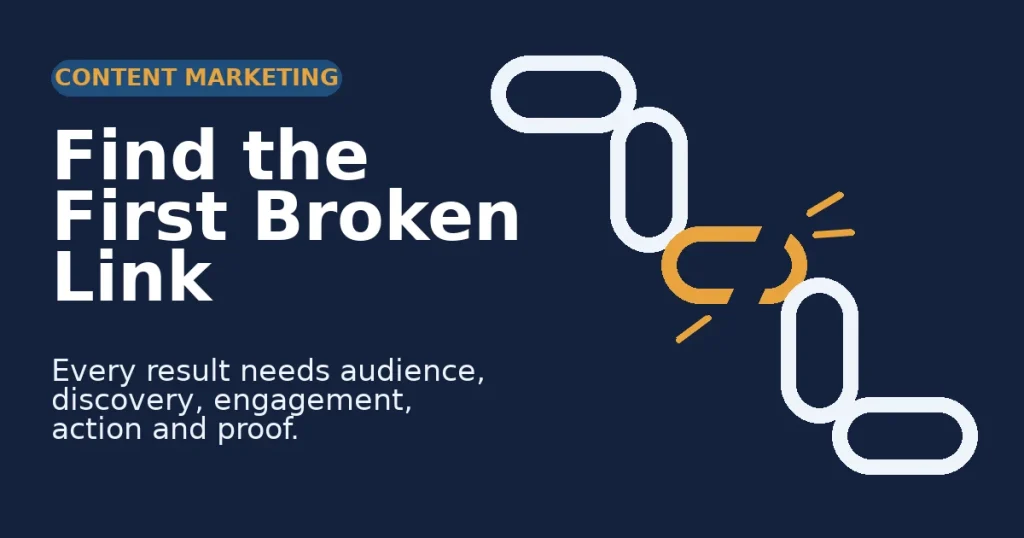
The biggest content marketing challenges are less about producing more and more about five weak links: the wrong audience, pages nobody finds, copy that sounds like everyone else, readers who never act, and results nobody can prove. Find the first broken link, fix it, and then measure again.
Key Takeaways
- Most pages are never found. Ahrefs analysed about 14 billion pages and found that 96.55% get no traffic from Google, so check discovery before you blame your writing.
- Getting readers to act is the most named problem. In a Content Marketing Institute and MarketingProfs survey of 1,015 B2B marketers, 40% named content that prompts action as a top challenge.
- AI raised output, not results. The same survey found that 95% of organisations use AI tools, yet only 39% of marketers who use AI for content see better content performance.
- Proof is still missing. A third of those B2B marketers (33%) named measuring content effectiveness as a top challenge, which is why weak links stay hidden for months.
- Old content is an asset. HubSpot reported that updating old blog posts raised their monthly organic search views by an average of 106%, a figure from its own blog rather than an independent test.
In this guide
- What Most Lists of Content Marketing Challenges Miss
- How Content Marketing Really Produces Results
- Five Content Marketing Challenges, One for Each Link
- How to Fix Each Content Marketing Challenge
- How to Measure Progress on Content Marketing Challenges
- The Most Useful Rule: Fix the First Broken Link
- A Real Case: How HubSpot Fixed Content It Already Had
- Frequently Asked Questions About Content Marketing Challenges
- Start With One Broken Link, Then Expand
What Most Lists of Content Marketing Challenges Miss
Most articles on content marketing challenges give you a list: not enough time, not enough ideas, too much competition. Each item is true. But a list does not tell you which problem is costing you results right now, so you end up fixing everything a little and nothing properly.
This guide takes a different view. It treats content marketing challenges as links in one chain, where a single weak link blocks every result further down. Then it shows how to find that link from numbers you already have, and what to change for each one.
Here are the ground rules. The survey figures come from named studies, and each one has limits that we state next to it. For example, the Content Marketing Institute research is mostly North American and self-reported. The five-link model is our own framework, an informed inference from that evidence, not a settled fact. Treat the statistics as a snapshot, not a permanent ranking, because tools and audiences keep moving.
How Content Marketing Really Produces Results
Content marketing means publishing useful material, such as articles, videos or emails, so that the right people find you, trust you and eventually buy. If you want the full basics first, read our guide on what content marketing is and how it works. The mechanism matters more than the definition, though, because it explains why effort often fails.
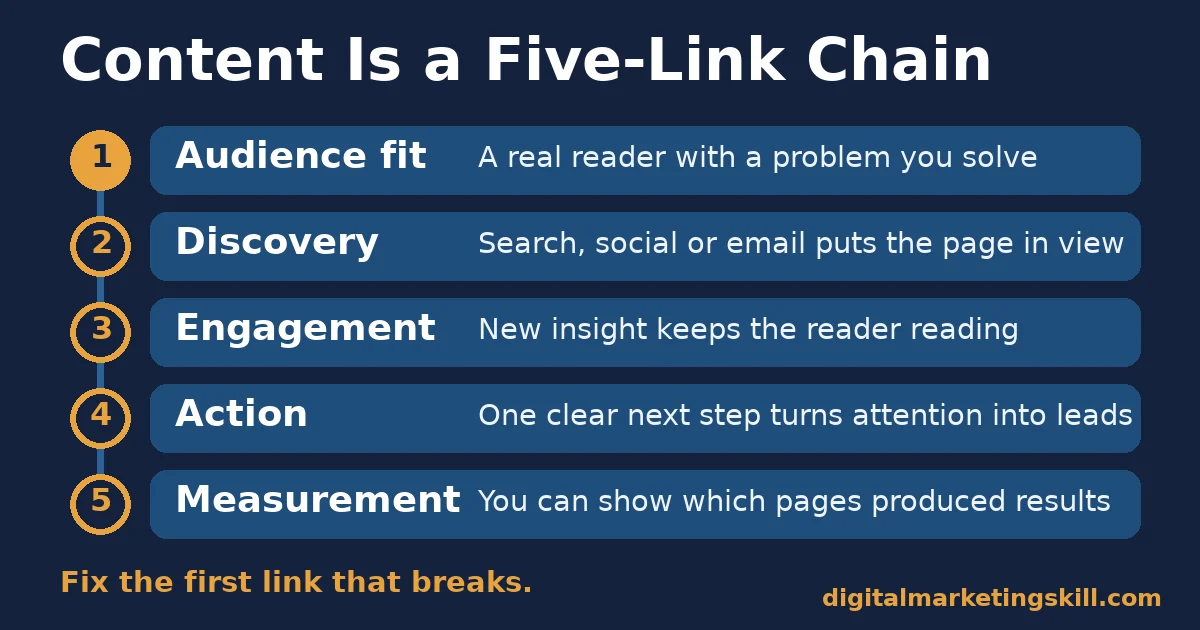
Every result passes through five links in order. First comes audience fit, which means a real reader with a problem you can solve. Next is discovery, where search, social or email puts the page in front of that reader.
Then comes engagement, where the reader stays because the page adds something new. After that is action, the one next step that turns attention into a lead or a sale. Finally, measurement shows which pages produced which results.
Why Order Matters More Than Any Single Challenge
Most content marketing challenges look separate on a slide, but in practice they stack. The order matters because each link depends on the one before it. A brilliant call to action cannot work on a page nobody visits. Likewise, perfect tracking cannot rescue content written for nobody in particular. So when results are weak, the useful question is not “what are our problems?” but “where does the chain break first?”
The audience you can reach is large, which makes the chain worth fixing. DataReportal’s global digital overview counts about 6.12 billion internet users, roughly 73.8% of the world’s population. Whether your customers live in your country or across many countries, the same five links decide whether any of those people become customers.
Five Content Marketing Challenges, One for Each Link
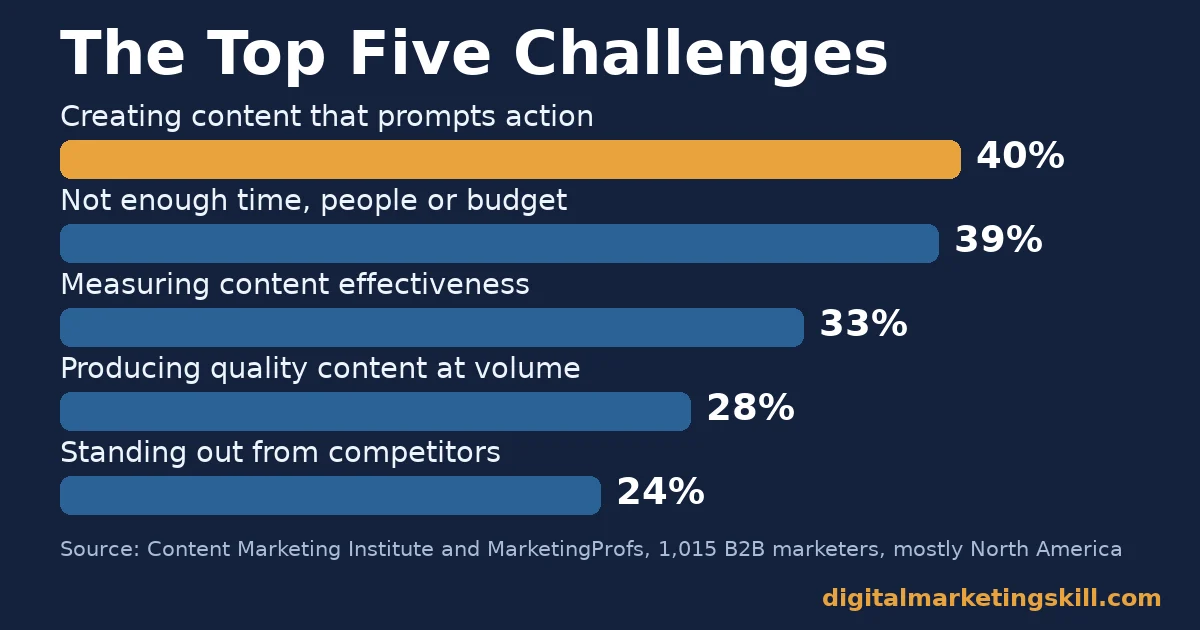
The research lines up neatly with the chain. In the latest Content Marketing Institute and MarketingProfs survey of 1,015 B2B marketers, the most named problems were creating content that prompts action (40%), a lack of time, people or budget (39%), and measuring effectiveness (33%). Producing quality content at volume (28%) and standing out from competitors (24%) followed. Storyblok sponsored that study, and most respondents work in North America.
Small businesses and solo creators face the same content marketing challenges, just with fewer people. When one person does everything, a single weak link can stall the whole programme for months. That makes the order of your fixes even more important.
Audience Fit: Content Built for Everyone Reaches No One
The first break happens before anyone writes a word. Teams pick topics from a keyword tool or a brainstorm, then guess what the reader wants. The result is content that is accurate but generic, so it attracts visitors who were never going to buy.
A previous edition of the same Content Marketing Institute research found that marketers whose strategy underperformed most often blamed a lack of clear goals (42%) and poor alignment with the customer journey (39%). Both are audience problems in disguise, because a clear goal starts with a clear reader.
Discovery: Most Pages Are Never Found
Discovery is where most content quietly dies. In its search traffic study, Ahrefs looked at about 14 billion pages and found that 96.55% receive no traffic from Google at all, while another 1.94% get between one and ten visits a month.
Ahrefs gives three reasons for this. Some topics have no search demand. Others have demand, but the page has no backlinks, which are links from other websites that signal trust. The rest miss search intent, the reason behind the search. That study covers Google search only, so it says nothing about pages that live on social media or email.
Engagement: AI Made Average Content Cheap
Generative AI changed the economics of writing. HubSpot’s State of Marketing report, a survey of more than 1,500 marketers, found that 86.4% of teams use AI in at least a few areas, and 42.5% use it extensively for content creation. As a result, competent but average content is now almost free to produce.
That is why standing out has become harder. The Content Marketing Institute found that 58% of marketers who use AI for content say quality improved, but only 39% see better performance. In other words, AI helps teams write faster, but it does not tell them what only they know.
Action: Readers Arrive but Do Not Act
Creating content that prompts action was the most named content challenge in the latest survey, at 40%. Readers find the page, read part of it, and leave without a next step.
This usually happens for one of two reasons. Either the page offers no next step at all, or it offers a step that does not match why the reader came. A person comparing two tools does not want a newsletter; they want a checklist or a demo.
Of all the content marketing challenges in the survey, this one sits closest to revenue. A page that attracts the right readers but asks for nothing is a leak, and you can often fix it in an afternoon.
Measurement: Results Nobody Can Prove
The last break is measurement, and it hides every other break. A third of B2B marketers (33%) named measuring content effectiveness as a top challenge. Similarly, HubSpot found that measuring marketing ROI is the leading obstacle, named by 33% of its respondents, while 73% say budgets face more scrutiny than before.
Without numbers per page, a team cannot see where the chain breaks. So it falls back on the loudest opinion in the room, which usually means “publish more”. This is the quietest of all content marketing challenges, because nothing looks broken until someone asks for proof.
How to Fix Each Content Marketing Challenge
Each broken link needs a different fix. The mistake is to apply the same cure, usually more content, to every problem. Below, each fix mirrors one of the content marketing challenges above, so you can jump to the one your numbers point to.
Audience Fit: Fix It With Real Customer Language
Start with five short conversations with real customers or prospects. Ask what problem made them search, what they tried first, and what nearly stopped them buying. Write their exact phrases down, because those phrases become your headlines and subheadings.
Then write one sentence for every planned piece: “This page helps [reader] do [task] so they can [result].” If you cannot fill the gaps, drop the topic. A documented plan helps here, and our guide to building a content marketing strategy walks through the full process.
Discovery: Fix It With Demand, Intent and Links
Before writing, confirm that people search for the topic and look at what already ranks. If the top results are all product pages, a long article will struggle, because the intent is to buy rather than learn. Match the format that already wins, then make yours more useful.
After publishing, earn links rather than waiting for them. Share original data, offer a quote to a journalist, or update an older post that already has links. Also check for technical problems, since many pages fail for simple reasons such as missing titles. Our list of common SEO mistakes and how to fix them covers the usual culprits.
Engagement: Fix It With Evidence Only You Have
If AI can write your article from the top ten results, it adds nothing new. Google’s guidance on creating helpful, reliable, people-first content asks whether a page provides “original information, reporting, research, or analysis”. That question is the fix.
Add something the reader cannot get elsewhere: your own numbers, a real customer story, a tested template, or a clear opinion with reasons. Ahrefs found no penalty for AI use in its study of AI content and rankings, but pages with less AI content earned two to three times the impressions in its data. So use AI for drafts and research, then add the human evidence yourself.
Action: Fix It With One Next Step per Page
Give every page one next step that matches the reader’s intent. An early-stage guide might offer a checklist, while a comparison page might offer a demo or a price list. Place the offer where the reader has just solved part of their problem, not only at the bottom.
Then remove competing requests. When a page asks readers to subscribe, follow, download and buy, most do nothing. One clear request tends to beat five weak ones, although you should test this on your own pages.
Measurement: Fix It With Three Numbers per Page
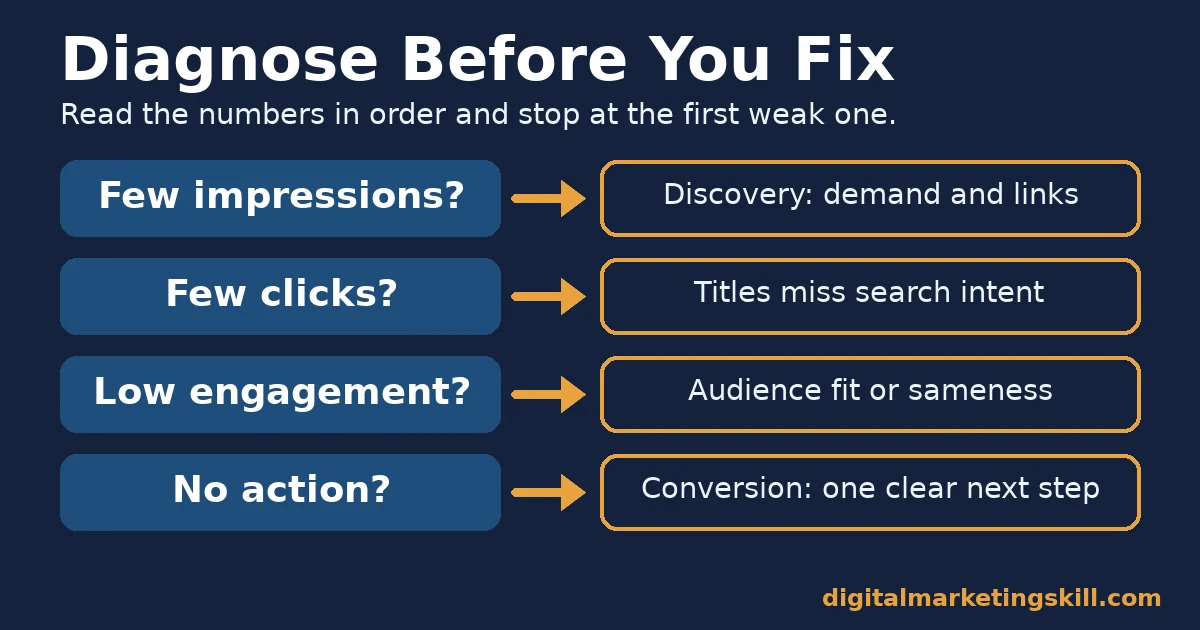
You do not need a complex dashboard to start. Track three numbers for each page: search impressions, engagement rate and conversions. Those three cover discovery, engagement and action, which are the links that break most often.
Set up conversion tracking before you publish, not after. Then review the numbers monthly and write one sentence per page about what changed. For a deeper walk-through, see our guide to measuring content marketing results.
How to Measure Progress on Content Marketing Challenges
Measurement turns this framework into a routine. Each metric below maps to one link, so a weak number tells you exactly where to look. You can pull all of them from free tools, and they sit alongside the traffic and sales figures you already track.
- Search impressions (discovery). Google Search Console defines impressions as how many times your site appeared in search results. If impressions stay near zero after a few months, the problem is demand or links, not your writing.
- Click-through rate (discovery and intent). Search Console calculates click-through rate as clicks divided by impressions. A page with many impressions but few clicks usually has a title that does not match the searcher’s intent.
- Engagement rate (engagement). Google Analytics counts a session as engaged when it lasts longer than 10 seconds, has a key event, or includes two or more page views. Engagement rate is the share of sessions that are engaged, so a low figure suggests the page misses the reader.
- Conversion rate per page (action). This is the share of visitors who take the next step you offered, such as a sign-up. Compare pages with similar intent rather than comparing a beginner guide with a pricing page.
- Revenue or leads influenced (measurement). Count the leads or sales where the buyer read a given page before converting. This number connects content to the revenue figures your manager already watches.
Where to Find These Numbers for Free
You can find the exact definitions in the Search Console performance report help page and the Google Analytics engagement definitions. Read the metrics in chain order and stop at the first weak one.
Review all five together once a month, in the same spreadsheet. When one number improves, the next link usually becomes the new constraint. That is how content marketing challenges shift over time, and it is why a monthly review beats a yearly audit.
The Most Useful Rule: Fix the First Broken Link
If you remember one thing from this guide, make it this decision rule. Work through the chain in order, and fix only the first link that fails. Until the earlier link holds, a later fix wastes effort, because no one reaches it. This rule turns a vague list of content marketing challenges into one clear job for this month.
Here is an illustrative example, with invented numbers. A small accounting firm publishes 20 guides and gets two enquiries in three months. The team wants to write more posts. Search Console, however, shows that 14 of the 20 guides have fewer than 50 impressions a month, so discovery is the first broken link.
Instead of writing new posts, the team rewrites four guides to match real search intent and earns links to two of them. Impressions on those four rise first, then clicks. Only once readers arrive does the team test a stronger next step. The order saved them from polishing calls to action on pages nobody saw.
A Real Case: How HubSpot Fixed Content It Already Had
HubSpot’s marketing team faced the same content marketing challenges as everyone else, just at a larger scale. It found that most of its results came from old content. In a study of its own blog, Pamela Vaughan reported that 76% of monthly blog views and 92% of monthly blog leads came from older posts rather than new ones.
So the team started updating and republishing old posts instead of only writing new ones. According to HubSpot’s report on historical blog optimisation, updated posts gained an average of 106% more monthly organic search views, and the number of leads from those posts more than doubled.
The case works because it fixed links in order. The team first chose posts that already had traffic or leads, which showed audience fit and discovery were in place.
It then refreshed the content and aligned each call to action with the topic readers came for. Keep the limits in mind, though: these are HubSpot’s own figures, from a very large blog, and a small site should expect smaller absolute gains.
Frequently Asked Questions About Content Marketing Challenges
What is the biggest challenge in content marketing?
In the latest Content Marketing Institute and MarketingProfs survey, the most named challenge was creating content that prompts action, at 40% of B2B marketers. For many smaller sites, though, discovery comes first, because Ahrefs found that 96.55% of pages get no Google traffic.
How do I know which content marketing problem to fix first?
Read your numbers in chain order: impressions, click-through rate, engagement rate, then conversions. Fix the first metric that is clearly weak, because later fixes cannot work until readers reach that stage.
Does AI-written content hurt search rankings?
Ahrefs found no evidence that Google penalises content simply for using AI. However, pages with less AI content earned more impressions in its data, so add original evidence and a human point of view.
Are content marketing challenges different for B2B and B2C brands?
The five links are the same, but the weak points often differ. The Content Marketing Institute figures cover B2B marketers only, so consumer brands should check their own numbers before assuming the same ranking of content marketing challenges.
How long does content marketing take to show results?
Search-driven content usually takes months, not weeks, because pages need time to earn links and trust. Email and social distribution can show engagement within days, so use those channels to test topics while search catches up.
How can a small team overcome a lack of time and budget?
Publish less and update more. HubSpot reported that refreshing old posts raised their organic search views by an average of 106%, so improving pages that already rank is often the cheapest win.
Which free tools measure content marketing performance?
Google Search Console shows impressions, clicks and click-through rate for each page. Google Analytics shows engagement rate and conversions, which together cover most of the five links.
Start With One Broken Link, Then Expand
Content marketing challenges feel endless when you look at them as a list. Seen as a chain, they become a sequence you can work through one link at a time. Pick the first broken link on your most important page, apply the matching fix for a month, and measure the result before you move on.
If you want guided practice, Digital Marketing Skill Institute teaches these skills hands-on. The Master Diploma in Digital & AI Marketing includes nine practical courses, among them AI-powered SEO and content marketing, with unlimited 1-on-1 coaching and mentoring. It also includes real project work inside a U.S. company, and the diploma is dual US and UK accredited and recognised in more than 100 countries.
The programme is fully online, so you can study from anywhere in your country. You can read more guides on the Digital Marketing Skill Institute blog, see what past students say on our reviews page, or apply for the Master Diploma when you are ready. Start at the Digital Marketing Skill Institute homepage to compare your options.
Every figure in this guide was checked against its original source before publication. Figures marked as illustrative are invented examples, not real results.
![9 Amazing Digital Marketing Skills to Make Money Online [With Proof]](https://digitalmarketingskill.com/wp-content/uploads/2019/07/9-Amazing-Digital-Marketing-Skills-to-Make-Money-Online-With-Proof-17-300x169.png)