
AI ethics is the set of values and rules that guide how artificial intelligence should be built and used so that it is fair, safe, honest and respects people’s rights. It asks not just “can we do this with AI?” but “should we, and how do we do it well?” For marketers, it matters because AI now writes ads, picks audiences and talks to customers, and each of those choices affects real people.
Key Takeaways
- AI ethics covers fairness, privacy, transparency, safety, accountability and human oversight.
- UNESCO’s Recommendation on the Ethics of AI, adopted by its 193 member states, is the first global standard on the topic.
- The OECD AI Principles and company codes, such as Microsoft’s six principles, cover much the same ground.
- In marketing, the big risks are biased targeting, misleading AI content, privacy breaches and hidden automation.
- Good practice is simple to start: tell people when they deal with AI, check outputs and keep a human in charge.
What Is AI Ethics?
AI tools learn from data. Then they make or suggest choices. That makes them strong, but it also means they can copy the flaws in their data or be used in ways that harm people. AI ethics is the field that tries to spot those risks early and set fair rules.
UNESCO puts the concern plainly. It says the way AI systems are designed and used may lead to “reproducing and amplifying biases”, harming the climate and threatening human rights. At its core, its Recommendation says AI must respect human rights and human dignity.
For example, imagine an AI tool that decides who sees a job ad. If it learned from past data where most applicants were men, it might show the ad mainly to men. Nobody planned that outcome. Even so, it is unfair, and it may break the law.
How AI Ethics Works
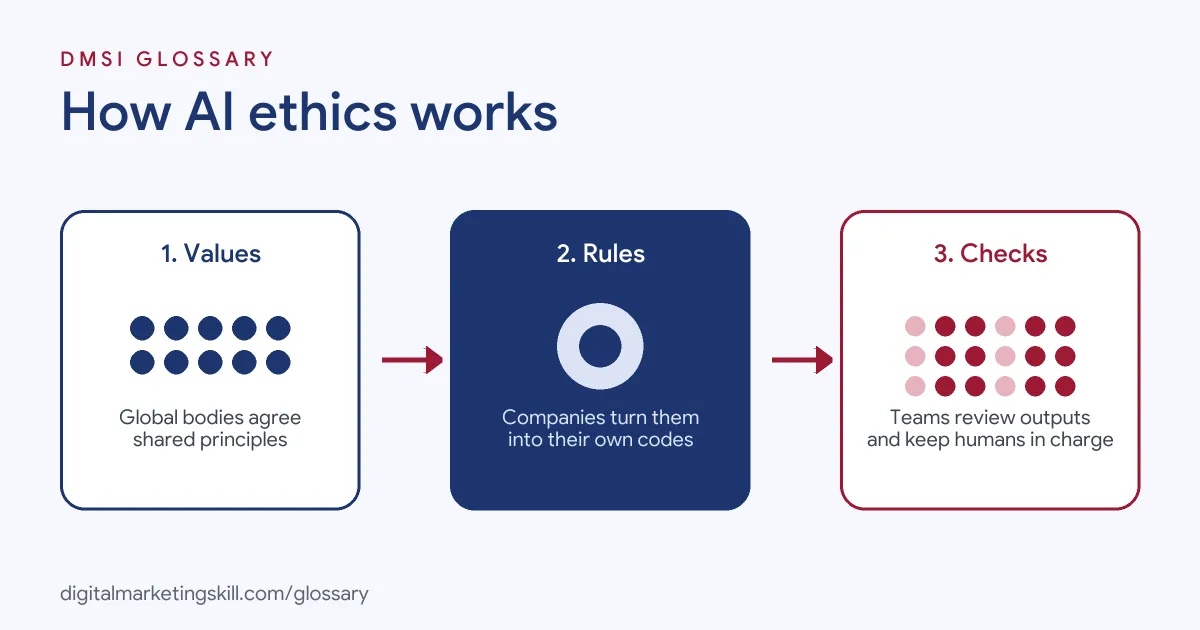
AI ethics works in layers. First, global bodies agree broad values. Next, companies turn those values into their own principles and rules. Finally, teams apply them in daily work through checks, reviews and clear lines of responsibility.
Global Standards
UNESCO’s Recommendation sets out four core values. These are respecting human rights and dignity, fostering peaceful and fair societies, ensuring diversity and inclusion, and supporting the environment. It then lists ten principles, including do no harm, privacy, transparency, human oversight, fairness and awareness.
Similarly, the OECD AI Principles were the first intergovernmental standard on AI. They set out five values-based principles: inclusive growth and well-being, human rights and democratic values, transparency, robustness and safety, and accountability.
Company Principles
Many tech firms publish their own codes. Microsoft, for instance, lists six principles: fairness, reliability and safety, privacy and security, inclusiveness, transparency and accountability. In other words, the same ideas appear again and again, just in different words.
Where Ethics Meets the Law
Some ethical ideas are now legal duties. The EU AI Act’s Article 50, for example, says people must be told when they are interacting with an AI system, unless it is obvious. It also says providers of tools that generate synthetic audio, images, video or text must mark the output in a machine-readable way.
AI Ethics Examples in Marketing
Here are three made-up examples of ethical choices marketers face:
- Chatbot disclosure (example): A retailer adds an AI assistant to its site. It labels the chat “AI assistant” and offers a link to a human, so customers know who they are talking to.
- Fair targeting (example): A lender reviews its automated ad delivery and finds older users rarely see its offers. It changes its settings and checks the results each month.
- Honest visuals (example): A skincare brand wants AI-made “before and after” photos. Instead, it uses real customer photos with consent, because fake results would mislead buyers.
In each case, the ethical choice also protects the brand’s reputation.
AI Ethics Principles Compared
Here is how three well-known frameworks line up:
| Theme | UNESCO | OECD | Microsoft |
|---|---|---|---|
| Fairness | Fairness and non-discrimination | Human rights, including fairness | Fairness; inclusiveness |
| Privacy | Right to privacy and data protection | Human rights, including privacy | Privacy and security |
| Openness | Transparency and explainability | Clear, explainable AI | Transparency |
| Safety | Safety and security | Robustness, security and safety | Reliability and safety |
| Responsibility | Responsibility and accountability; human oversight | Accountability | Accountability |
So if you understand these five themes, you understand the heart of most frameworks.
How to Apply AI Ethics in Your Marketing
You don’t need a legal team to start. Follow these steps:
- List your AI tools. Note every tool that writes, targets, scores or talks to customers.
- Ask who could be affected. Think about customers, job seekers, staff and anyone left out.
- Check the data. Ask where the training or input data came from, and whether you are allowed to use it.
- Test for bias. Compare results across groups, such as age, gender or location.
- Be open. Tell people when they are talking to AI or seeing AI-made content where it matters.
- Keep a human in charge. Have a person review important outputs before they go live.
- Write it down. Record your rules and checks, so the whole team follows them.
Five Quick AI Ethics Questions
Before you use an AI tool on a task, ask these short questions. They take a minute, and they catch most problems early.
- Is it true? Check facts, figures and claims before they go out.
- Is it fair? Ask if any group could be left out or treated worse.
- Is it private? Make sure no customer data goes where it should not.
- Is it clear? Ask if people would feel misled if they knew AI was used.
- Who signs it off? Name the person who checks the work and owns the result.
If the answer to any of these is no, or you are not sure, stop and fix it first. In short, a pause now saves a public apology later.
Best Practices
A few habits make ethics part of everyday work:
- Fact-check AI content. AI can state false things with confidence, so verify claims before you publish.
- Protect personal data. Don’t paste customer details into tools unless you know how the data is handled.
- Avoid fake proof. Never use AI to invent reviews, testimonials or results.
- Train your team. UNESCO lists awareness and literacy as a core principle, and that applies inside companies too.
Common Mistakes to Avoid
First, many teams treat ethics as a one-off checklist, not a habit. Second, they trust AI outputs without review. Third, they assume a tool is fair because a big company made it. Finally, they hide the use of AI from customers, which can damage trust when people find out. Each of these is easier to prevent than to fix.
Where You’ll Use AI Ethics at Work
More and more, employers ask for this in AI and leadership roles. For example, current remote job listings ask for:
- “Knowledge of data governance, technology policies, AI ethics, and responsible AI frameworks” (Artificial Intelligence Manager).
- Someone to “Establish data governance, AI ethics, and responsible AI frameworks to ensure compliance and risk management” (Head of AI).
- “Experience with AI governance, data privacy, and ethical AI practices” (Head of AI).
As a marketer, you may not write these frameworks. However, you will use AI tools every day, so you need to apply the rules well. A good first step is to learn why AI tools make mistakes, which our page on AI hallucination explains.
Learn It in Any DMSI Track
AI fundamentals, covering strategy and planning, are part of every track in the DMSI Master Diploma. There, you learn to use AI tools for real marketing tasks and to check their output with care. You also join a U.S. Project Internship from day one, with unlimited 1-on-1 mentoring.
For a wider view of AI’s role in the field, read our guide to AI in digital marketing.
Frequently Asked Questions
What is AI ethics in simple terms?
It is the set of values and rules for building and using AI in a way that is fair, safe, honest and respectful of people’s rights.
What are the main principles of AI ethics?
Most frameworks cover fairness, privacy, transparency, safety and accountability. UNESCO also stresses human oversight, sustainability and public awareness.
Why does AI ethics matter in marketing?
AI now writes content, targets ads and talks to customers. If it is biased or misleading, it can harm people and damage your brand.
Is AI ethics a legal requirement?
Partly. Some ideas, such as telling people they are talking to AI, appear in laws like the EU AI Act. Others are good practice rather than law.
How can a small team practise AI ethics?
Keep a list of AI tools, review important outputs, protect customer data, be open about AI use and never use it to fake proof. Start small, then build from there.
Sources: UNESCO: Recommendation on the Ethics of AI; OECD.AI: AI Principles; Microsoft: Responsible AI principles; EU AI Act: Article 50; remote job listings on Himalayas.