
An AI hallucination is when an AI tool gives an answer that sounds confident and believable but is false or made up. It might invent a statistic, a quote, a source or a fact about a real person or company. For marketers, it matters because publishing a hallucination can damage trust in your brand, so every AI output needs checking.
Key Takeaways
- An AI hallucination is a plausible but false statement from an AI model.
- It happens because language models predict likely words rather than look up verified facts.
- OpenAI says common training and testing methods reward guessing over admitting uncertainty.
- Rare, specific facts, such as dates, names and figures, are the most likely to be wrong.
- Human review, trusted source material and clear prompts all reduce the risk.
What Is an AI Hallucination?
OpenAI defines it simply: “Hallucinations are plausible but false statements generated by language models.” IBM describes them as “instances where an AI system produces outputs that sound plausible but are factually wrong.”
The key word is plausible. A hallucination rarely looks like an obvious error. Instead, it reads smoothly and fits the question. For example, you might ask an AI tool for three studies on email open rates. It could return three titles, authors and journals that look real. However, one or more of them may not exist at all.
An AI hallucination is a known limit of the technology. Wikipedia notes that ChatGPT “may generate incorrect or nonsensical answers that sound plausible.” The same is true of other AI chat tools. So the problem is not one product. Rather, it comes from the way these models work.
How an AI Hallucination Happens
To see why this happens, it helps to know how the model writes. It does not search a database of facts. Instead, it predicts the next word based on patterns from its training. When a pattern is strong, the answer is usually right. When the model has no reliable pattern to follow, it still produces an answer, and that answer can be wrong.
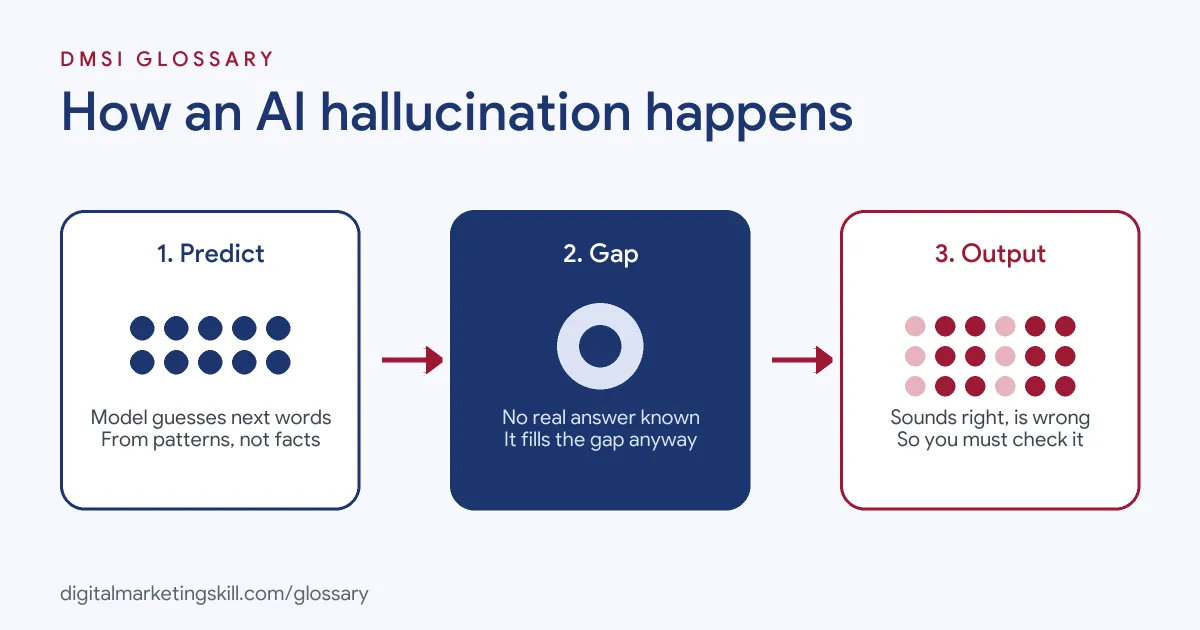
Next-Word Prediction
OpenAI explains that models first learn through “a process of predicting the next word in huge amounts of text.” That text does not come labelled true or false. As a result, the model learns what fluent language looks like, but not always which facts are correct. Spelling and grammar follow steady patterns, so models get them right. By contrast, rare facts do not.
Rare and Random Facts
Some facts cannot be guessed from patterns. A person’s birthday is a good example. OpenAI says such details “cannot be predicted from patterns alone and hence lead to hallucinations.” In its own test, a chatbot gave three different wrong birthdays for the same researcher. For marketers, the same risk applies to exact figures, quotes, prices, dates and names.
Rewards for Guessing
There is also a training problem. According to OpenAI, standard methods “reward guessing over acknowledging uncertainty.” It compares this to a multiple-choice exam. Leaving a question blank scores zero, while a guess might score a point. So the model learns to guess. OpenAI suggests tests should “penalize confident errors more than you penalize uncertainty.”
Other Causes of AI Hallucination
IBM lists more causes too. Training data can contain errors, bias and gaps. Models can also latch onto patterns that do not matter. Finally, bad actors can use tricky prompts, such as prompt injection, to push a model towards false output.
AI Hallucination Examples
Here are three real and realistic examples:
- Legal filings: IBM describes a lawyer who used ChatGPT to help draft court papers. The tool supplied case law, but “several of the cases were entirely fictitious.”
- Search answers: IBM also reports that an AI summary in Google search suggested adding non-toxic glue to pizza sauce. The idea came from an old joke on Reddit.
- Marketing copy: A marketer asks an AI tool for a statistic to open a blog post. It returns a precise figure with a named source. When she checks, the source never published that number, so she removes it.
In each case, the output looked convincing. Only a check against a real source caught the problem.
Notice the pattern. The risk is highest when you ask for something specific that the tool cannot know for sure, such as a precise figure, a recent change or a quote from a named person. By contrast, an AI hallucination is less likely when you ask the tool to reword, shorten or restructure text you have already checked. So a safe rule is simple: let AI help with the wording, but bring the facts yourself.
Ways to Reduce Hallucinations Compared
IBM lists several ways to lower the risk. Here is how the main ones compare:
| Method | What it does | When it helps most |
|---|---|---|
| Trusted source material | Limits answers to documents you supply, often with citations | Product facts, policies and help content |
| Structured prompts | Sets the task, format and rules clearly | Repeat tasks, such as briefs or summaries |
| Limiting responses | Tells the tool to say it does not know when unsure | Questions with exact answers |
| Human review | A person checks every claim before use | Anything you publish or send to clients |
In short, no single method removes the risk. However, combining them makes errors far less likely to reach your audience.
How to Check for an AI Hallucination
Use these steps before you publish any AI-assisted content:
- Highlight every fact, number, name, date, quote and source in the draft.
- Find each one in a trusted original source, such as the company’s own site or official documents.
- Delete any claim you cannot confirm. Do not keep it just because it sounds right.
- Click every link. Make sure the page exists and actually says what the draft claims.
- Next time, give the tool your own source material and ask it to use only that.
- Add a line to your prompt, such as “If you are unsure, say you do not know.”
This takes a few extra minutes. However, it protects your reputation and your client’s brand.
Best Practices to Prevent AI Hallucination
A few habits keep your AI work accurate:
- Treat output as a draft. Use AI for ideas and structure, then verify the facts yourself.
- Be extra careful with numbers. Exact figures are a common place for errors.
- Ask for sources, then read them. A listed source is not proof until you open it.
- Keep a human in the loop. IBM recommends human review for high-stakes content.
- Write clear prompts. Specific instructions and context leave less room for guessing.
Common Mistakes to Avoid
Beginners tend to make the same few errors. First, they trust an answer because it sounds confident. Second, they publish statistics without finding the original source. Third, they ask the AI to check its own work and accept its reply. Finally, they assume a newer tool never makes things up. Each of these can let an AI hallucination slip into a live ad, post or email.
Where You’ll Use This at Work
Spotting AI errors is now part of many jobs. In technical roles, it is even named in listings. For example, current remote job listings include lines such as:
- “Investigate hallucinations, inconsistencies, silent failures, and quality degradation in AI-driven conversations” (AI Product Analyst, Voice AI Agents).
- Work “with a focus on reducing hallucinations in medical record summarization and legal document analysis” (AI Engineer).
In marketing, the skill is just as useful. Social Media Managers, SEO Specialists and Email Marketing Specialists all use AI tools to draft content. So employers expect them to check facts and keep false claims out of anything they publish.
Learn It in the Full Stack Programme
AI fundamentals, including how to plan with AI and check its output, are part of every DMSI track. To apply them across every channel, the Full Stack programme covers all four tracks and all ten courses, with one portfolio project from each. You also work on a U.S. Project Internship from day one, with unlimited 1-on-1 mentoring.
Want to write better prompts? Read our guide on how to write ChatGPT prompts, or start with our glossary entry on generative AI.
Frequently Asked Questions
What is an AI hallucination in simple terms?
It is when an AI tool makes something up but presents it as true. For example, a fake statistic or a source that does not exist.
Why do AI tools hallucinate?
They predict likely words instead of checking facts. OpenAI also says training methods often reward guessing over admitting uncertainty.
Can you stop an AI hallucination completely?
Not completely. However, trusted source material, clear prompts and human review make errors much less likely.
How can I tell if an AI answer is wrong?
Check every fact against an original, trusted source. If you cannot find it, treat it as false and remove it.
Are some answers more likely to be wrong?
Yes. Rare, specific details, such as exact numbers, dates, names and quotes, carry the highest risk.
Sources: OpenAI: Why language models hallucinate; IBM: What are AI hallucinations?; Wikipedia: ChatGPT; remote job listings on Himalayas.