
Predictive analytics is the use of past data, statistics and machine learning to estimate what is likely to happen next, such as who will buy, who will leave or how much a customer will spend. It doesn’t tell you the future for certain, but it gives you a probability you can act on. It matters because marketers can spend time and budget on the people most likely to respond, instead of treating everyone the same.
Key Takeaways
- You look back to look ahead. Models learn patterns from past data, then score new cases.
- Common marketing uses include the chance to buy, the risk of leaving and how much a customer will spend.
- Tools such as Google Analytics and Klaviyo offer built-in predictions, so you don’t need to build models yourself.
- Each tool has data minimums. Without enough clean events, predictions won’t appear.
- Predictions are probabilities, not facts. Test them against a control group before you trust them.
What Is Predictive Analytics?
IBM describes it as “a branch of advanced analytics that makes predictions about future outcomes by using historical data combined with statistical modeling, data mining techniques and machine learning.” In other words, it looks at what happened before. Then it guesses what will happen next.
It helps to compare it with other kinds of analytics. Descriptive analytics tells you what happened, such as last month’s sales. Predictive analytics tells you what is likely to happen, such as which customers will buy next week. That shift lets you act before the event, not after.
For example, an online pet shop could look at every customer’s order history. A model notices that people who usually reorder food every 30 days, but haven’t ordered in 45, often stop buying. The shop can then send those customers a reminder before they drift away.
Here is a simple way to think about it. Picture a shop owner who knows her regulars come in every Friday. If one stops coming, she notices and checks in. A model does the same thing, but for thousands of customers at once. It spots the small signs that a person is about to buy or leave. Then it flags them, so you can act in time.
How Predictive Analytics Works
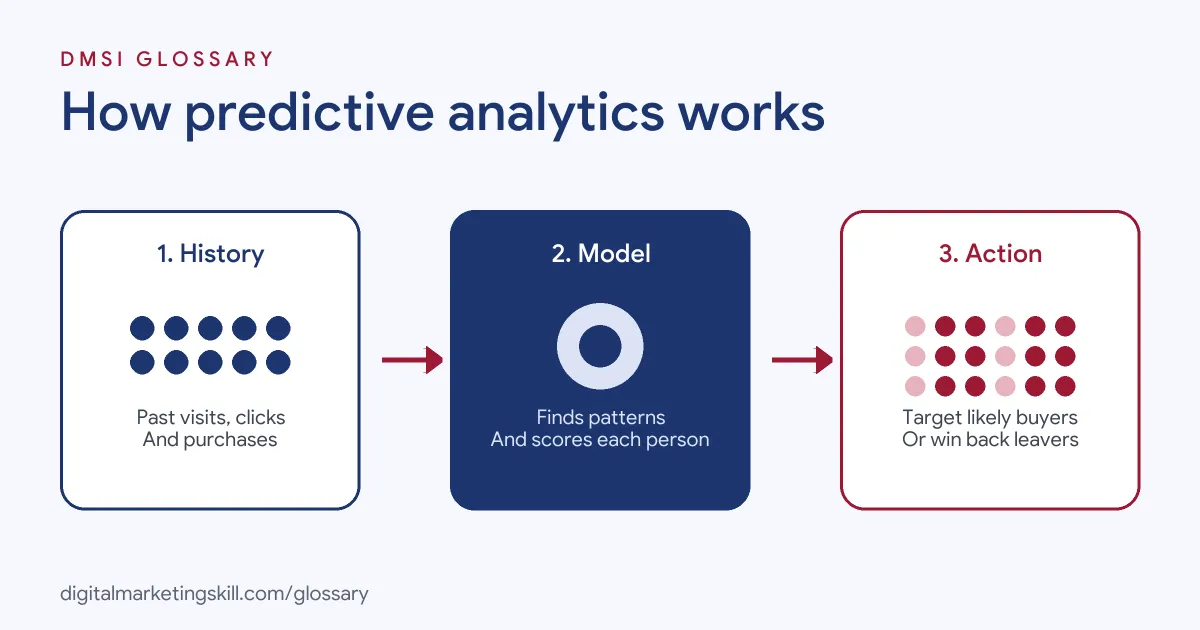
According to IBM, it “works by using historical data and past patterns to forecast future outcomes.” Most projects follow the same broad steps: collect data, clean it, build a model, then use and monitor that model.
The Data Behind Predictive Analytics
Everything starts with history. In marketing, that usually means events such as visits, clicks, sign-ups and purchases. The cleaner and more complete this data, the better the model can learn. For instance, Google Analytics needs purchase events that include value and currency before it can predict revenue.
The Models
IBM groups the main model types into a few families:
- Classification models sort cases into categories, such as “will buy” or “won’t buy”. IBM lists types including logistic regression, decision trees, random forest, neural networks and Naive Bayes.
- Clustering models group similar records together. For example, IBM notes an online shop can use one to separate customers into groups and build a marketing plan for each.
- Forecasting models estimate future values over time, such as next month’s demand.
Monitoring and Updating
A model is not done once it goes live. Think of it like a weather forecast that needs fresh data each day. IBM stresses that “it is essential to continuously monitor the models and make adjustments as needed” so they stay accurate. Customer behaviour changes, so old patterns can stop working.
Predictive Analytics Examples in Marketing
Here are real predictions offered by two common tools:
- Purchase probability (Google Analytics): the chance that a user active in the last 28 days will log a specific key event within the next 7 days.
- Churn probability (Google Analytics): the chance that a user active in the last 7 days will not be active in the next 7 days.
- Predicted revenue (Google Analytics): the revenue expected from a user’s purchases in the next 28 days.
- Predicted lifetime value (Klaviyo): how much a customer will spend over the prediction period, which is one year by default.
Marketers then act on these scores. Each one is just a number until you do something with it. A store might send a special offer to people with rising churn risk. Meanwhile, it might target high-probability buyers with ads for new products.
Predictive Analytics in Google Analytics vs Klaviyo
Both tools offer ready-made predictions, but they focus on different data:
| Feature | Google Analytics | Klaviyo |
|---|---|---|
| Main data source | Website and app events | Orders and email activity |
| Example predictions | Purchase probability, churn probability, predicted revenue | Predicted lifetime value, churn risk, average time between orders |
| How you use them | Build predictive audiences for ads and analysis | Segment profiles for emails and flows |
| Data needs | Purchase events with value and currency, plus enough active users | At least 500 customers who ordered, 180 days of history, recent orders |
How to Use Predictive Analytics
- Pick one business question, such as “Who is likely to buy this week?”
- Check your tracking. Make sure key events, such as purchases, are recorded with their value.
- Confirm you meet your tool’s data requirements.
- Turn on the built-in predictions, or ask a data team to build a model.
- Create an audience or segment from a prediction. In Google Analytics, go to Audiences and choose a predictive template.
- Send that group a tailored message or ad, and hold back a control group.
- Compare results between the two groups.
- Review the model’s accuracy over time, then refine your approach.
How Predictive Audiences Pick People
Google explains its suggested audiences with a simple example. Users join the “Likely 7-day purchasers” audience when their purchase probability is above the 90th percentile. If the model were based on 1,000 users, that audience would include the top 100, or 10%, with the highest scores.
Best Practices
- Start with one use case. Churn or repeat purchase is often the easiest place to show value.
- Fix the data first. A model trained on broken tracking gives confident but wrong answers.
- Always use a control group. It proves whether acting on the prediction made a difference.
- Watch for bias. Google says it builds its predictive models to avoid creating or reinforcing unfair bias, and you should check your own outputs too.
- Keep people in charge. Use predictions to guide decisions, not to make them blindly.
Common Mistakes
A common mistake is treating a score as a sure thing. A 70% chance of buying still means three in ten people won’t. Another is switching on predictions before tracking is reliable. Some teams build audiences but never test them against a control, so they can’t prove any gain. Others forget to monitor models, even as customer habits change. Finally, many chase complex models when a simple one would answer the question just as well.
Where You’ll Use Predictive Analytics at Work
More and more data and growth roles ask for this skill. For example, recent remote job listings ask candidates to:
- “Contribute to the creation of forecasting and predictive analytics models” (Manager, PE Analytics).
- Show “Experience collaborating with Data Scientists on predictive modelling, experimentation or customer analytics” (Business Analytics Manager).
So if you want to work as a Web Analytics Specialist or a Google Ads Specialist, you will need to read predictive metrics, build audiences from them and test whether they work.
Learn It in the Google Specialist Track
Google Analytics is where many marketers first use predictions, so the best fit is the AI-Powered Google Specialist track. It covers AI fundamentals, Google Ads across Search, Display, Discovery, Gmail and YouTube, and Google Analytics. Your portfolio project is a Google Ads campaign you launch and measure with conversion tracking. You also get unlimited 1-on-1 mentoring and a U.S. Project Internship from day one.
Next, read our guide to marketing analytics and our list of marketing analytics tools. You may also like our glossary entries on churn rate and machine learning.
Frequently Asked Questions
What is predictive analytics in simple terms?
It is using past data to estimate what is likely to happen next, such as which customers will buy or leave, so you can act early.
Is predictive analytics the same as AI?
Not exactly. It often uses machine learning, which is a type of AI, but it can also use traditional statistics such as regression.
Do I need to code to use it?
No. Google Analytics and Klaviyo both offer built-in predictions. Coding helps if you want to build custom models.
Why can’t I see predictive metrics in Google Analytics?
Your property may not meet the requirements yet. For example, it needs purchase events with value and currency, and enough user activity.
How accurate are predictions?
It depends on your data and how stable customer behaviour is. That’s why you should test them against a control group and monitor them over time.
Sources: IBM: What is predictive analytics?; Google Analytics Help: Predictive metrics; Google Analytics Help: Predictive audiences; Klaviyo Help: Predictive analytics; remote job listings on Himalayas.