
AI personalisation is the use of artificial intelligence to tailor messages, offers and content to each person based on their data and behaviour. Instead of writing rules by hand, you let a model predict what each customer is most likely to want next. It matters because people now expect relevant experiences, and AI makes that possible at a scale no team could manage manually.
Key Takeaways
- Rule-based personalisation follows fixed “if this, then that” logic. AI personalisation learns patterns from data and makes predictions.
- McKinsey found that 71% of consumers expect personalised interactions, and 76% get frustrated when they don’t get them.
- Common uses include product recommendations, send-time choices, predicted spend and churn risk.
- The tools need enough clean data. For instance, Klaviyo needs at least 500 customers who have ordered before it shows lifetime value predictions.
- Consent rules still apply. People have an absolute right to opt out of direct marketing.
What Is AI Personalisation?
The idea is simple: show different people different things. A basic version adds a first name to an email. A smarter one changes the products, offers and timing for each person.
The old way relies on rules you write. For example, “if someone bought trainers, show them socks.” That works, but you can only write so many rules. AI personalisation replaces many of those rules with predictions. A model studies past behaviour across thousands of customers. Then it estimates what each person is likely to do or want next.
For example, an online bookshop might use AI to predict which readers are likely to buy again within a week. It can then send those readers a tailored list of new titles, while sending a different offer to readers who seem likely to drift away.
How AI Personalisation Works
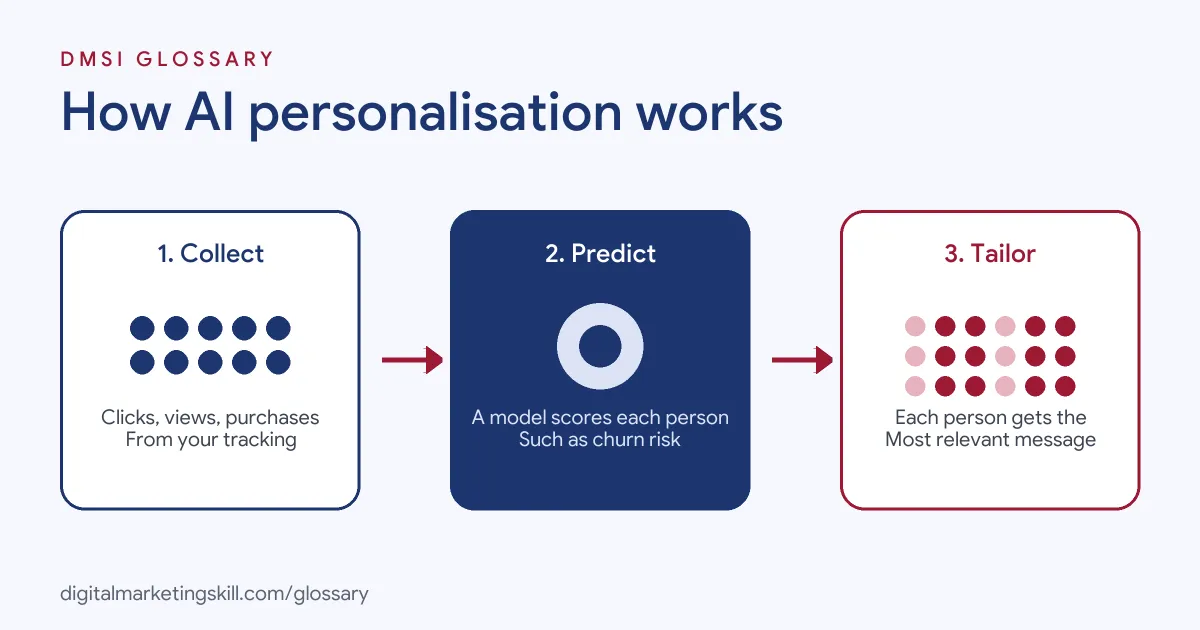
Most systems follow three steps. First, they collect data about what people do. Next, a model finds patterns and makes predictions. Finally, the platform uses those predictions to choose the content each person sees.
The Data AI Personalisation Uses
The inputs are usually events: page views, clicks, sign-ups, purchases and email opens. Google Analytics, for example, builds its predictive metrics from structured event data. That’s why tracking matters so much. If your events are missing or messy, the predictions will be weak.
The Predictions
Tools turn that data into scores you can act on. Here are real examples from two tools:
- Purchase probability (Google Analytics): the chance that a user active in the last 28 days will make a specific key event within the next 7 days.
- Churn probability (Google Analytics): the chance that a user active in the last 7 days will not be active in the next 7 days.
- Predicted lifetime value (Klaviyo): how much a customer is expected to spend over the prediction period, which is one year by default.
- Churn risk (Klaviyo): based on the number and frequency of orders. It rises as time passes between orders.
The Tailored Experience
Finally, you act on those scores. This is the part your customers see. You might send a loyalty offer to people with high churn risk. Alternatively, you might show premium products to people with high predicted spend. In Google Analytics, you can turn predictions into audiences, such as “likely 7-day purchasers”, and use them in ads.
AI Personalisation Examples
Here are three made-up examples of how businesses use it:
- Online fashion store: The site recommends items based on what similar shoppers bought. As a result, two visitors on the same page see different products.
- Subscription box: The email platform flags customers whose churn risk is rising. It then sends them a “skip a month” option before they cancel.
- Training provider: Ads target a predictive audience of people likely to sign up soon. Meanwhile, others get helpful content instead of a hard sell.
Rule-Based vs AI Personalisation
Both approaches have a place. Here is how they compare:
| Feature | Rule-based personalisation | AI personalisation |
|---|---|---|
| How it decides | Fixed rules you write | Predictions from a trained model |
| Data needed | Little; works from day one | Enough history to learn from |
| Scale | Limited by how many rules you can manage | Can tailor content to each person |
| Easy to explain? | Yes | Less so; it is harder to say why it chose |
| Best for | Small lists, simple journeys | Larger audiences with rich behaviour data |
In practice, most teams use both. Rules handle the basics. AI handles the choices that depend on patterns. Start with rules if your list is small, then add AI as your data grows.
Why AI Personalisation Matters
The business case is strong. McKinsey reports that personalisation “most often drives 10 to 15 percent revenue lift”, with company results ranging from about 5% to 25%. It also found that faster-growing companies drive 40% more of their revenue from personalisation than slower-growing ones.
However, those figures are averages across many firms. Your results depend on your data, your offer and how well you set things up. So treat them as a reason to test, not a promise. A small test on one segment will tell you more than any report.
How to Start With AI Personalisation
- Pick one goal, such as more repeat orders or fewer cancellations.
- Check your tracking. Make sure key events, such as purchases with value and currency, reach your tools.
- Confirm you meet each tool’s data needs. For example, Klaviyo needs 180 days of order history, recent orders and some customers with three or more orders.
- Turn on the built-in predictions in your email or analytics platform.
- Build one segment from a prediction, such as high churn risk.
- Send that segment a tailored message, and keep a control group that gets the standard one.
- Compare results, then expand to the next use case.
Best Practices
- Start with clean data. Predictions are only as good as the events behind them.
- Be open. The UK ICO says you should clearly explain to people how you plan to use their information.
- Respect opt-outs. According to the ICO, people have “an absolute right to object to or opt out of direct marketing at any time.”
- Keep a human in the loop. Review what the model chooses, especially for sensitive offers.
- Measure against a control. Otherwise, you can’t tell if the AI helped.
Common Mistakes
Teams often switch on AI features before their tracking is ready, so the model learns from gaps. Others go so far that it feels creepy. Some never test against a control group, so they can’t prove any gain. Finally, many forget the rules on automated decisions. The ICO explains that special rules apply when a solely automated decision has “legal or similarly significant effects” on a person. Most marketing tweaks won’t reach that bar, but you should know where the line sits.
Where You’ll Use AI Personalisation at Work
Employers now want marketers who can use AI to make each message fit the reader. For example, one recent remote job listing asks candidates to:
- “Apply AI to accelerate campaign creation, improve personalization, automate workflows, and optimize performance” (Director of Marketing, EMEA).
- Show “Hands-on experience applying AI, automation, intent data, and personalization to marketing workflows” (Director of Marketing, EMEA).
That is a senior role, but you can start building the same skills early. So if you want to work as an Email Marketing Specialist or Marketing Automation Specialist, you will need to set up predictions, build segments and prove the lift.
Learn It in the Lead Generation and Email Track
Email is where most teams first use AI to personalise, so the best fit is the AI-Powered Lead Generation and Email Automation track. It covers AI fundamentals, lead generation, and email marketing and automation. Your portfolio project is a lead magnet and an automated email sequence that converts. You also get unlimited 1-on-1 mentoring and a U.S. Project Internship from day one.
Next, read our guide to personalised marketing. You may also like our glossary entries on machine learning and customer lifetime value.
Frequently Asked Questions
What is AI personalisation in simple terms?
It is using AI to predict what each customer wants and then showing them the most relevant message, product or offer.
How is it different from adding a first name to an email?
A first name is a simple merge of data you already have. AI goes further by predicting behaviour, such as who is likely to buy or leave soon.
Do I need a data scientist?
Not to start. Many email and analytics tools have built-in predictions. You mainly need clean tracking and enough customer history.
Is AI personalisation legal under UK GDPR?
It can be, if you are transparent, have a lawful basis and respect opt-outs. Extra rules apply when a machine alone makes a big decision about someone.
How do I know it is working?
Compare a personalised group with a control group that gets the standard message. Then check sales, repeat orders or retention, not just clicks.
Sources: McKinsey: The value of getting personalisation right; Google Analytics Help: Predictive metrics; Klaviyo Help: Predictive analytics; ICO: Automated decision-making and profiling; ICO: Direct marketing guidance; remote job listings on Himalayas.