
Customer lifetime value (CLV or LTV) is the total amount a customer spends with your business over the whole relationship. It turns a single sale into a long-term number, so you can see what each customer is really worth. That matters because it tells you how much you can afford to spend to win a customer, and which customers deserve the most attention.
Key Takeaways
- CLV looks at the full relationship, not one order. It adds up what a customer spends from the first purchase to the last.
- A simple formula is average order value × purchase frequency × average customer lifespan.
- Multiplying by your gross margin gives a profit-based version, which is safer for budget decisions.
- Shopify describes a 3:1 ratio of lifetime value to acquisition cost as a common benchmark.
- Email and CRM tools such as Klaviyo can predict future CLV, but only when you have enough order history.
What Is Customer Lifetime Value?
Imagine two shops. One sells a customer a single coat. The other sells a customer coffee every week for three years. The first sale looks bigger, yet the second customer is worth far more over time. CLV captures that difference.
In other words, it shifts your focus from “How much did this order make?” to “How much will this person spend with us?” Marketers use the number to set ad budgets, plan loyalty schemes and decide which audiences to target. Finance teams, meanwhile, use it to forecast revenue.
You will see the term written as CLV, CLTV or LTV. They all mean the same idea. Some teams measure revenue, while others measure profit, so always check which version a report uses.
How Customer Lifetime Value Works
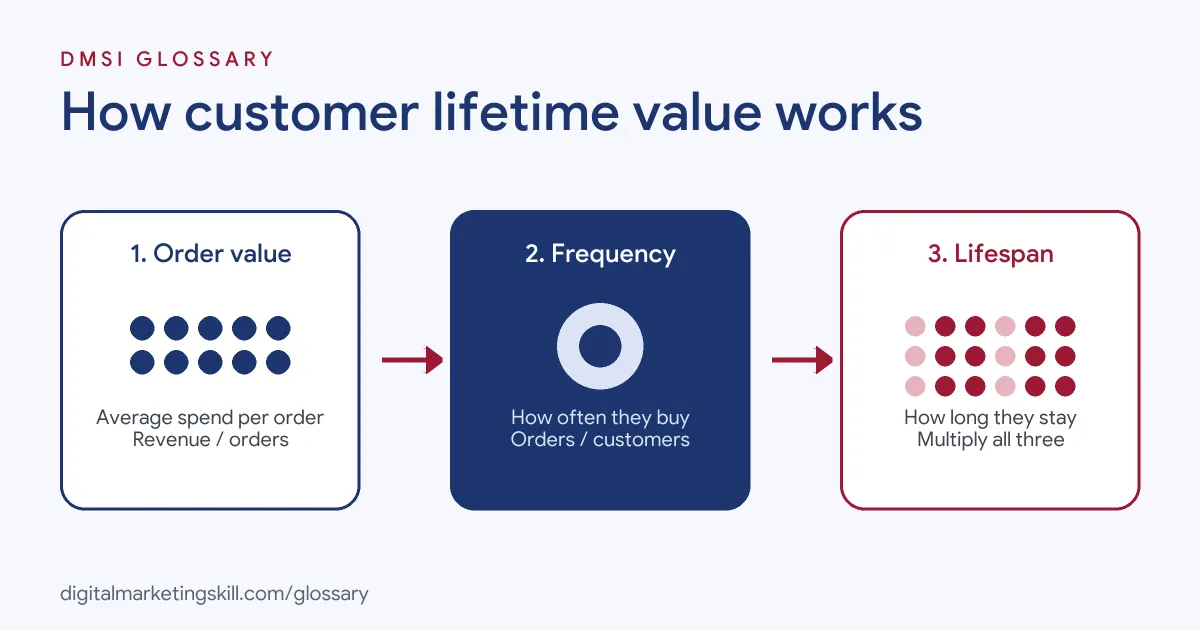
CLV combines three simple numbers. First, how much a customer spends per order. Next, how often they buy. Finally, how long they stay. Multiply them together and you get an estimate of their total value.
The Basic Formula
Shopify gives the core formula as: CLV = average order value × purchase frequency × average customer lifespan. Each part has its own simple calculation:
- Average order value: total revenue divided by the number of orders.
- Purchase frequency: orders in a year divided by the number of unique customers who bought that year.
- Average lifespan: the total length of all customer relationships divided by the number of customers.
A Worked Example
Shopify uses a clothing store to show the maths. Its customers spend $50 per order, buy three times a year and stay for two years. So the lifetime value is $50 × 3 × 2 = $300.
However, revenue is not profit. If the store’s gross margin is 60%, the margin-adjusted CLV is $300 × 0.6 = $180. That lower figure is the one to use when you decide how much to spend on ads.
Historic and Predicted CLV
Some tools split the number into parts. Klaviyo, for instance, shows historic CLV, which is the total value of a person’s past orders. It also shows predicted CLV, which forecasts spending over a set period, one year by default. Total CLV is simply the two added together.
Customer Lifetime Value Examples
- Coffee retailer: In another Shopify example, a coffee retailer’s customers spend $30 per order, order 12 times a year and stay three years. That gives a CLV of $1,080.
- Online course provider: A school finds that students who join through a free webinar later buy a second course. As a result, it gives webinar sign-ups more budget than one-off buyers.
- Skincare brand: A brand compares customers by first product. It notices that buyers of its cleanser reorder more often. So it makes the cleanser the hero of its new-customer ads.
In each case, CLV helps the team decide where to spend, not just what to sell.
CLV vs CAC vs AOV vs Churn Rate
These metrics often sit side by side on the same dashboard:
| Metric | What it measures | How it links to CLV |
|---|---|---|
| Customer lifetime value | Total spend over the whole relationship | The main figure |
| Customer acquisition cost (CAC) | What you spend to win one new customer | Compared with CLV to judge profit |
| Average order value (AOV) | Spend per order | One input to the CLV formula |
| Churn rate | Share of customers who leave in a period | Higher churn means a shorter lifespan and lower CLV |
The most common pairing is CLV and CAC. Shopify calls a 3:1 ratio the benchmark, which means $3 of lifetime revenue for every $1 spent to gain a customer. Still, it notes that the right target depends on your margins and costs.
How to Calculate Customer Lifetime Value
- Choose a time window. Pick a period with enough orders to be reliable, such as the last full year.
- Work out average order value. Divide total revenue by the number of orders.
- Work out purchase frequency. Divide the number of orders by the number of unique customers.
- Estimate lifespan. Use how long customers usually keep buying. If you’re new, start with a cautious guess and update it later.
- Multiply the three. That gives you revenue-based CLV.
- Apply your margin. Multiply by gross margin to see profit-based CLV.
- Split by segment. Compare channels, products or countries, because an average can hide big differences.
Then compare the result with your acquisition cost for each channel. That tells you which channels are worth more budget.
Predicting CLV With Software
If you use an email platform, it may predict the number for you. Klaviyo, for example, needs at least 500 customers who have placed an order, at least 180 days of order history, recent orders within the last 30 days, and some customers with three or more orders. It retrains its model at least once a week. Even so, Klaviyo warns that predictions are not expected to be exact for any single person. They work best when you average them across many customers.
Best Practices for Customer Lifetime Value
- Use profit, not just revenue. A high-revenue customer who only buys discounted items may earn you little.
- Track it by cohort. Group customers by the month or channel they joined, so you can see whether quality is rising or falling.
- Invest in keeping customers. A Harvard Business Review article notes that winning a new customer can cost five to 25 times more than keeping an existing one.
- Raise repeat purchases. Shopify points to loyalty schemes, complementary products, upsells and faster checkout as practical levers.
- Review it often. Prices, products and markets change, so refresh your inputs at least every quarter.
Common Mistakes to Avoid
A few errors make the number misleading. First, many teams use one average for every customer, which hides your best and worst segments. Second, some forget to remove refunds, which inflates the result. Third, new businesses often assume a long lifespan before they have the data to prove it. Finally, teams sometimes compare revenue-based CLV with acquisition cost and think they are profitable when they are not.
Where You’ll Use Customer Lifetime Value at Work
CLV appears in growth, retention and analytics roles. For example, remote job listings ask candidates to:
- “Monitor key retention metrics, including subscriber churn, renewal rates, repeat purchases, customer lifetime value, and reactivation performance” (Head of Retention).
- “Establish strategies to reduce churn and enhance customer lifetime value” (Growth Specialist).
- “analyze Customer Lifetime Value and retention by dealer segments and cohorts across business units” (Revenue Management Analyst).
So whether you aim to be a Growth Marketer, a Digital Marketing Manager or a freelancer who runs ads for clients, you will need to explain what a customer is worth and how your work raises that number.
Learn It in the Full Stack Programme
CLV connects every channel, which is why it fits the Full Stack (all four tracks) option. You take all ten courses and complete one portfolio project from each track, from paid social to Google Ads, email and SEO. You also work on a U.S. Project Internship from day one, with unlimited 1-on-1 mentoring.
To go deeper, read our guide to customer retention rate and our article on customer acquisition strategy. Together, they cover both sides of the CLV-to-CAC ratio.
Frequently Asked Questions
What is customer lifetime value in simple terms?
It is the total amount one customer is likely to spend with your business, from their first order to their last.
What is the formula for CLV?
A common version is average order value × purchase frequency × average customer lifespan. Multiply by gross margin if you want a profit-based figure.
What is a good LTV to CAC ratio?
Shopify describes 3:1 as the benchmark. That said, the right ratio depends on your margins and running costs.
Is LTV the same as customer lifetime value?
Yes. LTV, CLV and CLTV are different short forms for the same measure.
How can I increase customer lifetime value?
Focus on repeat buying and retention. Loyalty rewards, useful follow-up emails, related products and an easy checkout all help customers come back.
Sources: Shopify: Customer lifetime value; Klaviyo Help Center: Predictive analytics and CLV; Harvard Business Review: The value of keeping the right customers; remote job listings on Himalayas.