
AI voice cloning is the use of artificial intelligence to copy a real person’s voice from recorded samples, so software can then speak any new text in that voice. A good clone can match the person’s tone, accent and pace closely. It matters because marketers can produce voiceovers, translations and ad variations quickly, but only when they have clear consent and use it honestly.
Key Takeaways
- You record or upload samples of a voice, and the tool builds a clone that reads any script you type.
- ElevenLabs offers two methods: Instant Voice Cloning from short samples, and Professional Voice Cloning, which trains a dedicated model.
- For an instant clone, ElevenLabs suggests about one to two minutes of clean audio. Quality matters more than length.
- You need the speaker’s consent. Many tools ask you to confirm you have the right to clone the voice.
- Laws apply. In the US, the FCC treats AI-generated voices in calls as “artificial” under the TCPA.
What Is AI Voice Cloning?
Text-to-speech tools have read text aloud for years, but they used stock voices. AI voice cloning goes a step further. It learns what one particular person sounds like and then speaks in that voice.
For example, a course creator could clone her own voice once. Then, whenever she updates a lesson, she types the new script and the tool reads it in her voice. As a result, she does not need to re-record every change.
The same power creates risk. Someone could copy a voice without permission and use it to mislead people. That is why consent, disclosure and the law sit at the centre of any responsible use.
How AI Voice Cloning Works
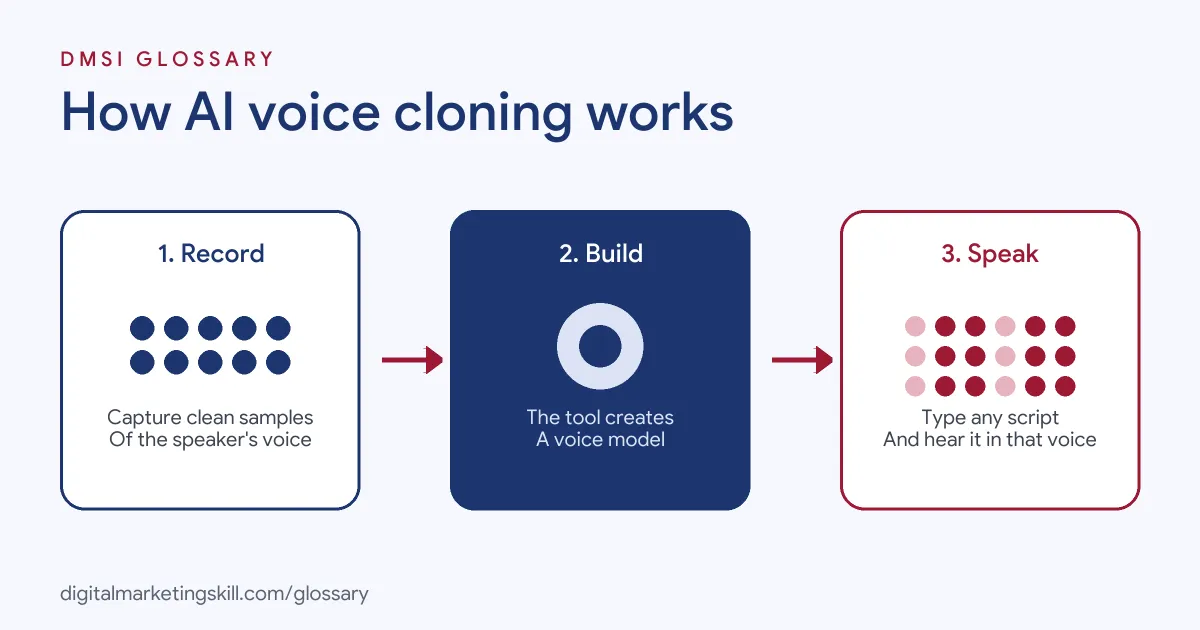
Every clone follows three broad steps. First, you provide voice samples. Next, the tool builds a voice model from them. Finally, you type a script and the tool generates speech in the cloned voice.
Instant Cloning
ElevenLabs describes Instant Voice Cloning as a way to create clones “from shorter samples near instantaneously”. Interestingly, it “does not train or create a custom AI model”. Instead, it uses what the system already learned in training to make “an educated guess”. This works well for many voices. However, ElevenLabs notes it can struggle with a very unusual voice or an accent the model has rarely heard.
Professional Cloning
Professional Voice Cloning trains a dedicated model on a larger set of recordings. ElevenLabs says the result is “virtually indistinguishable from the original voice”. The trade-off is time. Fine-tuning generally takes three to six hours, and sometimes longer when many requests are queued.
Why Sample Quality Matters
ElevenLabs says “How the audio was recorded is more important than the total length”. For an instant clone, it advises at least one minute of audio but warns against going over three minutes, since extra audio adds little. Clean recordings, with no echo or background noise, give the best result. In fact, the AI copies everything it hears, including room noise.
AI Voice Cloning Examples
Here are three made-up examples of how marketers might use voice clones with consent:
- Course updates: A training company clones its lead tutor’s voice. When a module changes, it updates the narration from a script instead of booking a studio.
- Ad variations: A brand founder approves a clone of his voice for short video ads. The team then tests five different opening lines without five recording sessions.
- Avatar videos: A coach pairs a voice clone with an AI avatar of herself. Together, they let her publish weekly update videos from written scripts.
In each case, the real person agreed and stays in control of how their voice is used.
Instant vs Professional AI Voice Cloning
Here is how the two ElevenLabs methods compare:
| Feature | Instant Voice Cloning | Professional Voice Cloning |
|---|---|---|
| How it works | Uses existing training to guess the voice | Trains a dedicated model on your voice |
| Audio needed | About one to two minutes of clean audio | A larger set of voice data |
| Time to create | Near instant | Generally three to six hours of fine-tuning |
| Best for | Common voices and quick projects | Unusual voices and long-term brand use |
Other tools work in a similar way. For instance, HeyGen says each of its video avatars “includes a voice cloning feature”, so your avatar can speak in your own voice.
How to Clone a Voice Responsibly
These steps follow the ElevenLabs guide for instant clones, plus basic good practice:
- Get written consent. Agree in writing how, where and for how long the voice may be used.
- Record in a quiet room. ElevenLabs suggests deadening echo, even with a “blanket fort” or a closet.
- Use a decent microphone. Keep the volume steady and the delivery consistent.
- Upload one to two minutes of clean audio. If you use MP3, ElevenLabs advises 128 kbps or higher.
- Confirm your rights. The tool asks you to confirm you have “the right and consent to clone the voice”.
- Test with a short script. Listen for odd pauses, wrong stress or a strange accent.
- Label the output where needed. Check the platform rules and the law in each market.
After that, store the consent record safely. You may need it if anyone asks how the voice was made.
Best Practices
- Keep scripts natural. Write how the person really speaks, with short sentences.
- Match the sample to the use. The AI mimics the style it hears, so record in the tone you want.
- Review every file. A human should check each clip before it goes live.
- Disclose synthetic audio. Under the EU AI Act, deepfake content, including audio, must be disclosed as artificially generated.
Setting Up a Simple Recording Space
You do not need a studio, but you do need a quiet, “dead” room. ElevenLabs suggests reducing echo and reverb as much as possible. If you have no vocal booth, a closet full of clothes or a DIY blanket set-up can work well.
Next, think about the microphone. ElevenLabs calls a good microphone “crucial”. It adds that a professional XLR microphone costing about $150 to $300 is enough for most voiceover work, used with an audio interface and a pop filter. Then keep your distance from the microphone steady, so the volume stays even across the whole recording. Small steps like these often improve a clone more than any setting in the tool.
Common Mistakes to Avoid
The worst mistake is cloning a voice without permission. That can harm the person and break the law. Another mistake is using noisy recordings, which leads to a clone with hiss or echo. Some teams also upload far too much audio, even though ElevenLabs says more than three minutes adds little for an instant clone. Finally, many forget about phone rules. In the US, a legal analysis of the FCC ruling notes that callers using AI voices must first get, at a minimum, prior express consent.
Where You’ll Use AI Voice Cloning at Work
Voice cloning shows up in both creative and technical job ads. For example, remote listings mention:
- Producing ads that “mix UGC, creator footage, stock, and AI-generated video, avatars and voiceovers” (Video Editor and Producer, AI and Performance Ads).
- “Lead R&D into AI voice and audio generation, including voice cloning, text-to-speech, and audio synthesis” (AI Engineer, Voice R&D).
So for a Content Creator or Social Media Manager, voice cloning is a practical production skill. You will be expected to use it well, and to know when not to use it.
Learn It in the Social Media Track
You can learn to use AI voice cloning as part of video production in the AI-Powered Social Media Management and Advertising track. It covers AI fundamentals and content creation with graphics and video. You plan, create and run a paid social campaign for a real brand, with unlimited 1-on-1 mentoring and a U.S. Project Internship from day one.
For more on AI tools, read our guides to AI marketing tools and AI in digital marketing. You can also learn about an AI avatar and the risks of a deepfake.
Frequently Asked Questions
How much audio do I need for AI voice cloning?
For an ElevenLabs instant clone, about one to two minutes of clean audio. A professional clone uses a larger set of recordings.
Is AI voice cloning legal?
It can be, with consent and honest use. Rules vary. In the US, the FCC treats AI voices in calls as artificial under the TCPA.
Can I clone someone else’s voice?
Only with their clear permission. Tools such as ElevenLabs ask you to confirm you have the right and consent to clone the voice.
How long does a professional voice clone take?
ElevenLabs says fine-tuning generally takes three to six hours, and sometimes longer when there is a queue.
Do I need to label cloned voices?
Often, yes. In the EU, the AI Act requires deepfake audio to be disclosed as artificially generated. Platforms may have their own rules too.
Sources: ElevenLabs Docs: Voice cloning overview; ElevenLabs Docs: Instant Voice Cloning; Wilson Sonsini: FCC rules AI-generated voices are artificial under the TCPA; EU AI Act: Article 50; remote job listings on Himalayas.