
Perplexity is an AI-powered search engine that answers your questions in plain language and shows links to the web sources it used. Instead of a list of blue links, you get a short written answer with numbered citations. So it sits somewhere between a search engine and a chatbot. For marketers, it matters in two ways: you can use it for research, and your brand can appear in its answers.
Key Takeaways
- Perplexity is an AI search engine that writes answers and cites its sources.
- It pulls content from the web in real time as you ask questions.
- It offers several search modes, including Pro Search and Deep Research.
- Its crawler, PerplexityBot, finds pages to show and link in Perplexity results.
- Marketers use it for research and also track whether their brand appears in its answers.
What Is Perplexity?
Perplexity describes itself as an “AI-powered search engine that transforms how you discover and interact with information.” You type a question, just as you would in Google. Then Perplexity searches the web, reads the pages, and writes a short answer. Each answer comes with links to the sources, so you can check them.
For example, imagine you ask, “What are the best ways to cut email bounce rates?” A normal search engine gives you ten links to read. By contrast, Perplexity gives you a summary first, with small numbers that link to each page it used. Then you can ask a follow-up question, and it keeps the context of the chat.
Perplexity says, “Content is sourced from the web in real-time as you ask your questions.” It also says each response includes “citations and links to original sources.” This is the key difference from a chatbot that only uses its training data. As a result, answers can include recent pages, not just what a model learned in the past.
Models behind Perplexity
Perplexity uses large language models to write its answers. According to its help centre, it integrates models such as “OpenAI’s GPT models and Anthropic’s Claude,” and some users can choose which one to use. In addition, it offers an API for developers who want to build its search into their own tools.
Why it matters
Some people now ask AI tools questions they once typed into search engines. So tools like Perplexity are part of the wider shift to AI search. For marketers, this creates a new question. When someone asks about your product category, does your brand show up in the answer? And if it does, is the information correct?
How Perplexity Works
Perplexity follows a simple loop. First, it reads your question. Next, it searches the web for relevant pages. Finally, it writes an answer from those pages and adds citations. This method is similar to retrieval-augmented generation, where a model looks things up before it writes.
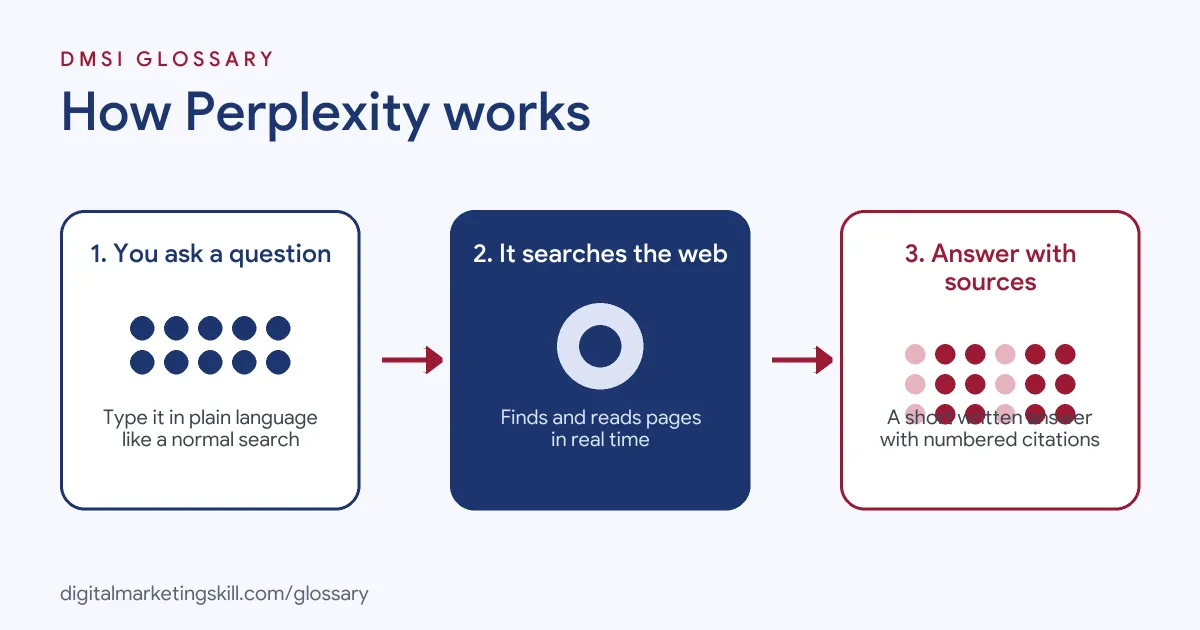
Search and retrieval
When you ask a question, Perplexity looks for pages that can answer it. To build its index, it uses a crawler called PerplexityBot. Perplexity’s docs say this bot is “designed to surface and link websites in search results on Perplexity.” The docs also say it is “not used to crawl content for AI foundation models.”
Writing the answer
Then a language model reads the pages it found. It pulls out the key points and writes a short answer. Along the way, it adds numbered citations that link back to each source. So you can click through and read the original page.
Search modes
Perplexity offers more than one way to search. For instance, regular search gives quick answers. Pro Search goes deeper on harder questions. Also, Deep Research runs a longer search across many sources and returns a fuller report. The modes available to you depend on your plan.
User-requested fetches
There is a second agent too, called Perplexity-User. It fetches a page when a user’s question needs it. Because a person asked for that page, Perplexity says it “generally ignores robots.txt rules.” This matters if you manage a site’s robots.txt file and want to understand who visits it.
What this means for your brand
So how does a brand end up in a Perplexity answer? In short, its pages must be found, read and judged useful for the question. That means your site needs to be crawlable. Also, your pages should answer common questions clearly and accurately. In addition, other trusted sites that mention your brand can shape what the answer says. Therefore, many SEO teams now track AI answers next to their normal rankings.
Examples of Perplexity in Marketing
- A content team planning a guide. The writer asks Perplexity for the main questions people have about a topic. Then she opens the cited pages to check facts and spot gaps the guide can fill.
- A software company checking its visibility. The marketing lead asks Perplexity, “What are the best tools for small business invoicing?” Next, she notes which brands appear and which pages Perplexity cites. After that, the team updates its own pages to answer the question more clearly.
- An agency preparing a pitch. An account manager uses Deep Research to gather public information about a prospect’s market. However, she checks every source before using any fact in the proposal.
Perplexity vs ChatGPT vs Google Search
| Point | Perplexity | ChatGPT | Google Search |
|---|---|---|---|
| Main format | Written answer with citations | Chat conversation, with optional web search | Ranked list of links, plus AI Overviews on some searches |
| Uses live web results | Yes, as you ask | When search is used | Yes |
| Shows sources | Numbered citations on answers | Links when it searches the web | Links on every result |
| Main crawler | PerplexityBot | OpenAI’s crawlers | Googlebot |
| Marketing angle | Being cited in AI answers | Being mentioned and cited in chats | Ranking in classic results |
Each tool has its place. For example, many marketers use ChatGPT for drafting and Perplexity for sourced research. Meanwhile, Google remains a key source of traffic for most sites.
How to Use Perplexity for Marketing
- Start with a clear question. Write a specific prompt, such as the audience, the goal and the format you want.
- Read the citations. Open the linked sources. Then check that each fact really appears there.
- Ask follow-up questions. Narrow the topic, ask for examples, or ask what the sources disagree on.
- Use Deep Research for big topics. For market research or competitor reviews, try the longer research mode.
- Check your brand’s presence. Ask the questions your buyers ask. After that, note whether your brand appears and which pages are cited.
- Improve your pages. Give clear, direct answers, add facts with sources, and keep content up to date.
- Review your robots.txt. Decide whether to allow PerplexityBot, and check that you don’t block it by mistake.
- Track over time. Repeat the same questions each month and log any changes in how your brand is described.
Best Practices for Using Perplexity
- Always verify facts. AI answers can still contain mistakes, so check the source before you publish.
- Prefer primary sources. When Perplexity cites a blog that quotes a study, find and read the study itself.
- Keep sensitive data out. Don’t paste private client details into any AI tool without approval.
- Write answer-ready content. Clear headings and short, direct answers help with answer engine optimisation.
- Test several prompts. Different wording can surface different brands and sources.
- Combine tools. Use Perplexity for sourced research, then your own judgement for strategy and tone.
Common Mistakes to Avoid
- Trusting answers without checking. Even with citations, a summary can misread a source or suffer an AI hallucination.
- Copying answers straight into content. Use Perplexity for research. Then write in your own words and add your own insight.
- Blocking the crawler by accident. A broad robots.txt rule can stop PerplexityBot from surfacing your pages.
- Testing one prompt only. One question gives a narrow view. So test the many ways buyers might ask.
- Ignoring outdated pages. If old pages on your site are cited, wrong details can spread in AI answers.
- Treating it as the whole of search. AI search is growing. Still, classic search and other channels matter too.
Where You’ll Use Perplexity at Work
Perplexity often appears in SEO, content and growth roles, especially where teams track visibility in AI answers. For example, real remote job listings mention:
- “Deep understanding of search algorithms and AI-driven search trends (e.g., ChatGPT, Perplexity, AI Overviews).” (Senior Account Manager – Online Reputation Management).
- “Plan and run SEO / LLMO / GEO experiments (e.g., AI Overviews, ChatGPT/Perplexity visibility, query capture, content engineering).” (Organic Growth Strategist).
- “helps brands show up in AI answers – on ChatGPT, Perplexity, Google AI Mode, and others.” (Growth Engineer).
Learn It in the WordPress and SEO Track
You can learn to use AI search tools and optimise for AI answers in the AI-Powered WordPress and SEO Specialist track. Every track includes a U.S. Project Internship from day one, with unlimited 1-on-1 mentoring.
Frequently Asked Questions
Is Perplexity a search engine or a chatbot?
It is both, in a way. Perplexity calls itself an AI-powered search engine, but you talk to it in a chat and can ask follow-up questions.
Does Perplexity show its sources?
Yes. Each answer includes citations and links to the original sources, so you can check the facts yourself.
How can my website appear in Perplexity answers?
Make sure PerplexityBot can crawl your site. Then publish clear, accurate pages that answer real questions directly.
Which AI models does Perplexity use?
Perplexity says it integrates models such as OpenAI’s GPT models and Anthropic’s Claude. The choice of model depends on your plan and settings.
Is Perplexity good for marketing research?
It can save time, because it gathers and cites many sources at once. However, you should always read the key sources before using any fact.
Sources: Perplexity Help Center: What is Perplexity?; Perplexity Docs: Perplexity Crawlers; Perplexity Help Center: What are Projects?; remote job listings on Himalayas, Himalayas and Himalayas.