
Artificial intelligence (AI) is technology that lets computers learn from data, spot patterns and make decisions in ways that used to need a human. It powers tools that can sort data, answer questions, write text and predict what people will do next. For marketers, it matters because it now sits inside the ad platforms, analytics tools and content apps you use every day.
Key Takeaways
- Artificial intelligence is the umbrella term. Machine learning, deep learning and generative AI all sit inside it.
- Every AI tool you can use today is “narrow” AI. In other words, it is built to do one task or a small set of tasks well.
- AI learns from data rather than from fixed rules. So the quality of your data shapes the quality of its output.
- In marketing, AI already sets bids, picks audiences, writes drafts and recommends products.
- AI can be wrong or biased. A human still needs to check its work and own the final decision.
What Is Artificial Intelligence?
Google Cloud describes artificial intelligence as “a set of technologies that empowers computers to learn, reason, and perform a variety of advanced tasks in ways that used to require human intelligence.” Put simply, it is software that gets better at a task by studying examples.
Google Cloud also offers a handy picture. It says AI is like “teaching a computer by showing it a million examples instead of writing a million rules.” For instance, a spam filter does not follow a list of banned words. Instead, it has seen huge numbers of spam and normal emails, so it learns what spam tends to look like.
That is why AI is so useful in marketing. Ad platforms see millions of clicks and sales each day. As a result, they can spot patterns no person could find by hand.
How Artificial Intelligence Works
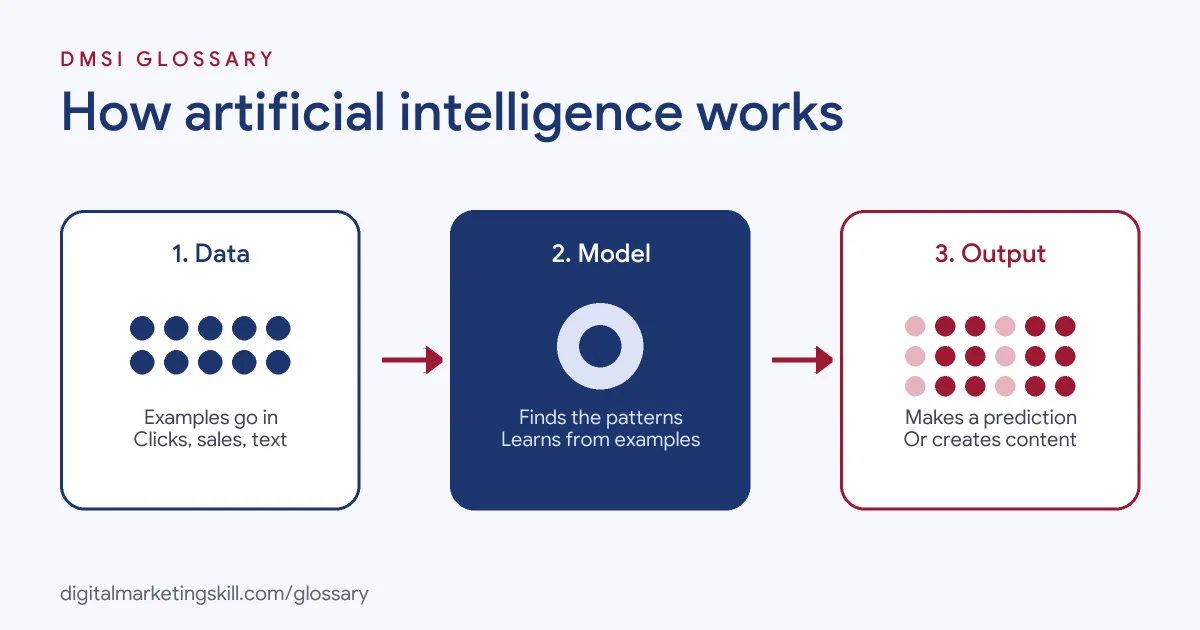
According to Google Cloud, all AI methods rely on three things: data, algorithms and computing power. First, the system takes in a large set of examples. Next, an algorithm looks for patterns in that data. Finally, the trained model uses those patterns to make a guess about something new.
Machine Learning
Machine learning is the part of AI that learns from data. IBM explains that it involves “creating models by training an algorithm to make predictions or decisions based on data.” So when you hear that a tool “uses AI”, it usually means it uses machine learning.
Deep Learning and Generative AI
Deep learning is a type of machine learning. IBM says it “uses multilayered neural networks, called deep neural networks.” These layers let it handle hard tasks, such as reading images or speech.
Generative AI is built on deep learning. Rather than just sorting or scoring data, it creates new content, such as text, images or code. Tools like ChatGPT and Gemini are well-known examples.
Narrow vs General Artificial Intelligence
IBM calls the AI we have today “weak AI” or “narrow AI”. It is “designed to perform a specific task or a set of tasks.” Strong AI, also known as artificial general intelligence (AGI), would be able to learn and apply knowledge across a wide range of tasks. However, Google Cloud states plainly that “AGI does not yet exist.”
AI Agents
A newer idea is the AI agent. IBM defines it as “an autonomous AI program” that can finish tasks with very little human input. For example, an agent might read a new lead, look up the company and add notes to your CRM. When several agents work together on a bigger goal, IBM calls this agentic AI. Even so, the same rule applies. You still set the task, give the agent clear limits and check what it did.
Artificial Intelligence Examples in Marketing
Here are three common ways marketers use AI at work:
- Bidding on ads: Google’s Smart Bidding uses “Google AI to optimize for conversions or conversion value in every auction.” It looks at signals such as device, location, time of day and the search query, then sets a bid for each auction.
- Product suggestions: An online shop shows “you might also like” items. IBM notes that deep learning can “recommend products and services customers are likely to want.”
- Customer support: A chatbot answers common questions on a website at any hour. As a result, staff can focus on harder cases.
In each case, the AI does the repetitive work. Meanwhile, the marketer sets the goal, feeds in good data and checks the results.
Types of Artificial Intelligence Compared
These terms are often mixed up, so here is a quick guide:
| Term | What it does | Marketing example |
|---|---|---|
| Artificial intelligence | The broad field of machines doing tasks that need human-like thinking | Any smart feature in a marketing tool |
| Machine learning | Learns patterns from data to predict or decide | Automated bidding and audience targeting |
| Deep learning | Uses many-layered neural networks for complex data | Image recognition and product suggestions |
| Generative AI | Creates new text, images, audio or code | Drafting ad copy or social captions |
| AI agent | An AI program that completes tasks with little human input | A tool that books meetings or updates a CRM |
In short, each layer is a more specific kind of the one above it.
How to Use Artificial Intelligence in Your Marketing
You don’t need to code to use AI. Instead, follow these steps:
- Pick one task. Choose a slow, repeated job, such as writing first drafts or sorting leads.
- Check your data. Make sure your conversion tracking and customer lists are accurate, because AI learns from them.
- Choose the tool. Start with AI features inside tools you already use, such as Smart Bidding in Google Ads.
- Set a clear goal. Tell the system what success means, such as sales or leads, not just clicks.
- Review the output. Read every draft and check every result before it goes live.
- Measure and adjust. Compare results with your old method, then keep what works.
Best Practices
- Keep a human in charge. AI can suggest, but you decide what goes out under your brand name.
- Feed it good data. IBM warns that biased training data can lead to unfair results, such as skewed targeting.
- Respect privacy. IBM points out that rules such as GDPR set privacy principles for how you handle personal data. So check what data you share with any AI tool.
- Give it time. Automated bidding needs enough data to learn. Therefore, avoid big changes every day.
- Be transparent. If a chatbot talks to customers, make it clear that it is not a person.
Common Mistakes to Avoid
Beginners often make the same errors with AI. First, they trust the output without checking it. Second, they give the tool a vague goal, such as “more traffic”, and then wonder why sales stay flat. Third, they paste private customer data into public tools. Finally, they expect AI to replace strategy. In fact, AI is fast at tasks, but it still needs you to set direction.
Where You’ll Use Artificial Intelligence at Work
AI skills now appear across marketing job listings, not just in tech roles. For example, recent remote listings say:
- Act as “the primary architect of joint artificial intelligence demand strategies” (Alliance Marketing Manager, Artificial Intelligence).
- The company “helps brands show up in AI answers on ChatGPT, Perplexity, Google AI Mode, and others” (AI Visibility Engineer, Intern).
- “We’re looking for a Director of AI Solutions to join our AI team” (Director, AI Solutions, at a marketing agency).
Notice that none of these roles ask you to build AI from scratch. Instead, they want people who know where AI helps, how to brief it and how to judge its output. Those are skills you can learn and practise on real campaigns.
So whether you aim to be a Digital Marketing Manager, a Growth Marketer or a freelancer, employers will expect you to use AI tools well and to explain the results they produce.
Learn It in the Full Stack Programme
AI fundamentals, covering strategy and planning, are part of every DMSI track. To use AI across every channel, choose the Full Stack programme, which covers all four tracks and all ten courses. You build one portfolio project from each track. You also get unlimited 1-on-1 mentoring and a U.S. Project Internship from day one.
Want to see where AI fits today? Read our guide to AI in digital marketing, then explore these AI marketing tools.
Frequently Asked Questions
What is artificial intelligence in simple terms?
It is software that learns from examples, so it can spot patterns and make decisions without being given every rule. Spam filters, maps and chatbots all use it.
Is machine learning the same as artificial intelligence?
No. Machine learning is one part of AI. It is the method most AI tools use to learn from data.
How is artificial intelligence used in digital marketing?
It sets ad bids, finds audiences, suggests products, powers chatbots and drafts content. However, a marketer still sets the goals and checks the results.
Can artificial intelligence make mistakes?
Yes. It can give wrong answers or repeat bias from its training data. That’s why you should review its output before you use it.
Do I need to code to use AI in marketing?
No. Most marketers use AI features built into tools like Google Ads, email platforms and writing apps. Instead of code, you need clear goals and good data.
Sources: Google Cloud: What is artificial intelligence?; IBM: What is artificial intelligence?; Google Ads Help: About Smart Bidding; remote job listings on Himalayas.