
ChatGPT is an AI assistant made by OpenAI that answers questions and writes text in a chat, based on large language models. You type a request in plain words, and it replies with drafts, ideas, summaries or explanations. For marketers, it matters because it can speed up research, writing and planning, as long as you check what it produces.
Key Takeaways
- ChatGPT is a chatbot from OpenAI. It runs on large language models called GPTs.
- It learned to hold a conversation through human feedback, where trainers ranked its answers.
- Besides text, it can search the web, create images and talk by voice.
- It can sound confident and still be wrong, so every fact needs checking.
- Clear, specific prompts with context give far better results than vague ones.
What Is ChatGPT?
Wikipedia describes ChatGPT as a “chatbot and artificial intelligence assistant based on large language models.” In simple terms, it is a tool you talk to. You ask it something, and it writes back in full sentences.
The “GPT” part stands for generative pre-trained transformer. That is the type of AI model underneath. It reads your prompt and then writes a reply one piece at a time, based on patterns it learned from huge amounts of text.
OpenAI says ChatGPT is free to use, with paid subscription plans on offer as well. So most people start on the free version and upgrade only if they need more. Many businesses now give staff access to it, just like email or spreadsheets.
It also reaches beyond the chat window. OpenAI says developers can build the same technology into their own apps and products through its API. As a result, you may meet it inside other tools you use at work, such as writing assistants or customer service chat. The core skill stays the same, though. You still need to give clear instructions and judge the output.
How ChatGPT Works
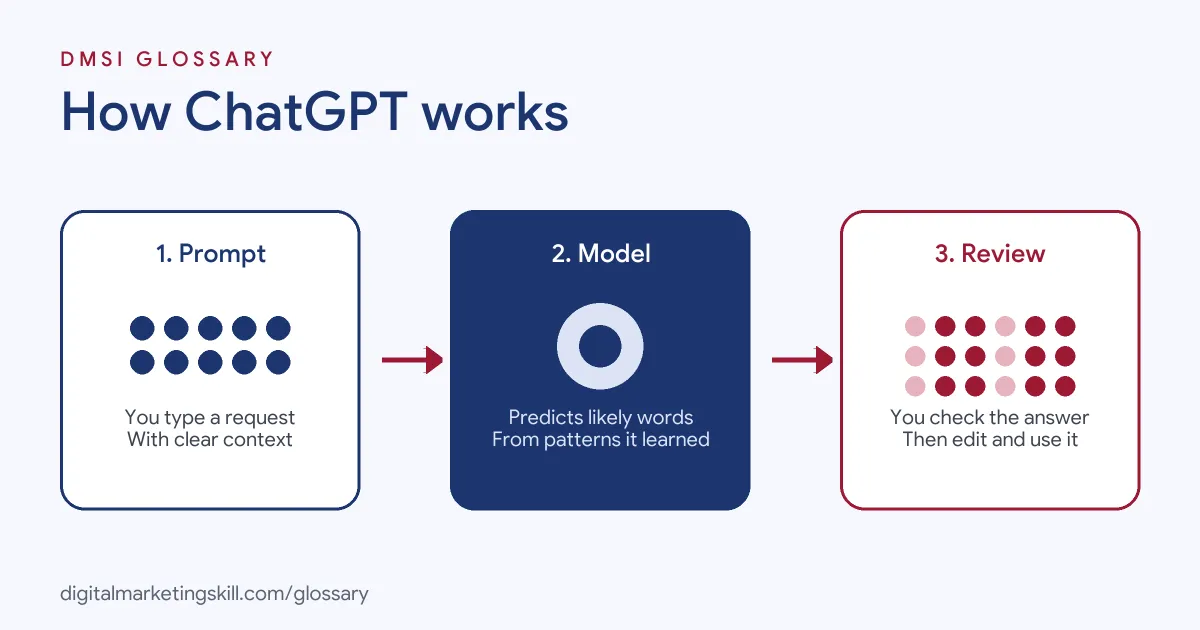
Under the surface, ChatGPT works in three broad steps. First, you write a prompt. Next, the model predicts the most likely words to come next, based on what it learned in training. Finally, it returns a reply that you can read, edit and refine with a follow-up message.
How ChatGPT Was Trained
The model first learned from a very large set of text. After that, OpenAI tuned it for conversation. According to Wikipedia, trainers played both the user and the assistant to create example chats. They also ranked the model’s answers from best to worst. Those rankings then helped train the model further. This method is called reinforcement learning from human feedback, or RLHF.
What ChatGPT Can Do
Today, ChatGPT can do far more than chat. For example, it can search the web for up-to-date answers. It can also create images and work with images you add to a prompt. In addition, you can talk to it by voice. Finally, GPT Builder lets you create a custom version, called a GPT, for one specific task.
Its Limits
The tool has clear limits. Wikipedia notes that it “may generate incorrect or nonsensical answers that sound plausible.” It can also reflect bias from its training data. In addition, it tends to agree with users, even when they are wrong. That is why you should treat every answer as a first draft, not a final fact.
ChatGPT Examples for Marketers
Here are three common ways marketing teams use ChatGPT:
- Social media manager: A manager asks for ten caption ideas for a product launch, in a friendly tone. Then she picks the best two and rewrites them in the brand’s voice.
- SEO specialist: A specialist pastes in a list of keywords and asks ChatGPT to group them by topic. As a result, he gets a rough content plan in minutes, which he then checks against real search data.
- Email marketer: A marketer asks for three subject lines for a welcome email. Next, she tests the strongest two against each other and keeps the winner.
In each case, the person stays in charge. The tool speeds up the first draft, but the marketer makes the final call.
There are many other everyday uses too. For instance, you can ask it to summarise a long report, turn a blog post into a short video script, or explain a new term in plain words. You can also ask it to play the role of a sceptical customer and question your sales page. That kind of feedback is quick, and it often shows gaps you had missed.
ChatGPT vs Search Engine vs Custom GPT
People often ask how ChatGPT differs from tools they already know. Here is a simple comparison:
| Tool | What it gives you | Best for |
|---|---|---|
| Search engine | A list of links to pages written by others | Finding sources and checking facts |
| ChatGPT | A written answer or draft in a conversation | Ideas, drafts, summaries and rewrites |
| Custom GPT | A version of ChatGPT set up for one task | Repeat jobs, such as briefs in a set format |
In short, a search engine points you to sources, while ChatGPT writes for you. However, its web search feature now blurs that line, so always check which sources it used.
How to Use ChatGPT Well at Work
These steps follow OpenAI’s own advice on writing prompts:
- Be clear and specific. OpenAI says prompts should be “clear, specific, and provide enough context for the model to understand what you are asking.”
- Give it a role and an audience. For example, “You are an email marketer writing to first-time buyers.”
- Set the tone. Use words such as friendly, formal or professional to guide the style.
- Add your own material. Paste in your notes, brand rules or product facts, so it does not guess.
- Iterate. OpenAI notes that good prompting “often requires an iterative approach.” So review the answer, then ask for changes.
- Check and edit. Verify every fact, number and name before you publish anything.
For a deeper guide, see our article on how to write ChatGPT prompts.
Best Practices
A few habits keep your work accurate and safe:
- Protect private data. OpenAI says it may use content from personal accounts to train its models, although users can opt out. By contrast, it says it does not train on content from business plans such as ChatGPT Business or Enterprise.
- Keep your brand voice. Always rewrite drafts, so they sound like your brand rather than a generic AI.
- Ask for sources. When it searches the web, open the links and read them yourself.
- Save good prompts. Reuse prompts that work, or turn them into a custom GPT.
- Follow your employer’s rules. Many companies set clear policies on AI use, so check them first.
Common Mistakes to Avoid
Beginners often make the same few errors. First, they write one-line prompts and then blame the tool for bland answers. Second, they copy the reply straight into a live post. Third, they trust facts and statistics without checking them. Finally, they paste customer data into a personal account. Each of these mistakes is easy to avoid once you treat ChatGPT as a helpful assistant, not an expert.
Where You’ll Use ChatGPT at Work
AI tools now appear in many marketing job listings. For example, current remote roles ask candidates to:
- “Leverage AI tools such as ChatGPT and Claude to support ideation, scripting and content planning” (Creative Strategist, Meta Ads Contents).
- Show “exposure to using ChatGPT or AI tools for SEO research, ideation, or content support” (SEO Executive).
- Bring “hands-on, day-to-day use of AI tools (e.g., ChatGPT, Claude, Copilot) in your own work” (Senior Director, Client Strategy).
So whether you aim to be a Social Media Manager, SEO Specialist or Email Marketing Specialist, employers will expect you to use AI tools well. They will also expect you to know where those tools go wrong.
Learn It in the Full Stack Programme
AI fundamentals, including strategy and planning with tools like ChatGPT, are part of every DMSI track. To use them across every channel, the Full Stack programme covers all four tracks and all ten courses, with one portfolio project from each. You also work on a U.S. Project Internship from day one, with unlimited 1-on-1 mentoring.
New to the wider topic? Start with our glossary entry on generative AI.
Frequently Asked Questions
What is ChatGPT in simple terms?
It is an AI chatbot from OpenAI. You type a question or task, and it writes a reply in plain language.
Is ChatGPT free?
OpenAI says it is free to use, with paid subscription plans for people who need more.
Can ChatGPT be wrong?
Yes. It can give answers that sound right but are false. So check every fact before you use it.
How do marketers use ChatGPT?
Marketers use it to brainstorm ideas, draft captions and emails, group keywords, summarise research and rewrite copy for different audiences.
Will ChatGPT replace marketers?
It speeds up tasks, but it still needs a person to give context, judge quality and check facts. In fact, many job listings now ask for people who can use it well.
Sources: Wikipedia: ChatGPT; OpenAI Help Center: What is ChatGPT?; OpenAI Help Center: Prompt engineering best practices for ChatGPT; remote job listings on Himalayas.