
A drip campaign is a series of automated emails or messages that go out to people over time after a trigger, such as signing up or leaving items in a basket. Each message is written in advance and sent on a schedule or in response to what the person does next. It matters because it lets you follow up with every lead or customer at the right moment, without sending each message by hand.
Key Takeaways
- A drip campaign starts with a trigger, then sends a planned sequence of messages with time delays between them.
- Email platforms often call it a flow, an automation or a sequence. Klaviyo, for example, says flows are “also known as automations or drip campaigns”.
- Common types include welcome series, abandoned cart, post-purchase and winback flows.
- Branches and filters let you send different messages to different people.
- Consent rules still apply. In the UK, you generally need specific consent to email individuals.
What Is a Drip Campaign?
Picture a tap that releases one drop at a time. This kind of sequence works the same way. Instead of sending everything at once, it releases a message, waits, then sends the next one.
For example, someone downloads a free guide from a language school. Straight away, they get the guide by email. Two days later, they get a tip on learning faster. A few days after that, they receive an invitation to book a trial lesson. The school writes these emails once, and the system sends them to every new subscriber.
This is a core tool for lead nurturing. Most people aren’t ready to buy the first time they hear from you, so an automated series keeps you in touch until they are.
How a Drip Campaign Works
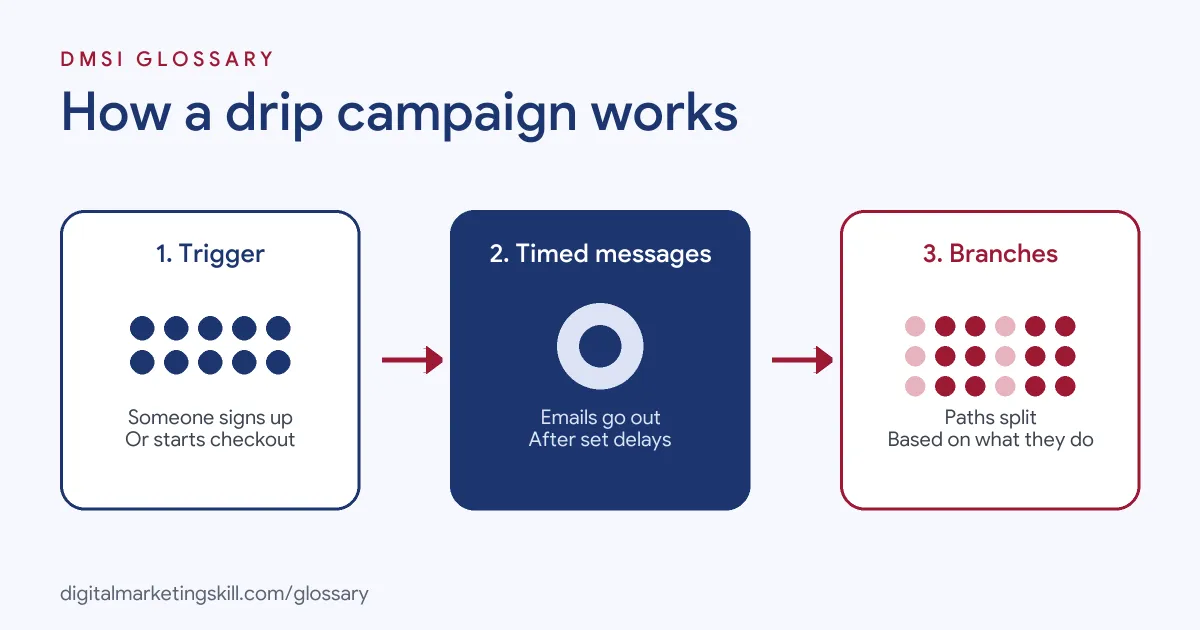
Every sequence has three building blocks: a trigger, a set of messages and the rules that decide timing. Klaviyo describes a flow as “a sequence of automated actions (e.g., sending messages) triggered by a behavior or event”. Most email platforms follow the same idea.
The Trigger
The trigger is what puts someone into the sequence. According to Klaviyo, a flow might start “when someone joins a list or starts checkout, when an order is fulfilled, or as a date approaches”, such as a birthday. In practice, the trigger should match the moment when a message is most useful.
Delays and Messages
Next come the messages and the gaps between them. You decide how long to wait after the trigger before the first email, then between each one after that. Short delays suit urgent moments, such as an abandoned basket. Longer gaps, on the other hand, suit a slower education series.
Branches and Filters
Finally, modern tools let a sequence change course. Klaviyo notes that flows “can include time delays between actions and multiple paths that split based on different criteria”. For instance, people who buy can leave the sequence, while those who don’t get a reminder.
Drip Campaign Examples
Klaviyo recommends a handful of flows to set live first. Here is what each one does:
- Welcome series: It introduces new subscribers to your brand and aims to turn them into first-time customers.
- Abandoned cart: It follows up when someone leaves items in their basket, and it can change based on what they left.
- Post-purchase: It thanks customers and suggests related products.
- Winback: It re-engages customers who bought before but haven’t bought again for a while.
Outside ecommerce, the same pattern works for webinars, free trials and course enquiries. For example, a software company might send five emails over a 14-day trial, each one showing a feature the user hasn’t tried yet. That is a made-up example, but the structure is common.
Drip Campaign vs Newsletter vs Broadcast
These three types of email are easy to confuse. Here is how they differ:
| Type | What sends it | Who gets it | Best for |
|---|---|---|---|
| Drip campaign | A trigger plus planned delays | Each person, at their own pace | Onboarding, nurturing, reminders |
| Newsletter | A regular schedule you set | Your whole list or a segment, at once | Ongoing news and content |
| One-off broadcast | You press send | A list or segment, at once | Launches, sales, announcements |
In short, a newsletter talks to everyone at the same time. A drip campaign, by contrast, talks to each person based on when and how they joined.
How to Build a Drip Campaign
The steps below work in most email platforms, from Klaviyo to Mailchimp or HubSpot. The menu names differ, but the logic is the same.
- Pick one goal. For example, turn new subscribers into first-time buyers.
- Choose the trigger. This might be joining a list, starting checkout or booking a call.
- Map the messages. Plan three to five emails, each with one job and one call to action.
- Set the delays. Decide the wait before each email based on how quickly people usually decide.
- Add exit rules. Remove people who reach the goal, so buyers don’t get “still thinking?” emails.
- Preview and test. Klaviyo recommends reviewing, customising and previewing all default messages before you turn a flow live.
- Turn it on and watch the numbers. Track opens, clicks, conversions and unsubscribes for each email.
For a fuller walk-through, see our guide to building an email automation workflow that converts.
How to Measure the Results
Judge each email on its own, then the sequence as a whole. First, look at clicks and conversions for every message. A sudden drop at one step usually means that email needs a better subject line, offer or timing. Next, check unsubscribes and spam complaints at each step, since a spike tells you a message feels unwelcome.
Finally, compare the whole flow with a simple benchmark. For instance, compare people who went through the welcome series with people who joined before it existed. If the first group buys more often, the sequence is doing its job. Klaviyo also provides flow analytics for this kind of review.
Drip Campaign Best Practices
- Start from consent. The UK ICO says you must not send marketing emails or texts to individuals without specific consent, apart from a limited “soft opt-in” for existing customers.
- Make leaving easy. Google requires bulk senders to support one-click unsubscribe in marketing messages, with a visible unsubscribe link in the body.
- Authenticate your domain. Google asks all senders to set up SPF or DKIM, and bulk senders to add DMARC as well.
- Watch spam complaints. Google asks senders to keep spam rates in Postmaster Tools below 0.3%.
- Write for one reader. Each email should feel like a helpful note, not an advert.
Common Drip Campaign Mistakes
The most common mistake is sending too much, too fast. Another is forgetting exit rules, so customers who already bought keep getting sales emails. Some teams also import bought lists into a sequence. However, the ICO is clear that the soft opt-in does not apply to new contacts from bought-in lists. Finally, many people set up a flow and never look at it again. As a result, old offers and broken links keep going out for months.
Where You’ll Use Drip Campaigns at Work
Automated sequences appear in many email and CRM job listings. For example, remote roles ask candidates to:
- “Plan, implement, and refine email marketing strategies and drip campaigns to nurture leads and boost conversions” (Content Marketing Specialist).
- “Create and manage drip campaigns to maintain consistent communication with prospects” (Appointment Setter – PH).
- Be “hands-on in the ESP to build automated workflows (drip campaigns), QA their logic, build segmentation, etc.” (Lifecycle Marketing Sr Klaviyo Specialist).
So if you want to work as an Email Marketing Specialist or Marketing Automation Specialist, you will build, test and report on sequences like these.
Learn It in the Lead Generation and Email Track
You can build a real sequence in the AI-Powered Lead Generation and Email Automation track. Your portfolio project is a lead magnet and an automated email sequence that converts. Along the way, you get unlimited 1-on-1 mentoring and a U.S. Project Internship from day one.
Want to see how automation fits a small business? Read our email marketing automation framework.
Frequently Asked Questions
What is a drip campaign in simple terms?
It is a set of emails written in advance that send automatically, one after another, after someone takes an action such as signing up.
Is a drip campaign the same as an email flow?
Mostly, yes. Klaviyo says its flows are also known as automations or drip campaigns. Other tools call them sequences or journeys.
How many emails should a drip campaign have?
There is no fixed number. Many sequences use three to five emails, but the right length depends on your goal and how fast people usually decide.
Do I need consent to send a drip campaign?
Usually, yes. In the UK, the ICO says you need specific consent to email individuals, unless the soft opt-in for existing customers applies.
Can a drip campaign use SMS?
It can, if your platform supports text messages. In the UK, the ICO’s consent rules cover marketing texts as well as emails.
Sources: Klaviyo Help: Getting started with flows; ICO: Electronic mail marketing; Google: Email sender guidelines; remote job listings on Himalayas.