
A cold email is a first-contact email sent to someone who doesn’t know you yet and hasn’t signed up to hear from you, usually to start a business conversation. Freelancers, agencies and sales teams use it to find clients, partners or new leads. Done well, it is short, relevant and respectful of the rules, because a careless message can damage your reputation, your inbox placement and even break the law.
Key Takeaways
- This kind of outreach goes to people with no existing relationship with you, so relevance and personalisation matter most.
- In the US, the FTC says the CAN-SPAM Act “makes no exception for business-to-business email.”
- In the UK, the ICO says you can email corporate bodies, but sole traders and some partnerships count as individuals.
- Google asks all senders to authenticate their domains and keep spam rates in Postmaster Tools below 0.3%.
- Every message should say who you are and give an easy way to opt out.
What Is a Cold Email?
Think of it as the email version of a polite knock on a stranger’s door. You have no prior relationship, so the reader owes you nothing. As a result, the message has to earn attention quickly by being clearly relevant to them.
It differs from email marketing to a subscriber list. People on your list chose to hear from you. By contrast, a cold message goes to someone who didn’t. That’s why the rules, the tone and the volume all need more care.
For example, a freelance designer might email the owner of a local gym to point out that its website is hard to use on mobile, then offer a quick fix. The email is unexpected, but it is specific, useful and easy to ignore if it isn’t wanted.
How a Cold Email Works
The process runs in three stages. First, you research and pick the right people to contact. Next, you send a short, personal message that offers clear value. Finally, you follow up once or twice, then stop if there’s no interest.
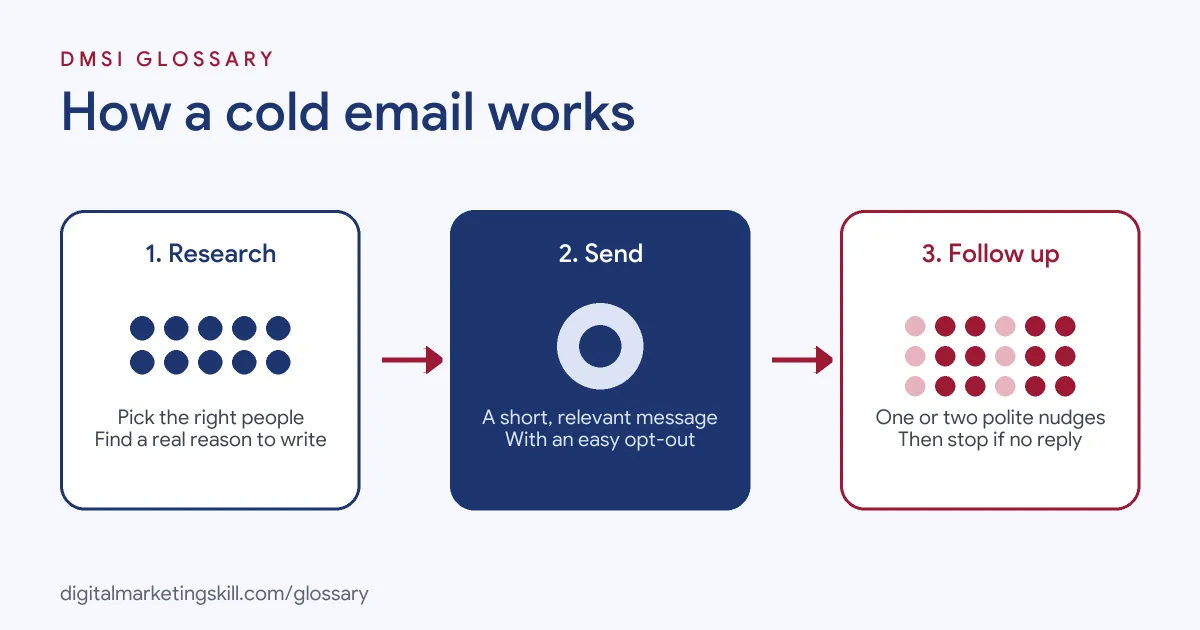
Research and Targeting
Good outreach starts with a short list, not a huge one. Find people whose role and business match what you offer. Then look for one specific reason to write, such as a recent launch, a gap on their website or a challenge common in their industry.
The Message
Keep it brief. A strong message usually has a clear subject line, one or two sentences on why you’re writing to this person, one sentence of value or proof and a simple question as the call to action. The FTC’s guidance also bans deceptive subject lines, so the subject must reflect what’s inside.
Deliverability
Even a great message fails if it lands in spam. Google’s sender guidelines say all senders to Gmail should set up SPF or DKIM authentication, use valid DNS records, send over a TLS connection and keep spam rates “below 0.3%.” Senders of more than 5,000 messages a day must also set up DMARC and support one-click unsubscribe for marketing messages.
Cold Email Examples
Here are three made-up openings that show a relevant first line:
- Freelance SEO: “I noticed your bakery doesn’t appear on Google Maps for ‘birthday cakes near me,’ even though your reviews are excellent.”
- Video editor: “Your latest YouTube tutorial has great advice, but the first 20 seconds are an intro card. I can show you a tighter opening.”
- Agency: “You’re hiring two sales reps, so I thought a steady flow of qualified leads might help them hit the ground running.”
Each one proves you looked at their business before you wrote, which is the fastest way to earn a reply.
Cold Email Rules: US vs UK
| Topic | US (CAN-SPAM, FTC) | UK (PECR, ICO) |
|---|---|---|
| Business emails | No exception for business-to-business email | You can email corporate bodies, such as companies and LLPs |
| Sole traders | Same rules apply | Treated as individuals, so you usually need consent |
| Identify yourself | Use honest headers and include your postal address | Don’t disguise or conceal who you are |
| Opt-out | Honour opt-outs within 10 business days | Offer an opt-out and keep a “do not email” list |
This table is a simple summary, not legal advice. Check the rules for every country you email, and get proper advice if you’re unsure.
How to Write a Cold Email
- Define your ideal contact. Pick the industry, company size and job title you want to reach.
- Research each person. Find one specific, genuine reason to write to them.
- Write an honest subject line. Make it short and accurate, never misleading.
- Open with them, not you. Next, start with their situation, then link it to what you offer.
- Add one piece of proof. For example, a short result from similar work.
- Ask a simple question. Such as, “Would a quick call next week be useful?”
- Include who you are and an opt-out. Add your name, business details and a clear way to say no.
- Follow up politely. Finally, send one or two short follow-ups, then stop.
A Sample Email
Here is a made-up example that puts the steps together:
- Subject: Quick idea for your class bookings
- Opening: “Hi Sam, I saw that your yoga studio’s booking page asks for nine fields before someone can reserve a class.”
- Value: “I helped a Pilates studio cut a similar form down to three fields, and their online bookings went up.”
- Question: “Would it help if I sent over a one-page mock-up of a shorter form?”
- Sign-off: Your name, business name and address, plus “Not interested? Just reply ‘no’ and I won’t email again.”
It is short, specific and polite, and it makes saying no just as easy as saying yes. That respect is what keeps your name in good standing.
Best Practices
- Send fewer, better messages. A small, well-researched list beats a large, generic one.
- Authenticate your domain. Set up SPF, DKIM and DMARC, as Google recommends for all senders.
- Keep a do-not-contact list. The ICO calls this good practice, and it protects your reputation.
- Write like a person. Plain text, short lines and a friendly tone can feel more personal than heavy design.
- Track replies, not just opens. A reply shows real interest.
Common Mistakes
A common mistake is sending the same message to hundreds of people, which feels like spam because it is. Another is writing about yourself for three paragraphs before mentioning the reader. Some senders also use tricky subject lines like “Re: our call” when there was no call, which is the kind of misleading subject line the FTC warns against. Finally, many ignore opt-outs or keep chasing people who said no, which can break the law and harm your sender reputation.
Where You’ll Use Cold Email at Work
This skill shows up in sales, growth and freelance roles. For example, real remote job listings include lines like these:
- “Source new sales opportunities through outbound efforts like cold calling, cold email, and LinkedIn engagement and onsite territory plan” (Account Executive).
- “Experience using LinkedIn, cold emailing, or AI tools for lead generation is a plus” (Freelance Business Development).
- “Utilise various channels, such as cold emailing, email campaigns, and Linkedin, to identify and engage potential clients across Africa, United States, Germany, United Kingdom and broader EU region” (Sales Development Representative).
So as a Lead Generation Specialist or Email Marketing Specialist, you may write and test outreach sequences. If you freelance, it is often how you land your first clients.
Learn It in the Lead Generation and Email Track
The AI-Powered Lead Generation and Email Automation track covers lead generation, email marketing and automation. You build a lead magnet and an automated email sequence that converts, so you learn to write emails people actually want to read. You also get unlimited 1-on-1 mentoring and a U.S. Project Internship from day one.
For a step-by-step method, read our guide to cold email marketing. To stay out of spam folders, see our guide to email deliverability.
Frequently Asked Questions
Is cold email legal?
It can be, if you follow the rules where your recipients are. In the US, CAN-SPAM applies to business email too. In the UK, you can email companies but generally need consent for sole traders.
How long should a cold email be?
Short. A few sentences that explain why you’re writing, what you offer and one simple question are usually enough.
How many follow-ups should I send?
One or two polite follow-ups is a sensible limit. After that, stop and respect their silence.
What’s the difference between cold email and spam?
Good outreach is relevant, personal, honest and easy to opt out of. Spam is mass, generic and often misleading.
Do I need to include an unsubscribe option?
Yes. The FTC requires a way to opt out of future marketing email, and the ICO’s checklist includes offering an opt-out and acting on it promptly.
Sources: FTC: CAN-SPAM Act compliance guide for business; ICO: Electronic mail marketing; Google: Email sender guidelines; remote job listings on Himalayas.