
A case study is a short, evidence-based story that shows how a business helped a real customer solve a specific problem, and what results followed. It usually moves from the challenge, to the solution, to measurable outcomes. In marketing, it matters because buyers trust proof from people like them far more than claims a brand makes about itself.
Key Takeaways
- The classic structure is challenge, solution and results.
- Hallam, a digital marketing agency, says a good one is “not about you, but your customer.”
- Hard numbers matter. Without clear results, you don’t really have a story to tell.
- Specific, industry-focused stories work better than general ones, because readers recognise themselves.
- For freelancers and job seekers, your own project write-ups work as portfolio proof.
What Is a Case Study?
Hallam describes it as “a way of demonstrating how your business’s helped a person or client overcome a particular challenge.” It “clearly lays out how your products or services were used to solve a problem, and the results.”
Copy.ai, a marketing software company, adds that it is “a detailed, real-world account” that takes readers “from the initial challenge your client faced, to the solution you provided, and the transformative results they achieved.” In other words, it is a story with evidence.
It is also not a sales pitch. Hallam stresses that it isn’t a press release or a direct advert. Instead, it shows your work in the context of helping someone else.
How a Case Study Works
Every strong example follows the same arc. First, it sets out the customer’s problem in their own terms. Next, it explains what you did and why. Finally, it shows the results, ideally in numbers, and lets the customer speak in their own words.
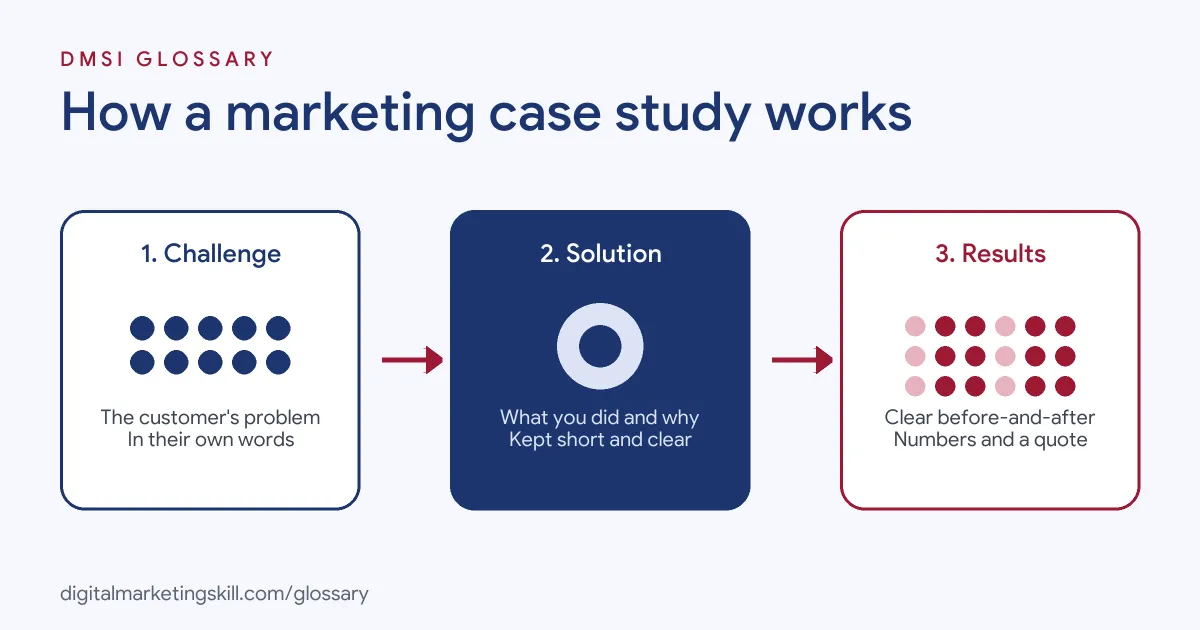
The Challenge
Start with the situation before you arrived. Who is the customer, what were they trying to do and what stood in the way? Hallam advises keeping the story specific to an industry, so readers in that sector can “recognise themselves in your story.”
The Solution
Next, explain what you did. Hallam calls these stories “solution-centric,” meaning they must show how you solved the problem using your expertise, products or services. Keep the detail relevant. Readers want to understand your approach, not every meeting you held. If one decision made the biggest difference, such as changing the offer or the audience, explain that choice in a sentence or two.
The Results
Results are the heart of it. Hallam is blunt: “if you don’t have the results, you simply don’t have a case study.” So include clear numbers where you can, such as more leads, lower costs or faster sales. Zoom’s guide to marketing proposals suggests the same, showing “the shift in plain numbers,” for example an email list growing from 200 to 1,400 subscribers.
Case Study Examples
Here are three made-up outlines to show the format in action:
- Local gym: Challenge: few new members after a quiet spell. Solution: a referral offer and short video ads. Result: new sign-ups rose by a third over two months.
- Online bookshop: Challenge: many abandoned baskets. Solution: a three-email reminder series. Result: more recovered orders and a higher average basket.
- Accountancy firm: Challenge: little search traffic. Solution: a set of guides on common tax questions. Result: steady growth in enquiries from search.
Notice that each one names a clear problem and a clear outcome. As a result, a reader can judge quickly whether the story applies to them.
Case Study Formats Compared
| Format | Length | Best for |
|---|---|---|
| Full write-up | A web page or PDF | Buyers comparing options in detail |
| Snapshot | A few lines and one key number | Proposals, ads and landing pages |
| Video story | One to three minutes | Social media and sales calls |
| Portfolio project | One page per project | Freelancers and job seekers |
Many teams turn one full write-up into several shorter formats, so the same story works across channels.
How to Write a Case Study
- Pick the right project. Hallam suggests choosing your best work, where the client was happy and the results are clear.
- Get permission. Ask the customer before you name them or share their numbers.
- Interview the customer. Next, ask about the problem, why they chose you and what changed.
- Gather the data. Collect before-and-after figures from analytics, reports or sales records.
- Write the story. Follow the challenge, solution and results structure, and add one or two short quotes.
- Add a clear headline. Lead with the result, for instance “How a bakery doubled online orders.”
- Get approval and publish. Finally, share it on your website, in proposals and with your sales team.
Questions to Ask the Customer
A good interview gives you most of the story. Try questions like these:
- What was going wrong before you started working with us?
- What had you already tried, and why didn’t it work?
- Why did you choose us over other options?
- What changed after the work, and how did you measure it?
- What would you tell a business like yours that is thinking of doing the same?
Record the call, with permission, so you can quote the customer exactly. Their own words are often more convincing than anything you write.
Best Practices
- Lead with the customer. Make them the hero, not your company.
- Use real quotes. The customer’s own words add trust that your summary can’t.
- Be specific. One clear number beats a page of vague praise.
- Keep it short. Busy readers should grasp the story in a minute.
- Collect proof as you go. Save screenshots and numbers during each project, so you never have to hunt for them later.
- Match the reader. Copy.ai notes that prospects relate to challenges like their own, so write one for each main industry you serve.
Where to Use Your Stories
Copy.ai suggests using these stories strategically to guide buyers through the sales funnel, not just to fill a page on your site. In practice, that means putting them where decisions happen. For example, add a short snapshot to a landing page next to the sign-up button. Include one relevant story in each proposal. Share a quote and a key number in a social post, then link to the full write-up. Finally, give your sales team a one-page version they can send after a call. The same story, cut in different ways, can support the whole journey from first visit to signed deal.
Common Mistakes
The most common mistake is writing a sales pitch dressed up as a story. Another is skipping the numbers, which leaves readers with nothing to judge. Some teams also publish without the customer’s sign-off, which can damage the relationship. Others fill the page with jargon the customer would never use. Finally, many bury the result at the end. Put the headline outcome near the top, so readers see the value straight away.
Where You’ll Use Case Studies at Work
Content and marketing roles ask for this skill directly. For example, real remote job listings include lines like these:
- “Own the case study program end to end: find customers with Sales and Customer Success, interview them, secure approvals and publish” (Content Marketing Manager).
- “Proven experience managing multiple content formats (case studies, blogs, whitepapers/ebooks, bylines)” (Content Marketing Manager).
- “Case studies – working from a detailed brief to create compelling success stories” (Creative Copywriter).
So whether you become a Digital Marketing Manager, a Growth Marketer or a Freelance Digital Marketer, you will write these stories. As an Agency Owner, you will also rely on them to win new clients.
Learn It in the Full Stack Programme
The Full Stack (all four tracks) programme covers all ten courses, with one portfolio project from each track. Each project gives you real work and results you can turn into your own case study. You also get unlimited 1-on-1 mentoring and a U.S. Project Internship from day one.
To use these stories well, read our guide to social proof marketing. For your own career, see how to build a marketing portfolio.
Frequently Asked Questions
What is a case study in marketing?
It is a short story, backed by evidence, that shows how a business solved a real customer’s problem and what results followed.
What should a case study include?
Most include the customer’s challenge, the solution, measurable results and one or two quotes from the customer.
How long should a case study be?
There is no fixed length. Many work well as a single web page, while short snapshots fit into proposals and ads.
Can I write a case study without big numbers?
You need some clear evidence of change. Even small, honest results, such as time saved, are better than vague claims.
Can beginners create case studies?
Yes. A practice project, a volunteer job or a course project can become a case study for your portfolio, as long as you’re honest about what it was.
Sources: Hallam: How to write a case study for your website; Copy.ai: How to write a case study; Zoom: How to write a marketing proposal that wins clients; remote job listings on Himalayas.