Most sites copy a rival’s keywords and call it strategy. Real SEO competitor analysis goes further. It finds why a page outranks you, not just what it targets. Done well, it tells you which gaps are worth closing first, and which ones to ignore.
Spotting a gap is only half the job; pair it with consistent keyword rank tracking so you can tell whether closing that gap actually moved your position.
Key Takeaways
- 95% of pages get zero backlinks from other sites. A competitor with even a modest link profile already has an edge (Backlinko).
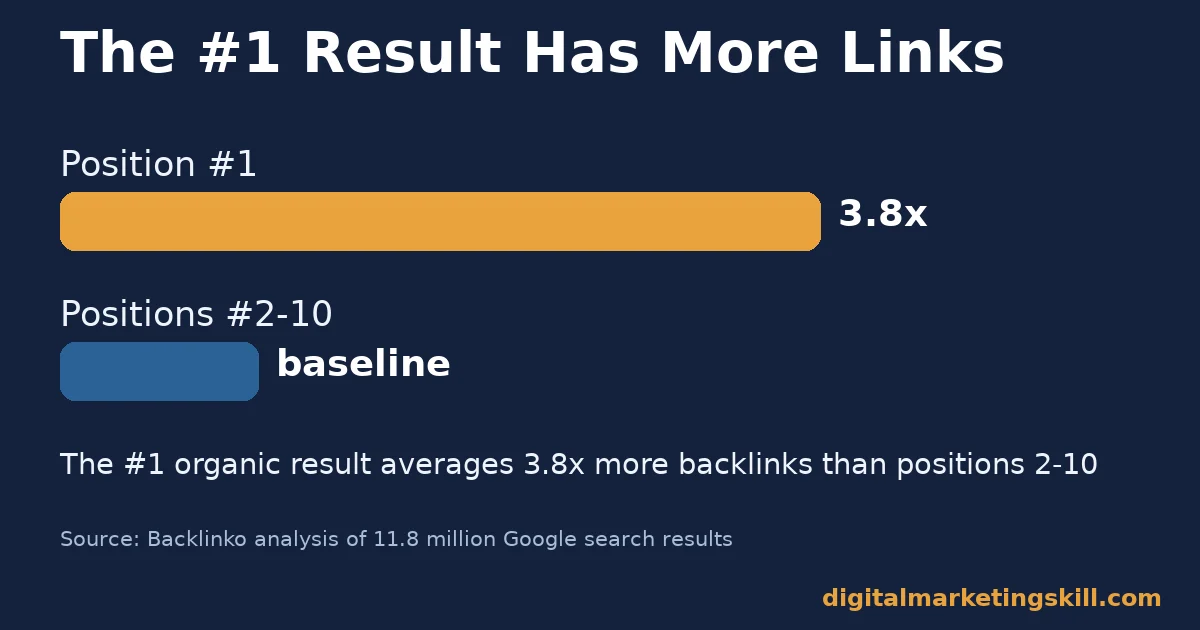
- The #1 organic result has roughly 3.8 times more backlinks than pages in positions 2 through 10 (Backlinko).
- Position 1 earns a click-through rate over 10 times higher than position 10. Rank position itself compounds the traffic gap (Backlinko).
- Google’s own algorithm weighs hundreds of ranking signals, so SEO competitor analysis works by isolating which ones actually explain a specific ranking gap, not by guessing.
- Average Google Ads cost per click across industries is $5.42 in the US, according to Focus Digital’s 2026 benchmark report, so PPC gap analysis can reveal cheaper paid opportunities too.
In this guide
- Why Most Competitor Research Stops Too Early
- How Competitor Research Actually Explains a Ranking
- What Differs Across the Three Layers of SEO Competitor Analysis
- How to Lead With Each Layer of SEO Competitor Analysis
- Common Mistakes in SEO Competitor Analysis
- How to Measure Whether the Analysis Paid Off
- The One Decision Rule Worth Following
- A Real Case: What Backlinko’s Own Study Found
- Frequently Asked Questions About SEO Competitor Analysis
- Where to Go From Here
Why Most Competitor Research Stops Too Early
Most SEO competitor analysis stops at a keyword list. A tool exports the terms a rival ranks for. Someone skims it, and the list gets filed away. That approach misses the part that actually explains the ranking: why that page earns its position.
Most marketing teams already agree competitive research matters. Far fewer turn it into a specific change on the page. The gap is not access to data. Most SEO tools expose the same raw numbers on keywords, rankings and backlinks. The real gap is turning that data into a specific, testable change to your own page.
One ground rule before the detail: benchmarks here come from US-focused studies unless stated otherwise. Competitive landscapes shift, so treat every number as a snapshot from when it was measured, not a permanent ranking.
How Competitor Research Actually Explains a Ranking
A ranking is the output of several signals working together. Content relevance, backlink authority, technical health and user engagement all play a part. SEO competitor analysis works by isolating which of those signals explains the gap between your page and a rival’s.
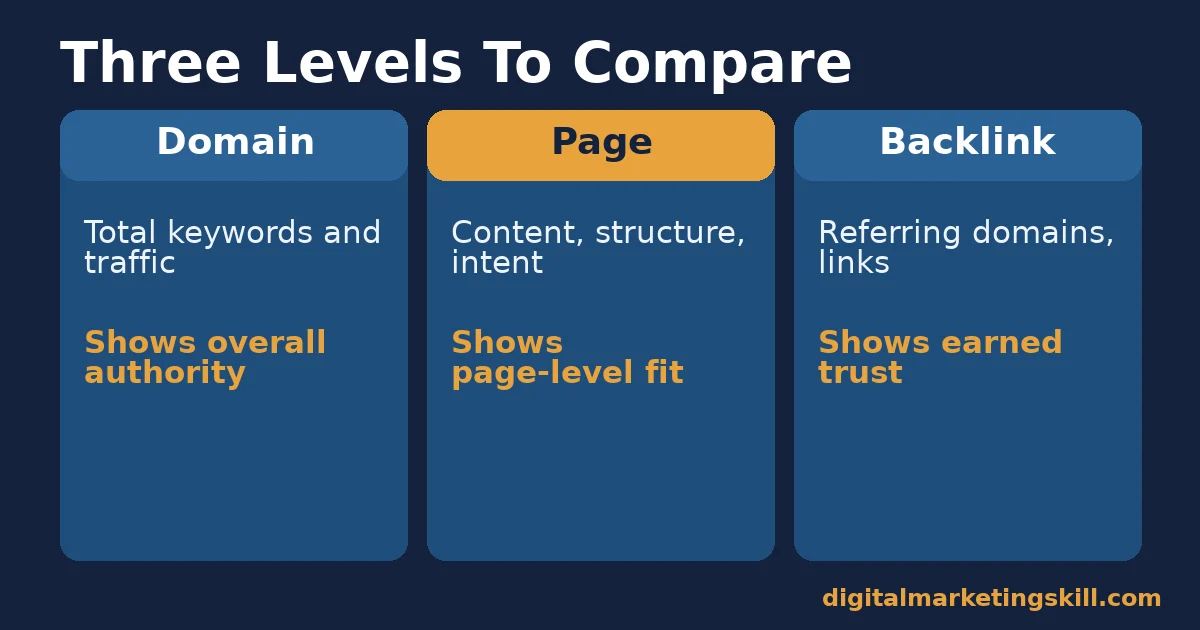
Start wide, then narrow. First compare visibility at the domain level: how many keywords each site ranks for, and how much estimated traffic that represents. Then narrow to the page level for your target keyword. Which exact page ranks? What does it cover? How is it structured? Finally, check the backlink and technical layer behind that single page.
This order matters, because a domain-level gap and a page-level gap call for different fixes. A domain with broad authority but a weak specific page needs page-level work. One with a strong specific page but no overall authority needs a broader link and content programme instead.
Telling a Domain Gap From a Page Gap
A quick way to tell the two apart: check whether the competitor’s other pages also rank well for unrelated terms. If most of their pages rank strongly across many topics, you are likely facing domain-level authority.
If only this one page performs well, the advantage is probably specific to that page. This single check often saves hours of research, since it points you straight at the right layer before you open a single backlink report.
Skipping straight to tactics is the most common mistake in SEO competitor analysis. Teams often jump to “write more content” or “build more links” before confirming which layer is actually holding the page back. That guesswork wastes the exact time the analysis was meant to save.
A simple way to avoid this: score each layer on a basic scale before deciding where to act. Rate your content coverage, your referring-domain count and your page speed, each against the same metric for the top three ranking pages. Whichever layer shows the widest gap gets the first fix.
What Differs Across the Three Layers of SEO Competitor Analysis
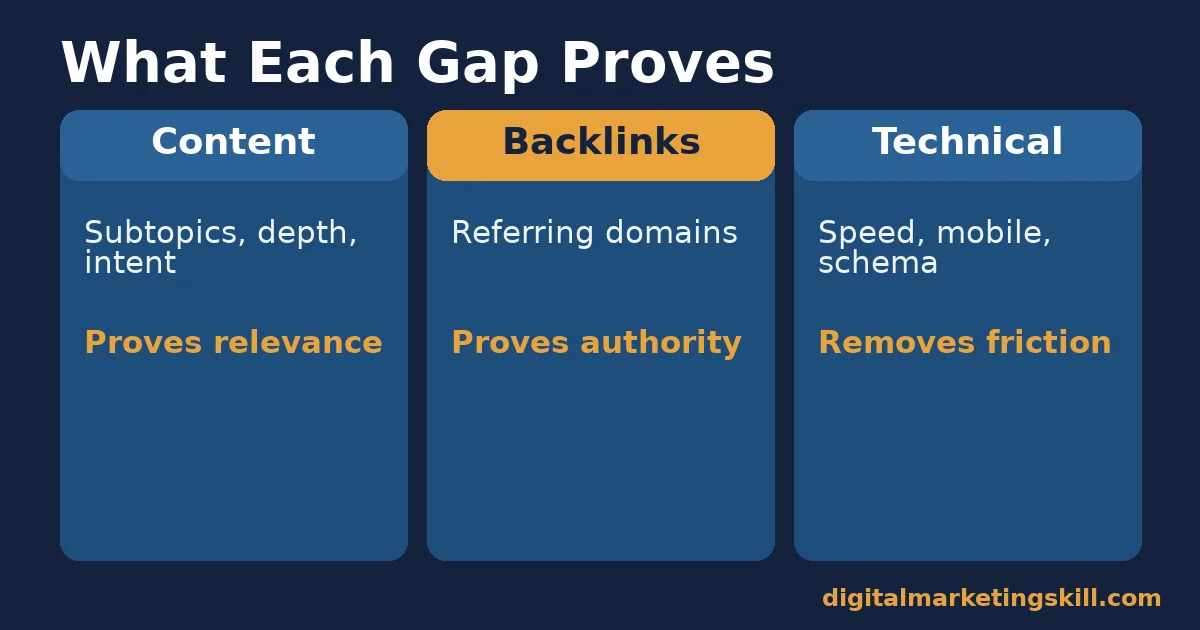
Content Gaps: Built to Prove Relevance
Content gap analysis compares what a top-ranking page covers against what yours covers. It is not about word count. The average first-page Google result runs to roughly 1,447 words, according to Backlinko’s analysis of 11.8 million search results. Length follows depth, not the other way round. Look for subtopics, questions and data the competitor includes that you do not.
A simple way to spot this gap: open the top three ranking pages in separate tabs, and list every subheading from each one in a spreadsheet. Any subheading that appears on two or more competitor pages but not on yours is a strong candidate to add.
Backlink Gaps: Built to Prove Authority
Backlink gap analysis compares who links to a competitor’s page but not to yours. This matters more than most people assume. 95% of pages have zero backlinks at all, and the same Backlinko study found the #1 result averages 3.8 times more backlinks than pages ranked 2 through 10.
A page with even a handful of relevant referring domains already separates itself from most of the web. Quality matters more than quantity here. A single link from a respected, topically relevant site usually does more than a dozen links from unrelated directories.
Technical Gaps: Built to Remove Friction
Technical analysis compares load speed, mobile usability, structured data and crawl health. These rarely win a ranking by themselves, but they can lose one. A competitor with weaker content and links can still outrank a slower, harder-to-crawl page, once the gap in content and backlinks is small.
Free tools can surface most of this. A browser’s own developer console reports load timing, and structured data can be checked with Google’s Rich Results Test. Neither requires a paid subscription, so technical gaps are often the cheapest layer to diagnose, even when they are not the cheapest to fix.
How to Lead With Each Layer of SEO Competitor Analysis
When the Gap Is Content
If a competitor’s page covers questions yours doesn’t, list every subheading on their page and compare it against yours, section by section. Add the missing subtopics as real sections, not single sentences bolted on. The same discipline shows up in SEO content writing generally: cover the full intent, not just the keyword.
Then check whether your page answers the query as directly as theirs does in the opening lines. A page that buries its answer under three paragraphs of introduction loses readers before it ever gets credit for the research underneath.
When the Gap Is Backlinks
If the content is comparable but the competitor still outranks you, check referring domains for both pages. Find sites that link to the competitor but not to you, especially ones relevant to your topic. Reach out with a genuine reason to link to your page instead, or in addition. Earning five relevant links usually beats fifty irrelevant ones, since 95% of pages never earn any at all.
Keep a simple record of who you contacted and when. A backlink campaign that tracks outreach sees which pitches actually work, instead of repeating the same weak pitch across every site on the list.
Realistic expectations help here too. Not every site you contact will respond, and not every response will turn into a link. A response rate in the low double digits is normal for cold outreach, so plan to contact more sites than you expect to actually earn links from.
When the Gap Is Technical
If content and backlinks look close, audit page speed, mobile rendering and structured data on both pages. Fix the slowest-loading elements first, since speed problems compound. A slow page loses both rankings and the visitors who do arrive. This matters even more on mobile SEO, where Google’s own documentation on mobile-first indexing confirms it evaluates the mobile version of your page by default.
Common Mistakes in SEO Competitor Analysis
Picking the Wrong Competitor
The first mistake is analysing the business you consider a rival, instead of whoever actually ranks for the keyword. A well-known brand and a search competitor are not always the same thing. Always start from the actual search results for your target term, not your mental list of rivals.
The second mistake is comparing homepages instead of the specific ranking page. A competitor’s homepage rarely tells you why one of their blog posts outranks yours. Always compare the exact URL that appears in the search results.
Treating It as a One-Time Snapshot
The third mistake is running the analysis once and never returning to it. Rankings shift as competitors publish new content and earn new links. A gap you closed six months ago can reopen without warning.
The fourth mistake is acting on every gap at once. Spreading effort across content, backlinks and technical fixes in the same week makes it hard to tell which change actually moved the ranking. Fix the biggest gap first, then measure, then move to the next one.
The fifth mistake is ignoring search intent entirely. Two pages can target the same keyword and still serve different purposes: one answers a quick question, the other compares options in depth. Matching the format a keyword’s top results already use often matters more than any single on-page tweak.
How to Measure Whether the Analysis Paid Off
Four metrics show whether competitor research changed anything real.
- Keyword position: where your page ranks for the target term. This is the most direct measure, but it moves slowly, often over weeks.
- Click-through rate: the share of searchers who click your result at its position. Position 1 earns a CTR over 10 times higher than position 10, according to Backlinko’s organic CTR study. Even a small rank improvement near the top of page one can lift clicks sharply.
- Referring domains: the count of unique sites linking to your page, as distinct from total backlink count (Ahrefs explains the difference). Track growth here separately from total backlinks. Several links from one low-value site matter less than one link from a relevant, authoritative site.
- Organic traffic to the page: the actual visits your analytics tool records, such as Google Analytics. This confirms whether rank and click-through gains are translating into real visitors, not just better numbers in a rank tracker.
Check these monthly rather than daily. Rankings and backlink counts both have natural noise that settles out over a longer window. A single day’s drop rarely means the work failed.
Keep a simple spreadsheet with one row per keyword and a column for each metric, updated on the same day every month. Over a few cycles, that log turns scattered impressions into a clear record of which fixes actually moved the needle, and which ones did not.
The One Decision Rule Worth Following
Fix the layer with the biggest gap first, not the layer that is easiest to work on. Writing more content is easier than earning backlinks, so it’s tempting to default to content work even when backlinks are the real gap. Measure the gap in each layer before choosing where to spend time.
Illustrative, invented numbers: your page covers the same subtopics as a competitor’s, and scores similarly on page speed. But it has 3 referring domains against their 40. More content will not close a 37-domain backlink gap. A focused outreach effort aimed at 5 to 10 relevant sites is the higher-leverage move here.
The same rule runs in reverse. A page with strong backlinks and solid technical health, but thinner content than the top three results, gains more from a content rewrite than from more outreach. Match the fix to the actual gap, not to whichever fix feels more familiar.
This rule also protects against a common trap: treating every ranking drop as a sign to start over. Before rewriting a page from scratch, run the three-layer comparison again. Often only one layer has actually changed since the last check, and a full rewrite fixes a problem that was never there.
A Real Case: What Backlinko’s Own Study Found
Backlinko analysed 11.8 million Google search results to test which factors correlate with first-page rankings. Among the findings: the number of referring domains correlated with rankings more strongly than almost any other factor tested. The average top-10 result had between 35 and 168 referring domains.
The limits matter. Correlation in a large dataset does not prove any single link caused any single ranking. Google’s own algorithm weighs hundreds of signals that a correlational study cannot isolate individually. Treat the finding as a strong directional signal for where to focus SEO competitor analysis, not as a guaranteed formula.
What makes this case useful is its scale. Smaller studies can be swayed by a handful of unusual pages. A dataset of 11.8 million results smooths out most of that noise, which is why the backlink pattern it found keeps showing up across industries and keyword types.
That scale is also why this case anchors the decision rule above. When a pattern holds across millions of results and many different industries, it is a reasonable default to check first, even though your own page will always need its own, specific comparison before you act.
Frequently Asked Questions About SEO Competitor Analysis
What is the first step in SEO competitor analysis?
Identify who actually ranks for your target keyword, which is not always the business you consider your main competitor. Then compare content, backlinks and technical health for that specific ranking page, not just the competitor’s homepage.
How many competitors should I analyze?
Three to five ranking pages is usually enough to spot a pattern. Analyzing more than that adds research time without much extra insight, since the top results tend to share similar strengths.
Do I need a paid tool for SEO competitor analysis?
A paid tool speeds up backlink and keyword-gap research, but you can start manually: search your target keyword, open the top three results, and compare their subheadings, word count and obvious backlink sources by hand. This manual approach is often enough for the budgets covered in our guide to SEO for small businesses.
How often should I repeat a competitor analysis?
Revisit it every few months for competitive keywords, and immediately after a major ranking drop. Search results change as competitors update content and earn new links, so a single analysis goes stale.
Is a bigger competitor always the bigger threat?
No. A large, well-known site with a weak specific page can be easier to outrank on that exact keyword than a smaller site with a tightly focused, well-linked page targeting the same term.
What’s the difference between a content gap and a keyword gap?
A keyword gap is a term a competitor ranks for that you don’t target at all. By contrast, a content gap is a subtopic or question missing from a page you already have, even though you rank for the keyword.
Should I copy a competitor’s backlink sources exactly?
Treat their referring domains as a starting list of relevant sites, not a guaranteed yes. Each one still needs its own genuine reason to link to your specific page.
Can SEO competitor analysis help with paid search too?
Yes. Comparing a competitor’s likely ad spend and keyword targeting can reveal cheaper, less contested terms. With average cost per click varying widely by industry, a gap in paid competition can be just as valuable as a gap in organic rankings.
Does SEO competitor analysis work for a brand-new website?
Yes, and it matters more early on. A new site has little authority of its own, so understanding exactly what the established pages in its space already do well helps it avoid wasting its first content and outreach efforts on the wrong priorities. Starting with the three-layer check also keeps a small team from spreading thin, early effort across tactics that established competitors have already mastered.
How long before a fix from SEO competitor analysis shows results?
Content and technical fixes can show early movement within a few weeks. Backlink-driven gains usually take longer, often two to three months, since new links need time to be discovered and trusted.
Where to Go From Here
Pick your most important keyword, identify the current top three ranking pages, and run through the content, backlink and technical layers above for each one. Fix the single biggest gap before moving to the next keyword. Most sites get further by closing one real gap at a time than by running a broad analysis and never acting on it.
If you want structured, mentor-led training in SEO competitor analysis alongside the rest of digital marketing, the Digital Marketing Skill Institute’s Master Diploma in Digital & AI Marketing covers this inside its AI-Powered WordPress and SEO Specialist track. That is one of four AI-powered tracks built from ten courses in total, with a Full Stack option for learners who want all four.
The programme includes unlimited one-on-one coaching and mentoring, a U.S. Project Internship with a verified U.S. Work Reference Letter, and dual US and UK accreditation recognised in more than 100 countries. It is delivered 100% online, so you can study anywhere in your country.
Explore the full curriculum on the Master Diploma page, browse more guides on the blog, or go straight to the application page to get started.
You can also read real outcomes on the reviews page; our earnings disclaimer applies to any income figures mentioned there. Learn more at digitalmarketingskill.com, or start your application from the homepage wherever you live.
Every figure in this guide was checked against its original source before publication. Figures marked as illustrative are invented examples, not real results.