
A micro-influencer is a social media creator with a mid-sized, focused following, often described as somewhere between 10,000 and 100,000 followers. They usually speak to one niche, such as vegan cooking, running or budget travel. They matter because brands can reach a specific, engaged audience through someone that audience already trusts, often for a lower fee than a big name.
Key Takeaways
- There is no official cut-off. One common definition is 10,000 to 100,000 followers, with nano-influencers below that.
- Brands often work with several smaller creators at once, rather than one celebrity.
- Smaller tiers are where many brands focus their planning. In one industry survey, nano and micro were the tiers priced most often.
- Audience quality still matters. Fake or bot followers were the most reported fraud issue in the same survey.
- The same ad rules apply at every size. Gifted and paid posts must be clearly labelled as ads.
What Is a Micro-Influencer?
Creators are often grouped into tiers by follower count. Sprout Social, for instance, defines this tier as “an influencer with between 10,000 and 100,000 followers”. It also describes creators with 1,000 to 10,000 followers as nano-influencers. Above the micro tier sit macro-influencers and celebrities.
These ranges vary between sources, so treat them as a guide. What really sets a micro-influencer apart is focus. They tend to post about one topic, and their followers follow them for that topic.
For example, a home baker with 25,000 followers who shares sourdough tips is a classic micro-influencer. Her audience is small next to a celebrity chef’s. However, almost everyone in it cares about bread, flour and baking kit.
How Micro-Influencer Marketing Works
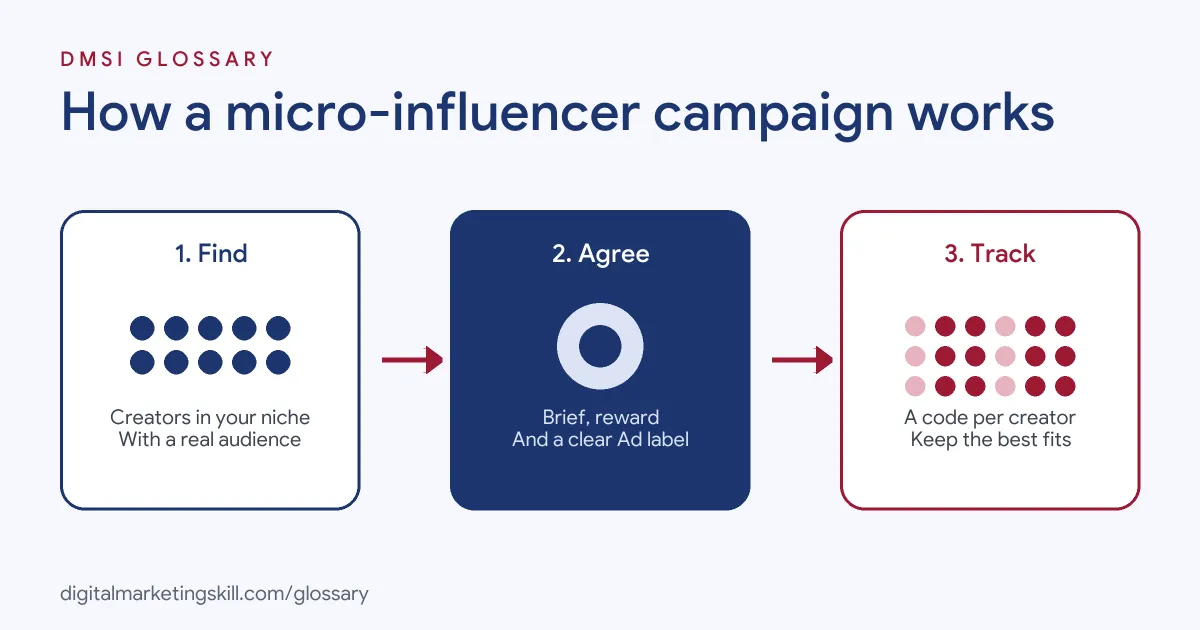
The process is like any creator campaign, but usually at a larger number of smaller partnerships. First, you find creators in your niche. Next, you agree a brief, a reward and a clear ad label. Finally, they post, and you track results for each creator.
Why Brands Use a Micro-Influencer
Sprout Social gives four main reasons. Lower fees let brands work with several creators and test different content. Smaller audiences tend to interact more with each post. Niche focus helps products reach people who already care about the topic. And their content often feels like a tip from a peer, which helps build trust. For a small brand, one micro-influencer with the right audience can be a low-risk first test.
The wider market reflects this. Influencer Marketing Hub’s benchmark report describes “a continued shift toward nano/micro and UGC-driven production.” In its survey, nano and micro were the most frequently priced tiers, at 29.54% and 22.36% of all cost selections. Macro creators made up just 4.35%.
Rewards and Labels for a Micro-Influencer
Smaller creators are often paid in free products, discounts or commission rather than cash. That doesn’t change the rules. The UK Competition and Markets Authority (CMA) says “Any form of incentive or reward” counts as payment, including gifts. So any post made in return must be “clearly labelled as an advert or ad”.
Micro-Influencer Examples
Here are three made-up examples of how brands use this tier:
- Local gym: A boxing studio invites five local fitness creators for free classes. Each posts a labelled review with a code for a free first session.
- Skincare start-up: A brand sends samples to 20 creators who focus on sensitive skin. It then reuses the best videos as paid social ads, with permission.
- Software tool: A design app partners with three creators who teach Canva-style tutorials. Each gets an affiliate link and a commission on paid sign-ups.
In each case, the brand picks creators by audience fit, not by size alone.
Micro-Influencer vs Nano, Macro and Celebrity
Here is a rough guide to the tiers. Follower ranges for nano and micro follow Sprout Social’s definitions; the other columns are general trade-offs:
| Tier | Typical followers | Main strength | Main trade-off |
|---|---|---|---|
| Nano | 1,000 to 10,000 | Close, personal audience | Very small reach per post |
| Micro | 10,000 to 100,000 | Niche focus with useful reach | Needs several creators to scale |
| Macro | Above micro | Large reach in one post | Higher fees, broader audience |
| Celebrity | Millions | Mass awareness | Highest cost, least targeted |
How to Work With a Micro-Influencer
A deal with a micro-influencer is often less formal than a big agency contract. Even so, it still needs a clear plan. Use these steps:
- Define your goal and your ideal customer.
- Search hashtags, keywords and competitors’ tagged posts to find creators in your niche.
- Check each creator’s audience. Look for real comments, steady growth and followers in your target country.
- Reach out with a short, personal message that shows you know their content.
- Agree the reward, deliverables, dates, ad label and any rights to reuse the content.
- Give each creator a unique code or tracked link.
- Let them write in their own voice, but check claims are accurate.
- Compare results across creators, then keep working with the best fits.
How to Measure Micro-Influencer Results
Because you work with several creators, measure each one on its own. Start with the action you care about, such as sales, sign-ups or app installs. Then add the numbers that explain why a creator did well or badly:
- Tracked results: orders or sign-ups from each creator’s code or link.
- Cost per result: what you paid, including the value of free products, divided by those results.
- Engagement quality: real comments and questions, not just likes.
- Content value: whether the post is good enough to reuse in your own ads.
Here is a made-up example. A brand gifts products worth £40 each to ten creators, so it spends £400. Two creators drive 30 orders between them, while the other eight drive five. The brand now knows where to focus. Next time, it offers those two a paid, longer partnership and tests a fresh group of creators alongside them.
Best Practices
- Choose fit over follower count. A creator whose audience matches yours beats a bigger one who doesn’t.
- Check for fake followers. The benchmark report found fake or bot followers made up 56.5% of reported fraud and quality issues.
- Build long-term relationships. Repeat partners know your product and sound more natural.
- Label every post. Gifted posts need a clear “Ad” label too.
- Track each creator separately. That shows you who drives results, not just reach.
Common Mistakes
Brands often contact dozens of creators with the same copied message, so few reply. Others pick creators by follower count and ignore where the audience lives. Some forget that gifts count as payment and skip the ad label. Many send rigid scripts that make posts sound forced. Finally, some judge the campaign on likes alone. The benchmark report warns that raw engagement “can mislead you” unless you check its quality.
Where You’ll Work With Micro-Influencers
Job listings rarely use the exact term, but creator partnerships appear in many social and marketing roles. For example, recent remote listings ask candidates to:
- “Identify and coordinate local partnerships with businesses, creators, influencers, and community organizations” (Social Media and Partnerships Coordinator).
- Show “Experience with UGC, influencer marketing and creator partnerships” (Digital Marketing Manager).
- Be “Knowledgeable in SEO, SMM, PPC, Influencer marketing or similar fields” (Digital Marketing Manager).
So if you want to work as a Social Media Manager, Paid Social Specialist or Content Creator, expect to find niche creators, manage several partnerships and report on each one.
Learn It in the Social Media Track
You can learn to plan creator campaigns in the AI-Powered Social Media Management and Advertising track. It covers AI fundamentals, content creation with graphics and video, social media marketing and analytics, and social media advertising. Your portfolio project is a paid social campaign that you plan, create and run for a real brand. You also get unlimited 1-on-1 mentoring and a U.S. Project Internship from day one.
Next, read our guides to influencer marketing for small businesses and becoming a social media influencer. You may also like our glossary entry on influencer marketing.
Frequently Asked Questions
How many followers does a micro-influencer have?
A common definition is 10,000 to 100,000 followers. However, there is no official standard, so ranges vary between sources.
What is the difference between nano and micro?
Nano-influencers are smaller, often 1,000 to 10,000 followers. Micro-influencers sit above them, with more reach but usually a similar niche focus.
Do micro-influencers need to label gifted posts?
Yes. In the UK, the CMA treats gifts as payment, so any post made in return for a gift must be clearly labelled as an ad.
Are micro-influencers cheaper than big creators?
Usually, yes. Lower fees are one reason brands work with them, which lets them partner with several creators for the same budget.
How do I find the right creators?
Search your niche’s hashtags and keywords, look at who your customers follow and check each creator’s audience before you reach out.
Sources: Sprout Social: Micro-influencers; Influencer Marketing Hub: Benchmark report; CMA: Social media endorsements guide; remote job listings on Himalayas.