
A digital creator makes original content, such as video, writing, audio or graphics, for an audience on one or more platforms. Income comes through ads, sponsorships or direct sales. Becoming one takes a real platform threshold to clear, a format to commit to, and more than one income source. This guide shows the actual numbers behind each step.
Key Takeaways
- Platforms set a hard bar, not a vibe. YouTube’s own Partner Program requires 1,000 subscribers plus either 4,000 public watch hours in the past 12 months or 10 million Shorts views in the past 90 days before ad revenue turns on.
- Nobody agrees on the market size. Research firms sizing the creator economy for the same year landed anywhere from roughly $214 billion to $323 billion. That spread is a sign the category is still being defined, not a number to quote as settled fact.
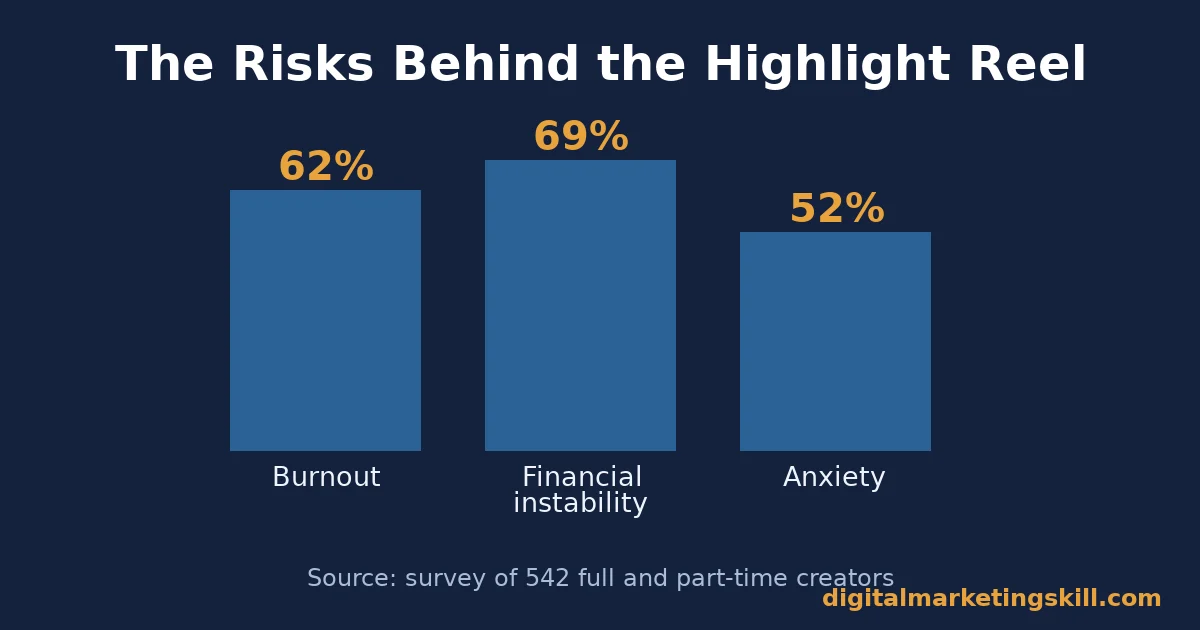
- Burnout is common and underserved. A survey of 542 creators found 62% reported burnout and 69% reported financial instability tied directly to their work. Most said they lack specialized mental health support.
- Consistency still beats volume. Buffer’s analysis of over 100,000 social accounts found creators active 20 or more weeks out of 26 earned roughly 5x the per-post engagement of those active 4 weeks or fewer.
- The creator tooling market keeps growing. Grand View Research values the influencer marketing platform market at $34.2 billion, expanding at a 14.4% compound annual growth rate.
In this guide
- What Most “Become a Digital Creator” Guides Skip
- How Creators Actually Get Paid
- Three Formats, Three Different Paths to an Audience
- How to Lead With Proof in Each Format
- Mistakes That Slow Down New Creators
- The Risks Most Guides Leave Out
- How to Measure Whether You Are Building a Real Audience
- A Simple First 90 Days for a New Digital Creator
- The One Rule: Clear One Platform Threshold Before You Go Full Time
- A Real Case: Income Before a Big Following
- Frequently Asked Questions About Becoming a Digital Creator
- Start With One Format, One Platform, One Proof Point
What Most “Become a Digital Creator” Guides Skip
Most advice says “find your niche” and “stay consistent,” then stops. It rarely names the actual threshold a platform requires before it pays you anything. It almost never mentions that most creators run on more than one income source, because any single one is unreliable.
This guide treats those two gaps as the real content. It names the specific numbers platforms publish, and it builds the discipline of earning income you do not depend on a single algorithm to keep. That discipline starts with knowing how to identify your target audience before you pick a format or a platform.
How Creators Actually Get Paid
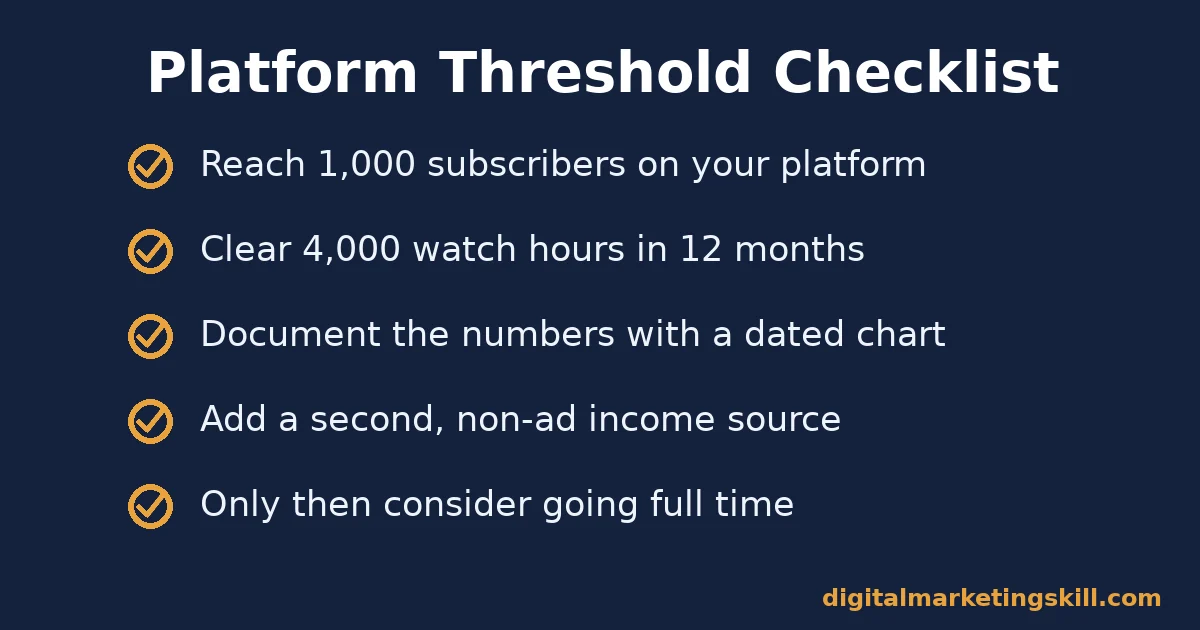
Ad revenue is the most visible income source, but it only switches on past a published threshold. YouTube’s Partner Program needs 1,000 subscribers. It also needs either 4,000 public watch hours in the trailing 12 months or 10 million Shorts views in the trailing 90 days. Watch hours and Shorts views do not combine; a channel must clear one path or the other.
Why Consistency Beats a Single Viral Post
A single viral post rarely builds a career on its own, because platforms reward accounts that keep showing up. Buffer tracked over 100,000 accounts across 10 platforms for 26 weeks. Accounts active in 20 or more of those weeks earned about 5x the per-post engagement of accounts active in 4 weeks or fewer. Engagement peaked around week 21.
That is the mechanism behind “post consistently.” The platform is reading cadence, not just quality. A creator who posts on a schedule, even an imperfect one, builds more measurable proof than one who waits for the perfect idea.
Sponsorships and affiliate income work on a different mechanism. A brand pays for documented reach or a documented result, not for the platform’s own ranking signal. That is why a creator’s own analytics, screenshotted and dated, matter as much as the social media content itself when a brand decides whether to pay for a sponsorship.
Brands typically pay a digital creator one of two ways: a flat fee for a specific deliverable, or a performance-based rate tied to clicks or sales. A flat fee is predictable but caps the upside; a performance rate can pay more, but only once an audience is large and trusting enough to act on a recommendation.
Three Formats, Three Different Paths to an Audience
The format you choose changes which platform threshold applies and how fast you can realistically grow. Picking one format and going deep beats spreading thin content across three.
None of the three formats below is objectively better. The right one depends on what you can produce consistently with the equipment and time you already have, not on which format looks most impressive.
Video Creator: Built for Reach Through Watch Time
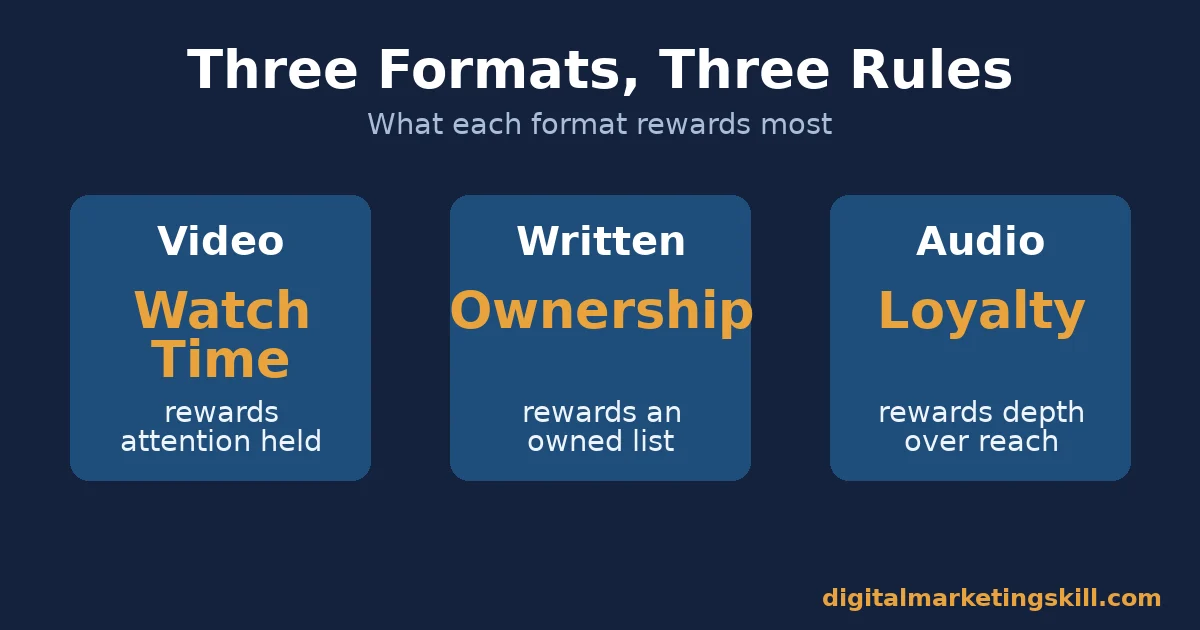
Video rewards watch time directly. YouTube’s own threshold is measured in watch hours, so a video creator’s early goal is simple: hold attention long enough, often enough, to accumulate that number.
Short-form video also carries real reach. HubSpot’s State of Marketing research found short-form video was the single highest-ROI content format marketers named, cited by 48.6% of respondents.
A practical starting point: pair a short-form clip with a longer version of the same idea. The short clip earns discovery, while the longer video earns the watch hours YouTube’s threshold actually counts. Many creators treat the short form as the trailer and the long form as the product.
Written Creator: Built for Search and Ownership
Written content, such as a blog or newsletter, grows more slowly. It gives the creator something video rarely does: an owned list and a search-indexed archive that keeps working without a repost.
A written creator is less exposed to a single platform’s ranking change, because the audience list travels with them. That matters even more once it is paired with a few reliable content distribution channels outside the platform you grew up on.
A practical starting point: turn every long article into a short email to your own list. The article earns search traffic over time, while the email earns a direct, repeatable relationship that no algorithm change can take away.
Audio Creator: Built for Loyalty Over Raw Reach
Podcast audiences are smaller on average than video audiences, but they listen longer per session. They also convert well for sponsors who want attention, not just impressions.
An audio creator typically trades reach for depth: fewer listeners, but listeners who finish episodes and trust recommendations made inside them.
A practical starting point: interview one guest with a built-in audience of their own. A single well-chosen guest episode can introduce a new podcast to listeners who would never have searched for it directly.
How to Lead With Proof in Each Format
Each format rewards a different kind of evidence when you pitch a sponsor or apply for a platform fund. Build the proof your format actually produces.
Video Creator: Lead With a Watch-Time Chart
Show average view duration and total watch hours over a defined period, with the upload cadence that produced them. A sponsor wants to see that people finish your videos, not just click on them.
Written Creator: Lead With List Growth and Open Rate
Show subscriber growth and open rate over a defined period. A healthy open rate on a smaller list usually outperforms a large, disengaged one when a sponsor is deciding where to spend.
Audio Creator: Lead With Completion Rate and a Direct Testimonial
Show episode completion rate alongside one or two direct listener testimonials naming a specific action they took after an episode. Completion rate tells a sponsor your audience listens to the end, where most sponsor reads live.
Mistakes That Slow Down New Creators
Five habits keep a new digital creator stuck at “hobbyist” long after they have put in real hours.
Chasing every platform at once. Splitting limited time across five platforms produces five shallow channels instead of one that can actually clear a threshold. Pick one platform and one format first.
Skipping the niche decision. A digital creator who posts about everything rarely builds the loyal, returning audience that sponsors and platforms both reward. A narrow niche, done well, beats a broad one done thinly.
Ignoring the platform’s own numbers. Posting without checking watch time, open rate or completion rate means flying blind. Those numbers tell a creator exactly what to change next.
Relying on one income source. Ad revenue alone is fragile, since a single policy or algorithm change can remove it overnight. Add a second income source, such as an affiliate link or a small digital product, as soon as you have any audience at all.
Quitting a stable income too early. The burnout and financial instability data below is a direct warning: treat full-time creating as a destination you grow into, not a leap you take on faith.
The Risks Most Guides Leave Out
Two risks deserve more attention than they usually get, because both are documented, not anecdotal.
Burnout is common. A survey of 542 full and part-time creators found 62% reported burnout and 52% reported anxiety tied to their work. Another 69% reported financial instability as a direct result. Treat a posting schedule as sustainable, not just ambitious, from the start.
Platform dependency is a real business risk. A single algorithm change can cut reach overnight. That is why diversifying income across ads, sponsorships, affiliate links and owned products protects a creator the way a diversified portfolio protects an investor. No single income source should cover more than you can afford to lose.
Comparison is a quiet third risk. Watching other creators’ highlight reels while judging your own behind-the-scenes numbers distorts how progress actually feels. Compare your current month to your own prior month, not to someone else’s best day.
How to Measure Whether You Are Building a Real Audience
Four numbers separate a growing creator career from a stalled one.
- Watch time or read time is how long people actually spend with your content, not just whether they clicked. It is the clearest signal that content is working, because platforms and sponsors both weight it heavily.
- Subscriber-to-view ratio compares your subscriber count to your average views. A high ratio shows an engaged audience returning on purpose, not a one-time viral spike.
- RPM (revenue per thousand views) is the ad or platform income you earn for every 1,000 views, after the platform’s share. It shows whether growth is translating into money, not just attention.
- Income source count is simply how many separate ways you get paid. One is fragile; three or four is a business.
Track these monthly, not daily. A single viral day distorts every number for a week. Look at the trend across a full month before you change your content strategy.
Compare each number against your own baseline, not against a creator with a much bigger audience. A small, steady increase in watch time or open rate matters more than a single spike that never repeats.
A digital creator who tracks these four numbers for even three months has something most beginners never build: a real record of what their specific audience responds to, instead of a guess borrowed from someone else’s content.
A Simple First 90 Days for a New Digital Creator
Here is a simple plan, because a vague goal rarely turns into a finished routine. It breaks “become a digital creator” into a sequence of checkable steps.
Weeks 1 to 2: pick the niche and format. Write down the specific audience you want to reach and the one format you will use. Do not choose a platform yet; choose the audience and the content first.
By week six, publish on a fixed schedule. Pick a cadence you can sustain for months, not just weeks, and publish on that schedule even when a piece feels unfinished. Consistency, not perfection, is what the data in this guide rewards.
Around week ten, review the numbers and adjust. Check watch time, open rate or completion rate, whichever applies to your format. Keep whatever is working, and change the specific element, such as the opening or the topic, that is not.
In the final weeks, add a second income test. Even with a small audience, test one monetization path, such as an affiliate link or a small digital product. That way you are not waiting on ad revenue alone to prove the idea works.
The One Rule: Clear One Platform Threshold Before You Go Full Time
If you remember one piece of advice from this guide, make it this. Hit a real, documented platform threshold, such as YouTube’s 1,000 subscribers and 4,000 watch hours, before you treat creating as your main income.
Here is an illustrative example, with invented numbers, not a real channel: post consistently for 26 weeks, track watch hours monthly, and aim to cross the YouTube threshold by week 20. Hitting it with documented proof gives you something concrete to show a sponsor.
Quitting a stable income before any platform threshold is cleared turns a creative hobby into an unplanned financial risk, and the burnout data above shows how often that risk turns real.
A Real Case: Income Before a Big Following
Azeezat Bukola, a graduate of the Digital Marketing Skill Institute, reported making back double the cost of her course in her first month, before she had built any following on social media. The case matters because it shows income can come from applying a skill directly to clients, not only from audience size or ad revenue.
It does not mean every new creator doubles their investment in a month. Results depend on the skill, the market and the effort involved, and individual results vary, as the Institute’s own earnings disclaimer states. Every successful digital creator this guide has referenced started with one format, a real schedule, and numbers they were willing to look at honestly, including the disappointing months.
What it demonstrates is the point this guide makes about diversification: a creator skill can produce income through direct client work while an audience is still being built, which is exactly the kind of second income source the risks section above recommends.
Frequently Asked Questions About Becoming a Digital Creator
What is the difference between a digital creator and an influencer?
A digital creator focuses mainly on making original content, such as videos, writing or audio. An influencer focuses on using an established audience to promote brands, products or opinions. Many people do both, but the core focus differs: creation first, versus influence first.
How long does it take to become a full-time digital creator?
There is no fixed timeline, because it depends on format, niche and consistency. Clearing a real platform threshold, such as YouTube’s 4,000 watch hours in 12 months, is a more useful milestone than a calendar date. It shows a platform is actually ready to pay you.
Do you need expensive equipment to start?
No. A smartphone camera and basic free editing software can produce content good enough to test a format and a niche. Upgrade equipment once a specific limitation, such as audio quality, is actually holding back your results.
How do digital creators make money besides ads?
Common sources include sponsorships, affiliate marketing commissions, selling digital products or courses, memberships or subscriptions, and consulting. Most sustainable creator income comes from combining several of these rather than relying on one.
Is becoming a digital creator still worth it with so much competition?
Yes, but expect a real threshold to clear before it pays consistently. Competition is real, which is why a defined niche, a documented posting cadence and proof of audience engagement matter more than simply being first.
Do digital creators need to disclose sponsored content?
Yes, wherever sponsored content appears. The FTC’s disclosure guidance requires a material connection to be stated clearly, next to the content itself, not hidden in a bio or buried among hashtags.
Which platform should a new creator start on?
Start on the platform that matches your chosen format, where your specific audience already spends time, based on current data rather than assumption. Go deep on one platform and one format before adding a second.
How narrow should a digital creator’s niche be?
Narrow enough that a specific audience immediately knows the content is for them, but broad enough to sustain months of ideas. A digital creator who tries to serve everyone usually ends up reaching no one consistently.
Start With One Format, One Platform, One Proof Point
You do not need every platform or every income stream on day one. You need one format, posted consistently, with the numbers tracked honestly enough to show a sponsor or justify going full time.
Pick the format from this guide that matches what you can commit to now. Track your numbers monthly, and treat the YouTube threshold, or your platform’s equivalent, as your first real milestone.
For structured practice instead of guesswork, the Digital Marketing Skill Institute’s Master Diploma in Digital & AI Marketing includes an AI-Powered Social Media Management and Advertising track, one of four AI-powered tracks totalling ten courses, with a Full Stack option if you want all four.
Every track includes unlimited 1-on-1 coaching and mentoring, a U.S. Project Internship with a verified U.S. Work Reference Letter, and dual US and UK accreditation recognised in more than 100 countries. You study 100% online, from anywhere in your country.
See the program details and apply at the Master Diploma in Digital & AI Marketing, or browse more guides on the digital marketing blog. Go straight to the application page when you are ready. Learn more at digitalmarketingskill.com, wherever you live, or start browsing from the homepage today.
Every figure in this guide was checked against its original source before publication. Figures marked as illustrative are invented examples, not real results.
