

Choosing a marketing agency comes down to proof, not pitch quality. The top reasons clients fire an agency are dissatisfaction with delivery and dissatisfaction with value, each cited by 61% of departing clients. Yet most agencies still blame budget cuts for lost accounts. This guide shows what to actually check before you sign, wherever your business is based.
Key Takeaways
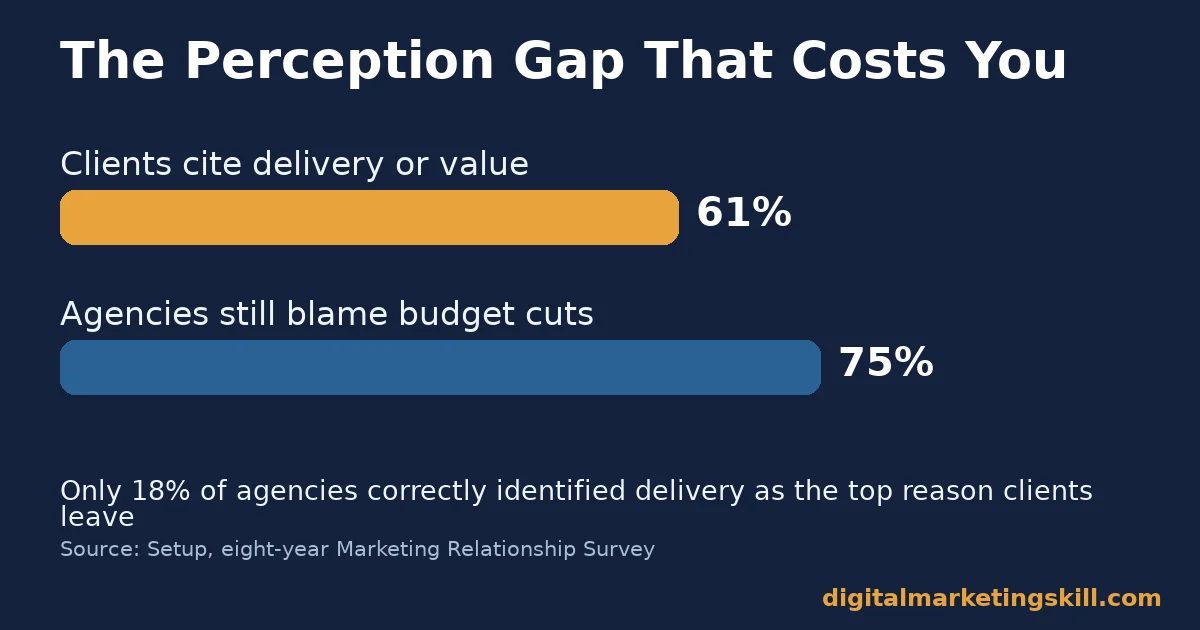
- Delivery and value drive firings, not budget. Setup’s eight-year Marketing Relationship Survey found 61% of clients cite dissatisfaction with delivery and 61% cite dissatisfaction with value as top reasons for ending an agency relationship.
- There is a perception gap you can use. The same research found 75% of agencies still believe budget cuts are the leading cause of lost clients, while only 18% of agencies correctly identified delivery issues. Ask delivery questions the pitch will not volunteer.
- Good relationships now run for years, not months. ANA and 4As tenure research found the average client-agency relationship now runs about 7 years, more than double the 3.2-year average reported roughly a decade earlier.
- Skill gaps make the wrong hire costly. In Robert Half’s research on marketing hiring, 52% of US marketing and creative leaders report skill shortages have caused project delays, and 44% say analytics work is hit hardest. A weak agency hire compounds exactly that gap.
- Reporting ability is rarer than agencies claim. Content Marketing Institute’s B2B research found 25% of marketers point to a lack of data skills as the reason they struggle to prove results. Ask to see a real report before you sign.
In this guide
- The Perception Gap Most Agency-Selection Advice Misses
- Why Agency Relationships Actually End
- Three Angles for Choosing a Marketing Agency, Beyond the Pitch Deck
- How to Test Each Angle Before You Sign
- How to Measure an Agency Relationship Once It Starts
- The One Decision Rule: Judge the Ordinary Month, Not the Pitch
- A Short Evaluation Process Before You Sign
- What Pricing Transparency Should Look Like
- What to Expect on Price, Without Chasing the Lowest Number
- Red Flags Worth Asking About Directly
- How to Run a Reference Call That Actually Helps
- A Real Case: What the Right Specialist Fit Can Produce
- Common Mistakes When Choosing a Marketing Agency
- Frequently Asked Questions About Choosing a Marketing Agency
- Ask for the Ordinary Month, Then Decide
- Related Reading on Marketing Agencies and Careers
The Perception Gap Most Agency-Selection Advice Misses
Most guides to choosing a marketing agency list generic questions: ask about experience, ask about pricing, check references. None of that is wrong, but none of it closes the actual gap between what agencies think keeps clients and what keeps clients in reality.
That gap is documented, not assumed. Clients say delivery and value end relationships. Most agencies still believe it is the client’s budget. A buyer who understands this gap can ask sharper questions than one working from a generic checklist.
This guide builds from that gap. Where a figure comes from a US-only survey, that is flagged, because typical pricing, contract norms and legal protections vary by country.
Three things stay stable enough to plan around no matter where your business is based. Delivery and value, not budget, decide most agency breakups. Reporting on real outcomes beats reporting on activity. And testing fit before signing beats discovering problems after. Choosing a marketing agency carefully on these three points avoids most of the regret this guide is built to prevent.
Why Agency Relationships Actually End
An agency rarely loses a client over one bad month. It loses them when delivery quietly slips below what was promised, and nobody flags it until the client has already decided to leave.
This is why asking about past results is not enough. Almost every agency can show a strong case study from somewhere. What predicts a good fit is how the agency handles the ordinary months, not just its best one.
Relationship length confirms this. Agencies with longer average tenure tend to be the ones built around regular, honest reporting rather than infrequent reviews. The ANA and 4As research found that clients without mandatory review periods actually stayed longer than those with frequent, high-pressure reviews, because consistent reporting replaced the need for a formal check-in.
Choosing a marketing agency well also means hiring well once work starts. Harvard Business Review’s research on skills-based hiring backs weighing proven project work over job titles alone, a principle worth asking an agency about directly: who on the account team has actually delivered the specific result you need, not just who holds the title.
Three Angles for Choosing a Marketing Agency, Beyond the Pitch Deck
Most buyers evaluate an agency on one thing: the pitch. A sharper evaluation checks three separate angles, because each one predicts a different kind of future problem.
Choosing a Marketing Agency on Delivery Proof
Ask for a recent, ordinary month of client reporting, not the agency’s best case study. This shows you how they communicate when results are average, which is most months for most clients.
Choosing a Marketing Agency on Communication Fit
Ask who you will actually work with day to day, not just who is in the pitch meeting. A senior pitch team handing you off to a junior account manager is one of the most common sources of later dissatisfaction.
Choosing a Marketing Agency on Reporting Transparency
Ask which metrics they report by default, and which ones they only share if asked. An agency that defaults to activity metrics, like posts published, over outcome metrics, like leads generated, is telling you how it will report when things slow down.
How to Test Each Angle Before You Sign
Knowing what to check only helps if you actually test it during the sales process, not after the contract starts.
Delivery: Request a Sample Report, Not Just a Case Study
Ask directly for a real, recent monthly report, with client names redacted if needed. An agency that hesitates to share one is telling you something about what their regular reporting actually looks like.
Communication: Meet the Actual Account Team
Before signing, ask to speak briefly with the person who will run your account day to day. An agency confident in its delivery will not resist this request.
Reporting: Agree the Metrics in Writing First
Put the specific outcome metrics you expect to see, and how often, into the contract or statement of work. This removes the ambiguity that lets activity metrics quietly replace outcome metrics later.
How to Measure an Agency Relationship Once It Starts
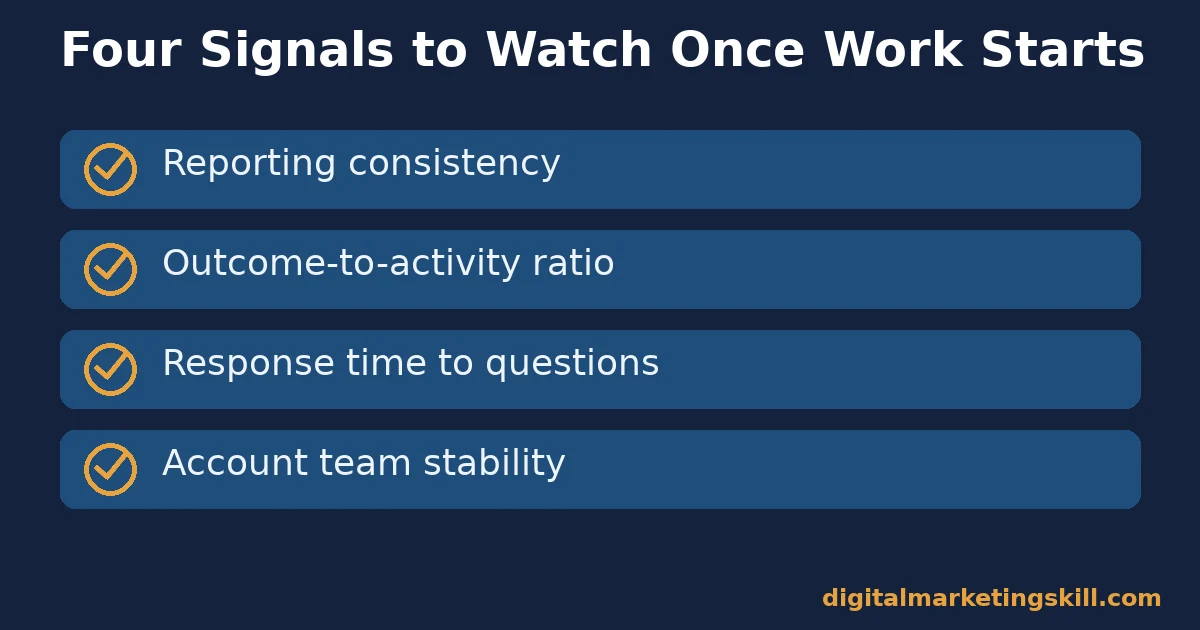
Once work begins, track these four signals so a slipping relationship is visible early, not only at renewal time.
- Reporting consistency. Whether reports arrive on schedule, with the agreed metrics, every period. A slipping cadence is often the first visible sign of a slipping relationship.
- Outcome-to-activity ratio in reports. How much of each report covers actual outcomes versus activity completed. A rising share of activity-only reporting is a warning sign worth raising directly.
- Response time to questions. How long it takes to get a clear answer when something looks off. Slow, vague answers tend to appear before larger delivery problems do.
- Account team stability. Whether the same people stay on your account over time. Frequent unexplained handoffs often precede the delivery slip that ends relationships.
Read these four together. Good reporting with a slow response time usually means an overloaded team, not a dishonest one. Frequent handoffs with declining outcome reporting is the combination most worth raising early, before it becomes a reason to leave.
The One Decision Rule: Judge the Ordinary Month, Not the Pitch
Before signing, ask to see how the agency reports on an average month, not its best case study. A pitch is built to impress once. An ordinary monthly report shows you what you are actually buying for the other eleven months of the year.
Here is an illustrative, invented example to show the logic, not a real study. Two agencies pitch with similarly strong case studies. One shares a real, unremarkable monthly report when asked; the other stalls and sends a polished summary instead. The first agency is showing you its actual process. That second one is still pitching. The case studies look identical, but the decision rule points clearly to one choice.
A Short Evaluation Process Before You Sign
Turn the angles above into a simple process you can run with any shortlist, instead of judging agencies purely on gut feeling.
Step One: Request the Ordinary Report
Ask every shortlisted agency for a recent, ordinary monthly report, with client details redacted if needed. Compare how each one responds, not just what the report contains.
Step Two: Meet the Actual Account Team
Ask to briefly meet whoever will run your account day to day, separate from the pitch team. A short call reveals more about fit than another round of slides.
Step Three: Agree Metrics and Cadence in Writing
Before signing, write down the specific outcome metrics you expect and how often you expect them. This single step prevents most of the vague-reporting disputes that surface later.
Step Four: Set a Review Point Early
Pick a review date in the first few months, before a full year has passed. This gives both sides a clear, low-pressure point to course-correct instead of waiting for frustration to build.
What Pricing Transparency Should Look Like
A trustworthy proposal explains what you get for the price, not just the number itself.
A Clear Scope Attached to the Price
The proposal should state exactly what is included each month: how many deliverables, which channels, and what is explicitly out of scope. A vague scope is where future upsells and disputes usually start.
Clarity on What Costs Extra
Ad spend, tools and one-off projects are often billed separately from the core retainer. Ask for this breakdown upfront, so the invoice never contains a surprise you were not warned about.
What to Expect on Price, Without Chasing the Lowest Number
Price varies a lot by country, by channel and by agency size. There is no single safe number to quote here. What matters more is how the price maps to the scope.
Ask a simple question of every quote. What exactly do you get for this price, each month? If the answer is vague, the price itself tells you very little. If the answer is specific, you can compare quotes fairly, even across very different price points.
Be wary of a quote that sits far below every other one on your shortlist. It usually means less time on your account, not a better deal. Choosing a marketing agency on price alone, without checking scope, is one of the most common and most avoidable mistakes in this guide.
Red Flags Worth Asking About Directly
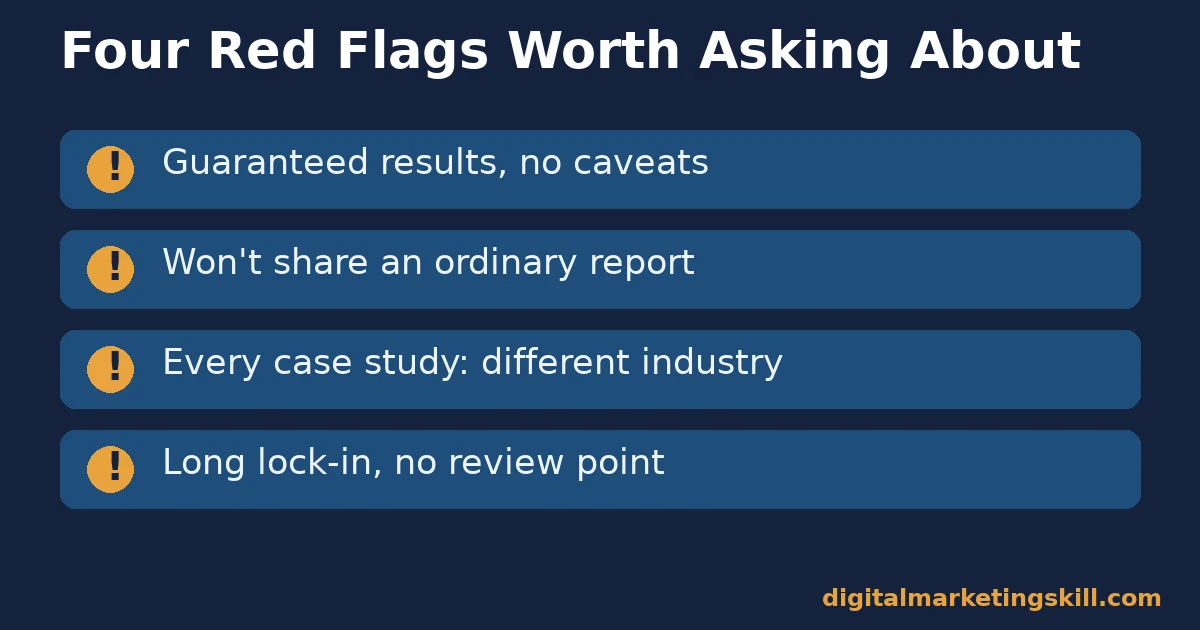
None of these alone disqualifies an agency, but each one deserves a direct question before you sign.
- Guaranteed results with no caveats. No honest agency can guarantee a specific outcome in a channel it does not fully control, such as organic search rankings.
- Reluctance to share an ordinary report. Covered above, and still one of the clearest signals available before you sign anything.
- Every case study is from a different industry than yours. Relevant experience in your specific market is not required, but its total absence is worth a direct conversation.
- Long lock-in with no early review point. A confident agency should be comfortable with a review point well before the contract’s full term ends.
How to Run a Reference Call That Actually Helps
Most reference calls waste time. The agency picks the reference. The reference says nice things. You learn little you could not have guessed. A better call asks sharper, more specific questions.
Ask About an Ordinary Month, Not the Best One
Ask the reference to describe a normal month, not their best result. This question alone usually separates a genuinely strong agency from one that only shines in its pitch.
Ask How the Agency Handled a Real Problem
Every agency relationship hits a rough patch eventually. Ask how the team responded when something went wrong. The answer tells you more about choosing a marketing agency wisely than any list of services ever will.
Ask Why They Stayed, or Why They Left
If the reference is a current client, ask what would make them leave. If they are a former client, ask directly why they left. Both answers map closely to the delivery and value reasons covered earlier in this guide.
A Real Case: What the Right Specialist Fit Can Produce
Olajire Jacob, a graduate of the Digital Marketing Skill Institute, shows what choosing the right specialist can look like from the client’s side. As published on the Digital Marketing Skill Institute reviews page, he built a focused service around email marketing flows, charging around $500 per project for clients in the US, UK and Canada.
His clients kept returning and referring more work, which let him scale to roughly $5,000 a month. From the client side, that pattern usually means the specialist delivered consistently, not just once. Results like this are individual and not typical for every provider or every market, so read the Institute’s earnings disclaimer before treating any income figure as a guarantee.
Common Mistakes When Choosing a Marketing Agency
These mistakes show up again and again, regardless of company size or budget.
Judging Only on Case Studies
A case study is the agency’s single best month, curated for the pitch. Ask for an ordinary one too, since that is closer to what most months will actually look like.
Assuming the Pitch Team Will Run Your Account
Senior staff often lead the pitch, then hand the account to a more junior team. Confirm who will actually do the work before you sign, not after.
Accepting Vague Reporting Promises
“We’ll send regular updates” is not a commitment. Agree specific metrics and a specific cadence in writing, so there is something concrete to hold the relationship to later.
Choosing on Price Alone
The cheapest proposal is rarely the cheapest outcome once delivery slips and you have to search again. Weigh price against the delivery and reporting proof described in this guide, not in isolation.
Skipping Reference Calls to Save Time
A reference call takes twenty minutes. A bad agency fit can cost months. Make the time, and ask the sharper questions in this guide, not just the generic ones.
In the US specifically, the Bureau of Labor Statistics finds roughly 20% of new businesses close within their first year. A struggling client is far more likely to blame a cheap, unproven agency than to absorb the cost of switching again.
Frequently Asked Questions About Choosing a Marketing Agency
What questions should I ask before choosing a marketing agency?
Ask for a real, recent monthly report, ask who will actually run your account day to day, and ask which metrics they report by default. These three questions reveal more than a generic reference check.
How long should a marketing agency contract be?
There is no universal answer, but shorter initial terms with a clear review point let you test fit before committing to a longer relationship. Avoid long lock-in periods with an agency you have not worked with before.
Is it a red flag if a marketing agency won’t share a sample report?
Yes, generally. An agency confident in its regular delivery usually has no reason to withhold a redacted, ordinary monthly report. Hesitation here is worth exploring further before you sign.
Should I choose a specialist or a full-service marketing agency?
It depends on your need. A specialist usually delivers deeper results in one channel, while a full-service agency offers convenience across several. Match the choice to whether you need depth in one area or coordination across many.
How do I know if my current marketing agency is underperforming?
Track reporting consistency, the balance of outcome versus activity metrics, and how quickly questions get clear answers. A decline in any of these often appears before results visibly slip.
Can a marketing agency be based in another country?
Yes. Since most agency work is delivered through calls, shared documents and dashboards, location matters far less than delivery proof, communication fit and reporting transparency.
What should be in a marketing agency contract before you sign?
Include the specific scope, the metrics the agency will report and how often, what costs extra, and an early review date. These four items prevent most of the disputes that surface later in agency relationships.
How many agencies should I shortlist when choosing a marketing agency?
Three is usually enough to compare meaningfully without the evaluation process becoming a project in itself. Run the same four-step evaluation on each one, so the comparison stays fair.
What is the single best question to ask when choosing a marketing agency?
Ask to see a real, ordinary monthly report. It reveals more about delivery, honesty and communication style than any other single question in this guide.
Ask for the Ordinary Month, Then Decide
Pick one agency on your shortlist. Ask to see an ordinary monthly report, not just the best case study. Let that single document do more of the deciding than the pitch meeting did. Choosing a marketing agency this way takes a little longer up front, but it is far cheaper than restarting the search in six months.
If you are building this kind of specialist skill yourself rather than hiring it out, the Master Diploma in Digital & AI Marketing at Digital Marketing Skill Institute pairs practical courses with unlimited one-on-one mentoring. The courses include AI-powered lead generation, AI-powered email marketing and automation, and AI-powered search engine optimisation and content marketing, with a real project inside a US partner company.
The diploma is dual US and UK accredited, and recognised in more than 100 countries. It is delivered 100% online, so you can build that proof of delivery anywhere in your country, or abroad. See the full program details and apply here when you are ready, or browse more practical guides on the Digital Marketing Skill Institute blog.
Related Reading on Marketing Agencies and Careers
For deeper reading on related decisions, see our guides on how to start a digital marketing agency that gets clients and digital marketing career tips that get you hired. Also see what the data says about pay, demand and skills and what skills-based hiring really takes.
Every figure in this guide was checked against its original source before publication. Figures marked as illustrative are invented examples, not real results.
![9 Amazing Digital Marketing Skills to Make Money Online [With Proof]](https://digitalmarketingskill.com/wp-content/uploads/2019/07/9-Amazing-Digital-Marketing-Skills-to-Make-Money-Online-With-Proof-17.png)






