

A digital marketing agency survives on retention, not on winning clients once. Retainer-based agencies hold clients for an average of 56 months, while project-only agencies lose them after about 24. That single fact should shape how you launch. This guide shows the model, the numbers to track, and the mistakes that sink a new agency early, wherever you are starting from.
Key Takeaways
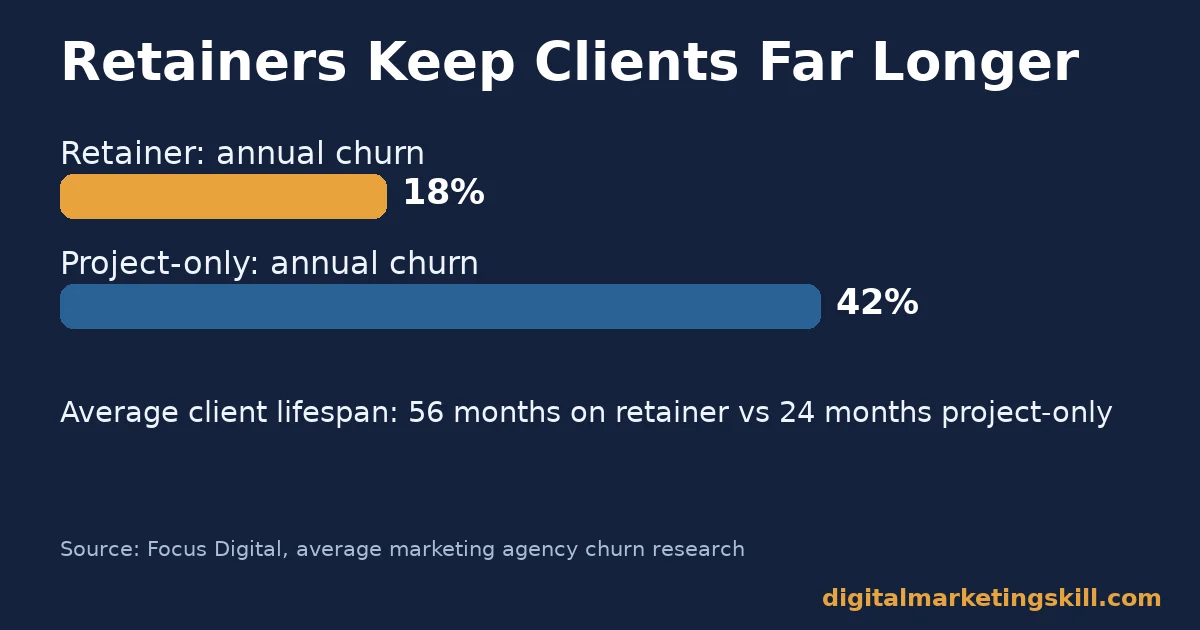
- Retainers beat projects on retention. Agency research from Focus Digital found retainer-based agencies have an 18% annual churn rate and a 56-month average client lifespan, against 42% churn and 24 months for project-only agencies.
- New businesses fail faster than most people think. US Bureau of Labor Statistics data shows roughly 20% of new businesses close within their first year, and under half are still operating five years later.
- The skills gap is your opening. In Robert Half’s research on marketing hiring, 52% of US marketing and creative leaders say skill shortages caused project delays, and 44% say analytics work was hit hardest. A capable agency fills exactly that gap.
- Measurement skill is rarer than people assume. Content Marketing Institute’s B2B research found that 25% of marketers point to a lack of data skills as the reason they struggle to prove results. Agencies that can prove results stand out immediately.
- The client pool is global. DataReportal’s global digital overview puts internet users at more than seven in ten people worldwide, so a digital marketing agency is not limited to one city or country from day one.
In this guide
- What Most Digital Marketing Agency Advice Skips
- How a Digital Marketing Agency Actually Survives Its First Year
- Three Ways to Start a Digital Marketing Agency, and What Each One Risks
- How to Launch Each Model Without the Common Early Mistakes
- How a Digital Marketing Agency Should Price Its Work
- How to Measure Whether Your Digital Marketing Agency Is Actually Working
- The One Decision Rule: Fix Retention Before You Chase More Leads
- A Four-Week Plan to Launch a Digital Marketing Agency
- Where a New Digital Marketing Agency Actually Finds Its First Clients
- A Real Case: Scaling One Skill Into a Client Business
- Common Digital Marketing Agency Mistakes to Avoid
- Frequently Asked Questions About Starting a Digital Marketing Agency
- Start With One Service, One Retainer Client, Then Build
- Related Reading on Building a Digital Marketing Business
What Most Digital Marketing Agency Advice Skips
Most guides to starting a digital marketing agency list the same steps. Pick a niche. Build a website. Find clients. None of that is wrong, but none of it explains why some agencies grow past their first few clients while others stall and close within a year.
The missing piece is the business model underneath the services. A digital marketing agency selling one-off projects behaves completely differently from one selling retainers, and the data on survival and churn makes that difference concrete.
This guide treats that difference as the starting point. Where a figure comes from a US-only survey, that is flagged, because startup costs, typical pricing and legal setup vary sharply by country.
Three things stay stable enough to plan around no matter where you start a digital marketing agency. Retainer relationships last longer than project relationships. Skill shortages at other companies are opportunity for yours. And reporting on real outcomes, not just activity, is what keeps a client past the first renewal. Everything below builds on those three facts.
How a Digital Marketing Agency Actually Survives Its First Year
A new agency rarely fails because the work was bad. It fails because the pipeline runs dry between projects, or because clients leave faster than new ones arrive. Those are both retention problems, not skill problems.
This is where the retainer-versus-project distinction matters. A retainer client pays every month for ongoing work, which gives a digital marketing agency predictable income and a longer relationship to prove results. A project client pays once, then the relationship has to be won again from zero.
The churn numbers above are not abstract. An agency living on projects needs roughly twice the new-client flow of a retainer agency just to stay the same size, because its clients leave twice as fast. That single mechanism explains more about early agency failure than any list of launch steps.
Three Ways to Start a Digital Marketing Agency, and What Each One Risks
Most people starting a digital marketing agency choose between three realistic starting models. Each one trades speed for stability differently.
Model 1: Freelance-First Proves Demand Before You Hire Anyone
You take on client work solo, under your own name or a simple brand, before building a team. This proves real demand exists before you take on the overhead of staff. The risk is a ceiling: one person can only service so many retainer clients well.
Model 2: A Niche Specialist Agency Proves Expertise Fast
You pick one channel, such as email marketing or paid social, and one or two industries you understand. Specialists can charge more and close deals faster, because the pitch is specific. The risk is a smaller addressable market, which matters less once you have real client results to point to.
Model 3: A Full-Service Agency Proves You Can Scale, Eventually
You offer a wide range of services from the start, aiming to be a one-stop shop. This can win larger clients who want one vendor for everything. The risk is depth: a small team spread across many services rarely matches a specialist on quality, especially in the first year.
When you do hire, Harvard Business Review’s research on skills-based hiring backs weighing a candidate’s proven project work over job titles alone. That matters even more at agency scale, where one weak hire affects several client accounts at once.
How to Launch Each Model Without the Common Early Mistakes
Each starting model needs a different first move. Here is what actually works for each one.
Freelance-First: Lead With One Proven Skill and One Case
Do not open with a full services list. Open with the one service you can prove, backed by a real result, even a small one. A single verified outcome beats a long menu of services nobody has tested with you yet.
Niche Specialist: Lead With the Industry, Not Just the Channel
Name the industry you serve in your pitch, not only the channel. “Email marketing for independent clinics” closes faster than “email marketing agency,” because the prospect immediately sees themselves in the pitch.
Full-Service: Lead With a Core Service, Add the Rest Later
Even a full-service agency should launch around one strong core offer. Add the other services once the first one is earning retainer revenue, instead of launching all of them at once with no proof behind any of them.
How a Digital Marketing Agency Should Price Its Work
Pricing decides how fast cash flow stabilises, so pick deliberately rather than copying a competitor’s rate card.
Hourly Pricing: Simple to Explain, Hard to Scale
You charge for time spent. It is easy for a client to understand, but it caps your income to the hours you can personally bill, and it rewards slowness over results. Most digital marketing agency owners outgrow this model once they have steady client demand.
Fixed-Fee Projects: Predictable for the Client, Risky for You
You quote one price for a defined scope. Clients like the certainty, but scope creep eats your margin fast if the brief is not locked down in writing before work starts.
Monthly Retainers: Slower to Sell, Far More Stable to Run
You charge a fixed amount every month for ongoing work. This is the model behind the churn and lifespan numbers earlier in this guide, and it is usually the better long-term choice for a digital marketing agency once you have proof to sell it with.
Value-Based Pricing: The Hardest to Sell, the Most Rewarding to Win
You price against the result delivered, not the hours or the scope. It works only once you can show a track record, which is why most new agencies start with fixed fees or retainers and move toward value-based pricing later, client by client.
How to Measure Whether Your Digital Marketing Agency Is Actually Working
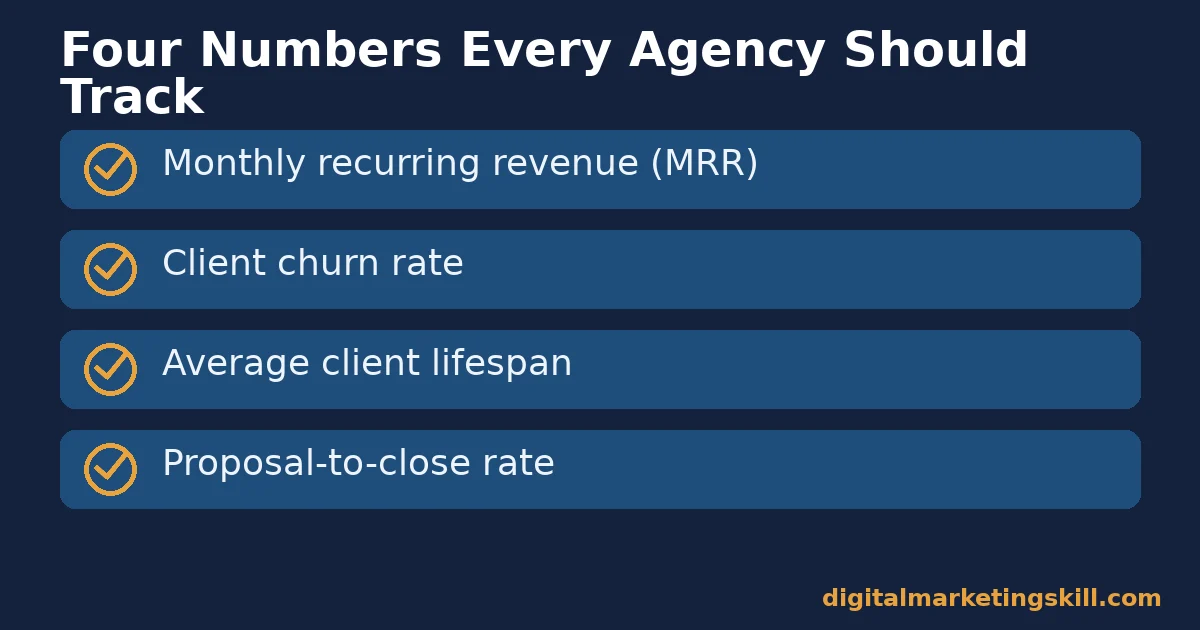
Revenue alone hides problems. Track these four numbers from your very first client onward.
- Monthly recurring revenue (MRR). The total of your active retainer contracts, counted monthly. This is the number that tells you whether the agency is actually stabilising, not just busy.
- Client churn rate. The share of clients who leave each month. Compare your own number against the 1.6% monthly benchmark for retainer agencies cited above, not against project-based norms.
- Average client lifespan. How long a client stays, on average, from signing to leaving. A rising lifespan means your retention work is paying off.
- Proposal-to-close rate. The share of proposals that become paying clients. A low rate with decent lead flow usually means the pitch needs to be more specific, not that you need more leads.
Read these four together. High MRR with high churn is a leaky bucket, not real growth. A strong close rate with short client lifespans means the sales pitch overpromises what the delivery team can actually hold onto.
The One Decision Rule: Fix Retention Before You Chase More Leads
If your churn rate is above the retainer benchmark, fix delivery and reporting before spending more on new client acquisition. More leads into a leaky agency just means more churn next quarter. Only once churn is under control does adding leads actually grow monthly recurring revenue instead of replacing what just left.
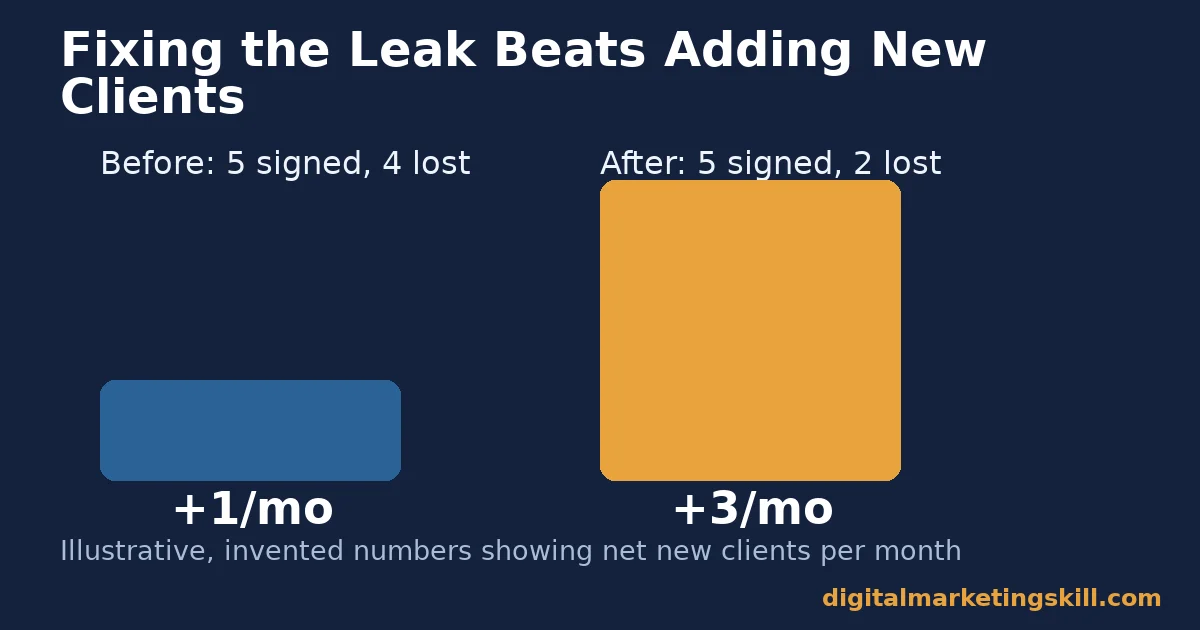
Here is an illustrative, invented example to show the logic, not a real case. An agency signs five new clients a month and loses four. Net growth is one client a month.
Fixing retention to cut losses to two a month, with the same five signed, triples net growth to three a month, without spending a cent more on sales. The exact numbers will vary, but the mechanism holds: fixing the leak usually beats adding more water.
A Four-Week Plan to Launch a Digital Marketing Agency
Turn the models and rules above into a schedule you can actually run.
Week One: Pick a Model and One Core Service
Choose one of the three models above, and one service inside it you can already deliver well. Resist adding a second service until the first one has a client and a real result behind it.
Week Two: Land One Retainer Client
Prioritise a monthly retainer over a one-off project wherever you can, even at a lower starting price, because retainer relationships are what the churn data says actually survive.
Week Three: Set Up Reporting Before You Need It
Build a simple monthly report that shows the client exactly what changed and why. Agencies that report on meaningful outcomes, not just activity, keep clients substantially longer, which is the entire point of choosing the retainer model.
Week Four: Track Your Four Numbers From Day One
Set up a simple spreadsheet for MRR, churn, client lifespan and proposal-to-close rate before you have ten clients to track, not after. The habit is easier to build small than to retrofit later.
Where a New Digital Marketing Agency Actually Finds Its First Clients
The channel matters less than most people assume. What matters is picking one and working it consistently, instead of spreading thin across several at once.
Referrals From Your Existing Network
Your first clients are more likely to come from people who already trust you than from cold outreach. Tell your network specifically what you do and who you help, not just that you are “available for work.”
Published Proof of Your Work
A single detailed case study, even from a personal or unpaid project, does more selling than a generic portfolio page. Publish the process and the result, not just a before-and-after screenshot.
Direct Outreach to a Narrow List
A short, specific list of prospects who clearly need your core service converts better than a long, generic list. Reference something real about their business in the first message, not a template line. Quality of the list matters more than quantity, especially in the first few months of a new digital marketing agency.
Partnerships With Adjacent Service Providers
Web developers, accountants and consultants often meet businesses that need marketing help but are not your competitors. A simple referral arrangement with a few of them can outperform paid lead generation in the first year.
A Real Case: Scaling One Skill Into a Client Business
Olajire Jacob, a graduate of the Digital Marketing Skill Institute, built exactly this kind of specialist operation. As published on the Digital Marketing Skill Institute reviews page, he focused on one service, email marketing flows, and charged around $500 per project for clients in the US, UK and Canada.
From that single specialism, he expanded into a recurring client base and scaled his monthly income to roughly $5,000. The pattern matches the niche-specialist model above: one provable skill, sold clearly, grown into repeat and recurring work. Results like this are individual and not typical for every graduate or market, so read the Institute’s earnings disclaimer before treating any income figure as a guarantee.
Common Digital Marketing Agency Mistakes to Avoid
These mistakes show up across almost every failed launch, regardless of which model was chosen.
Listing Every Service Before Proving One
A ten-service menu with no case studies signals inexperience, not range. Prove one service first, then expand the list once you have results to back each addition.
Chasing Project Work Over Retainers
Project work feels safer because it ends. That is exactly the problem: it ends, and then you are selling from zero again. Prioritise retainers even when the first-month price is lower.
Skipping Client Reporting Until Someone Complains
Waiting for a client to ask what happened to their budget is already too late. Build reporting into the retainer from day one, not as a reaction to churn risk.
Treating the Client Search as Local Only
A digital marketing agency rarely needs to be local to its clients. Limiting your search to one city early on means missing most of the realistic client pool described in the key takeaways above.
Underpricing to Win the First Few Clients
A very low introductory price attracts clients who expect that price forever, which makes a later increase feel like a broken promise. Price close to where you intend to stay, even if it slows your first sale slightly.
Working Without a Written Scope
An informal agreement feels faster at the start, but it is the fastest route to scope creep and an unhappy client later. Put the scope, the deliverables and the review process in writing before the first invoice, even for a small project.
Frequently Asked Questions About Starting a Digital Marketing Agency
How much does it cost to start a digital marketing agency?
Costs vary widely by country and by how much of the work you do yourself versus outsource. The real early cost is usually time spent proving one service works, not equipment or office space, since most agencies can start from a laptop and a handful of tools.
Do I need past agency experience to start a digital marketing agency?
It helps but is not required. What matters more is proving one service on a real project before selling a full services list. A single verified result carries more weight with prospects than years of unproven claims.
Should a new digital marketing agency specialise or stay general?
Specialising usually wins early, because a specific pitch closes faster and proves expertise sooner. A generalist model can work, but it needs more time and a larger team to execute well across many services at once.
How many clients does a digital marketing agency need to be sustainable?
There is no fixed number, because it depends on your pricing and your retention rate. Track monthly recurring revenue and churn from the first client, so you know your real sustainable client count instead of guessing.
What is the biggest reason new digital marketing agencies fail?
Weak retention, not weak skills. An agency that wins clients but cannot keep them spends all its energy replacing churn instead of growing, which matches the churn data in this guide closely.
Is it better to work solo or hire a team right away?
Working solo first lets you prove demand and refine your core service without the overhead of payroll. Hire only once your pipeline is consistent enough that a new team member adds capacity you actually need, not capacity you hope to need.
Can a digital marketing agency be run from anywhere?
Yes. Since most client work is delivered through shared documents, calls and dashboards, location rarely limits who an agency can serve, whichever country it is run from.
Which pricing model should a new digital marketing agency start with?
Most new agencies start with fixed-fee projects or a modest retainer, because value-based pricing needs a track record you do not have yet. Move toward retainers and value-based pricing once you have verified results to point to.
How long does it take to see steady income from a digital marketing agency?
It depends heavily on how quickly you convert clients from one-off projects to retainers, since retainer income is what stabilises monthly revenue. Track your own MRR from the first client rather than comparing timelines with other founders.
Start With One Service, One Retainer Client, Then Build
Pick one model from this guide. Prove one service with one real client. Lead with a retainer relationship over a one-off project wherever you can.
Want that first proven service built in from day one? The Master Diploma in Digital & AI Marketing at Digital Marketing Skill Institute pairs practical courses with unlimited one-on-one mentoring.
The courses include AI-powered lead generation, AI-powered email marketing and automation, and AI-powered search engine optimisation and content marketing. You also get a real project inside a US partner company, so you graduate with a provable service, not just a certificate.
The diploma is dual US and UK accredited, and recognised in more than 100 countries. It is delivered 100% online, so you can build your digital marketing agency anywhere in your country, or abroad. See the full program details and apply here when you are ready, or browse more practical guides on the Digital Marketing Skill Institute blog.
Related Reading on Building a Digital Marketing Business
For deeper reading on related decisions, see our guides on digital marketing career tips that get you hired and what the data says about pay, demand and skills. Also see what skills-based hiring really takes, which skills actually get you hired, and how to land your first role without experience.
Every figure in this guide was checked against its original source before publication. Figures marked as illustrative are invented examples, not real results.
