
Ecommerce, short for electronic commerce, is the buying and selling of goods and services online, through websites, apps, marketplaces and other digital channels. A customer finds a product, places an order and usually pays online, then the business delivers it or gives access. It matters because ecommerce lets even a small business sell to customers far beyond its local area, and it drives much of the work digital marketers do.
Key Takeaways
- Ecommerce covers any sale where the order is placed or agreed online. The US Census Bureau notes that “Payment may or may not be made online.”
- Common models include business to consumer (B2C), business to business (B2B), direct to consumer (D2C) and marketplaces.
- An online store needs products, a way to take payment, delivery or access, and marketing to bring in visitors.
- Google can show product details, such as price and availability, in search results when you share product data.
- WordPress sites often use WooCommerce, which describes itself as “the open-source ecommerce platform for WordPress.”
What Is Ecommerce?
Think of ecommerce as a shop that never closes and has no walls. As a result, customers can browse, compare and buy from anywhere, at any time, on a phone or a computer.
The US Census Bureau gives a useful definition. It describes e-commerce as “The sale of goods and services where the buyer places an order, or the price and terms of the sale are negotiated over an Electronic Data Interchange, the Internet, or any other online system.” In other words, what makes a sale ecommerce is how the order happens, not how the payment is made.
For example, a candle maker might sell through her own website, a marketplace and an Instagram shop. So all three are ecommerce. However, each channel needs a slightly different marketing plan. For more, our guide to what ecommerce is covers the basics in more depth.
How Ecommerce Works
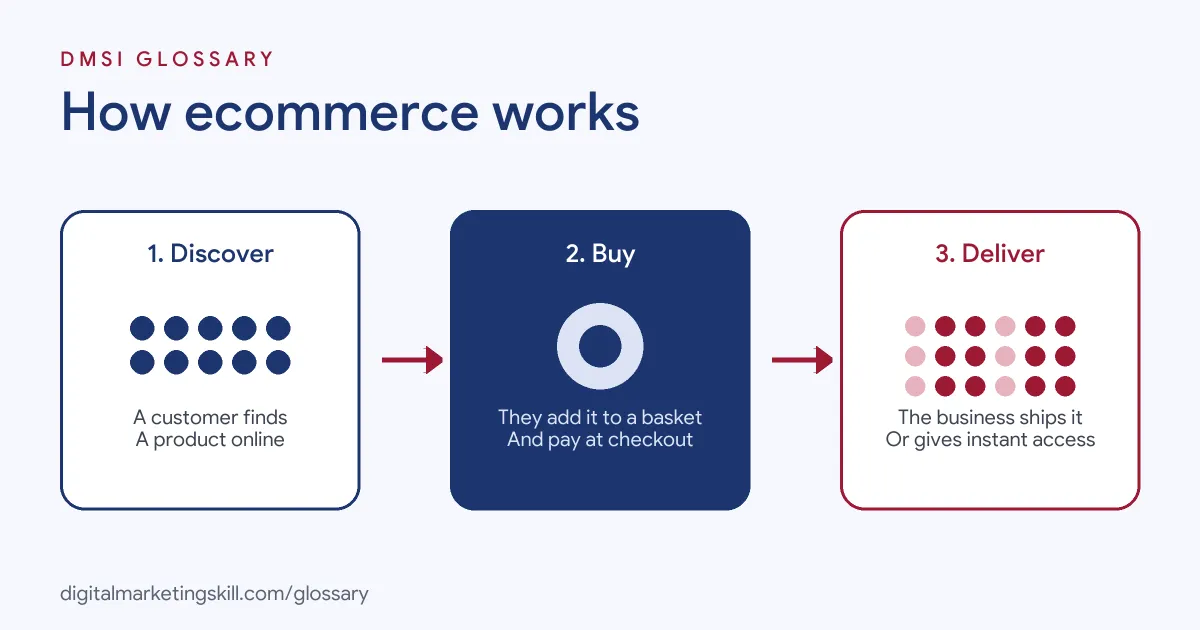
Every online sale follows three steps. First, a customer discovers a product, often through search, social media, ads or email. Next, they add it to a basket and pay at checkout. Finally, the business fulfils the order by shipping the product or giving access to a digital item.
The Storefront
First, the storefront is where customers see your products. It can be your own website, built on a platform such as WooCommerce or Shopify, or a listing on a marketplace. For instance, WooCommerce says its core platform “is free” and lets you sell physical and digital goods, subscriptions, bookings and memberships through extensions.
Payment and Fulfilment
Next, you need a way to take payment, such as cards or digital wallets, through a payment provider. After that, the order must reach the customer. For example, physical goods need packing, shipping and a returns process. Digital goods, such as courses or software, need instant access.
Getting Found Online
Of course, a store with no visitors makes no sales. Google’s ecommerce guidance says the key challenge for online stores is being “discovered in Search.” When you add product structured data, Google says your product details can appear in richer ways, so “users can see price, availability, review ratings, shipping information, and more right in search results.” You can also upload a product feed through Google Merchant Center.
Ecommerce Examples
Here are three made-up examples of ecommerce businesses:
- Clothing brand (example): A small label sells T-shirts on its own WooCommerce store and promotes new drops with Instagram ads and emails.
- B2B supplier (example): A cleaning supplies company lets trade customers log in, see their own prices and reorder in a few clicks.
- Digital product (example): A designer sells printable planners as instant downloads, so there is nothing to ship.
In each case, the business sells online, but the product, customer and marketing differ.
Types of Ecommerce Compared
Here are the most common models:
| Model | Who sells to whom | Example (made up) |
|---|---|---|
| B2C | A business sells to consumers | An online bookshop |
| B2B | A business sells to other businesses | A wholesaler of office furniture |
| D2C | A brand sells directly to consumers, without shops in between | A skincare brand’s own website |
| Marketplace | Many sellers list products on one platform | A craft marketplace with thousands of makers |
| Subscription | Customers pay regularly for repeat deliveries or access | A monthly coffee box |
In short, the model shapes your pricing, your marketing and how you keep customers coming back.
How to Start Selling Online
- Choose your products. Check that there is demand and that you can make a profit after costs and delivery.
- Pick your channel. Decide between your own store, a marketplace or both.
- Build the store. On WordPress, you can add WooCommerce to sell from your own site.
- Set up payments and delivery. Add a payment provider, shipping rates and a clear returns policy.
- Write strong product pages. Also show clear photos, honest descriptions, prices and stock levels.
- Share product data with Google. Add product structured data and, if you like, a Merchant Center feed.
- Drive traffic. Then use SEO, email, social media and ads to bring in visitors.
- Measure and improve. Track sales, conversion rate and average order value, then fix the weak points.
Google notes that providing both structured data and a Merchant Center feed “maximizes your eligibility” for its shopping experiences.
Measuring an Online Store
Here is a made-up example. A store gets 10,000 visits in a month and 200 orders, so its conversion rate is 2%. If the average order is £40, sales total £8,000. As a result, raising the conversion rate to 2.5% would add 50 orders, or about £2,000, without any extra traffic. That’s why many teams improve product pages and checkout before they spend more on ads.
Best Practices for Ecommerce
- Make checkout simple. That’s because every extra step gives people a reason to leave. See our guide to checkout mistakes.
- Show trust signals. For example, reviews, clear contact details and a fair returns policy help people buy.
- Test on phones too. Check your store on a small screen as well as a computer, because people shop on both.
- Use clear site structure. Google’s ecommerce guidance covers navigation, URLs and internal links that show which pages matter most.
- Look after existing customers. Follow-up emails and loyalty offers bring people back.
Common Mistakes to Avoid
A common mistake is building a beautiful store with no plan to bring in traffic. Another is hiding delivery costs until the last step, which can make people abandon their baskets. Some sellers also write thin product pages with one photo and a copied description. Others forget to track sales properly, so they can’t tell which ads or emails work. Finally, many ignore returns and customer service, even though these shape reviews and repeat sales.
Where You’ll Use Ecommerce at Work
Many marketing jobs focus on online stores. For example, real remote job listings ask for:
- “3+ years of hands-on Meta Ads Manager work for ecommerce or DTC brands” (Growth Marketing Manager, Paid Media and Klaviyo).
- “Ecommerce and Growth Marketing experience.” (Paid Media Specialist SR.).
- Someone to “Work closely with Sales, E-commerce, Creative, Product Development, and Country Managers to align marketing initiatives with business objectives.” (Group Marketing Manager).
So if you want to work as a Digital Marketing Manager, Growth Marketer or Freelance Digital Marketer, you will often help online stores win and keep customers.
Learn It in the Full Stack Programme
Ecommerce draws on every channel, so it fits the Full Stack (all four tracks) programme. You take all ten courses and build one portfolio project from each track, including a WordPress site or store that you rank with an SEO content plan. Roles it prepares you for include Digital Marketing Manager, Growth Marketer, Freelance Digital Marketer and Agency Owner. You also get unlimited 1-on-1 mentoring and a U.S. Project Internship from day one.
Next, read our guides to e-commerce marketing strategies and the ecommerce sales funnel.
Frequently Asked Questions
What is ecommerce in simple terms?
It is buying and selling online. A customer orders through a website, app or marketplace instead of in a physical shop.
Is it ecommerce if payment happens offline?
It can be. The US Census Bureau counts a sale as e-commerce when the order is placed online, and says payment may or may not be made online.
What are the main types of ecommerce?
The most common are B2C, B2B, D2C, marketplaces and subscriptions. Each one sells to a different kind of customer in a different way.
Can I build an online store on WordPress?
Yes. WooCommerce adds a store to WordPress, and its core platform is free, with paid extensions for extra features.
How do products show in Google search results?
Add product structured data to your pages, upload a product feed to Merchant Center, or do both. Google says using both gives you the best chance of appearing.
Sources: US Census Bureau: Retail definitions; Google Search Central: Product structured data; Google Search Central: Ecommerce guidance; WordPress.org: WooCommerce; remote job listings on Himalayas.