
Embeddings are lists of numbers that an AI model creates to represent the meaning of a piece of text, an image or another item. Items with similar meanings get similar numbers, so a computer can measure how closely related they are. For marketers, embeddings power the smart search, recommendations and AI assistants you use every day, and they explain why these tools can match meaning rather than exact words.
Key Takeaways
- OpenAI describes an embedding as “a vector (list) of floating point numbers.”
- The distance between two embeddings shows how related the items are: small distances mean closely related.
- Common uses include search, clustering, recommendations, classification and spotting unusual items.
- Google’s machine learning course says embeddings capture meaning in a compact form that older methods miss.
- You usually store embeddings in a vector database, so you can search them quickly.
What Are Embeddings?
Computers don’t understand words the way people do. They work with numbers. So, to compare two sentences, a system first needs to turn each one into numbers that capture its meaning. Those numbers are embeddings.
OpenAI puts it simply: its text embeddings “measure the relatedness of text strings.” Each one is a long list of numbers. On their own, the numbers mean nothing to you. However, when you compare two lists, the gap between them tells you how similar the two texts are.
Here is a helpful picture. Imagine a huge map where every sentence has a location. Sentences about dogs cluster in one area, while sentences about tax returns sit far away. Embeddings are the coordinates on that map. Two reviews that both praise “quick delivery” land close together, even if one says “arrived fast” and the other says “speedy shipping.”
How Embeddings Work
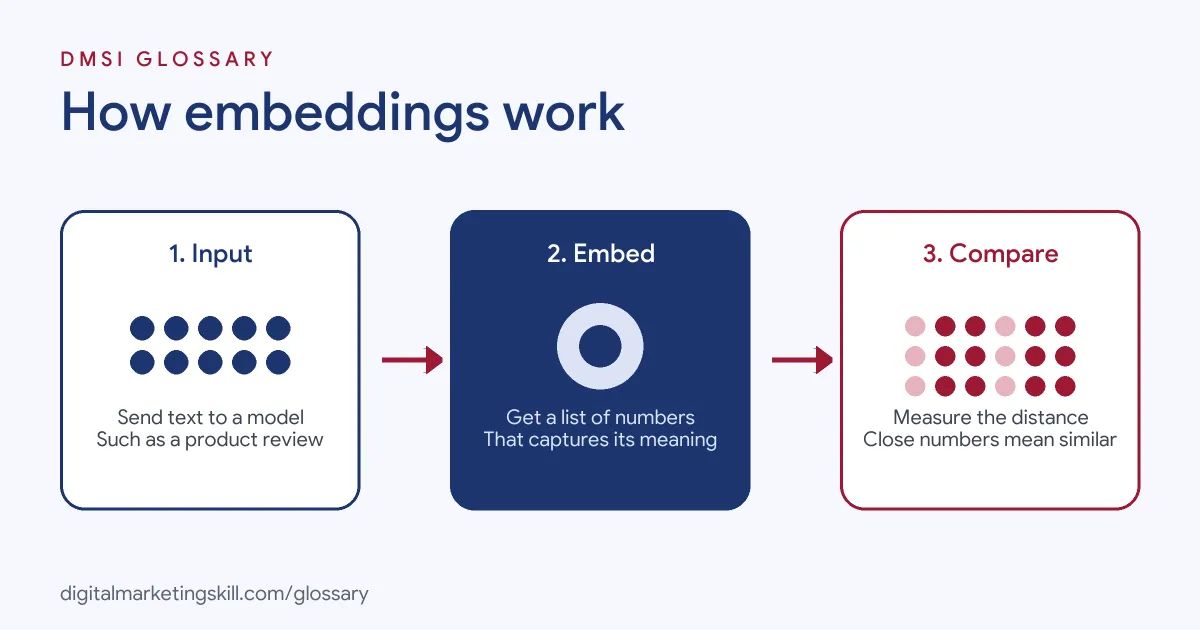
The process has three steps. First, you send your text to an embedding model. Next, the model returns a list of numbers for that text. Finally, you compare those numbers with others to find the closest matches.
From Text to Numbers
With OpenAI’s API, you send a text string and the name of a model, such as text-embedding-3-small. The response contains the embedding plus some extra details. According to OpenAI, the default length is 1,536 numbers for text-embedding-3-small and 3,072 for text-embedding-3-large. You can also ask for fewer numbers with a dimensions setting, which saves storage.
Why Not Use Simple Codes?
Google’s machine learning crash course explains the problem embeddings solve. An older method, called one-hot encoding, gives each item its own slot in a very long list. For a menu of 5,000 meals, each meal becomes a list 5,000 entries long. Google notes that these lists “lack meaningful relationships.” So the system can’t tell that a hot dog is more like a shawarma than a salad.
By contrast, embeddings are dense and much shorter. Google says they capture “semantic relationships” and reduce the size of the data. As a result, similar meals end up near each other, which is exactly what a recommendation app needs.
Measuring Closeness
Once you have embeddings, you compare them. OpenAI recommends cosine similarity. It explains that its embeddings are normalised to length 1, so cosine similarity and Euclidean distance give the same rankings. In practice, the model matters more than the maths you choose.
Search tools then need a fast way to find the nearest items. Elastic explains that a semantic search engine turns the query into embeddings, then uses a k-nearest neighbour (kNN) algorithm to match it with the closest documents.
Embeddings Examples
OpenAI lists several common uses. Here are three, with made-up marketing scenarios:
- Search: Results ranked by relevance to a query. For example, a shop’s search finds “waterproof jacket” when someone types “coat for rain.”
- Clustering: Text grouped by similarity. For instance, a brand groups 10,000 customer reviews into themes such as delivery, price and quality, without reading each one.
- Recommendations: Items with related text suggested together. A blog shows “you might also like” links based on meaning, not just tags.
OpenAI also mentions classification, anomaly detection and diversity measurement as uses.
A Worked Example: Sorting Reviews
Here is a made-up example in plain terms. A shop has 2,000 reviews. Nobody has time to read them all. So the team turns each review into a list of numbers. Then a simple tool puts reviews with close numbers into the same pile.
At the end, there are four piles. The first is about late parcels. Another covers sizes that run small. A third praises the fabric. The last is about price. Now the team can see that sizing is the biggest worry. As a result, it adds a size guide to every product page. The tool did the sorting; people made the decision.
Embedding Models Compared
OpenAI’s guide compares its main text models like this:
| Model | Default length | Max input | Score on MTEB benchmark |
|---|---|---|---|
| text-embedding-3-small | 1,536 numbers | 8,192 tokens | 62.3% |
| text-embedding-3-large | 3,072 numbers | 8,192 tokens | 64.6% |
| text-embedding-ada-002 | Older model | 8,192 tokens | 61.0% |
In short, the large model scores a little higher, while the small one is cheaper to run. For most marketing tasks, the small model is a sensible place to start.
How to Use Embeddings in a Simple Project
You don’t need to be an engineer to understand the steps. Here is how a basic “find similar content” tool works:
- Collect your content. For example, gather all your blog posts or product descriptions.
- Split long text. Next, break long pages into shorter sections, because each model has a maximum input.
- Create embeddings. Send each section to an embedding model and save the numbers it returns.
- Store them. OpenAI notes you can save the vectors in a vector database for later use.
- Embed the query. When someone searches, turn their query into numbers with the same model.
- Find the nearest matches. Compare the query with your stored items and return the closest ones.
- Check the results. Finally, test with real questions and adjust how you split the text.
Best Practices
- Use the same model throughout. You can’t compare numbers from two different models.
- Keep sections focused. A short passage on one topic gives a clearer embedding than a page on five topics.
- Refresh when content changes. If you update a page, create a new embedding for it.
- Protect personal data. Think carefully before you send customer details to any outside service.
- Test with real queries. For instance, ask colleagues to search the way customers do.
Common Mistakes
A frequent mistake is mixing two different models in one search, which produces nonsense matches. Another is feeding in whole long pages, so each embedding blurs several topics together. Some teams also forget that embeddings show similarity, not truth. A close match can still be out of date or wrong. Finally, many people skip testing, then wonder why the “smart” search returns odd results.
Where You’ll Use Embeddings at Work
Embeddings appear most often in AI and data roles, and increasingly in ad tech. For example, real remote job listings include lines like these:
- “Hands-on neural network work, such as embeddings of text, creative or user behavior” (Staff Applied Scientist, AdTech).
- “Conceptual depth with AI technology: familiarity with embeddings, RAG, and agent-based architectures at a level that earns engineering credibility” (Head of Product).
- “Strong understanding of retrieval-augmented generation, embeddings, and vector databases” (LLM Prompt Specialist).
As a marketer, you probably won’t build these systems. However, you will use tools that depend on them, from AI search to chatbots. Knowing how they work helps you choose tools, brief developers and explain results to clients.
Learn It in the Full Stack Programme
AI fundamentals, including strategy and planning, are part of every DMSI track. The Full Stack (all four tracks) programme covers all ten courses, with one portfolio project from each track, so you see how AI tools fit into social, email, Google Ads and SEO work. You also get unlimited 1-on-1 mentoring and a U.S. Project Internship from day one.
To see embeddings in action, read our glossary entry on retrieval-augmented generation. For the bigger picture, see our guide to AI in digital marketing.
Frequently Asked Questions
What are embeddings in simple terms?
They are lists of numbers that represent meaning. Texts or images with similar meanings get similar numbers, so a computer can compare them.
What are embeddings used for?
Common uses include search, recommendations, grouping similar items, classification and spotting unusual items.
Are embeddings the same as a large language model?
No. An embedding model turns text into numbers for comparison. A large language model generates new text. Many AI tools use both together.
How long is an embedding?
It depends on the model. OpenAI’s text-embedding-3-small returns 1,536 numbers by default, and text-embedding-3-large returns 3,072.
Where do you store embeddings?
Usually in a vector database, which is built to find the closest matches quickly among many stored vectors.
Sources: OpenAI: Vector embeddings guide; Google Machine Learning Crash Course: Embeddings; Elastic: What is semantic search?; remote job listings on Himalayas.