
Retrieval-augmented generation (RAG) is a method that lets an AI model look up information from a trusted set of documents before it writes an answer. The system finds the most relevant passages, adds them to the prompt, and the model then answers using that material. It matters because it helps AI tools give answers based on your own, current information, instead of only on what the model learned during training.
Key Takeaways
- RAG combines two parts: a search step that retrieves information, and a language model that generates the answer.
- It lets you add new or private knowledge without retraining the model.
- Most RAG systems split documents into small chunks, turn them into embeddings and store them in a vector database.
- Good retrieval matters more than anything else. If the search finds the wrong passage, the answer will be wrong too.
- RAG reduces made-up answers, but it does not remove them. You still need to check the output.
What Is Retrieval-Augmented Generation?
A large language model learns from a huge amount of text, but that learning stops at a point in time. As AWS explains, “LLM training data is static and introduces a cut-off date on the knowledge it has.” The model also knows nothing about your company’s private files, prices or policies.
RAG fixes this by giving the model an open book. Before it answers, the system searches a knowledge base that you control, such as help articles, product sheets or brand guidelines. Then it passes the best matches to the model along with the question.
In other words, the model no longer has to rely on memory alone. Instead, it can quote and summarise real documents. The idea comes from a research paper that combined a language model with what it called non-parametric memory: “a dense vector index of Wikipedia, accessed with a pre-trained neural retriever.”
How Retrieval-Augmented Generation Works
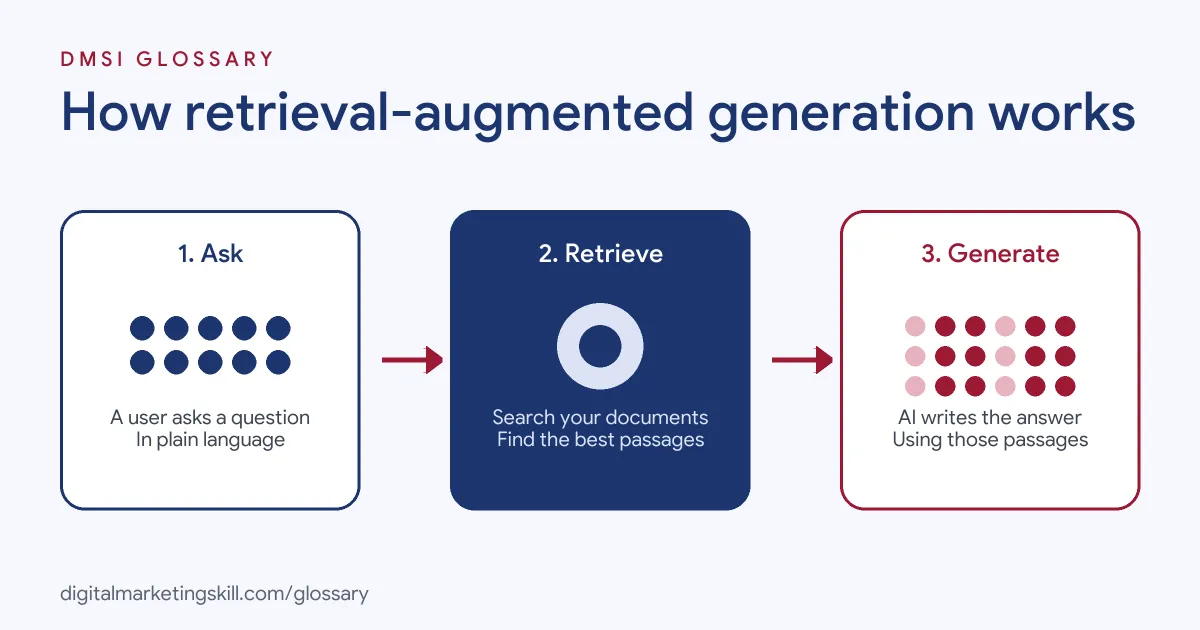
A typical system works in three stages. First, you prepare your documents. Next, the system retrieves the right passages for each question. Finally, the model generates an answer from them.
Prepare the Knowledge Base
First, the documents are split into small pieces called chunks. Anthropic notes these are “usually no more than a few hundred tokens.” Then an embedding model turns each chunk into a list of numbers that captures its meaning. These embeddings are stored in a vector database, so the system can search by meaning rather than by exact words.
Retrieve the Right Passages
When someone asks a question, the system converts the question into an embedding too. Then it finds the chunks with the closest meaning. However, meaning-based search can miss exact terms, such as product codes. That’s why many systems also use BM25, which Anthropic describes as “a ranking function that uses lexical matching to find precise word or phrase matches.”
Generate the Answer
Next, the retrieved passages are added to the prompt as context. The model reads them and writes a reply. As a result, it can also point to its sources. AWS notes that RAG lets the model “present accurate information with source attribution.”
Retrieval-Augmented Generation Examples
Here are three ways marketing and customer teams use RAG:
- Website chat assistant: A software company connects its help centre to a chat tool. When visitors ask how a feature works, the assistant answers from the latest help articles and links to them.
- Brand-safe content drafts: A marketing team stores its brand guide, product facts and approved claims. Then its AI writing tool retrieves them, so drafts use the right tone and only approved facts.
- Sales enablement: A sales team loads case studies and proposals. Before a call, a rep asks for examples in a certain industry, and the tool pulls the relevant stories.
In each case, the value comes from the documents. A RAG system is only as good as the content you give it.
RAG vs Fine-Tuning vs Pasting Everything Into the Prompt
RAG is not the only way to give a model new knowledge. Here is how it compares:
| Approach | How it works | Best for |
|---|---|---|
| Retrieval-augmented generation | Searches your documents and adds the best matches to each prompt | Large or changing knowledge bases |
| Fine-tuning or retraining | Trains the model further on your data | Changing style or behaviour, not adding facts that change often |
| Whole knowledge base in the prompt | Pastes all the material into the prompt every time | Small collections; Anthropic suggests this for knowledge bases under about 200,000 tokens |
AWS describes RAG as a more economical way to add new data, because you do not need to retrain the model. Meanwhile, the simplest option is often the best for small jobs. If your material is short, such as a single brand guide, you may not need retrieval at all. Just paste it into the prompt and test the answers.
How to Set Up Retrieval-Augmented Generation
You do not need to build everything yourself. Many AI tools now let you upload files and ask questions. Still, the same steps apply:
- Define the job. Decide what questions the system should answer and who will use it.
- Collect trusted documents. Use approved, current sources only, such as help articles and product sheets.
- Clean the content. Remove old versions, duplicates and anything confidential that users should not see.
- Index the documents. Split them into chunks and create embeddings, or let your tool do this for you.
- Write clear instructions. Tell the model to answer only from the retrieved passages and to say when it does not know.
- Test with real questions. Check whether the right passages are found and whether the answers are correct.
- Keep it updated. AWS advises refreshing documents and their embeddings so retrieval stays current.
Best Practices for Retrieval-Augmented Generation
- Improve retrieval first. Anthropic found that adding context to each chunk and combining embeddings with BM25 cut retrieval failures by 49%. With an extra reranking step, failures fell by 67%. Its method adds a short note to each chunk, typically 50 to 100 tokens, that explains where the chunk fits in the wider document.
- Use reranking for precision. A reranker scores the candidate chunks and keeps only the most relevant ones.
- Show sources. Let users see which document an answer came from, so they can check it.
- Control access. AWS notes that developers can restrict retrieval by authorisation level, which matters for private data.
- Keep humans in the loop. Review answers that go to customers, especially early on.
Common Mistakes to Avoid
Teams new to RAG often make the same errors. First, they load every file they have, including outdated ones, so the model retrieves old facts. Second, they assume RAG stops AI hallucination completely. It reduces it, but a model can still misread a passage. Third, they only test easy questions. Finally, they forget to update the knowledge base when products or policies change.
Where You’ll Use Retrieval-Augmented Generation at Work
RAG appears in listings for marketing technology and AI automation roles. For example, recent remote listings mention:
- “Familiarity with RAG, vector databases, embeddings, re-ranking” (AI/Automation Analyst).
- “Embeddings, and RAG grounded in approved content” (Senior Software Engineer, MarTech).
- “LLM APIs and agent tooling (Anthropic, OpenAI, Gemini, MCP, RAG)” (GTM Engineer, Web).
Even outside technical roles, marketers increasingly work with AI tools that answer from company documents. So knowing how retrieval works helps you set them up well and spot when they go wrong.
Learn It in the Full Stack Programme
AI fundamentals, including strategy and planning, are part of every DMSI track. To apply AI across social, email, Google Ads and SEO, look at the Full Stack (all four tracks) programme. It includes all ten courses and one portfolio project from each track. It also includes a U.S. Project Internship from day one and unlimited 1-on-1 mentoring.
For a practical view of which AI tools are worth your time, read our guide to AI marketing tools.
Frequently Asked Questions
What is retrieval-augmented generation in simple terms?
It is a way for an AI tool to look things up in your documents before answering. The answer is then based on those documents, not only on the model’s memory.
Does RAG stop AI from making things up?
It helps, but it does not stop it fully. The model can still misread a passage or fill gaps, so you should check important answers.
What is a vector database?
It is a store for embeddings, which are numbers that capture the meaning of text. It lets the system find passages with similar meaning to a question.
Is RAG better than fine-tuning?
They solve different problems. RAG is better for adding facts that change, while fine-tuning is better for changing how a model behaves or writes.
Do marketers need to code to use RAG?
Not always. Many AI tools let you upload files and ask questions. Coding helps for custom systems, but the key skills are choosing good content and testing answers.
Sources: AWS: What is retrieval-augmented generation?; arXiv: Retrieval-Augmented Generation for Knowledge-Intensive NLP Tasks; Anthropic: Introducing Contextual Retrieval; remote job listings on Himalayas.