
An Employer of Record (EOR) is a company that legally employs workers on behalf of another business, handling their contracts, payroll, taxes, benefits and local compliance. The business that hired them still manages their day-to-day work. So a company can hire someone in another country without setting up its own legal entity there. For remote marketers, this is one common way an overseas company can put you on its payroll as a full employee.
Key Takeaways
- An EOR is the legal employer, while the client company directs the actual work.
- It handles contracts, payroll, tax withholding, benefits and local employment law.
- Companies use EORs to hire abroad without opening a local entity.
- An EOR is different from a PEO, which shares employer duties with a client that already has an entity.
- Hiring through an EOR doesn’t give anyone the right to work in a country, so visa rules still apply.
What Is an Employer of Record?
In general, hiring someone in another country is hard. Each country has its own employment laws, tax rules and benefit rules. Normally, a company would need to set up a local business first. However, that takes time, money and legal advice.
An employer of record solves this problem. Oyster defines it as “an entity that legally employs workers on behalf of another business.” In practice, the EOR already has a legal entity in the worker’s country. So it signs the employment contract, runs payroll and follows local law. Meanwhile, the client company decides what the person works on.
For instance, here’s an everyday example. Imagine a US software company wants to hire a content marketer in Portugal. However, it has no office there. So it signs up with an EOR that operates in Portugal. Then the EOR employs the marketer under a Portuguese contract. The marketer joins the US team’s meetings and works on its campaigns, but the EOR pays them.
Why It Matters
Above all, EORs make cross-border hiring faster and simpler. For example, Oyster notes that an EOR “eliminates the need to establish a legal entity in each country where you want to hire.” As a result, companies can hire talent wherever it lives. For you, that can mean a full employment contract with a foreign company, rather than a freelance deal. Also, it often brings local benefits and statutory protections. That matters if you want stable remote work.
How an Employer of Record Works
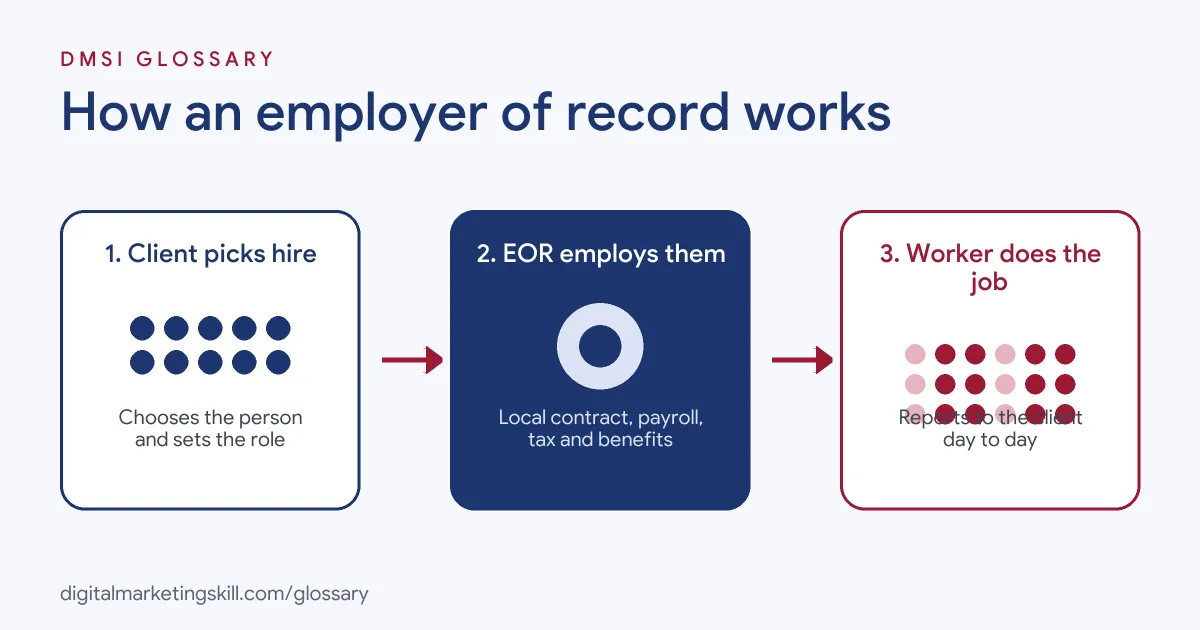
An EOR arrangement has three parties: the client company, the EOR and the worker. First, the client picks the person it wants to hire. Then the EOR employs that person legally. Finally, the worker does the job for the client, while the EOR handles the paperwork.
Step 1: The Client Chooses the Hire
First, the client company finds the candidate and agrees the role. It also sets the salary and job details. According to Deel, “Your organization maintains control over setting the employees’ salaries”. Then the client signs a service agreement with the EOR.
Step 2: The EOR Employs the Worker
Next, the EOR issues a local employment contract. Here, the worker signs with the EOR, not the client. After that, the EOR runs payroll, withholds taxes and arranges benefits. Deel explains that the EOR “must ensure compliance with local labor laws and regulations.” So it takes on the local legal duties of an employer.
Step 3: The Worker Does the Job
Then the worker joins the client’s team. Day to day, they use the client’s tools, attend its meetings and report to its managers. As Oyster puts it, “You manage the employee’s daily work while the EOR handles legal employment responsibilities.” Meanwhile, each month, the client pays the EOR for the salary, costs and a service fee.
Employment Status
Also, employment status matters here. For instance, GOV.UK explains that a person’s employment status helps determine their rights and their employer’s responsibilities. Yet some companies call remote workers “contractors” when they act like employees. However, that can break the rules. An EOR helps by employing the person properly, with the correct status.
Examples of an Employer of Record
- A US marketing agency hiring in South Africa. The agency wants a paid social specialist in Cape Town. So it uses an EOR with a South African entity. Then the specialist gets a local contract, while the agency manages their client work.
- A UK e-commerce brand testing a new market. The brand hires one sales and marketing lead in Germany through an EOR. Later, if the market grows, it may open its own German entity.
- A software start-up with a remote team. The start-up hires an SEO specialist, a designer and a copywriter in three countries. In addition, one EOR handles all three payrolls, so the founders don’t manage three sets of local rules.
Employer of Record vs PEO vs Contractor
| Point | Employer of Record (EOR) | PEO | Independent Contractor |
|---|---|---|---|
| Legal employer | EOR | Shared (co-employment) | Nobody; the person runs their own business |
| Client needs a local entity | No | Usually yes | No |
| Who runs payroll and tax | EOR runs it | Shared by PEO and client | Contractor’s own job |
| Benefits | Local employee benefits | Benefits through the PEO | None from the client |
| Best for | Hiring abroad without an entity | Outsourcing HR at home | Short or project-based work |
How to Work With an Employer of Record
- Understand the offer. If a company offers to hire you through an EOR, ask which EOR and which country your contract is in.
- Read the contract closely. Check the salary, currency, notice period, holidays and benefits.
- Know who does what. The EOR handles pay and HR. Meanwhile, your manager at the client company handles your work.
- Check your right to work. You must already have the legal right to work where you live. If not, check the official government guidance for that country.
- Complete onboarding. Send the EOR your ID, bank details and tax forms on time.
- Keep your payslips. Then you have proof of income and tax paid for your records.
- Raise HR questions with the EOR. For pay, leave or benefits, contact the EOR’s support team.
Best Practices for Employer of Record Arrangements
- Ask about the local entity. Some EORs use their own entities, while others use partners. So ask which applies to you.
- Compare total costs. For companies, the fee plus employer taxes can differ a lot by country.
- Clarify intellectual property. Make sure the contract states who owns the work you create.
- Protect personal data. Share ID and bank details only through secure EOR portals, in line with GDPR where it applies.
- Keep communication clear. Agree who to contact for work issues and who for HR issues.
- Review the set-up over time. As a team grows in one country, a company may later open its own entity.
Common Mistakes to Avoid
- Thinking an EOR gives you a visa. It doesn’t. Immigration rules are separate, whether you need a work visa or a digital nomad visa.
- Confusing EOR and freelance work. With an EOR, you’re an employee, not a freelance digital marketer.
- Skipping the contract details. Pay currency, notice and benefits vary, so read every line.
- Misclassifying workers. Calling a full-time employee a contractor can break employment and tax rules.
- Ignoring local holidays and leave. EOR contracts follow local law, so check your rights there.
- Trusting unverified offers. Check that the company and the EOR are real before you share personal details.
Where You’ll Use Employer of Record at Work
You may meet EORs as a remote employee, or you may market EOR services yourself. For example, real remote job listings say:
- “An Employer of Record (EOR) is a service provider that allows companies to legally hire and work with employees in foreign countries without establishing their own legal entity in that country.” (HR Advisor).
- “Conduct outbound calls and engage in proactive outreach to educate prospects about our Employer of Record services” (Business Development Representative).
- “Knowledge of the Employer of Record industry, HR outsourcing, or related services is a plus.” (Business Development Representative).
In addition, EOR and HR tech companies hire marketers for content, SEO, paid ads and B2B marketing. So knowing how EORs work helps you write clearly for that market too.
Learn It in the Full Stack Programme
You can build the skills remote employers look for in the Full Stack programme, which covers all four tracks. Every track includes a U.S. Project Internship from day one, with unlimited 1-on-1 mentoring.
Frequently Asked Questions
Is an employer of record my real employer?
Legally, yes. In other words, the EOR is your employer on paper. However, the client company directs your daily work.
Does an EOR give me a work visa?
No. An EOR handles employment, not immigration. So you still need the right to work where you live, as set out by that country’s government.
What is the difference between an EOR and a PEO?
An EOR is the sole legal employer and needs no client entity. By contrast, a PEO shares employer duties with a client that usually has its own local entity.
Who pays the EOR?
The client company pays the EOR. In turn, that fee covers your salary, employer costs and the EOR’s service charge.
Is working through an EOR better than freelancing?
It depends on your goals. An EOR contract usually brings employee rights and benefits, while freelancing gives more flexibility.
Sources: Oyster: What is an Employer of Record (EOR)?; Deel: Employer of Record; GOV.UK: Employment status; remote job listings on Himalayas, Himalayas and Himalayas.