
A marketing strategy is a business’s long-term plan for how it will reach the right customers, stand out from competitors and grow sales. It sets the goals, the audience, the message and the channels, and every campaign then follows from it. Without one, marketing becomes a string of random tactics that are hard to measure or improve.
Key Takeaways
- A marketing strategy explains the “why” and the direction. A marketing plan turns it into scheduled tasks and budgets.
- Most strategies answer three questions: where are we now, where do we want to be, and how will we get there?
- Tools such as SWOT analysis, the 4Ps and the Ansoff matrix help you make those choices.
- Clear goals and KPIs let you check whether the strategy is working.
- A good strategy says who you are not targeting as well as who you are.
What Is a Marketing Strategy?
Wikipedia sums it up as “the set of coordinated actions undertaken by an organization to increase sales,” with the aim of building a lasting advantage over competitors. In plain terms, it is the big picture that keeps everyone pulling in the same direction.
It helps to separate strategy from tactics. HubSpot says a strategy “defines the ‘why’ behind your efforts,” while the marketing plan “breaks that strategy down into clear, measurable actions.” For example, “become the first choice for busy parents who want healthy meals” is a strategy. By contrast, “run three Instagram Reels a week” is a tactic.
If you are new to the wider field, our glossary entry on digital marketing explains the channels a strategy usually draws on.
How a Marketing Strategy Works
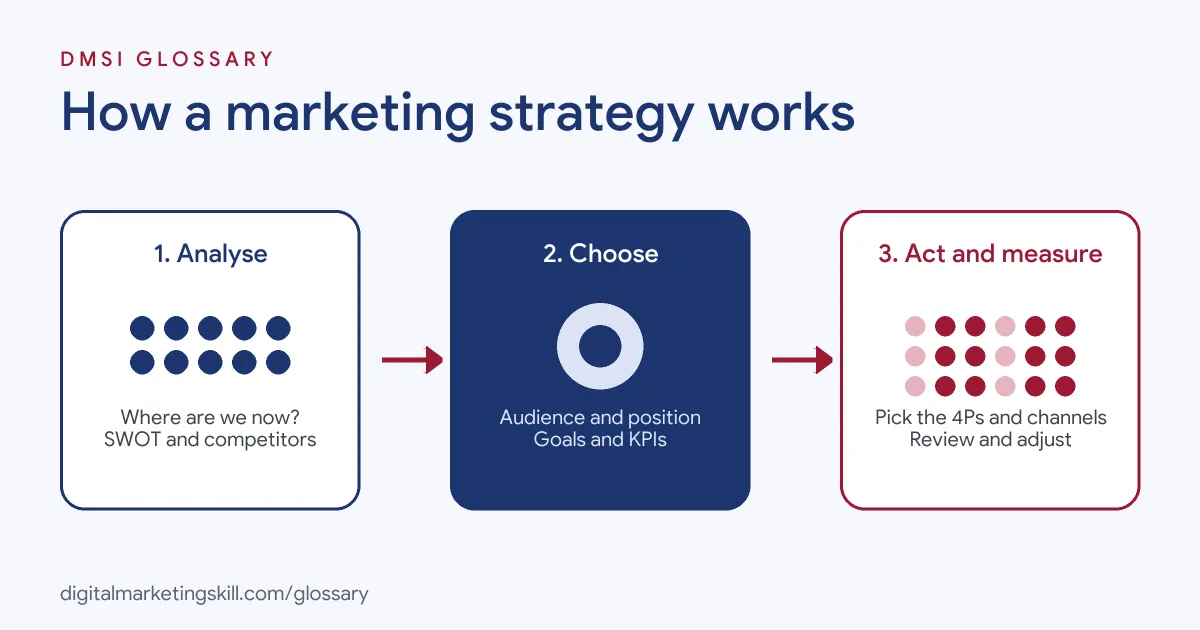
A strategy works by moving through three stages. First, you study the situation. Next, you make choices about audience, position and goals. Finally, you pick the mix of activity that will deliver those goals.
Situation Analysis
This stage answers “Where are we now?” A common tool is SWOT analysis, which Wikipedia describes as a technique that “identifies the strengths, weaknesses, opportunities, and threats” of a business. Strengths and weaknesses are internal, such as a skilled team or a small budget. Opportunities and threats are external, such as a growing market or a new competitor.
Alongside SWOT, look at your own data. Website analytics, sales records and social media insights show who already buys from you and how they found you. HubSpot suggests using website data to gauge audience interests and social media data for further insights. Together, these sources give you a realistic starting point rather than a wish list.
Choosing Where to Compete
Next, you decide who to serve and how to win them. Michael Porter’s generic strategies offer three broad routes. With cost leadership, a firm tries to be “the lowest-cost producer in the market.” With differentiation, it offers something unique that customers will pay more for. With focus, it “selects a narrow target market” instead of competing head to head.
The Ansoff matrix then helps you choose a growth path. It lists four options: market penetration, product development, market development and diversification. For instance, market penetration means “selling existing products to existing consumers.”
The Marketing Mix
Finally, you turn choices into action. The classic marketing mix covers Product, Price, Place and Promotion. According to Wikipedia, the mix “is majorly tactical in nature and is employed to carry out the overall marketing strategy.” So the 4Ps are where strategy meets daily work.
Marketing Strategy Examples
Here are three simple examples of how a business might set its direction:
- Local gym: It chooses a focus strategy, serving busy office workers near its location. As a result, it runs early-morning classes and promotes them with local search ads.
- Online course provider: It aims for market development, selling an existing course to students in new countries. Then it builds lead magnets and email sequences for each region.
- Skincare brand: It picks differentiation through natural ingredients. After that, every channel, from packaging to paid social, repeats that single message.
In each case, the strategy decides the tactics. That is why two firms in the same industry can market themselves in completely different ways.
Marketing Strategy vs Marketing Plan vs Tactics
These terms are often mixed up, so here is a quick comparison:
| Term | Question it answers | Example |
|---|---|---|
| Marketing strategy | Why, for whom and how will we win? | Be the go-to budget option for first-time home buyers |
| Marketing plan | What will we do, when, and with what budget? | A schedule of campaigns, owners, budgets and KPIs |
| Tactics | Which specific actions will we take? | A Google Ads campaign, a webinar, a weekly newsletter |
In short, the strategy sets the direction, the plan sets the route, and tactics are the individual steps.
How to Create a Marketing Strategy
You can build a simple version in a few working sessions. Follow these steps:
- Write down the business goal, such as more sales, more leads or a new market.
- Run a SWOT analysis to see where you stand today.
- Define your target audience and create one or two buyer personas.
- Study your main competitors, including their position, pricing and channels.
- Write a clear value proposition: what you offer, for whom, and why it is better.
- Choose the channels that suit your audience, such as search, social or email.
- Set KPIs and a budget, so you can tell whether it is working.
- Review results regularly, then adjust the plan and, when needed, the strategy.
If you freelance or work in an agency, you will often repeat these steps for each client. In that case, a simple template saves time and keeps your thinking consistent. Either way, keep the final document short. A strategy that fits on two pages is far more likely to guide real decisions.
Best Practices for a Marketing Strategy
A few habits keep a strategy useful:
- Start with the customer. Base decisions on real data from your website, sales and social channels, not guesses.
- Make choices. Saying who you are not targeting is just as important. HubSpot calls this an “inverted audience”.
- Link goals to numbers. For example, “grow leads from search” is vague, while a target number of leads is measurable.
- Share it. Everyone in sales, content and ads should know the core message.
- Revisit it. Markets change, so check the strategy whenever results or conditions shift.
Common Mistakes to Avoid
Many teams fall into the same traps. First, they confuse a list of tactics with a strategy. Second, they try to reach everyone, which makes the message weak. Third, they copy a competitor’s approach without asking whether it suits their own strengths. Finally, they never measure results, so they cannot tell what to keep or drop. Each of these is easy to avoid once you know the warning signs.
Another warning sign is a strategy that nobody reads. If the document is long and vague, teams soon fall back on old habits. So keep it short, share it widely and refer to it whenever you plan a new campaign.
Where You’ll Use a Marketing Strategy at Work
Strategy skills matter in almost every marketing role, from junior to senior. For example, recent remote job listings ask candidates to:
- Understand “each client’s business goals from day one and translate those into a marketing strategy with defined, measurable outcomes” (Marketing Account Manager).
- “Collaborate with the marketing team to align social media efforts with overall marketing strategies” (Social Media Manager).
- Help “develop, plan, communicate, execute, and lead worldwide marketing strategies (short and long-term) and tactics” (Sr Segment Marketing Manager).
So even if you start in a hands-on role, employers will expect you to understand how your work supports the wider strategy. Later, roles such as Digital Marketing Manager or Growth Marketer will ask you to write one.
Learn Marketing Strategy in the Full Stack Programme
You can learn to build a marketing strategy in the Full Stack (all four tracks) programme. It covers all ten courses, and you complete one portfolio project from each track, from paid social to Google Ads, email and SEO. Along the way, you join a U.S. Project Internship from day one and get unlimited 1-on-1 mentoring.
Want to check an existing plan? Our guide to a digital marketing strategy audit shows you what to review.
Frequently Asked Questions
What is a marketing strategy in simple terms?
It is a business’s long-term plan for reaching the right customers and growing sales. It sets the goals, audience, message and channels that every campaign follows.
What is the difference between a marketing strategy and a marketing plan?
The strategy explains why and in what direction. The plan lists the specific actions, owners, timings and budget that put the strategy into practice.
What are the 4Ps of marketing?
They are Product, Price, Place and Promotion. Together, they form the marketing mix, which is the set of tools you use to carry out your strategy.
How often should I review my marketing strategy?
Check results against your KPIs regularly, and revisit the strategy itself when results stall or your market changes. Tactics usually change more often than strategy.
Does a small business need a marketing strategy?
Yes. Even a one-page strategy helps a small team focus a limited budget on the customers and channels most likely to work.
Sources: Wikipedia: Marketing strategy; Wikipedia: SWOT analysis; HubSpot: Marketing plan examples; HubSpot: How to find your target audience; remote job listings on Himalayas.