
Fine-tuning is the process of taking an AI model that has already been trained on a huge amount of general data and training it a little more on a smaller set of examples for one specific task. The result is a model that keeps its general skills but performs better at your task, in your style. It matters to marketers because it is one of the ways teams make AI tools write, sort or answer in a consistent brand voice, although for most everyday work, good prompts are enough.
Key Takeaways
- Fine-tuning adapts a pre-trained model. It does not build a new model from scratch.
- Google notes that engineers can sometimes fine-tune a model on “just a few hundred or a few thousand training examples.”
- Prompt engineering doesn’t change the model at all. Fine-tuning changes the model’s weights.
- Parameter-efficient methods, such as LoRA, update only a small part of the model, which makes training cheaper.
- OpenAI’s own guide says good prompts “may be all you need”, so try prompting first.
What Is Fine-Tuning?
IBM describes fine-tuning as “the process of adapting a pre-trained model for specific tasks or use cases.” The starting point is a large language model or another model that already understands language or images well. You then show it many examples of the exact job you want done.
Think of a new employee who is already a strong writer. You don’t teach them English again. Instead, you give them a folder of your best past work and say, “Write like this.” Fine-tuning does the same thing for a model, but through training rather than instructions.
IBM also notes that it is “easier and cheaper to hone the capabilities of a pre-trained base model” than to train a new one. That’s why almost no marketing team trains its own model. When a business wants a custom model, it fine-tunes an existing one.
How Fine-Tuning Works
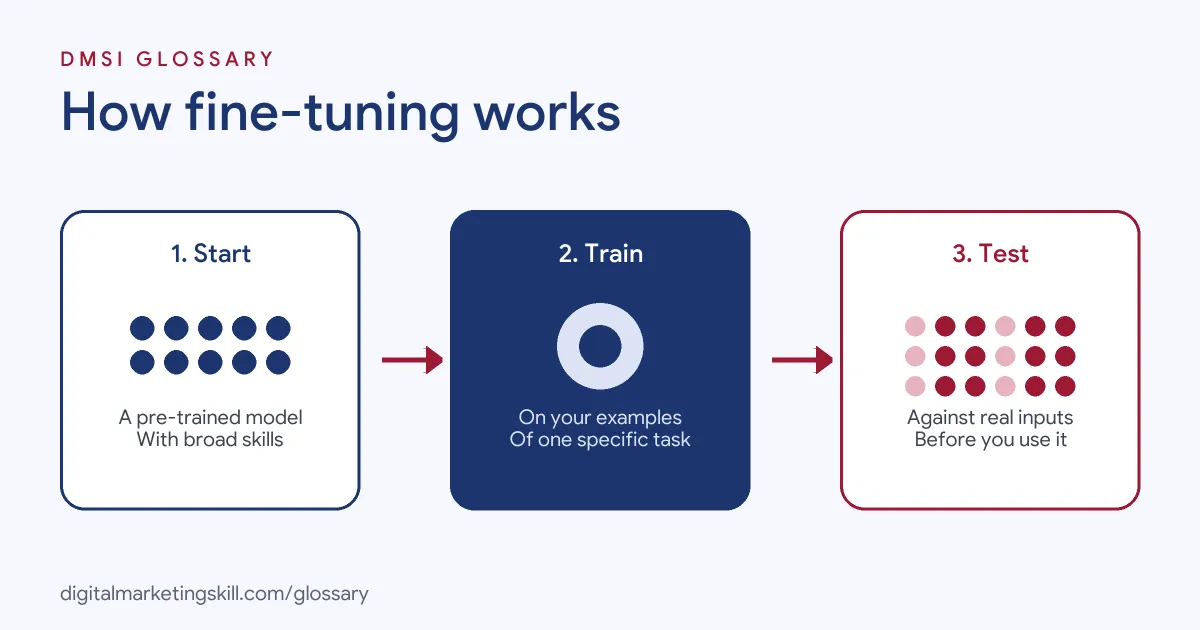
Every project of this kind follows the same basic loop. First, you collect examples of good inputs and outputs. Next, you train the base model on those examples. Finally, you test the new model against real tasks and compare it with the original.
The Training Data
The examples are the most important part. Each one pairs an input, such as a product brief, with the ideal output, such as a finished product description. OpenAI’s guide says its training files use the JSONL format, with one example per line.
You don’t always need millions of examples. Google’s Machine Learning Crash Course says engineers “can sometimes fine-tune a foundation LLM on just a few hundred or a few thousand training examples.” However, the examples must be accurate and consistent, because the model will copy their mistakes too.
Full Fine-Tuning vs Parameter-Efficient Tuning
In full fine-tuning, the training updates every parameter in the model. Google calls this computationally expensive. By contrast, parameter-efficient tuning adjusts “only a subset of parameters” on each step, which costs far less.
LoRA is a popular method of this second type. IBM explains that with LoRA, “the pre-trained model weights themselves remain frozen,” and training only learns a small set of changes. Teams can then swap different LoRA add-ons in and out for different tasks.
Common Training Methods
OpenAI’s guide lists several training methods. In supervised fine-tuning, you give examples of correct responses. With preference tuning, you give a better and a worse answer for each prompt. In reinforcement fine-tuning, a grader scores the model’s answers and the training rewards higher scores. Vision fine-tuning adds images to the examples.
Fine-Tuning Examples
Here are three made-up examples of how a marketing team might use it:
- Example: online retailer. It fine-tunes a model on a few thousand approved product descriptions. The new model writes first drafts in the brand’s tone with far shorter prompts.
- Example: customer support team. It trains a model on past support replies that customers rated highly. As a result, draft replies follow the company’s policies and style.
- Example: agency. It fine-tunes a small model to sort incoming leads into categories, such as “ready to buy” or “just researching”. The small model runs faster and costs less than a large general one.
In each case, the task repeats often, and the team has plenty of good examples. Those two conditions are what make the extra training worth the effort, time and cost.
Fine-Tuning vs Prompt Engineering vs Distillation
These three ideas are often mixed up. Google’s crash course separates them like this:
| Approach | Changes the model? | What it does | Main trade-off |
|---|---|---|---|
| Prompt engineering | No | Guides the existing model with instructions and examples in the prompt | No training needed, but long prompts on every request |
| Fine-tuning | Yes, its weights | Trains the model further on task examples | Better at one task, same size as the original |
| Distillation | Creates a new, smaller model | A large model teaches a small one | Faster and cheaper, but usually a little less accurate |
For most marketers, prompt engineering is the first tool to reach for. Extra training comes later, when a task is frequent and prompts alone stop giving consistent results.
How to Approach Fine-Tuning
If your team is considering it, work through these steps in order:
- Try prompting first. Write a clear prompt with a few examples. If the results are good, stop there.
- Define one narrow task. For example, “write a product description from a spec sheet”, not “do our marketing”.
- Collect high-quality examples. Use your best real work, checked by a person, and remove anything private you don’t need.
- Set aside test examples. Keep some examples out of training, so you can check the model on work it has not seen.
- Train with your chosen platform. Follow its data format and settings. OpenAI’s flow, for instance, is collect, upload, train, then evaluate.
- Compare against the base model. OpenAI advises you to “run evals using test data that is representative of real world inputs.”
- Review outputs before use. A fine-tuned model can still make errors, so keep a human check in place.
Best Practices
- Quality beats quantity. Accurate, consistent examples matter more than a huge pile of mixed ones.
- Protect the base skills. IBM warns of “catastrophic forgetting”, where training damages the model’s core knowledge. Parameter-efficient methods can reduce this risk.
- Use it for style and format. OpenAI notes that fine-tuning lets you use shorter prompts, which can cut cost and wait times.
- Keep a log. Record which data and settings produced each model, so you can repeat or undo a change.
Common Mistakes
Many teams jump to fine-tuning before testing good prompts. Others train on messy data, such as old copy that no longer matches the brand. Some skip the test set, so they can’t tell whether the new model is better. Finally, people sometimes expect the trained model to know fresh facts, such as today’s stock levels. However, a model only learns what its examples contained, so new facts still belong in the prompt.
Where You’ll Use Fine-Tuning at Work
Most job listings that mention fine-tuning are technical AI roles. For example, real remote listings ask for:
- “Experience training or fine-tuning LLMs” (Mid Data Science and AI Engineer).
- “Model adaptation: fine-tuning or distilling open-weight models, and serving them cost-effectively” (AI Tech Lead).
As a marketer, you are more likely to work alongside these teams than to train models yourself. Still, knowing what fine-tuning can and can’t do helps you write better briefs, prepare training examples and judge whether a custom model is worth it. Our guide to AI in digital marketing shows where these tools fit in day-to-day work.
Learn It in Any DMSI Track
AI fundamentals, covering strategy and planning, is part of every track in the DMSI Master Diploma. There, you learn how to choose between prompting and other ways to adapt AI tools for real marketing tasks. You also join a U.S. Project Internship from day one, with unlimited 1-on-1 mentoring.
Frequently Asked Questions
What is fine-tuning in simple terms?
It means giving an existing AI model extra training on your own examples, so it gets better at one specific job.
Is fine-tuning the same as training a model?
Not quite. Pre-training builds the model’s general knowledge from scratch. Fine-tuning is a shorter, extra round of training that starts from that finished model.
How much data do you need for fine-tuning?
It depends on the task. Google says engineers can sometimes fine-tune on a few hundred or a few thousand examples, as long as they are high quality.
Should I use fine-tuning or prompt engineering?
Start with prompt engineering. Move to fine-tuning only when a task repeats often, you have good examples, and prompts can’t give consistent results.
What is LoRA?
LoRA is a parameter-efficient fine-tuning method. It keeps the original model frozen and trains a small set of changes, which makes training cheaper.
Sources: IBM Think: What is fine-tuning?; Google Machine Learning Crash Course: Fine-tuning, distillation and prompt engineering; OpenAI: Model optimisation guide; remote job listings on Himalayas.