
Generative AI is a type of artificial intelligence that creates new content, such as text, images, audio, video or code, in response to a written request called a prompt. It learns patterns from huge amounts of existing data, then uses them to produce something original. For marketers, it matters because it can speed up first drafts, ideas and creative variations, as long as a person checks the result.
Key Takeaways
- This kind of AI creates new content. Older AI tools mostly sorted, scored or predicted.
- Most tools run on a foundation model. The most common kind is a large language model (LLM).
- You guide the output with a prompt. Clear, detailed prompts usually give better results.
- It can be wrong. IBM calls false or nonsensical output a “hallucination”, so every fact needs checking.
- Ad platforms now build it in. Google Ads, for example, can suggest headlines, descriptions and images for Performance Max.
What Is Generative AI?
IBM describes generative AI, sometimes called gen AI, as “artificial intelligence (AI) that can create original content.” Google Cloud adds that it “doesn’t just analyze data; it creates new content,” and compares it to “an AI artist, writer, or even coder.”
Well-known tools include ChatGPT for text and DALL-E for images, both named by Google Cloud as “prime examples.” Google’s own Gemini models can work with text, images, audio and video.
For instance, a marketer might type: “Write five short Instagram captions for a vegan bakery launching a new brownie.” A few seconds later, the tool returns five options. The marketer then picks one, edits it and posts it. In other words, the tool gives you a fast first draft, but you stay the editor.
How Generative AI Works
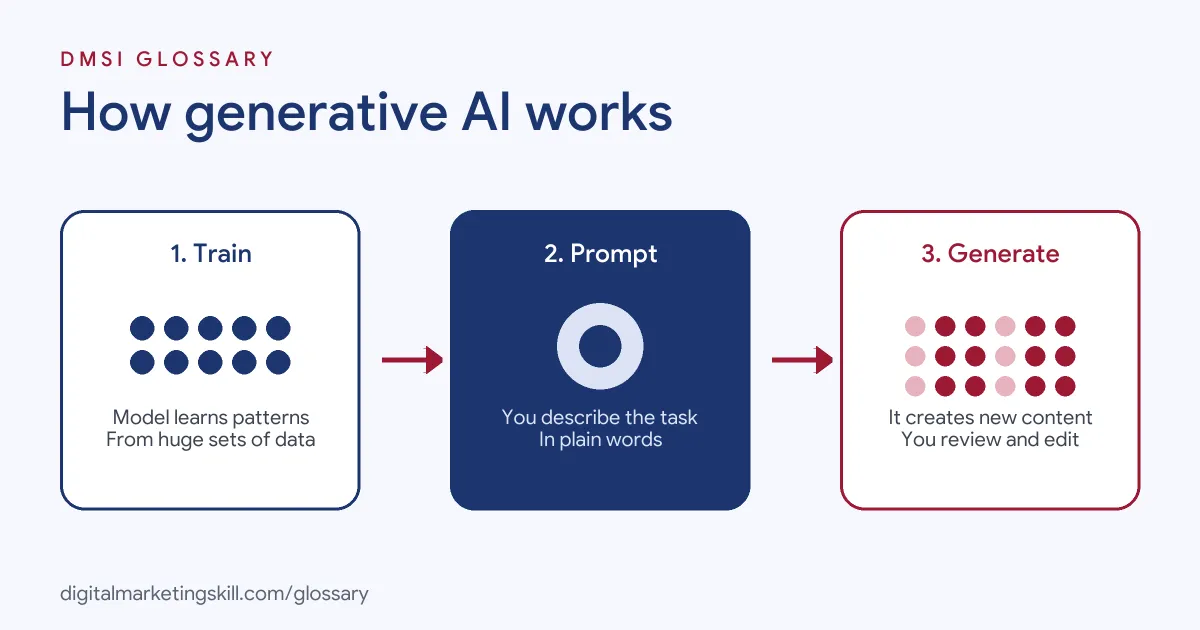
IBM explains that these tools work in three phases. First, a model is trained on a huge amount of data. Next, it is tuned for a specific job. Finally, it generates content, which people evaluate so the model can improve.
Foundation Models and LLMs
According to IBM, the process “begins with a foundation model.” This is a large model that can serve as the base for many different apps. IBM notes that “the most common foundation models today are large language models (LLMs).” Google Cloud describes LLMs as “large AI models trained on massive datasets of text and code.” As a result, they can answer questions, summarise documents, translate and write.
Prompts
A prompt is the instruction you give the tool. It can be a question, a task or a set of rules. The more context you add, such as your audience, tone and word limit, the closer the output will be to what you need. OpenAI also notes that ChatGPT “is sensitive to tweaks to the input phrasing,” so small changes to a prompt can change the answer.
Tuning and Outside Sources
Businesses often adapt a model for their own use. IBM lists methods such as fine-tuning on labelled examples. It also describes retrieval augmented generation (RAG), which lets an app pull in outside sources so its answers use current information.
What It Can Create
IBM lists a wide range of outputs. These include text, such as emails and articles, plus images, video, sound, speech and software code. It also covers design and art, and even synthetic data for research. For a marketer, the most useful ones are usually copy, images and short video. For example, one brief can become a blog outline, three email subject lines and a set of social graphics. Still, each format needs a human check, because a tool can get details wrong in a picture just as easily as in a sentence.
Generative AI Examples in Marketing
Here are three common ways teams use these tools:
- Ad assets: In Google Ads, you can enter your landing page and let Google AI suggest headlines, descriptions and images for a Performance Max asset group. You then keep only the assets that fit.
- Content drafts: IBM notes that marketing teams use gen AI tools “to draft copy,” which saves time on blogs, emails and social posts.
- Customer chat: A chatbot built on an LLM answers common questions on a website and passes harder ones to a person.
In each case, the tool does the first pass. Meanwhile, a person sets the brief and approves the final version.
Generative AI vs Traditional AI
Both are types of artificial intelligence, but they do different jobs:
| Feature | Traditional (predictive) AI | Generative AI |
|---|---|---|
| Main job | Sorts, scores or predicts | Creates new content |
| Typical output | A label, score or number | Text, images, audio, video or code |
| Marketing example | Smart Bidding sets a bid for each auction | A tool drafts ad headlines from your website |
| Main risk | Poor predictions from poor data | Confident but false or off-brand content |
In short, predictive AI helps you decide, while generative AI helps you make.
How to Use Generative AI Safely at Work
Use these steps to get useful results without risk:
- Pick a low-risk task. Start with ideas, outlines or first drafts, not final legal or medical text.
- Write a clear prompt. Include the goal, audience, tone, format and length.
- Give it context. Paste in your brand guidelines or key facts, but never private customer data.
- Ask for options. Request several versions, then choose and combine the best parts.
- Check every fact. Compare names, numbers and claims with a trusted source.
- Edit for your voice. Make the final version sound like your brand, not like a machine.
Best Practices
- Treat output as a draft. OpenAI says ChatGPT “sometimes writes plausible-sounding but incorrect or nonsensical answers.”
- Review ad assets before launch. Google says you “should review any generated or suggested assets to ensure that they’re accurate, not misleading.”
- Know the policies. Google also warns that AI-made assets “aren’t guaranteed to be approved by Ads Policy.”
- Watch for bias. IBM lists bias from training data as a key risk, so check that content treats every group fairly.
- Protect data and rights. IBM also flags security and intellectual property risks. Therefore, follow your company’s AI policy.
Common Mistakes to Avoid
New users tend to make a few errors. First, they publish the first answer without editing it. Second, they write one-line prompts and then blame the tool. Another mistake is using the same prompt for every channel, so the tone never quite fits. They also trust statistics or quotes the tool produces without checking them. IBM gives the example of a lawyer whose AI research tool invented fictional legal cases. Finally, some people paste sensitive client data into public tools, which can break privacy rules.
Where You’ll Use Generative AI at Work
These skills now appear in content, social and leadership roles. For example, recent remote job listings say:
- “Stay current with the latest generative AI tools for image and video creation and implement efficient workflows that accelerate content production” (Generative AI Content and YouTube Advertising Specialist).
- “Leveraging modern generative AI tools to draft, repurpose, and scale content efficiently” (Inbound Marketer).
- “Lead AI transformation with a focus on generative AI for content creation and summarization” (Vice President, Technology and Product).
Notice what these listings value. They don’t ask for people who can code a model. Instead, they want marketers who use the tools every day, know their limits and can show the work they produced.
So if you want to work as a Content Creator, Social Media Manager or Paid Social Specialist, expect employers to ask how you use these tools. They will also want to see examples of real work.
Learn It in the Social Media Track
AI fundamentals are part of every DMSI track. To apply gen AI to graphics, video and ad creative, choose the AI-Powered Social Media Management and Advertising track. There, you plan, create and run a paid social campaign for a real brand. You also join a U.S. Project Internship from day one, with unlimited 1-on-1 mentoring.
To sharpen your skills, read our guide on how to write ChatGPT prompts and our review of AI writing tools.
Frequently Asked Questions
What is generative AI in simple terms?
It is AI that makes new content, such as text or images, when you describe what you want in a prompt.
Is ChatGPT an example of generative AI?
Yes. Google Cloud names ChatGPT for text and DALL-E for images as prime examples.
What is an AI hallucination?
IBM defines it as output “that is nonsensical or altogether inaccurate.” That’s why you should check facts before you publish.
Can generative AI replace marketers?
It can speed up many tasks. However, people still set strategy, judge quality, check facts and take responsibility for what is published.
Does Google Ads use generative AI?
Yes. In Performance Max, Google AI can suggest headlines, descriptions and images based on your landing page. You review them and keep only those that fit.
Sources: IBM: What is generative AI?; Google Cloud: What is artificial intelligence?; Google Ads Help: Build a Performance Max asset group using generative AI; OpenAI: Introducing ChatGPT; remote job listings on Himalayas.