
A hook is the opening moment of a piece of content, such as the first line of a post or the first seconds of a video, designed to grab attention and make people keep watching or reading. It might be a bold claim, a question, a surprising image or a problem the viewer recognises. The hook matters because, in a fast-moving feed, people decide almost instantly whether to stay, so a weak start can sink even great content.
Key Takeaways
- It is the first thing people see or hear, and its job is to stop the scroll.
- TikTok advises putting your hook in the first six seconds and your main message in the first three.
- Google’s ABCD framework for YouTube ads starts with Attention: “Hook and sustain attention with an immersive story.”
- Strong openings use suspense, surprise, a clear problem or a striking visual.
- The hook must lead into real value; otherwise people leave anyway.
What Is a Hook?
Think of it as the headline of a video or post. A newspaper headline makes you read the story. In the same way, a good hook makes you watch the next few seconds, and then the next.
TikTok’s ads help centre recommends a simple structure that sells: “Have a hook, highlight your unique selling points, and end with a clear call-to-action.” So the opening is the first of three jobs, not the whole ad.
It applies to more than video. The first line of an Instagram caption, the opening of an email or the top of a landing page all need a hook too. Wherever people can leave in a second, the opening has to earn their attention. Writers and advertisers have always known this. The first line of a good article or a print advert does the same job as the first second of a reel.
How a Hook Works
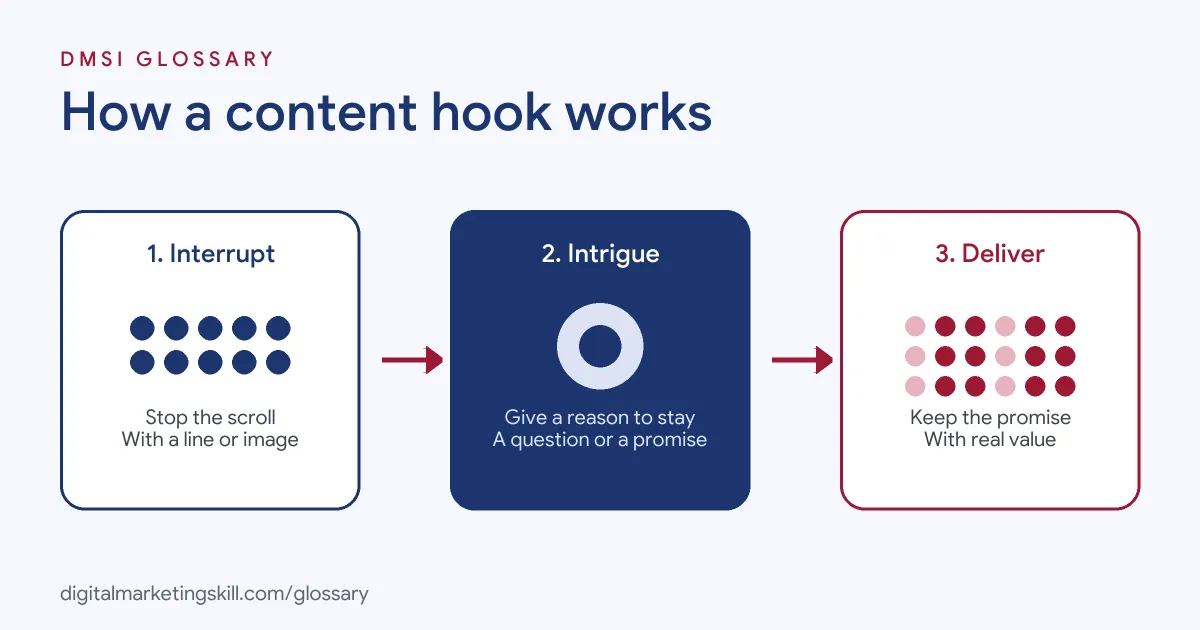
Every hook works in three quick steps. First, it interrupts the scroll with something unexpected. Next, it creates a reason to stay, such as a question you want answered. Finally, it hands over to the main content, which must deliver on that promise.
Timing Your Hook
Speed matters. TikTok says: “Prioritize your hook in the first 6 seconds to boost engagement and increase watch time.” It also suggests introducing your main message “in the first 3 seconds for better recall and awareness.” In practice, the best openings start in the very first frame.
Using Emotion
TikTok suggests creating a hook through “suspense, surprise, or other emotions.” Google’s ABCD guidance agrees, recommending emotional levers and storytelling techniques “such as humour, surprise and intrigue.” So a strong opening usually makes the viewer feel something, not just see something.
Sound and Visuals
Google advises jumping in fast, with “engaging pacing and tight framing to draw viewers in.” It also recommends bright, high-contrast visuals and using audio and on-screen text together. For YouTube Shorts, Google suggests you “announce yourself with audio” and use tight framing for ease of viewing. Because YouTube counts square or vertical videos of up to three minutes as Shorts, even a longer Short still depends on a strong opening.
Hook Examples
Here are some made-up openings that show the common types:
- Problem: “Your plants keep dying? It’s probably this one thing.”
- Surprise: A baker drops a cake on purpose, then shows how to rescue it.
- Question: “What would you do with an extra hour every morning?”
- Result first: The video opens on a finished room makeover, then rewinds to the start.
- Bold claim: “Most people wash their car the wrong way.”
Each one gives the viewer a clear reason to wait for the answer.
Types of Hook Compared
| Type | How it works | Best for |
|---|---|---|
| Problem | Names a pain the viewer feels | Tips, tutorials and product demos |
| Question | Opens a gap the viewer wants closed | Educational posts and stories |
| Surprise | Shows something unexpected | Entertainment and brand awareness |
| Result first | Shows the payoff, then how you got there | Before-and-after content |
| Bold claim | Challenges a common belief | Opinion pieces and myth-busting |
No single type always wins. That’s why testing several openings for the same video is so useful.
How to Write a Hook
- Know the one message. Decide what the viewer should take away before you write the opening.
- Find the viewer’s problem. Ask what they care about at the moment they see your content.
- Write five versions. Draft several openings using different types, such as a question and a bold claim.
- Cut every wasted word. Next, trim each one until it fits in a few seconds.
- Add a visual and sound. Pair the words with a striking first frame and clear audio.
- Add on-screen text. TikTok recommends captions or text overlays to give context.
- Test and compare. Finally, post or run the strongest versions and check which keeps people watching longest.
A Worked Example: Rewriting a Weak Opening
Here is a made-up example. A gardening brand posts a video that starts like this: “Hi everyone, welcome back to the channel. Today we’re going to talk about tomatoes.” Viewers leave within two seconds, because nothing gives them a reason to stay.
So the team rewrites the first line three ways and tests each one:
- “Your tomatoes are splitting for one simple reason.”
- “Stop watering your tomatoes like this.”
- A close-up of a split tomato, with the text: “Fix this in one week.”
After a few days, the close-up version keeps people watching the longest. As a result, the brand uses that style, a clear problem shown on screen in the first second, for its next five videos. The lesson is simple: the content didn’t change, but the opening did, and that made the difference.
Best Practices
- Brand early, but naturally. Google’s ABCDs suggest introducing your brand or product from the start.
- Feature people. TikTok and Google both recommend showing real people to help viewers relate.
- Keep the promise. If the hook asks a question, answer it clearly in the content.
- Test openings, not just whole videos. For instance, re-edit the same clip with three different first lines.
- Refresh often. Even a strong hook wears out once people have seen it many times.
Common Mistakes
The most common mistake is a slow start, such as a logo, a long greeting or “Hi everyone, welcome back.” Another is clickbait: a hook that promises something the content never delivers, which annoys viewers and can hurt trust. Others copy a trending opening that has nothing to do with the topic, so viewers feel tricked when the real subject appears. Some creators also rely on sound alone, although Google recommends supporting the story with both audio and on-screen text. Finally, many put the best moment at the end, when it should be at the start.
Where You’ll Use Hooks at Work
Hooks come up in almost every creative and social role. For example, real remote job listings include lines like these:
- “Take each video from idea to posted: hook, script, filming, editing, caption” (Social Media Lead, Student Creator).
- “Brainstorm creative concepts, hooks, and storytelling ideas to produce scroll-stopping content that captures attention and drives results” (Video Editor, Ads Campaign Creative).
- “Implement engaging hooks, dynamic pacing, and a strong narrative rhythm to maximize viewer retention” (Video Editor).
So whether you aim to be a Content Creator, a Social Media Manager or a Paid Social Specialist, writing a strong hook will be part of your daily work.
Learn It in the Social Media Track
The AI-Powered Social Media Management and Advertising track covers content creation, including graphics and video, plus social media marketing, analytics and advertising. You plan, create and run a paid social campaign for a real brand, so you can test which hook works best. You also get unlimited 1-on-1 mentoring and a U.S. Project Internship from day one.
To put your hook to work, read our glossary entry on short-form video. For written openings, see our copywriting tips.
Frequently Asked Questions
What is a hook in social media content?
It is the opening line, image or moment that grabs attention and makes people keep watching or reading.
How long should a hook be?
As short as possible. TikTok advises placing the hook within the first six seconds, and many hooks land in the first one or two.
What makes a good hook?
A good hook is clear, relevant to the viewer and creates curiosity, surprise or emotion. It also leads into content that keeps its promise.
Do hooks matter for ads as well as posts?
Yes. TikTok’s ad guidance and Google’s ABCDs for YouTube ads both put grabbing attention first.
How do I know if my hook works?
Compare how long people watch and how many of them leave in the first few seconds. If viewers drop off early, test a new hook.
Sources: TikTok Ads Help: Creative best practices for performance ads; Google Ads Help: About the ABCDs of effective video ads; YouTube Help: Understand three-minute YouTube Shorts; remote job listings on Himalayas.