
Keyword research is the process of finding the words and phrases people type into search engines, then deciding which ones your website or ads should target. It looks at what people search for, how often they search and what they want when they do. It matters because it shapes every page you write and every search ad you run, so you spend effort on topics real customers care about.
Key Takeaways
- Good research starts with your customers’ language, not your own product names.
- Good choices balance three things: relevance, search volume and intent.
- Free tools such as Google Keyword Planner and Search Console are enough to start.
- Long-tail keywords are longer, more specific phrases. They often have lower volume but less competition.
- Stuffing a page with keywords breaks Google’s spam policies. So write for people first.
What Is Keyword Research?
Every search starts with a few words. The job is to find those words before you write, so your page answers the question people are really asking.
Google’s own SEO Starter Guide gives a simple example. Someone who knows a lot about a topic might search for “charcuterie,” while someone new to it might search for “cheese board.” Both want similar things. However, they use different words. If you only write for one group, you miss the other.
In other words, this work is about listening. You find out how your audience describes their problem, then you use that language on the right page.
How Keyword Research Works
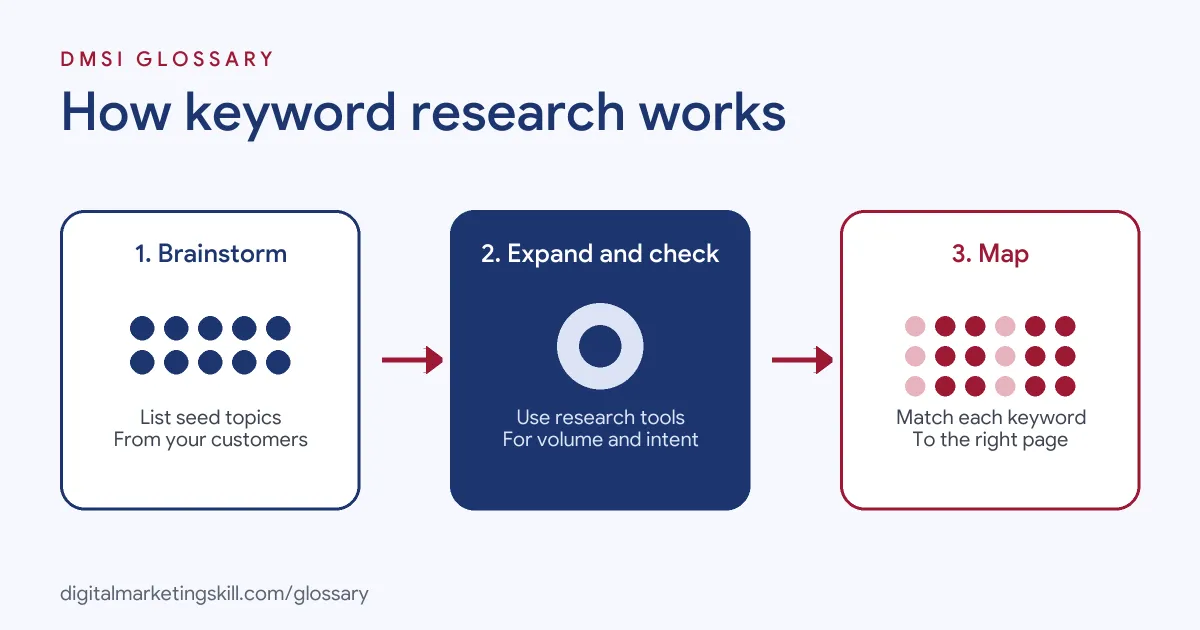
The process has three stages. First, you brainstorm seed topics from what customers ask. Next, you expand that list with tools and check each idea for volume and intent. Then you map each keyword to one page, so every page has a clear focus.
Seed Keywords
Seeds are the obvious starting words for your business. A florist’s seeds might be “flower delivery,” “wedding flowers” and “funeral flowers.” To find more, look at customer emails, sales calls, reviews and the questions people ask on social media.
Volume and Competition
Next, you check how often people search for each idea. Google Keyword Planner shows estimates of monthly searches and the average cost for an ad to show on a keyword. Paid tools such as Semrush add metrics like keyword difficulty, which helps you judge how hard it might be to rank.
High volume isn’t always better, though. Semrush notes that long-tail keywords “often have relatively lower search volumes but also lower levels of competition.” For a new site, these specific phrases are often the best place to start.
Search Intent
Intent is the reason behind a search. Someone typing “how to repot a plant” wants to learn. By contrast, someone typing “buy terracotta pot 20cm” wants to shop. So a guide suits the first search, while a product page suits the second. Semrush stresses that matching search intent helps you guide visitors towards actions such as purchases or sign-ups.
Mapping Keywords to Pages
The final stage turns your list into a plan. Give each page one main keyword and a handful of close variations. For example, a page about “wedding flowers” can also cover “bridal bouquets” and “wedding flower ideas.” Then use the phrase where it fits naturally, such as the title, the main heading and the opening paragraph. Meanwhile, keep a simple spreadsheet with the keyword, the page URL and its current position, so you can track progress.
Keyword Research Examples
Here are three ways businesses put this into practice:
- Local plumber: The owner finds that people search “boiler repair near me” more than “heating engineer.” As a result, he adds a dedicated boiler repair page.
- Online shop: A pet store sees steady demand for “grain-free dog food for small breeds.” It writes a buying guide and links it to the right products.
- Google Ads campaign: A software company uses Keyword Planner to forecast clicks and costs. Then it groups keywords into tight ad groups before launch.
In each case, the research led to a clear page or ad, not just a list.
Keyword Research Tools Compared
You don’t need expensive software to begin. Here is how the main options compare:
| Tool | What it shows | Best for |
|---|---|---|
| Google Keyword Planner | Keyword ideas, estimated monthly searches and average cost to show an ad | Finding ideas and planning search ads |
| Google Search Console | Queries that already show your site, with clicks, impressions, CTR and average position | Improving pages you already have |
| Paid SEO tools, such as Semrush | Search volume, keyword difficulty, questions and competitor rankings | Deeper research and competitor analysis |
One practical note: to use Keyword Planner, Google says you must first complete your Google Ads account setup, including billing details.
How to Do Keyword Research Step by Step
Follow these steps for any new page or campaign:
- List your seed topics. Use the words customers use, not internal jargon.
- Expand the list. In Keyword Planner, choose Discover new keywords and enter words or a website related to your business.
- Check volume and difficulty. Remove terms nobody searches for, and flag ones that look too competitive for now.
- Judge the intent. Search each keyword yourself and look at what already ranks.
- Group related terms. Put close variations together, since one page can cover them all.
- Map one main keyword to each page. This avoids two of your pages competing for the same search.
- Review results in Search Console. After that, update pages based on the real queries that show them.
Best Practices for Keyword Research
- Start with the customer. Above all, research their questions before you open a tool.
- Prioritise business value. A small keyword that brings buyers beats a big one that brings browsers.
- Look for quick wins. Semrush suggests checking keywords where you already rank on page two or beyond.
- Write naturally. Google says excessively repeating the same words “is tiring for users.”
- Repeat the process. Search habits change, so review your list regularly.
Common Mistakes to Avoid
Many beginners chase the biggest keywords first, then wonder why they never rank. Others pick keywords that don’t match their page, such as a “how to” phrase for a sales page. Some still add a keywords meta tag, even though Google says its search engine doesn’t use it. Another myth is that you need the keyword in your domain name. Google says keywords in a domain name or URL path alone have “hardly any effect” beyond appearing in breadcrumbs. The worst mistake, though, is keyword stuffing. Google’s spam policies describe this as filling a page with keywords “in an attempt to manipulate rankings.” In short, it can hurt you rather than help.
Where You’ll Use Keyword Research at Work
This skill appears in SEO, content and paid search roles. For example, recent remote job listings ask candidates to:
- “Own SEO for our websites and content: keyword research, on-page optimization, meta titles and descriptions, internal linking, and monitoring rankings” (Marketing Specialist).
- Write content that weaves “keyword research, search intent, and on-page best practices into genuinely good writing” (Senior Content Marketer, SEO).
- “Conduct keyword research, audience targeting, and competitor analysis to maximize campaign performance” (Marketing Ads Specialist).
So if you want to work as an SEO Specialist, Website Manager or WordPress Developer, employers will expect you to research, prioritise and map keywords to pages.
Learn It in the WordPress and SEO Track
You can learn keyword research in the AI-Powered WordPress and SEO Specialist track. It covers AI fundamentals, WordPress website and eCommerce development, and search engine optimisation and content marketing. For your portfolio, you build a WordPress site or store and rank it with an SEO content plan. You also join a U.S. Project Internship from day one, with unlimited 1-on-1 mentoring.
To go further, compare free and paid keyword research tools, read our guide to keyword strategy, and see our glossary entry on search engine optimisation.
Frequently Asked Questions
What is keyword research in simple terms?
It is finding the words people type into Google about your topic, then choosing which ones each page should target.
Do I need a Google Ads account for Keyword Planner?
Yes. Keyword Planner sits inside Google Ads, and Google says you must complete your account setup, including billing details, before you can use it.
What is a long-tail keyword?
It is a longer, more specific phrase, such as “waterproof hiking boots for wide feet.” These often have lower volume but less competition.
How many keywords should one page target?
Give each page one main keyword, plus close variations and related questions. That keeps the page focused and avoids overlap.
How often should I redo keyword research?
Review it whenever you plan new content, and check Search Console regularly to see which queries your pages already appear for.
Sources: Google Search Central: SEO Starter Guide; Google Search Central: Spam policies; Google Ads Help: Use Keyword Planner; Search Console Help: Performance report; Semrush: How to do keyword research; remote job listings on Himalayas.