
Topical authority is the trust a website earns as a go-to source on a particular subject, built by covering that subject in depth, accurately and over time. Instead of ranking one page for one keyword, a site with topical authority has many connected pages that together answer most of what people want to know about the topic. It matters because search engines and readers both tend to favour sources that clearly know a subject well.
Key Takeaways
- It comes from depth: many useful, connected pages on one subject, not scattered posts on everything.
- Google has a “topic authority” system for news, which looks at how notable, influential and reputable a publication is on a topic.
- For general websites, “topical authority” is an SEO term rather than a single Google score.
- Google’s helpful content guidance asks whether your site has “a primary purpose or focus”, which supports the same idea.
- You build it with keyword research, topic clusters, strong internal linking and genuine expertise.
What Is Topical Authority?
Think of it as becoming the specialist shop on a high street. A general store sells a bit of everything. A specialist bike shop, by contrast, has every part, a mechanic and staff who know the subject. When people need bike advice, they go to the specialist.
Websites work in a similar way. For example, a site with 60 helpful, linked guides on sourdough baking is more likely to be seen as an expert on sourdough than a general food blog with one sourdough post. Its pages support each other, and together they cover the topic from beginner questions to advanced techniques.
It’s worth being precise about the name. Google uses “topic authority” for a specific news system. Meanwhile, SEO specialists use “topical authority” more broadly, for a site’s depth and trust on any subject. Both ideas share the same core: real, focused expertise.
How Topical Authority Works
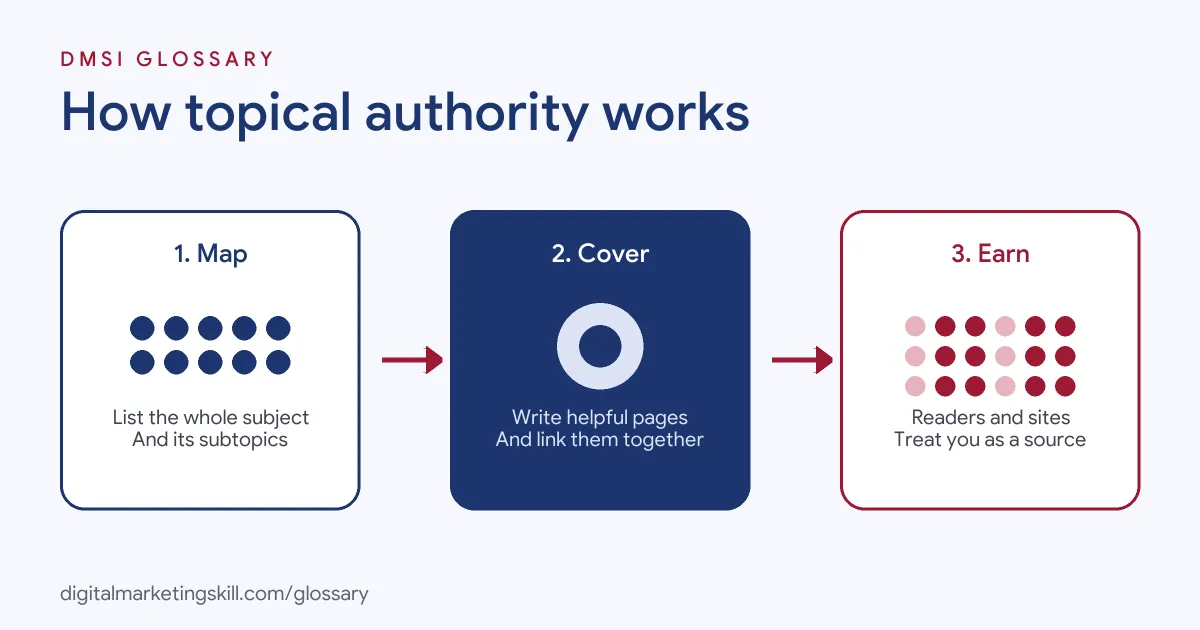
It builds in three steps. First, you map the whole subject, including the main topic and its subtopics. Next, you cover each part with helpful pages and link them together. Finally, over time, readers, other sites and search engines start to treat you as a trusted source on that subject.
Google’s Topic Authority System for News
Google’s Search Central blog describes a system called topic authority. It “helps determine which expert sources are helpful to someone’s newsy query in certain specialized topic areas, such as health, politics, or finance.” In other words, it is mainly about news, but its signals are useful clues for any site.
The Signals Google Describes
Google lists three prominent signals. The first is “How notable a source is for a topic or location.” For example, Google says people looking for news on Nashville high school football often turn to The Tennessean. The second is “Influence and original reporting”, which looks at how often other publishers cite a source’s original work. Finally, “Source reputation” looks at a history of high-quality reporting and recommendations from expert sources, such as professional societies.
Site Focus
Google’s guide to helpful content supports the same idea for all sites. Its people-first questions include whether your site has “a primary purpose or focus” and whether your content shows first-hand expertise. It also warns against producing lots of content on many different topics in the hope that some of it ranks.
Topical Authority Examples
Here are three made-up examples of sites building this kind of trust:
- Pet care site (example): It publishes linked guides on puppy training, from first commands to lead walking, plus advice reviewed by a qualified trainer.
- Accounting firm (example): It covers small business tax in depth, with guides on deadlines, expenses and VAT, all linked from one main hub page.
- Software company (example): It builds a full library on email deliverability, including how-to guides, glossary terms and original test data.
In each case, the site goes deep on one subject rather than wide on many.
Here is one more made-up example, step by step. A garden centre wants to rank for “growing tomatoes”. First, it writes one hub guide. Then it adds ten short guides on seeds, soil, watering, feeding, pests and more. Each guide links back to the hub. After a few months, the hub and several guides start to rank. Now the site looks like a tomato expert, not just a shop that sells plants.
Topical Authority vs Domain Authority
These two terms are often confused. Here is how they differ:
| Feature | Topical authority | Domain authority |
|---|---|---|
| What it describes | Depth and trust on one subject | A third-party score for a whole site’s link strength |
| Where it comes from | Content coverage, expertise and recognition | SEO tools that estimate it, mainly from links |
| Used by Google? | Google has a topic authority system for news | No, it is a metric made by SEO tool companies |
| How you grow it | Cover a subject fully and well | Earn more quality backlinks |
In short, domain authority is a tool’s estimate of link strength, while topical authority is about being the expert on a subject. For more on the tool metric, see our entry on domain authority.
How to Build Topical Authority
- Choose a focused subject. Pick a topic that matches your business and your real expertise.
- Map the subtopics. Use keyword research, customer questions and competitor sites to list every subtopic.
- Create a hub page. Write one broad guide that introduces the whole subject.
- Write supporting pages. Cover each subtopic in its own helpful page.
- Link them together. Link the hub to each page and each page back to the hub, using clear anchor text.
- Add original value. Share your own data, examples or expert reviews, which other sites may cite.
- Fill the gaps. Check which questions you haven’t answered yet, then add them over time.
- Keep it up to date. Update facts and prune pages that no longer help.
Best Practices for Topical Authority
- Go deep before you go wide. Finish one subject well before starting the next.
- Use internal links on purpose. Our entry on internal linking explains how links connect a topic.
- Show real expertise. Named authors and expert reviews build trust, especially on money or health topics.
- Earn citations. Original research and useful data give other sites a reason to reference you.
- Avoid duplicate pages. Two pages chasing the same question can compete with each other.
Common Mistakes to Avoid
A common mistake is publishing on every trending topic, which spreads a site thin. Another is writing many near-identical pages for small keyword changes, which adds little value. Some sites also forget internal links, so their pages sit alone instead of supporting each other. Others chase a third-party score and treat it as if Google uses it. Finally, many expect quick results, even though authority builds over months of steady work.
Where You’ll Use Topical Authority at Work
Planning content around topics is a core SEO and content skill. For example, real remote job listings ask for:
- A “Strong grasp of SEO fundamentals: search intent, topical authority, on-page optimization, and internal linking.” (Consultant, Content Strategist).
- Someone to “Conduct advanced keyword, entity, and topical authority research using AI-powered SEO tools.” (Senior SEO Specialist).
So if you want to work as an SEO Specialist or Website Manager, employers will expect you to plan content that covers a subject fully, not just one keyword at a time.
Learn It in the WordPress and SEO Track
You can learn to plan topic-based content in the AI-Powered WordPress and SEO Specialist track. It covers WordPress website and eCommerce development, search engine optimisation and content marketing. Your portfolio project is a WordPress site or store that you build and rank with an SEO content plan. You also get unlimited 1-on-1 mentoring and a U.S. Project Internship from day one.
Next, read our guide to content pillars, which helps you choose the subjects to build around.
Frequently Asked Questions
What is topical authority in simple terms?
It means being seen as an expert source on one subject, because you cover it fully and well.
Is topical authority a Google ranking factor?
Google has a topic authority system for news. For other sites, it is an SEO idea rather than a single score, but it matches Google’s advice on focus and expertise.
How long does it take to build?
There is no fixed time. It usually builds over months, as you publish and improve connected pages on one subject.
How many articles do I need?
There is no magic number. Aim to answer the main questions people have about your subject, and link those pages together.
Is topical authority the same as domain authority?
No. Domain authority is a score from SEO tools, mostly based on links. Topical authority is about depth and trust on a subject.
Sources: Google Search Central Blog: Understanding news topic authority; Google Search Central: Creating helpful, reliable, people-first content; Google Search Central: A guide to Google Search ranking systems; remote job listings on Himalayas.