
A digital marketing strategy audit checks whether your current plan still fits your actual numbers, not whether it looks busy. Most businesses have a strategy, even an unplanned one, built from whatever channels they happened to try first. This guide gives you a five-step audit. It finds what is working, what is wasting budget, and what to fix first.
Key Takeaways
- Budgets are shifting faster than plans. The CMO Survey found digital marketing spend rose 8.2% over the past year, nearly five times faster than overall marketing spend at 1.7%.
- Proving ROI is the top obstacle. HubSpot’s State of Marketing research found measuring marketing ROI is the top obstacle for 33% of marketers, and 73% report more scrutiny on budgets than before.
- Most martech goes unused. Analysis reported by MarTech found marketers use only about 33% of their stack’s capability, down from 42% and 58% in earlier waves.
- Tool overload is common. Salesforce’s small business research found 88% of surveyed small business leaders feel overwhelmed by too many business tools.
- Conversion benchmarks vary by device. Dynamic Yield’s ecommerce benchmark puts the global average conversion rate at 2.72%, with mobile and desktop differing depending on the dataset.
In this guide
- What Most Digital Marketing Strategy Audit Advice Gets Wrong
- Why an Audit Beats Starting Over
- The Five Steps of a Digital Marketing Strategy Audit
- What to Do With What the Audit Finds
- If Goals Do Not Match Numbers: Rewrite Them Around What You Can Measure
- If Your Audience Has Drifted: Follow the Data, Not the Plan
- If a Channel Is Idle: Cut It or Recommit, Do Not Leave It Drifting
- If Messaging Underperforms: Repeat What Specificity Proves Works
- If True ROI Is Weak: Reallocate Before You Expand
- How to Measure Whether the Fixes Worked
- The Most Useful Rule: Audit the Channel Carrying the Most Budget First
- A Real Case: Segmentation That Beat Its Own Growth Target
- A Four-Week Plan to Run Your Own Digital Marketing Strategy Audit
- Frequently Asked Questions About a Digital Marketing Strategy Audit
- Start With Your Biggest Channel, Then Work Down
What Most Digital Marketing Strategy Audit Advice Gets Wrong
Most strategy advice tells you to set goals, know your audience and pick the right channels. None of that is wrong. But it assumes you are starting fresh, when most businesses already have a strategy running, just one nobody has checked in months.
This guide is a digital marketing strategy audit, not a strategy from scratch. It shows you how to check what you already have, using the metrics you can access today. Here are the limits too. The CMO Survey covers only US for-profit firms. Salesforce and HubSpot are vendors surveying their own audiences, and the five-step process below is a practical framework, not a single settled standard. Treat every figure as a snapshot, not a permanent fact.
Why an Audit Beats Starting Over
Rebuilding a strategy from zero throws away whatever is already working alongside whatever is not. An audit keeps the first and fixes the second. That combination is faster and cheaper than a rebuild almost every time, because it spends effort only on the parts that actually need it.

Budgets Are Already Moving Toward Digital
The CMO Survey found digital marketing spend rose 8.2% over the past year, compared with 1.7% for overall marketing spend. That gap means budget is already shifting. A digital marketing strategy audit decides where that shifted budget should land, instead of it drifting toward whichever channel asked loudest.
Research on digital marketing benefits that actually move revenue covers why that shift is happening in the first place. Digital channels are measurable in ways traditional media is not, and that measurability is exactly what an audit relies on.
Proof, Not Effort, Is the Real Gap
HubSpot’s State of Marketing research found that measuring marketing ROI is the top obstacle for 33% of marketers, and 73% say their budget faces more scrutiny than in the past. Most teams are not short on effort. They are short on proof.
An audit forces that proof into the open. Instead of asking whether a channel feels like it is working, it asks for the number that shows it.
That shift in framing is the whole point of a digital marketing strategy audit. It replaces a conversation about effort and intuition with one about evidence, which is a harder conversation to have but a far more useful one to act on.
The Five Steps of a Digital Marketing Strategy Audit
Each step below checks one layer of your current strategy, from goals down to return. Work through them in order, because later steps only make sense once earlier ones are settled.
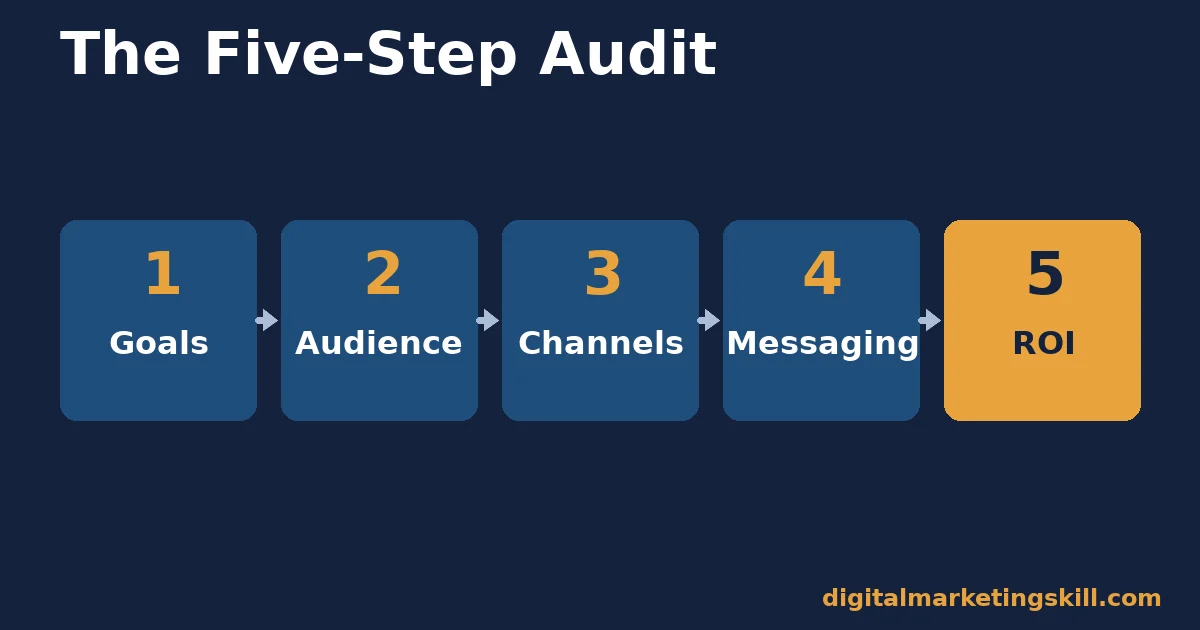
Step One: Re-check Your Goals Against Real Numbers
Pull up whatever goals you set last, even informal ones. Compare each against what actually happened: shares, follower growth, reviews, inbound visits and conversions. A goal with no matching number is not a goal yet, it is a hope.
This first step of a digital marketing strategy audit often surfaces goals that were copied from a template rather than chosen for the business. If a goal does not map to a number you can actually pull this week, treat that as a finding in itself, not a gap to work around.
If you never set formal goals, this step still works. Use your last three months of data to set the first real baseline, then audit against that baseline next time.
Step Two: Re-test Who You Think You Are Reaching
Customer profiles drift. A campaign built for one audience often ends up reaching a different one, and most businesses never notice because nobody checks. Pull your actual audience data and compare it against the profile your strategy assumes.
Look specifically at the gap between who you intended to reach and who actually engages, clicks or buys. A large gap is not automatically bad news. It can point to an unplanned, profitable audience worth building a deliberate strategy around, instead of treating it as an accident to correct.
Our guide to identifying your target audience covers the difference between a market and an audience. That difference is the exact gap that causes this kind of drift.
Step Three: Check Which Channels You Are Actually Active On
List every channel your strategy claims to use, then check your last 30 days of activity against that list. A channel with no recent activity is not part of your strategy anymore, no matter what the plan document says. This step alone often shrinks a long channel list down to the two or three that actually matter.
This step also catches tool overload. Salesforce’s small business research found 88% of surveyed small business leaders feel overwhelmed by too many business tools. Separate analysis reported by MarTech found marketers use only about 33% of their martech stack’s capability. An audit is where you decide which tools earn their place and which get cut.
Step Four: Score Your Messaging Against Engagement
Pull the engagement numbers for your last ten pieces of content: posts, emails, ads. Rank them from strongest to weakest, then read the top three and bottom three side by side. The pattern that separates them is usually obvious once you see it in that order, long before you need any statistical tool to prove it.
Specificity tends to win this comparison. A message with a named number, a named result or a named customer almost always outperforms a generic claim, because readers can check it.
Step Five: Calculate Real Return, Not Assumed Return
Add up what you actually spent, including labour hours, not just media spend. Then add up the revenue you can directly attribute to that spend, not revenue that merely happened during the same period. This step is where most informal strategies fall apart, because few businesses track labour time against a specific channel with any real discipline.
Compare the result against a channel benchmark, read as a rough guide rather than a target, since every industry and audience shifts that number in its own direction. Unbounce’s benchmark across 41,000 landing pages found a median conversion rate of 6.6%, while Dynamic Yield’s ecommerce benchmark puts the global average around 2.72%. Your own number matters more than either benchmark, but the gap between them shows how much conversion rates vary by context.
What to Do With What the Audit Finds
An audit is only useful if it changes a decision. The sections below mirror the five steps above, with the specific move each finding should trigger.
If Goals Do Not Match Numbers: Rewrite Them Around What You Can Measure
Replace vague goals with ones tied to a metric you already track. “Grow brand awareness” becomes “raise engagement rate on our top five posts by a stated amount.” The second version can be audited again next quarter. The first cannot.
If Your Audience Has Drifted: Follow the Data, Not the Plan
When real data contradicts your original customer profile, trust the data. Shift messaging and channel choice toward who is actually engaging, then re-test in another quarter rather than assuming the drift was a one-off. Document the change so the next audit has a clear before-and-after to compare, rather than relying on memory of what the original profile assumed.
If a Channel Is Idle: Cut It or Recommit, Do Not Leave It Drifting
An idle channel still costs attention even when it costs no money. Either recommit to a real posting schedule on it, or formally drop it from the strategy. That way nobody keeps budgeting time for work that is not happening.
If Messaging Underperforms: Repeat What Specificity Proves Works
Once your top and bottom performers are ranked side by side, do not just note the pattern and move on. Rewrite your next three pieces of content to copy the specific structure your top performers used, down to the level of detail they included.
Retire formats that consistently sit at the bottom, even if they are easy to produce. Easy and effective are not the same thing, and a digital marketing strategy audit exists precisely to tell them apart.
If True ROI Is Weak: Reallocate Before You Expand
A channel with weak true ROI should not get more budget just because it is familiar. Shift a defined share of its budget, such as a fifth, toward whichever channel the audit showed performing best. Track both channels for another quarter.
Resist the urge to abandon a weak channel entirely on one audit alone. One quarter of data can be noisy, so confirm the pattern holds before you cut a channel completely rather than just rebalancing it.
How to Measure Whether the Fixes Worked
Each step above has a matching metric. Track these for a full quarter before judging a change, since a single good or bad week rarely means much. A digital marketing strategy audit that changes its mind every week is not measuring anything, it is just reacting to noise.
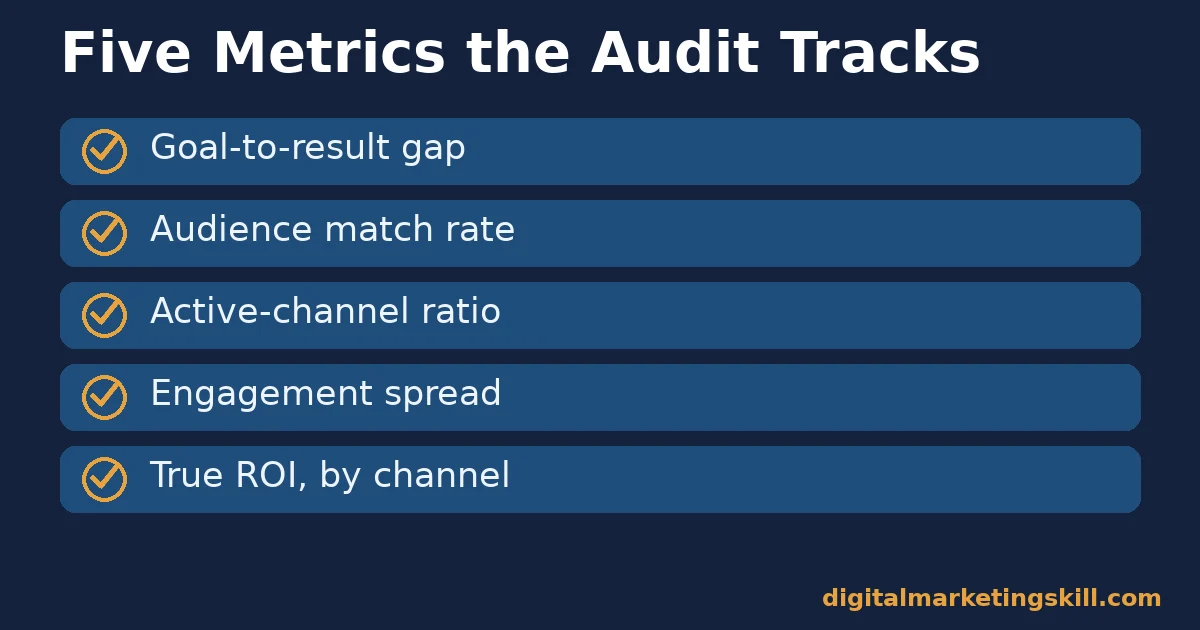
Five Metrics a Digital Marketing Strategy Audit Should Track
- Goal-to-result gap. The difference between your stated goal and the actual number. A shrinking gap over two audits means the strategy is converging on something real.
- Audience match rate. The share of engaged users who match your target profile. A low rate means messaging is attracting the wrong people even when volume looks healthy.
- Active-channel ratio. The share of listed channels with real activity in the past 30 days. This exposes strategy documents that no longer match reality.
- Engagement spread. The gap between your best and worst performing content in the same period. A wide spread usually means a format or message problem, not a channel problem.
- True ROI. Attributed revenue divided by total cost, including labour. This is the number that should decide next quarter’s budget, not last quarter’s habit.
Reading the Metrics Together
Read goal-to-result gap and true ROI together first. A shrinking gap with flat ROI usually means your goals got more realistic, not that performance improved. Then check active-channel ratio against engagement spread, because a channel can look active while still underperforming every other one you run.
Re-run the full audit every quarter, not just when something feels wrong. Waiting for a visible problem means the strategy already drifted further than it needed to.
The Most Useful Rule: Audit the Channel Carrying the Most Budget First
If you take one decision rule from this guide, make it this one. Audit whichever channel holds the largest share of your budget before auditing anything smaller, because that is where a wrong assumption costs the most.
Here is an illustrative example, with invented numbers. A mid-size retailer spends 60% of its marketing budget on paid social without ever calculating true ROI. A full audit finds the channel’s attributed revenue barely covers its cost once labour hours are included. Meanwhile, a smaller email programme, long ignored, returns far more per dollar. The retailer rebalances spend over the next quarter, and total marketing revenue rises even though total spend stays flat.
The lesson is about where the risk concentrates. A small, badly performing channel wastes a little money. A large one wastes a lot, so it deserves the first audit, every time. Once the largest channel is checked, work down the list in order of budget share, not in order of how interesting each channel feels to review.
A Real Case: Segmentation That Beat Its Own Growth Target
Bain & Company published a client case describing a telecoms company. It used tiered customer segmentation to align its growth strategy with what different customer groups actually needed. The approach drove 15% growth in networked services and a 20% boost in enterprise sales, and the company exceeded its year-one growth target by a percentage point.
The case shows the same principle this audit relies on: segment-level data, not a single blended number, revealed where the real opportunity sat. Treat this as one documented, published result rather than a guaranteed outcome, since results depend on the market, the company and the execution. The audit framework in this guide borrows that same discipline at a much smaller scale.
Scale down the same logic for a smaller business. You do not need enterprise-level customer segments to apply it, only a willingness to look at your numbers broken apart by channel and audience instead of as one combined total.
A Four-Week Plan to Run Your Own Digital Marketing Strategy Audit
You do not need new software to start. This plan uses the analytics you already have access to, spread across a month so no single week carries the whole workload.
- Week one: pull your numbers. Gather goal data, audience data, channel activity and content engagement from the last quarter in one place.
- Week two: run steps one and two. Compare goals against real numbers, and compare your assumed audience against who is actually engaging.
- Week three: run steps three and four. Check which channels are truly active, then rank your last ten pieces of content by engagement.
- Week four: run step five and decide. Calculate true ROI per channel, then rebalance budget toward whichever channel the audit actually supports.
At the end of the month, write down what changed and why, in one paragraph per channel. That record is what makes next quarter’s audit faster than this one.
Frequently Asked Questions About a Digital Marketing Strategy Audit
How often should I run a digital marketing strategy audit?
Quarterly works for most businesses, since it gives enough data to judge a channel fairly without letting a drifting strategy run too long unchecked.
What is the difference between a strategy audit and building a new strategy?
An audit checks and adjusts an existing strategy using real performance data. Building a new strategy starts from assumptions instead, which is slower and throws away whatever was already working.
What is the biggest obstacle to proving a strategy is working?
Measuring ROI. HubSpot’s research found it is the top obstacle for 33% of marketers, more than any other single challenge marketers named.
Do I need expensive software to run this audit?
No. The five steps use analytics platforms most businesses already have, such as website analytics, social platform insights and basic spend records. The audit is a process, not a tool purchase.
How many channels should a small business actively run at once?
Fewer than most strategy documents claim. An active-channel ratio audit often finds several listed channels with no real recent activity, so cutting those formally usually improves focus on the ones that work.
What counts as true ROI in this audit?
Attributed revenue divided by total cost, including labour hours, not just media spend. Revenue that merely happened during the same period, without a clear link to the channel, does not count.
Can a digital marketing strategy audit replace a marketing agency’s reporting?
It complements it rather than replaces it. An agency’s reports usually focus on the channels it manages, while a full audit looks across every channel, including the ones no agency is actively running.
Start With Your Biggest Channel, Then Work Down
None of the five steps above require specialist tools. They require honesty about numbers that might contradict your assumptions, and the discipline to act on what you find.
A digital marketing strategy audit works because it replaces assumptions with your own numbers. Start with the channel carrying the most budget, run the five steps above, and decide what to keep, fix or cut before you plan next quarter’s spend. Put the next audit date on your calendar now, not after the strategy has already drifted again.
If you want structured, hands-on practice with these skills, Digital Marketing Skill Institute teaches them directly. The Master Diploma in Digital & AI Marketing is built around four AI-powered tracks, including AI-Powered Google Specialist and AI-Powered WordPress and SEO Specialist, with a Full Stack option for completing all four. It comes with unlimited 1-on-1 coaching and mentoring, plus a U.S. Project Internship with a verified U.S. Work Reference Letter.
The programme is dual US and UK accredited, recognised in more than 100 countries, and fully online, so you can study and run your own audits from anywhere in your country. Browse more guides on the Digital Marketing Skill Institute blog, read real outcomes on the reviews page, and when you are ready, apply for the Master Diploma or start from the Digital Marketing Skill Institute homepage.
Every figure in this guide was checked against its original source before publication. Figures marked as illustrative are invented examples, not real results.
![9 Amazing Digital Marketing Skills to Make Money Online [With Proof]](https://digitalmarketingskill.com/wp-content/uploads/2019/07/9-Amazing-Digital-Marketing-Skills-to-Make-Money-Online-With-Proof-17.png)






