
A small business marketing plan needs four working parts before you spend on ads. These are a complete Google Business Profile, a basic website that states what you sell, one email capture point, and one consistently updated social channel. Build those first, in that order. Then layer paid promotion on top once each part is actually working.
Key Takeaways
- Most small businesses underspend, not overspend. The US Small Business Administration recommends 7-8% of gross revenue on marketing for businesses under $5 million. Yet 66.3% of small business owners spend under $1,000 a year.
- Digital already dominates the budget. WordStream-reported data puts 72% of small business marketing budgets in digital channels, with social media around 14.9% and email around 8%.
- Email still returns the most per dollar. Litmus data puts email marketing’s return at roughly $42 for every $1 spent, the highest of any channel measured.
- Reviews compound into revenue. Findstack’s analysis found businesses with 200 or more reviews have roughly twice the revenue of businesses with fewer. BrightLocal’s consumer survey puts the average local business at 39 Google reviews.
- A plan beats a channel list. A small business marketing plan sequences these four parts deliberately, rather than running all of them at once with no budget for any to work.
In this guide
- What Most Small Business Marketing Advice Skips
- Why Sequencing Beats Running Everything at Once
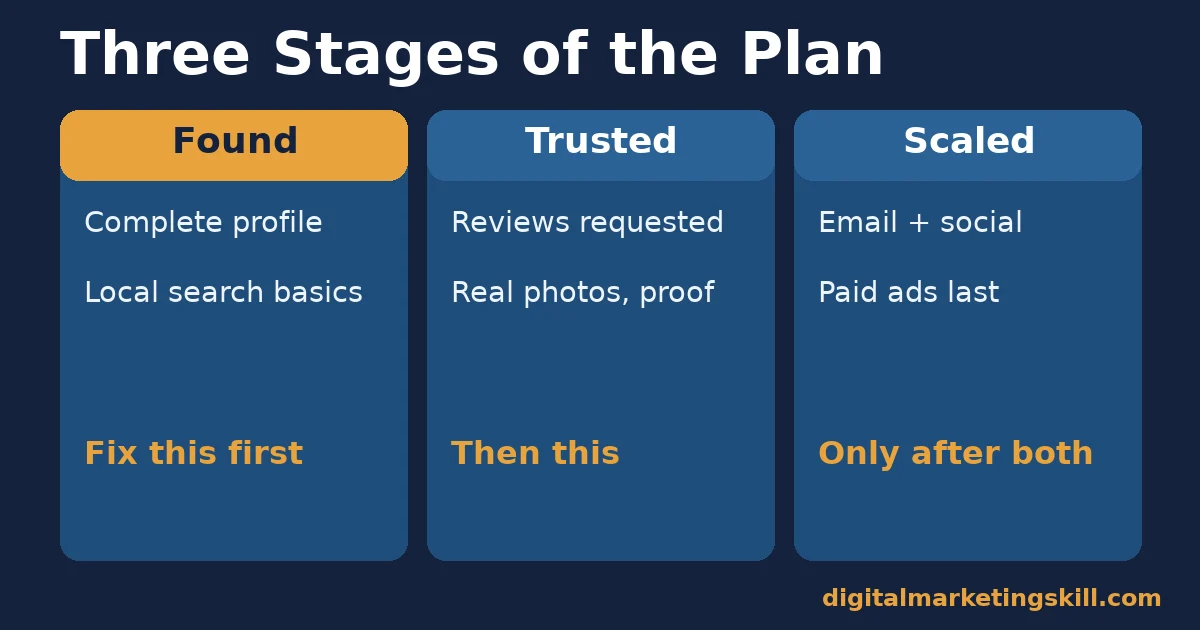
- Three Stages of a Small Business Marketing Plan
- How to Execute Each Stage
- Six Mistakes That Stall a Small Business Marketing Plan
- How to Measure Whether the Plan Is Working
- The One Decision Rule: Fund the Weakest Stage, Not the Favourite Channel
- A 90-Day Small Business Marketing Plan
- A Real Case: What Review Volume Does to Revenue
- Frequently Asked Questions About Small Business Marketing Plans
- Your Next Step
What Most Small Business Marketing Advice Skips
Most small business marketing advice is a channel list: try social media, try email, try search ads, try local SEO. None of that is wrong. But it skips the order. Running five channels on a small budget usually means none of them gets enough attention to actually work.
This guide treats a small business marketing plan as three sequential stages instead of a menu: being found, being trusted, then scaling what already converts. Treat every figure here as a snapshot from industry survey data. It is not a universal rule for every business or location.
Why Sequencing Beats Running Everything at Once
A small business marketing plan fails most often not from picking the wrong channel, but from spreading a small budget too thin across too many channels at once. Each stage below depends on the one before it being solid.
The Foundation Has to Exist First
Paid traffic sent to an incomplete Google Business Profile or a vague website wastes money. Visitors arrive and still cannot tell what you sell or why to trust you. The foundation stage fixes that before any paid spend begins.
How Much a Small Business Marketing Plan Should Cost
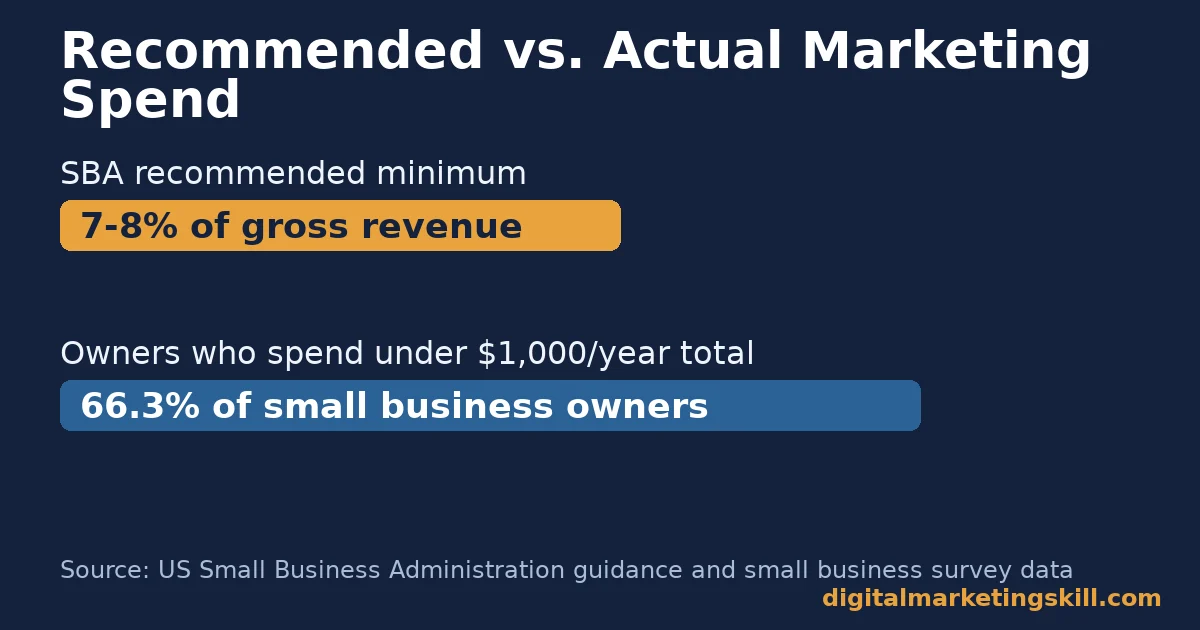
The US Small Business Administration recommends businesses under $5 million in revenue spend 7% to 8% of gross revenue on marketing. Despite that guidance, self-reported survey data shows 66.3% of small business owners spend under $1,000 a year in total. That is usually not enough to properly fund even one stage of a small business marketing plan, let alone all three.
Three Stages of a Small Business Marketing Plan
Each stage below answers a different question a customer asks, in the order they actually ask it: can I find you, can I trust you, then should I come back.
Stage One: Built to Be Found
This stage covers a complete Google Business Profile, basic local search terms on your website, and accurate contact details everywhere your business is listed. Without this, every later stage sends people to a dead end.
Stage Two: Built to Be Trusted
Once people can find you, they decide whether to trust you: reviews, a clear website that states what you do, and real photos of your work or premises. Findstack’s analysis found businesses with 200 or more reviews have roughly twice the revenue of businesses with fewer.
Stage Three: Built to Scale
Only once the first two stages are solid does paid promotion make sense. This stage layers social content, email marketing and paid ads on top of a foundation that can actually convert the traffic those channels send.
How to Execute Each Stage
The sections below mirror the three stages above. Complete each one fully before starting the next, rather than running all three in parallel on a small budget.
Stage One: Lead With a Complete Profile
Fill in every field on your Google Business Profile: hours, categories, services, and at least ten real photos. Our guide to Google Business Profile optimisation covers exactly what actually moves local rankings. Add your exact business name, address and phone number identically everywhere else it appears online, including in our guide to local SEO, since inconsistent details hurt how search engines trust the listing.
Stage Two: Lead With Proof, Not Promises
Ask every satisfied customer for a review immediately after a good experience, rather than waiting and hoping. Our guide on getting good customer reviews covers how to ask without feeling pushy. Respond to every review, good or bad. Then replace stock imagery on your website and profile with real photos, since real proof converts better than polished claims.
Stage Three: Lead With What Already Works
Look at which stage-one and stage-two channels already bring in a little organic interest, then put paid budget behind that channel first. Scaling a channel that already shows some traction is more reliable than guessing which new channel might work.
Six Mistakes That Stall a Small Business Marketing Plan
- Starting with ads before the foundation is ready. Paid traffic to an incomplete profile or vague website wastes the spend before it can convert.
- Running every channel at once on a small budget. Thin coverage across five channels usually underperforms focused coverage on two.
- Treating reviews as optional. Review volume and response rate both correlate with revenue, yet many small businesses never ask for reviews at all.
- Inconsistent business details across listings. A different address or phone number on one directory confuses both customers and search engines.
- No email capture point anywhere. Despite its $42-per-$1 reported return, many small business websites have no way to collect an email address at all.
- Measuring vanity numbers instead of conversions. Follower counts and impressions look good but do not pay the bills; track actual enquiries and sales instead.
Which Mistake to Fix First
An incomplete Google Business Profile or a vague website needs fixing before anything else, because it undermines every other channel. A solid foundation with no review-request habit yet is the next highest-leverage fix. And paid ads running with no foundation stage complete should pause until stage one and two are done.
How to Measure Whether the Plan Is Working
- Profile views to website clicks. The share of Google Business Profile views that become a website click or call, a direct read on how convincing the listing itself is.
- Review count and average rating. Both should rise steadily month over month if your request process is working.
- Email list growth rate. New subscribers per month, since a flat list means the capture point is not being seen or is not compelling.
- Enquiry-to-customer conversion rate. The share of enquiries, calls or form submissions that become paying customers, which is the number that actually matters.
- Cost per acquired customer, by channel. Once you reach stage three, track this separately for each paid channel so you can tell which one to scale.
The One Decision Rule: Fund the Weakest Stage, Not the Favourite Channel
If you take one rule from this guide, make it this one: put your next dollar and hour into whichever stage is weakest right now, not whichever channel is most exciting. A beautiful social campaign cannot fix an incomplete Google Business Profile underneath it.
Here is an illustrative example, with invented numbers. A small bakery spends $400 a month on social ads while its Google Business Profile has only 3 photos and 4 reviews. It redirects that same $400 for two months into professional photos, a review-request process and basic website fixes, before resuming ads. Its profile-to-website click rate rises well before a single extra ad dollar is spent.
A 90-Day Small Business Marketing Plan
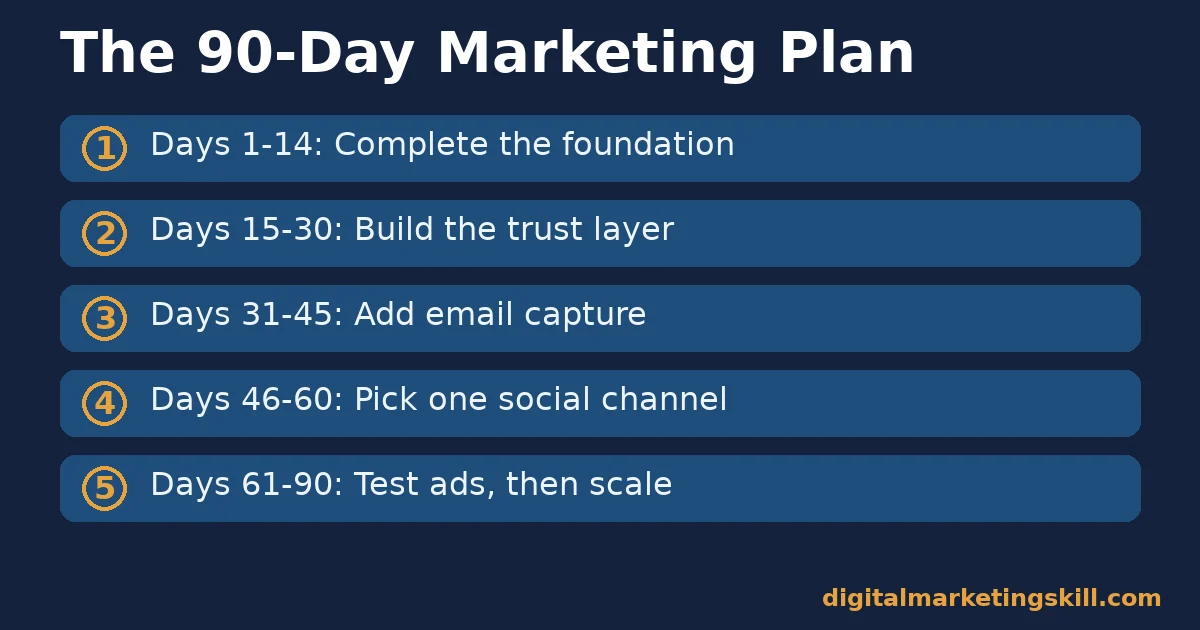
- Days 1-14: Complete the foundation. Fill every field on your Google Business Profile, add at least ten real photos, and fix your website’s headline so it states clearly what you sell.
- Days 15-30: Build the trust layer. Set up a simple process to request reviews after every sale, and respond to every existing review you have.
- Days 31-45: Add one email capture point. Place a simple sign-up form on your website or at checkout, offering one clear reason to join; our beginner’s guide to email marketing covers the basics of building that first list.
- Days 46-60: Pick one social channel. Choose the platform your actual customers use, and post consistently rather than occasionally across several.
- Days 61-75: Test a small paid budget. Put a modest amount behind whichever channel already shows organic traction from the stages above.
- Days 76-90: Review the numbers and double down. Compare cost per enquiry across whatever you tested, and commit more budget only to what is actually converting.
A Real Case: What Review Volume Does to Revenue
Findstack, a software and business research publisher, analysed the relationship between customer review volume and small business revenue. It reported that businesses with 200 or more reviews generate roughly twice the revenue of businesses with fewer reviews. BrightLocal’s separate consumer research puts the average local business at around 39 Google reviews, well short of that 200 threshold.
This is correlational research, not a controlled experiment. More reviews do not directly cause more revenue on their own. It is more likely that both come from the same underlying cause: a business that consistently delivers a good experience earns more reviews, plus more repeat and referred customers, at the same time.
The practical lesson still holds either way. A deliberate, consistent request-for-review process, built into stage two of a small business marketing plan, is one of the lowest-cost, highest-leverage habits a small business can build.
Frequently Asked Questions About Small Business Marketing Plans
How much should a small business spend on a marketing plan?
The US Small Business Administration recommends 7% to 8% of gross revenue for businesses under $5 million. The right figure for you depends on your margins, growth goals and how much of the foundation stage you still need to build.
What is the first step in a small business marketing plan?
Complete your Google Business Profile and make sure your website clearly states what you sell. Paid promotion before this foundation is in place tends to waste money.
Do small businesses really need an email list?
Yes. Reported industry data puts email marketing’s return around $42 for every $1 spent, among the highest of any channel measured, yet many small business websites have no way to capture an email address at all.
How many reviews does a small business need?
There is no fixed minimum, but research associates higher review counts with higher revenue, and the average local business has around 39 Google reviews. A steady, ongoing request process matters more than hitting any single number.
Should a small business run paid ads first?
Generally no. Paid traffic sent to an incomplete profile or unclear website converts poorly. Most small business marketing plans perform better when ads come after the foundation and trust stages are solid.
How long does a small business marketing plan take to show results?
Foundation and trust-stage work can show early signals, such as more profile clicks, within weeks. Paid-channel results depend on the channel and budget, so track cost per enquiry from the first dollar spent rather than waiting for a fixed deadline.
Can a small business marketing plan work with no budget at all?
A genuinely zero-budget plan is rare, since even a basic website or email tool usually carries some cost. But the foundation and trust stages require far more time than money. Even a business with almost no cash can complete a full Google Business Profile, request reviews consistently, and post on one social channel, largely through owner time rather than ad spend.
Your Next Step
Keep the plan sequenced, not scattered: found, then trusted, then scaled. Audit your Google Business Profile and website today, fix whichever is weaker, then build a simple review-request habit before you spend anything on ads.
If you want structured help building this out, Digital Marketing Skill Institute runs the Master Diploma in Digital & AI Marketing. It covers AI-Powered WordPress and SEO Specialist and AI-Powered Lead Generation and Email Automation among its four AI-powered tracks, totalling ten courses, with a Full Stack option for completing all four. Unlimited 1-on-1 coaching and mentoring come with it, alongside a U.S. Project Internship with a verified U.S. Work Reference Letter. The diploma is dual US and UK accredited and recognised in more than 100 countries, and it is entirely online, so you can build this plan from anywhere in your country.
Explore more guides on the Digital Marketing Skill Institute blog, read real outcomes on the reviews page, and when you are ready, apply for the Master Diploma or start from the Digital Marketing Skill Institute homepage.
Every figure in this guide was checked against its original source before publication. Figures marked as illustrative are invented examples, not real results.
![9 Amazing Digital Marketing Skills to Make Money Online [With Proof]](https://digitalmarketingskill.com/wp-content/uploads/2019/07/9-Amazing-Digital-Marketing-Skills-to-Make-Money-Online-With-Proof-17.png)






