
The top of funnel (TOFU) is the first stage of the marketing funnel, where people first become aware of a brand or a problem it solves. At this point, they are not ready to buy, so the goal is to reach them, help them and earn their attention. It matters because every lead and every sale later in the funnel starts with someone who discovered you here.
Key Takeaways
- TOFU is the awareness stage. People are learning, not buying.
- The funnel idea grew from the AIDA model: awareness, interest, desire and action.
- Typical tactics include blog posts, search, social media content, video and awareness ads.
- Success is measured with reach, traffic, new visitors and early sign-ups, not sales.
- Real buyer journeys are not always linear, so the funnel is a guide rather than a strict rule.
What Is the Top of Funnel?
Picture a funnel that is wide at the top and narrow at the bottom. Many people enter at the top. Fewer move into the middle, where they compare options. Finally, a small group reaches the bottom and buys. Marketers often shorten these stages to TOFU, MOFU and BOFU.
According to Wikipedia, the purchase funnel is a model of the journey a customer takes towards buying something. It builds on the AIDA model, which is often credited to the advertising pioneer E. St. Elmo Lewis. AIDA stands for awareness, interest, desire and action. So the top of funnel matches the first letter: awareness.
At this stage, people have a question or a problem. For example, someone might search “why does my dog scratch so much”. They are not looking for a brand yet. However, the pet shop that gives them a clear, helpful answer is the one they will remember later.
Some versions of the funnel go further than three stages. For example, Wikipedia describes five broad stages: awareness, consideration, purchase, loyalty and recommendation. In that model, the awareness stage is linked to lead generation, while consideration is linked to lead nurturing. Either way, the first stage has the same job. It brings new people into your world, so the later stages have someone to work with.
How the Top of Funnel Works
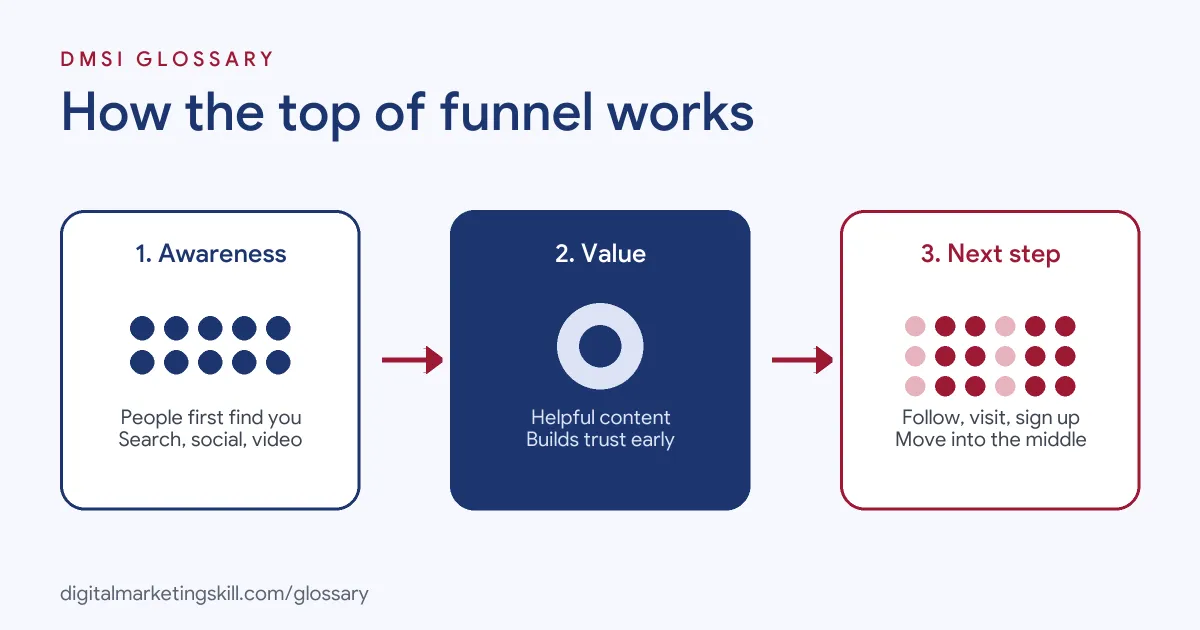
Awareness work follows a simple pattern. First, you reach people where they already spend time. Next, you give them something useful, such as advice, an idea or a short video. Then you invite them to take a small next step, such as following you, reading more or signing up for a guide.
Attract the Right People
HubSpot calls this the “attract” stage of its inbound method. It describes it as “drawing in the right people with valuable content and conversations.” HubSpot lists blog articles, content offers and social media posts as core tactics. It also says all content should be optimised for search, so people can find it when they look for help.
Use Awareness Ads
Paid ads can speed things up. For instance, Google Ads offers an awareness goal for Display and Demand Gen campaigns, which it describes as a way to “increase awareness of your products or services.” Meta also offers an awareness objective. HubSpot sums up the aim simply: “Create ads to increase awareness of your brand with your target audience.”
Hand Over to the Middle
The top stage only works if it leads somewhere. So every piece of content should point to a next step. That might be a related article, a free checklist or a newsletter. Once someone shares their email, they move into the middle of the funnel, where you can nurture them with more detailed content.
Top of Funnel Examples
Here are three ways different businesses build awareness:
- Accounting software: A software firm publishes a guide called “How to do your first tax return as a freelancer”. It ranks in search and brings in thousands of new readers. At the end, it offers a free invoice template.
- Fitness brand: A gym chain posts short workout videos on Instagram and TikTok. It also runs a small awareness campaign to reach people nearby. As a result, local followers grow, and some book a free trial.
- Online course provider: A school runs a free webinar on how to start a career in digital marketing. Attendees learn something useful, and afterwards they receive a short email series.
In each case, the first contact gives value before it asks for anything big.
TOFU vs MOFU vs BOFU
The three funnel stages need different content and different measures. Here is a quick comparison:
| Stage | What people want | Typical content | Main measures |
|---|---|---|---|
| Top of funnel (TOFU) | To learn about a problem or idea | Blog posts, social posts, short videos, awareness ads | Reach, traffic, new visitors, follows |
| Middle of funnel (MOFU) | To compare solutions | Guides, webinars, case studies, email series | Leads, sign-ups, email engagement |
| Bottom of funnel (BOFU) | To decide and buy | Demos, free trials, pricing pages, offers | Sales, conversion rate, cost per customer |
In short, the top stage earns attention, the middle builds trust, and the bottom closes the deal.
How to Build Top of Funnel Content
Follow these steps to plan your awareness stage:
- List the questions and problems your ideal customer has before they know your brand.
- Check which of those questions people search for, using a keyword tool.
- Choose two or three channels where your audience already spends time.
- Create helpful content that answers those questions clearly, with no hard sell.
- Add a simple next step to every piece, such as a related post or a free resource.
- Promote your best pieces with a small awareness budget.
- Track reach, traffic and sign-ups, then make more of what works.
After a few weeks, look at which topics bring in people who later become leads. Those topics deserve more of your time.
Best Practices for Top of Funnel Marketing
A few habits help your awareness work pay off:
- Lead with help, not sales. People at this stage are not ready to buy, so pushy offers drive them away.
- Know your audience. Broad reach is useless if it is the wrong people.
- Always offer a next step. Otherwise, visitors read once and never return.
- Repurpose content. For example, turn one blog post into a short video, a carousel and an email.
- Be patient. Awareness takes time to turn into leads, so judge it over weeks, not days.
Common Mistakes to Avoid
Many teams make the same few errors here. First, they judge awareness content on direct sales, then cut it too soon. Second, they chase traffic that has nothing to do with what they sell. Third, they forget the next step, so readers leave and never come back. Finally, they treat the funnel as a strict line. Wikipedia notes that people can enter at different stages and sometimes move “non-linearly or even reversing their engagement paths.” That is why some brands now use other models, such as the flywheel.
Where You’ll Use It at Work
Awareness work appears in social media, content and lead generation roles. For example, one current remote job listing includes a whole section called:
- “Top-of-Funnel Strategy & Execution” (Social Media Lead and Podcast Spokesperson).
- The same role asks the person to “Build and run TOF strategy” (Social Media Lead and Podcast Spokesperson).
More broadly, Lead Generation Specialists, Email Marketing Specialists and Marketing Automation Specialists all depend on a steady flow of new people from the top. So they need to know how awareness content feeds the lists and sequences they manage.
Learn It in the Lead Generation and Email Track
You can learn to fill and manage the funnel in the AI-Powered Lead Generation and Email Automation track. There, you build a lead magnet and an automated email sequence that converts, so you can show how strangers become leads. You also work on a U.S. Project Internship from day one, with unlimited 1-on-1 mentoring.
Want to see the full journey? Read our guide to the customer acquisition funnel, or learn how to increase brand awareness.
Frequently Asked Questions
What does top of funnel mean?
It means the first stage of the marketing funnel, where people first discover a brand or learn about a problem. The goal is awareness, not sales.
What is TOFU, MOFU and BOFU?
They stand for top, middle and bottom of the funnel. In order, these stages cover awareness, consideration and the decision to buy.
What is an example of top of funnel content?
A helpful blog post, a short social video or an awareness ad. For instance, a guide that answers a common beginner question.
How do you measure top of funnel success?
Look at reach, website traffic, new visitors, follows and early sign-ups. Over time, also check how many of those people become leads.
Is the marketing funnel still useful?
Yes, as a simple guide. However, real customers do not always move in a straight line, so many teams combine it with other models.
Sources: Wikipedia: Purchase funnel; HubSpot: What is inbound marketing?; Google Ads Help: About campaign objectives; remote job listings on Himalayas.