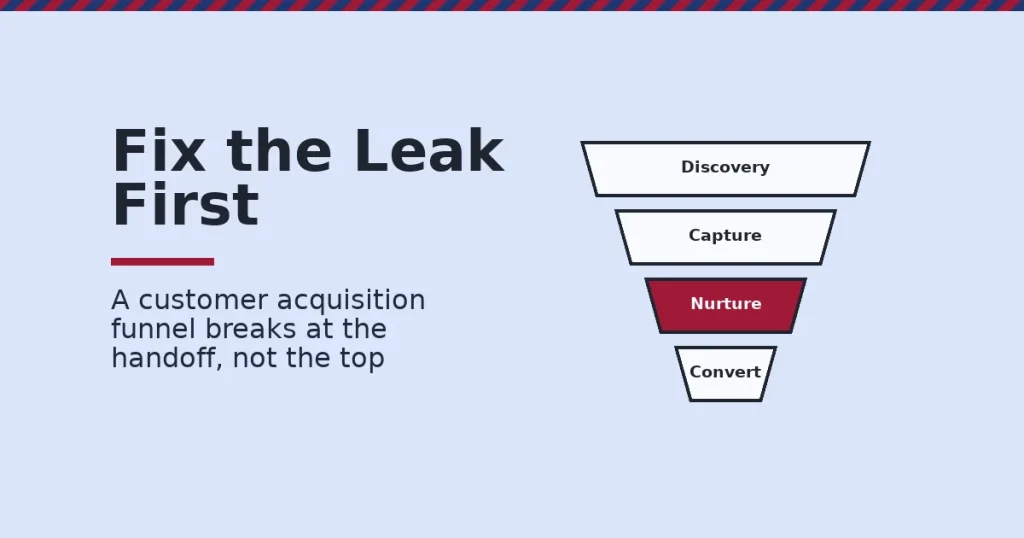
A customer acquisition funnel turns strangers into paying customers through four stages: discovery, capture, nurture, convert. Most funnels leak at the handoff between stages, not at the top, so fixing discovery traffic first usually wastes effort. This guide ranks the real fixes, shows what changes by lead source, and gives the one rule for where to look first.
Key Takeaways
- Discovery is harder than it looks. Ahrefs studied roughly 14 billion pages and found that 96.55% get no organic traffic from Google, so a customer acquisition funnel often fails before a single visitor arrives.
- Reps lose more time than you’d expect to non-selling work. Salesforce’s Seventh Edition State of Sales report, surveying more than 4,000 sales professionals, found reps spend 60% of their time on tasks other than selling.
- Overwhelmed sellers close less, not more. The same Salesforce report found overwhelmed sellers are 45% less likely to hit quota, which points straight at the nurture-to-convert handoff.
- Lead cost and lead quality vary sharply by channel. HubSpot’s compiled lead-cost benchmarks put average B2B cost per lead at $84, with SEO-sourced leads converting from MQL to SQL at 51% against 26% for PPC.
- A single on-site tactic can move the nurture stage fast. A vendor case study from OptinMonster reported AtHoc increased sales-qualified leads by 141% in one month using an exit-intent popup, a result worth reading with its vendor source in mind.
In this guide
- What Most Customer Acquisition Funnel Advice Skips
- How a Customer Acquisition Funnel Actually Works
- Why Filtering Out People Is the Point
- What Changes by Lead Source
- How to Lead With Each Source
- How to Measure a Customer Acquisition Funnel
- The One Decision Rule: Fix the Handoff Before Adding Traffic
- A Real Case: What One Exit-Intent Change Did to a Funnel
- Common Mistakes That Widen the Leak
- Frequently Asked Questions About Customer Acquisition Funnels
- Start With Your Narrowest Stage, Not More Traffic
What Most Customer Acquisition Funnel Advice Skips
Most customer acquisition funnel advice focuses on the top: get more traffic, run more ads, post more content. That advice is not wrong. It assumes, though, that the rest of the funnel can absorb the extra volume without breaking.
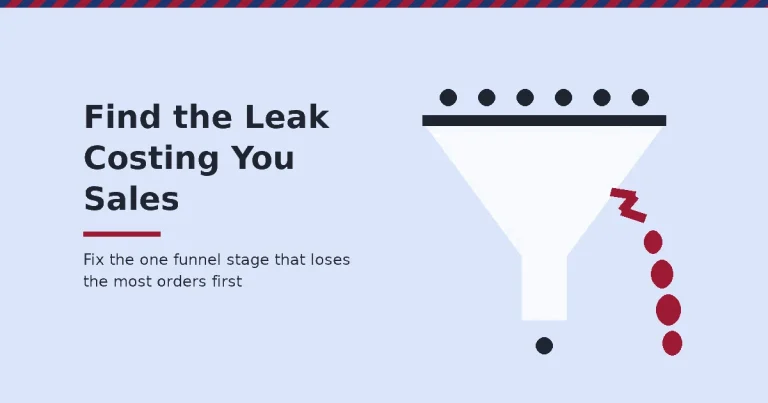
In most businesses, it cannot. A funnel with a broken handoff between nurture and convert does not get better with more traffic at the top; it just produces more leads that fall through the same gap.
A real customer acquisition funnel gets diagnosed stage by stage before anyone spends more on traffic. Find the narrowest point first. Fix it. Then decide whether more top-of-funnel volume is even the right next move.
Here are the limits of what follows. The statistics below come from named surveys and one vendor case study, each with its own scope and bias. Read every number as a snapshot, not a permanent ranking, and treat the vendor case study as one documented result, not a guarantee.
How a Customer Acquisition Funnel Actually Works
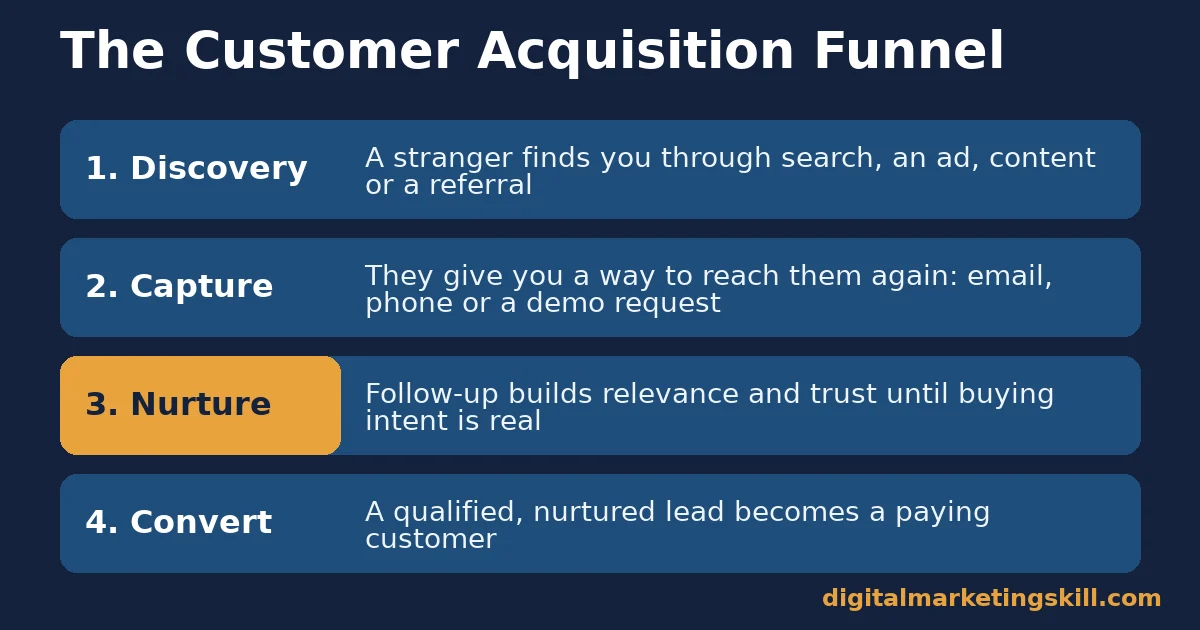
A customer acquisition funnel runs through four stages: discovery, capture, nurture, convert. Each stage filters out people who are not ready for the next one. That filtering is the point, not a flaw.
The Four Stages, in Order
Most teams can name all four stages without hesitation, yet few can say which one is actually underperforming right now. That gap between knowing the stages and measuring them is where most customer acquisition funnel advice quietly stops being useful.
Discovery is the moment a stranger finds you, through search, an ad, social content, or a referral. Most discovery fails quietly, long before anyone notices. Ahrefs’ search traffic study of about 14 billion pages, already cited above, found that 96.55% receive no organic traffic from Google at all.
Capture, Nurture and Convert
Capture happens when that stranger gives you a way to reach them again: an email address, a phone number, a demo request. In most cases, a visitor who leaves without being captured is gone for good.
Nurture is the stretch between capture and genuine buying intent. This is where most customer acquisition funnels actually die. The death is quiet, spread over weeks, because nobody follows up with enough relevance or speed. By the time anyone notices the lead went cold, the moment to recover it has usually passed.
Convert is the final stage, where a qualified, nurtured lead becomes a paying customer. It gets the most attention from sales teams. Even so, it depends entirely on how well the first three stages worked.
A sales team can be excellent at closing and still miss quota, simply because too few qualified leads ever reach them in a condition worth closing. Blaming the convert stage for a problem that started at discovery or capture is a common, costly mistake.
Why Filtering Out People Is the Point
It feels wasteful to lose people at every stage of a customer acquisition funnel. Many teams chase a zero-leak funnel as if that were the goal. It is not. A funnel that converts 100% of discovery traffic into customers is not efficient. It is a sign the discovery stage is too narrowly targeted to begin with.
Healthy filtering means the stranger who was never going to buy leaves early and cheaply. They do not consume sales time later. The goal is not zero loss at each stage. The goal is making sure the loss happens for the right reasons. Whoever makes it through should be genuinely more likely to buy than whoever dropped out.
What Changes by Lead Source
Treating every lead the same way might feel fair, but it ignores what each channel actually paid for in attention and intent. A single nurture template applied to every source wastes the advantage each channel brings.
A customer acquisition funnel cannot treat every lead source the same way. Someone who found you through search behaves differently from someone who clicked a paid ad.
Organic and Content Leads: Built on Patience
A lead sourced through content or search usually arrives mid-research, not ready to buy. They found an answer to a specific question. Your brand is incidental to that search at first.
HubSpot’s compiled benchmarks put SEO-sourced leads at a 51% MQL-to-SQL conversion rate, the highest of the channels measured. That strength comes with a cost. Organic discovery is slow to build, and per the Ahrefs figure above, most pages never get there at all. Patience is the price of the higher-quality lead.
Paid Leads: Built on Speed
A lead sourced through a paid ad usually arrives with higher intent. Their attention span is shorter, though, since they are actively comparing options funded by an ongoing ad budget.
The same HubSpot benchmarks put PPC-sourced leads at a 26% MQL-to-SQL rate, roughly half the organic figure. Paid leads reward speed of follow-up more than patience. The ad budget keeps running whether or not anyone replies quickly, so every slow day costs real money.
How to Lead With Each Source
Knowing how each lead source behaves is only half a customer acquisition funnel. The other half is matching the nurture approach to that behavior, source by source, instead of running one generic sequence for everyone.
Organic Leads: Lead With a Nurture Sequence
Build a multi-step email or content sequence that keeps answering the next question a researching buyer would have. Rushing a hard pitch on day one usually loses a lead who was not ready to buy yet. Patience here is a strategy, not a delay.
Tie this sequence to a working email automation strategy so follow-up happens on a schedule, not whenever someone remembers to check a spreadsheet. Consistency beats cleverness here; a plain sequence that always fires beats a brilliant one that sometimes does not.
Paid Leads: Lead With Fast First Contact
Respond within minutes where possible, not days. A paid lead is actively comparing your offer against competitors bidding on the exact same keywords right now, so a slow reply hands the deal to whoever answers first.
Route paid leads straight into a CRM with an automatic first-touch alert, so speed does not depend on one person checking an inbox at the right moment. A missed alert on a busy day can cost a sale that the ad budget already paid to win.
How to Measure a Customer Acquisition Funnel
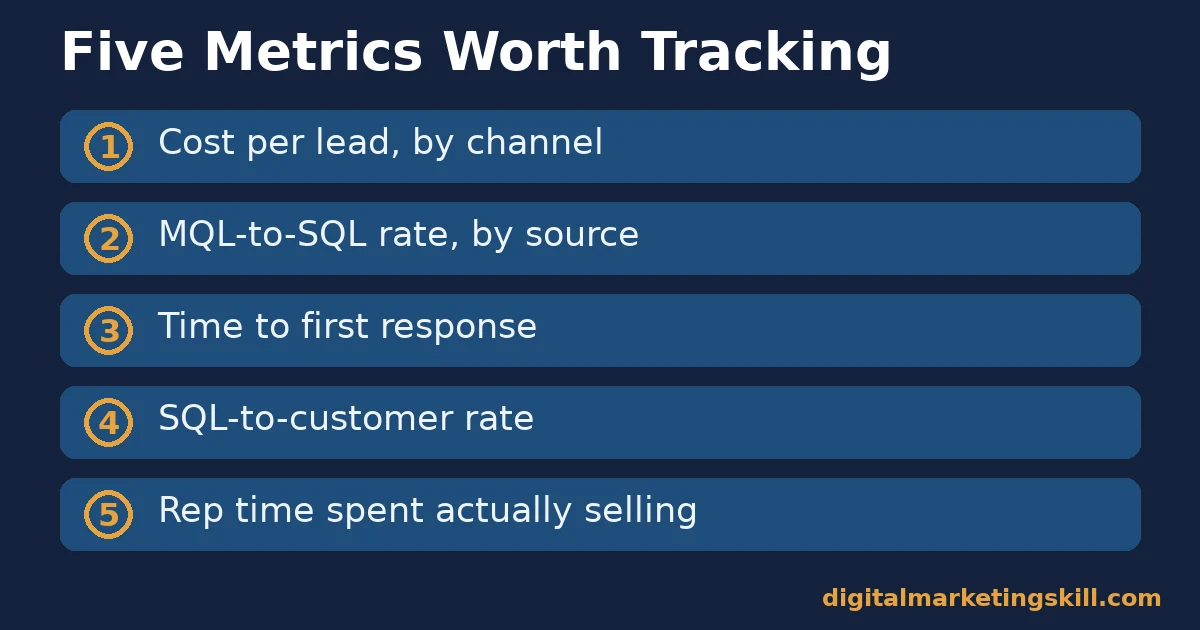
A customer acquisition funnel is only as useful as what you track at each stage. Five metrics, read together, show where the real leak is. Track them on a simple dashboard that every stakeholder can see, not buried in one person’s private spreadsheet.
None of these five metrics matters much in isolation. It is the pattern across all five, read side by side, that actually points to where a customer acquisition funnel is breaking.
Five Metrics Worth Tracking
- Cost per lead by channel. What each channel actually costs to produce one captured lead, since HubSpot’s benchmarks show this can range widely even within the same overall budget. A channel with a higher cost per lead can still win if its SQL rate is high enough.
- MQL-to-SQL rate by source. The share of captured leads that a sales team accepts as sales-qualified, split by where the lead came from.
- Time to first response. How long a new lead waits before any human or automated follow-up, since this single number often predicts whether nurture even has a chance to work. A lead contacted within minutes behaves very differently from one contacted the next day.
- SQL-to-customer rate. The share of sales-qualified leads that actually become paying customers, which isolates the health of the convert stage specifically.
- Rep time on selling activity. The share of a rep’s time spent actually selling versus administrative work, since Salesforce’s data ties low selling time to missed quota. Automating the admin work directly raises the number of leads a rep can properly nurture.
How to Read These Numbers Together
A high MQL-to-SQL rate with a low SQL-to-customer rate points to a convert-stage problem, not a lead-quality problem. Fixing the sales process matters more here than generating more leads. More leads into a weak close process just produces more missed opportunities.
A slow time-to-first-response paired with decent conversion once contact happens suggests the funnel works when it runs. It simply is not running fast enough. That is usually a staffing or automation fix, not a messaging fix, and it is often the cheapest problem on this whole list to solve.
The One Decision Rule: Fix the Handoff Before Adding Traffic
Here is the single most useful rule for any customer acquisition funnel. Before spending more on top-of-funnel traffic, find the stage with the steepest drop. Fix that stage first, before anything else on the list.
Apply it with a simple test. Pull your funnel numbers for the last full quarter, and calculate the conversion rate between each adjacent stage: discovery to capture, capture to nurture engagement, nurture to SQL, SQL to customer. Whichever rate is lowest relative to a reasonable benchmark is where you start, even if it is not the stage that feels most urgent.
Here is an illustrative example, with invented numbers. A company captures 500 leads a month and converts 10 into customers, a 2% overall rate.
Looking stage by stage tells a different story. 480 of those leads get a first response within 48 hours, but only 90 ever get a second touch. The real leak is follow-up persistence in nurture, not lead volume. Doubling ad spend here would only produce more leads that fall through the same gap, at twice the cost.
That is the logic behind fixing the narrowest stage first. Extra traffic poured into a leaking funnel produces more leads that leak out, not more customers. Fix the leak, then decide whether more traffic is worth paying for.
A Real Case: What One Exit-Intent Change Did to a Funnel
AtHoc, an emergency notification software company, wanted more product demo requests from visitors who were already on its site but leaving without converting. Its team was unsure how a security-focused, government-heavy audience would respond to an on-site popup, since that audience tends to be skeptical of anything that looks like a marketing gimmick.
According to a case study published by the tool vendor OptinMonster, AtHoc used an exit-intent popup aimed at visitors who were about to leave the site. It offered something relevant to a visitor already showing interest, rather than a generic discount. Sales-qualified leads rose 141% within one month of the change. The company attributed that result directly to the single capture-stage tactic.
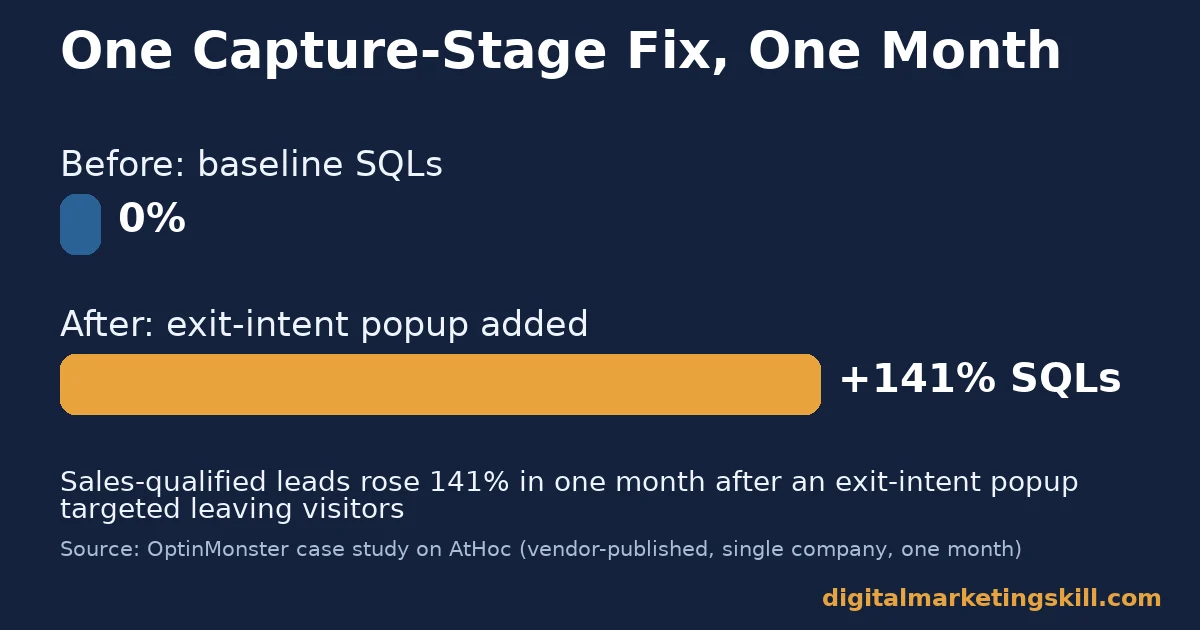
The limits matter here. This is a single company’s result over one month, published by the vendor whose tool produced it, not an independent audit. A result this large will not repeat on every site, and a cautious audience like government buyers responding well to a popup is itself a notable, specific finding rather than a universal rule.
Even with those limits, the mechanism is worth borrowing. The fix targeted the capture stage specifically, for visitors who had already shown discovery-stage intent by browsing the site. That is a narrower and cheaper fix than buying more top-of-funnel traffic, and it works on people who were already halfway convinced.
Common Mistakes That Widen the Leak
A few habits show up again and again in a weak customer acquisition funnel, and each one is cheap to fix once named. None of them require new tools, only a change in how the team works.
Running One Nurture Sequence for Every Source
A single generic sequence treats a patient, research-driven organic lead the same as a time-sensitive paid lead. Neither gets what it actually needs, and both convert worse than they would with a matched approach.
No Single Owner for the Handoff
When marketing owns leads up to MQL and sales owns them from SQL onward, the gap in between often belongs to nobody. Leads sit untouched exactly at the point where speed matters most, and nobody notices until the quarterly numbers come in low. Naming one owner for that gap, even informally, closes it faster than any new tool would.
Reporting Total Leads Instead of Stage Conversion
A rising lead count looks good in a monthly report, even while the SQL-to-customer rate quietly falls. Track the full stage-by-stage picture, not just the number that is easiest to celebrate. A dashboard that only shows total leads will always look fine, right up until revenue does not follow.
Frequently Asked Questions About Customer Acquisition Funnels
What is a customer acquisition funnel?
It is the path a stranger follows to become a paying customer, broken into four stages: discovery, capture, nurture, and convert. Each stage filters out people who are not ready for the next step, which is why the funnel narrows as it goes.
Where should I look first if my funnel is not converting?
Measure the conversion rate between each adjacent stage before changing anything. The stage with the steepest drop relative to a reasonable benchmark is almost always where the real problem sits, not the top of the funnel. Resist the urge to guess; the numbers usually point somewhere different from where attention naturally goes.
Does more traffic fix a weak customer acquisition funnel?
Rarely on its own. More traffic poured into a funnel with a broken handoff mostly produces more leads that fall through the same gap, which wastes the extra spend rather than fixing the underlying problem. Fix the handoff first, then let more traffic prove the fix worked. Only then does the extra spend actually turn into extra customers.
How fast should a lead get a first response?
As fast as your resources allow, especially for paid leads actively comparing options. Track time to first response directly, since a slow first touch quietly caps how well every later stage can perform.
Do organic and paid leads need different nurture approaches?
Yes. Organic leads tend to arrive mid-research and respond better to a patient, educational sequence. Paid leads tend to arrive with higher intent and reward fast, direct follow-up more than a long nurture sequence. Running one generic sequence for both wastes the strength of each.
What is the difference between an MQL and an SQL?
A marketing-qualified lead, or MQL, has shown enough interest to be worth marketing’s continued attention. A sales-qualified lead, or SQL, has met the criteria a sales team uses to accept it as worth direct selling effort. The MQL-to-SQL conversion rate is often the clearest single signal of whether marketing and sales agree on what a good lead looks like.
How often should a customer acquisition funnel be reviewed?
Review full-funnel conversion rates at least quarterly, and check time-to-first-response more often, since a slow response often has a simple, fast fix once it is noticed. Pair each review with one specific action, not just a report nobody acts on. A review with no owner and no deadline rarely changes anything.
Start With Your Narrowest Stage, Not More Traffic
A customer acquisition funnel improves fastest when you fix the narrowest stage before adding anything new at the top. Pull your last quarter’s numbers, find the steepest drop, and fix that one stage this month. Resist the pull toward more traffic until that fix is actually in place.
Want structured practice building and diagnosing funnels like this? The Master Diploma in Digital & AI Marketing at Digital Marketing Skill Institute includes an AI-Powered Lead Generation and Email Automation track built around exactly this kind of work, from capture mechanics to nurture sequencing.
The program pairs unlimited one-on-one mentoring with project-based work experience on a real U.S. partner company’s funnel, so you practice fixing a live handoff, not a simulation.
It is dual accredited in the US and UK and recognised in more than 100 countries, and it runs 100% online, so you can build this skill from anywhere in your country.
Read student outcomes on the reviews page, or browse more guides on the blog. Go straight to the application page when you are ready to build your own customer acquisition funnel at Digital Marketing Skill Institute. Whichever stage is leaking in your own funnel right now, start there, not at the top.
Every figure in this guide was checked against its original source before publication. Figures marked as illustrative are invented examples, not real results.
![9 Amazing Digital Marketing Skills to Make Money Online [With Proof]](https://digitalmarketingskill.com/wp-content/uploads/2019/07/9-Amazing-Digital-Marketing-Skills-to-Make-Money-Online-With-Proof-17.png)