

Here is how to get into tech without writing a line of code. Digital marketing roles like SEO, paid ads, email and content sit inside almost every tech company. They hire for communication, analysis and creativity, not engineering. The fastest way in combines one certification, a small portfolio of real work and one human referral, because referrals convert far better than cold applications.
Key Takeaways
- Non-technical roles are real tech jobs. The US Bureau of Labor Statistics projects marketing manager jobs to grow 7% over the next decade, with about 36,300 openings a year for the combined category, faster than the average occupation (US data).
- Referrals beat applications. SilkRoad’s Sources of Hire study, built from 14 million applications and 329,000 hires across 1,000-plus companies, found referrals produce over 30% of all hires.
- Flexibility is now a bargaining chip. Owl Labs surveyed 2,000 full-time US knowledge workers and found 47% would give up 10% or more of their salary just to keep flexible hours (US data).
- Your network outperforms the job board. In a LinkedIn survey of 15,905 members across 17 countries, 70% of people hired joined a company where they already had a connection.
- Most content never gets found on its own. Ahrefs studied about 14 billion pages and found 96.55% get no traffic from Google. That is exactly why companies keep hiring for SEO and content skills.
In this guide
- What Most “How to Get Into Tech” Advice Misses
- How Hiring Into Tech Actually Works
- Three Paths for How to Get Into Tech Through Digital Marketing
- How to Win Each Path Into Tech
- Six Digital Marketing Roles to Target Inside Tech
- Common Mistakes That Slow Down How to Get Into Tech
- How to Measure Your Progress Getting Into Tech
- The One Rule for How to Get Into Tech: Get a Referral First
- A Real Case: A Certificate Opened the Door Within Weeks
- Frequently Asked Questions About How to Get Into Tech
- Start With One Path, Then Apply What You Learn
What Most “How to Get Into Tech” Advice Misses
Most guides on how to get into tech point straight at coding bootcamps. That advice skips a much larger set of jobs. These jobs run on communication, data and creativity, not code. It also skips the one thing that moves an application from the pile to the interview: a real human connection.
This guide treats getting into tech as a skills-and-relationships problem, not a credentials problem. The pay and growth figures below come from US government data, so they are US-only. Treat them as a demand signal, not a guaranteed number in your market. The referral and networking research is self-reported, an informed signal rather than a settled law. Read every figure as a snapshot, not a permanent ranking.
How Hiring Into Tech Actually Works
To understand how to get into tech, start with why a company opens a role at all: it needs an outcome. More qualified leads. Higher search rankings. A launch that does not flop. The hiring manager is not grading your resume for its own sake. They are asking one thing: can you produce that outcome faster than the other 50 people in the pile?
That is why cold applications struggle. SilkRoad’s Sources of Hire research, built on 14 million applications and 329,000 hires across more than 1,000 companies, found referrals account for over 30% of hires. Separate Jobvite hiring data puts referrals at roughly 7% of applicants but close to 40% of hires. A referred candidate converts at several times the rate of a cold one.
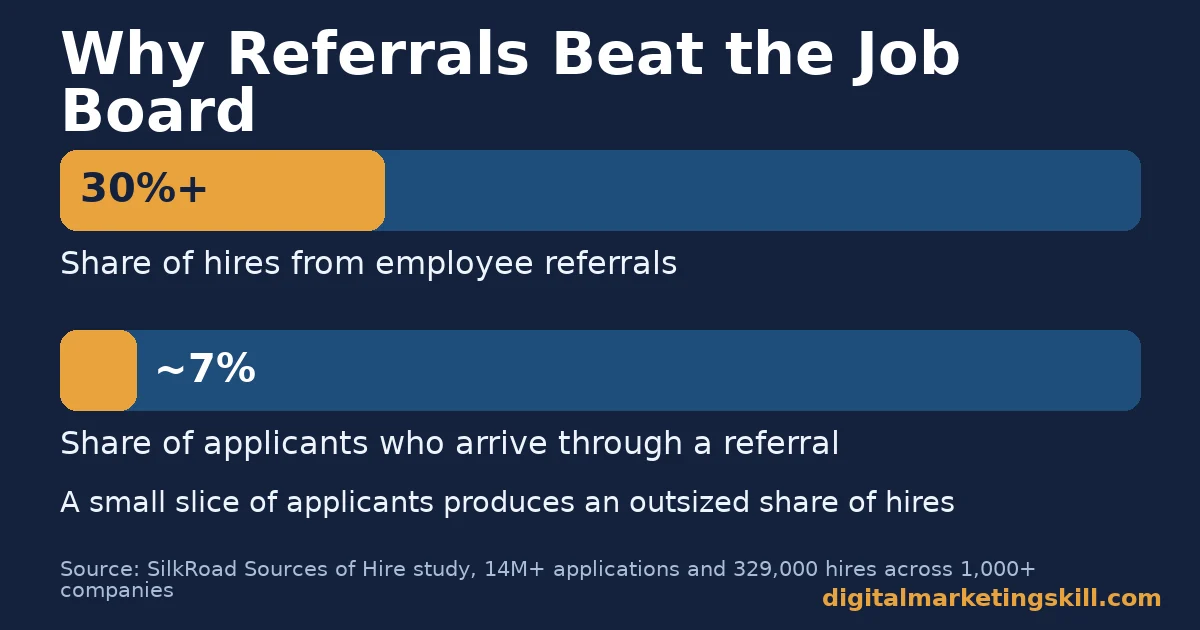
The mechanism is simple. A referral skips the resume screen, because someone the hiring manager trusts has already vetted you. So treat networking as a tactic with a real payoff, not a soft extra step. If you change one thing, make it this: get one real conversation inside your target company before you send a tenth cold application.
The same logic explains why a narrow portfolio beats a broad resume. A hiring manager scanning 50 applications is pattern-matching for proof, not potential. A resume that lists tools and job titles gives them nothing concrete to match against. One documented campaign with a before-and-after number does more than a dozen vague bullet points.
Three Paths for How to Get Into Tech Through Digital Marketing
Not every entry point looks the same. An employed role, a freelance client and a startup job each test for something different, so how you get into tech should change depending on which one you target. Prepare for each one differently.
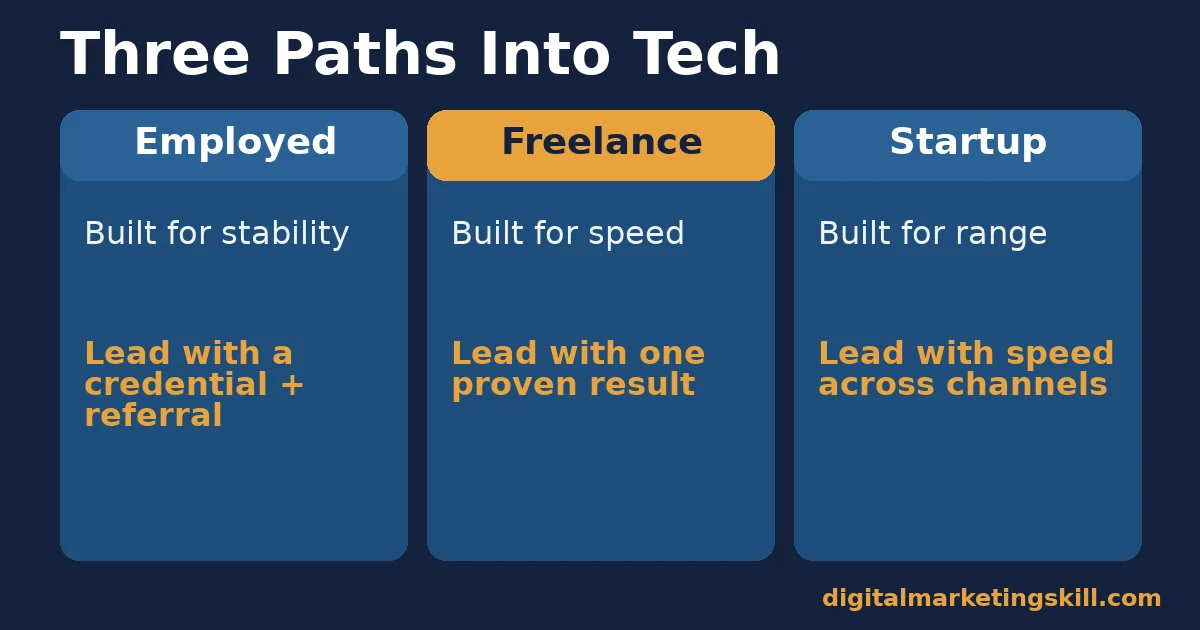
Employed Roles: Built for Stability and Mentorship
A salaried marketing role inside an established tech company gives you a manager, a team and a process to learn from. Expect a slower hiring process: a recruiter screen, a skills test, then one or two rounds with the team.
These companies want evidence you can follow a process and report results. Marketing managers in the BLS data sit inside large reporting structures, with median US pay of $166,790 a year. Pace is naturally slower here, so expect weeks, not days, between rounds. Use that time well: follow up once after a week of silence, and keep applying to other roles instead of waiting on a single decision.
Freelance Clients: Built for Speed and Visible Proof
A freelance client decides fast, often on one call, because they are hiring a deliverable, not a long-term employee. You trade less structure and no guaranteed next project for the shortest route from no portfolio to one paid result.
A client is testing one thing: can you solve their problem with the budget they already have? That is a different test from a corporate interview. It rewards a tight, specific portfolio over a broad resume.
Startup Jobs: Built for Range and Early Visibility
Early-stage tech startups hire generalists, because there is no team yet to specialise within. One week you write ad copy. The next you pull analytics or test a landing page.
Microsoft’s own newsroom cites roughly 50 million new startups launched worldwide every year. That is a constant supply of small teams that need a capable marketer before they can afford a specialist. You trade less mentorship, and a higher chance the company does not survive, for faster responsibility and a louder story for your next job.
How to Win Each Path Into Tech
Once you know which path you are chasing, the right preparation for how to get into tech looks different for each one. So match your prep to the path, not the other way around.
Employed Roles: Lead With a Credential and a Warm Introduction
For a salaried role, lead with a certification that proves you can run a channel end to end. Then pair it with a warm introduction wherever you can. A credential like the Digital Marketing Skill Institute’s Master Diploma program signals structured, hands-on practice, not just reading about the channel.
Work the connection angle directly. Comment on posts from people at your target company. Ask for a short call. Mention that conversation naturally if you do apply. In the LinkedIn survey of 15,905 professionals across 17 countries, 70% of people hired joined a company where they had an existing connection. Skipping this step leaves real odds on the table.
Freelance Clients: Lead With One Narrow, Provable Result
For freelance work, lead with one narrow case, not a long skills list. A single before-and-after campaign, even a small one, proves more than ten bullet points of “proficient in.”
Pick one platform, one audience and one measurable goal. Document the starting point and the result. Let that single example carry the pitch. A client hiring fast is scanning for proof you can repeat a win, not for how many tools you have touched.
Startup Jobs: Lead With Speed and a Willingness to Cover Gaps
For an early-stage startup, lead with examples of moving fast across more than one channel. That range is exactly what a four-person team needs. Mention specific moments you picked up an unfamiliar task under a deadline.
Startups respond to visible initiative too, even before you are hired. A short, respectful teardown of their current site or ad account often earns a reply that a formal application would not.
Six Digital Marketing Roles to Target Inside Tech
Digital marketing inside a tech company is not one job. It is a family of roles, each with its own skills and its own demand signal. Knowing these six roles is part of learning how to get into tech, because each one needs a different first portfolio piece.
Content Marketing Manager
A content marketing manager plans and ships the blog posts, guides and video scripts that pull in and educate an audience. They work with design and product teams to keep that content aligned with what the company sells.
The closest US government category, market research analysts and marketing specialists, reports median pay of $78,760 a year and growth of 7%, well above the average occupation. That is US data; content-specific pay still varies by company and seniority.
SEO Specialist
An SEO specialist researches keywords, audits technical site health and builds the signals search engines use to rank a page. The stakes are real. Ahrefs’ study of roughly 14 billion pages found that 96.55% earn zero organic traffic from Google. A specialist who moves a page out of that majority has a direct, measurable impact on growth.
Social Media Manager
A social media manager runs the daily voice of a brand across platforms. They plan the content calendar and read engagement data to decide what to do more of. This role sits closest to the public relations specialist category in US government data, at median pay of $74,750 a year, though social duties and pay still vary more by company stage.
Email Marketing Specialist
An email marketing specialist segments an audience, writes and tests subject lines, then reads open and click data to improve the next send. Email stays one of the most measurable channels, because every send produces a number you can report the same day.
PPC Specialist
A PPC specialist manages paid search and paid social campaigns. They research keywords or audiences, write ad copy, and adjust bids and budgets against a cost target. This role rewards comfort with numbers as much as creativity, because budget makes every decision visible within days.
Influencer Marketing Specialist
An influencer marketing specialist finds and vets creators who already hold a target audience’s attention. They negotiate the partnership terms, then measure whether the content moved awareness or sales. It is one of the newer roles here, and it often sits inside a broader social or content team.
Common Mistakes That Slow Down How to Get Into Tech
A few habits repeatedly slow career-changers down on how to get into tech. All of them are fixable in a weekend, because none of them need new skills, only a different order of operations.
- Applying before the portfolio is specific. A portfolio that says “social media, SEO, email, ads” reads as unfocused. One narrow, documented result beats four vague skills every time.
- Treating networking as an afterthought. Reaching out for a warm introduction after you already applied cold wastes the advantage. Do it before or alongside the application, not after a rejection.
- Chasing every role at once. Splitting effort across six job titles slows down the one portfolio piece that could land an interview. Pick one role from the list above and go deep first.
- Skipping the numbers in interviews. “I ran social media” is forgettable. “I grew engagement on one channel by a named amount over a set period” is not. Bring the number, even for a small or freelance project.
How to Measure Your Progress Getting Into Tech
Treat your job search like a campaign. Define the numbers that show whether your approach to how to get into tech works before you land the role.
- Application-to-interview rate. The share of applications that lead to a first conversation. A rate under about 5-10% usually means your resume or portfolio does not match what the role tests for.
- Warm-intro rate. The share of your outreach that comes through a referral, not a cold application. Referrals convert at several times the rate of cold applications, so raising this number is often your highest-leverage fix.
- Portfolio-to-callback rate. For freelance work, the share of portfolio views or pitches that get a real reply. A low rate usually means your lead example is too broad or too generic.
- Interview-to-offer rate. Once you reach final rounds, how often that turns into an offer. Repeated final-round rejections usually point to one fixable gap: a weak case-study answer, unclear numbers, or missing proof of ownership.
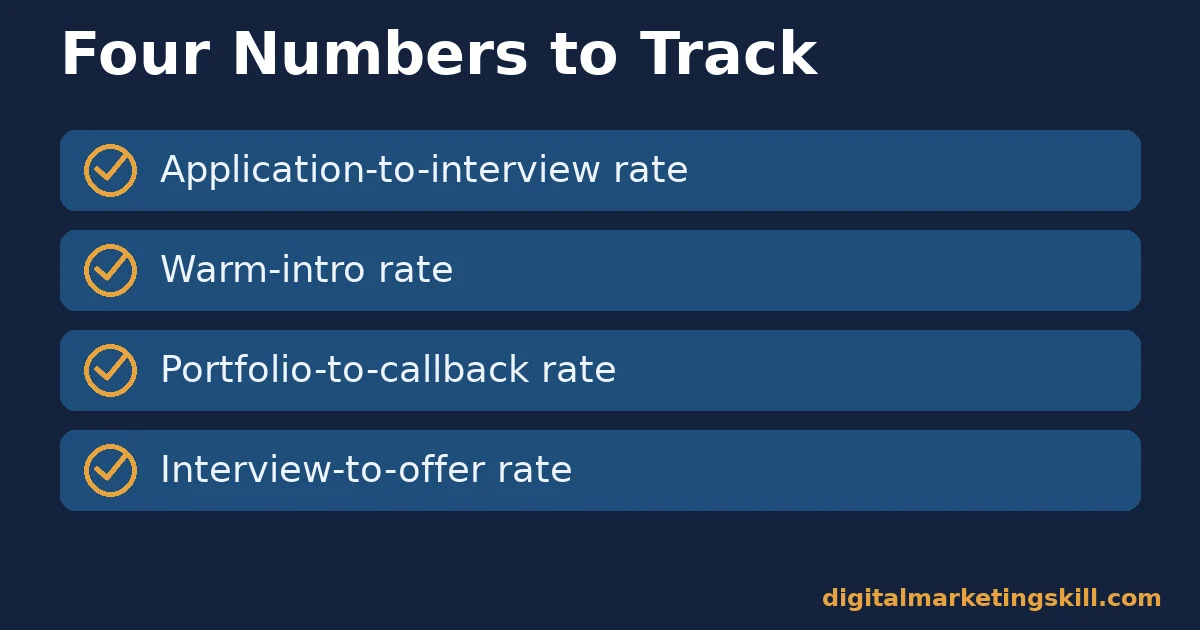
Read these four numbers together, not alone. A healthy warm-intro rate paired with a weak interview-to-offer rate points to a preparation problem, because you are reaching people but not converting the conversation.
A strong interview-to-offer rate with almost no interviews points to a visibility problem further up the funnel, so the fix there is volume of outreach, not better answers in the room. Track all four for a month before you change your whole approach to how to get into tech, because one bad week can make a single number look worse than it really is.
The One Rule for How to Get Into Tech: Get a Referral First
If you take one decision rule from this guide on how to get into tech, make it this one. Before you send your next ten applications, spend that same time getting one real conversation with someone who already works at a company on your list.
Illustrative, invented numbers: picture two job seekers, each sending 100 applications in a month. The first sends them all cold and lands 4 interviews, a 4% rate. The second spends the same hours getting 15 warm introductions first, then applies.
That second seeker lands 9 interviews from the same 100 applications, because referred resumes get pulled off the stack. The time cost is identical. The networking-first approach just points the same effort at a channel that converts several times better, which matches the referral research cited above.
A Real Case: A Certificate Opened the Door Within Weeks
Real results vary, and this is one documented case of how to get into tech, not a guarantee. A graduate of the Digital Marketing Skill Institute’s program was recruited by an international company to run social media marketing for a major platform’s regional operations, within weeks of finishing the course. The credential and portfolio built during training made the difference, as described in a review on the Institute’s reviews page.
What made the case work was not luck. It was a specific, checkable skill (social media management for a named platform), paired with a credential a hiring manager could verify fast. That shortened the distance between application and offer, which is where most career-changers get stuck.
However, one case is not a promise. Income and outcomes are never guaranteed, and results vary by effort, market and role, so see the Institute’s earnings disclaimer for the limits on any student result before you treat this as typical.
Frequently Asked Questions About How to Get Into Tech
Do I need to learn to code to get into tech?
No. Marketing, content, data and project roles inside tech companies hire for communication, strategy and analysis, not programming. Coding helps for engineering-specific roles. It is not a requirement for the marketing and growth roles in this guide.
How long does it take to get into tech with no technical background?
There is no fixed timeline. Most career-changers need a few months to build one credential and a small portfolio, then more time for active outreach and interviews. You move faster by prioritising referrals and a narrow portfolio over a long list of applications.
Is 40 too old to start a career in tech?
No. Hiring managers in marketing and growth roles weight demonstrated skills and a track record far more than age. A career-changer in their forties often has an edge: real experience managing budgets, clients or projects that a new graduate has not had the chance to build yet.
Which digital marketing role inside tech pays the most?
Among the roles in this guide, marketing management tops the US pay data, at a median of $166,790 a year per BLS figures, since it usually carries budget ownership and team leadership. Pay for any single role still depends on company size, location and seniority, so treat this as a direction, not a promise.
Should I apply directly or try to get a referral first?
Try for a referral first wherever you can. Referred candidates get hired at several times the rate of cold applicants in the data cited above. That does not mean skip direct applications. It means spend real effort on warm introductions alongside them, not instead of them.
Can freelancing really lead to a full-time tech job?
Yes. Freelancing is a real path in, because a completed paid project is some of the strongest, most specific proof you can show a future employer. Many hiring managers treat a well-documented freelance result as equal to, or stronger than, a line on a resume that only lists a job title.
Start With One Path, Then Apply What You Learn
Getting into tech without a technical background is a solvable problem, not a lucky break. Pick one of the three paths above. Build one credential and one specific portfolio piece. Spend real effort on warm introductions before you send another round of cold applications. Measure your application-to-interview and warm-intro rates as you go, and fix whichever one is weakest.
If you want a structured way to build that first credential, the Master Diploma in Digital & AI Marketing offers four AI-powered tracks, including AI-Powered Social Media Management and Advertising and AI-Powered Google Specialist, with a Full Stack option if you want all four.
It includes unlimited 1-on-1 mentoring and coaching, a U.S. Project Internship with a verified U.S. Work Reference Letter, and dual US and UK accreditation recognised in more than 100 countries, 100% online from anywhere in your country.
Browse the blog for more on specific roles, and read real outcomes on the reviews page. When you are ready, apply here. Wherever you live, the path on how to get into tech through digital marketing starts with one credential and one real conversation, not a computer science degree. Learn more at Digital Marketing Skill Institute.
Every figure in this guide was checked against its original source before publication. Figures marked as illustrative are invented examples, not real results.
