

Social media management skills decide one thing fast: can a new hire run a brand channel today, or do they need months of training first? This guide ranks the skills that job posts and managers actually demand. It groups them by career stage. Then it shows how to measure and build each one.
Key Takeaways
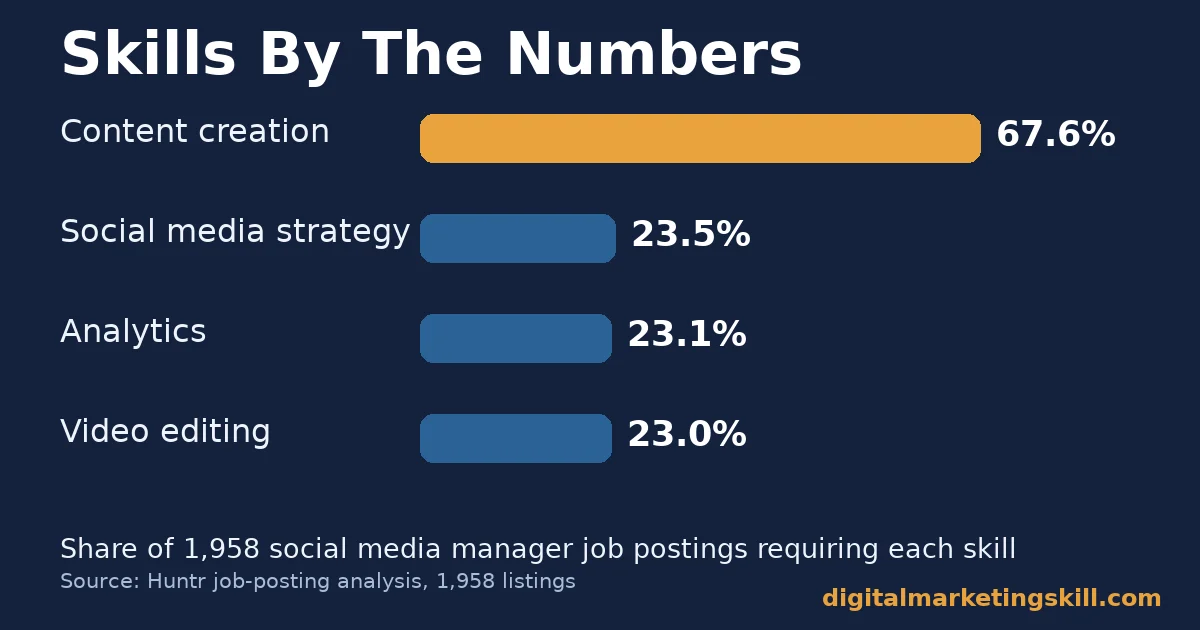
- Content creation appears in 67.6% of 1,958 social media manager job postings, far ahead of any other listed skill.
- Social media strategy, analytics, and video editing each sit near 23% of postings, per the same 1,958-posting analysis, so they form the next tier worth building.
- According to HubSpot’s research, 79% of customers expect a reply within 24 hours, and most want acknowledgment within 30 minutes on Facebook and Twitter/X.
- Even so, the average business still takes about five hours to reply, so response-time skill is a real gap, not a soft skill.
- The U.S. Bureau of Labor Statistics forecasts only 2% total growth, US data only, for public relations specialists, the closest tracked category, over its current decade-long outlook window. Because growth is slow, differentiated skills matter more than the job title alone.
In this guide
- Why So Many Social Media Hires Still Struggle
- What Social Media Management Skills Actually Cover
- What Social Media Management Skills Matter By Career Stage
- How To Build Social Media Management Skills At Each Stage
- Tools That Support Each Social Media Management Skill
- How To Measure Whether These Skills Are Working
- The One Decision Rule For Choosing What To Learn Next
- What This Looks Like In Practice
- Frequently Asked Questions About Social Media Management Skills
- Build These Skills With Structured, Guided Practice
Why So Many Social Media Hires Still Struggle
Most job descriptions list the same ten skills in a random order. Candidates memorize the list. Yet managers still complain that new hires freeze when a post needs a fast rewrite, or a campaign underperforms. The real gap is not a missing line on a resume. It is not knowing which skill matters at which stage of the job. It is not knowing how to prove that skill with a number.
The same gap shows up in reverse, too. A manager sometimes hires for a long checklist of social media management skills, then wonders why the new hire still cannot produce a usable post on day one. The checklist tested for breadth. The job tested for speed on one specific task. Matching the hiring test to the actual day-to-day job closes more of this gap than adding another skill to either list.
Closing The Mismatch On Both Sides
Both sides of this mismatch are fixable without a complete career change. A candidate can ask, before accepting an offer, which social media management skills the job actually leans on week to week. A manager can rewrite a job posting around one real task sample instead of a generic skills list. Either change takes an afternoon, and both close more of the hiring gap than another round of interviews ever will.
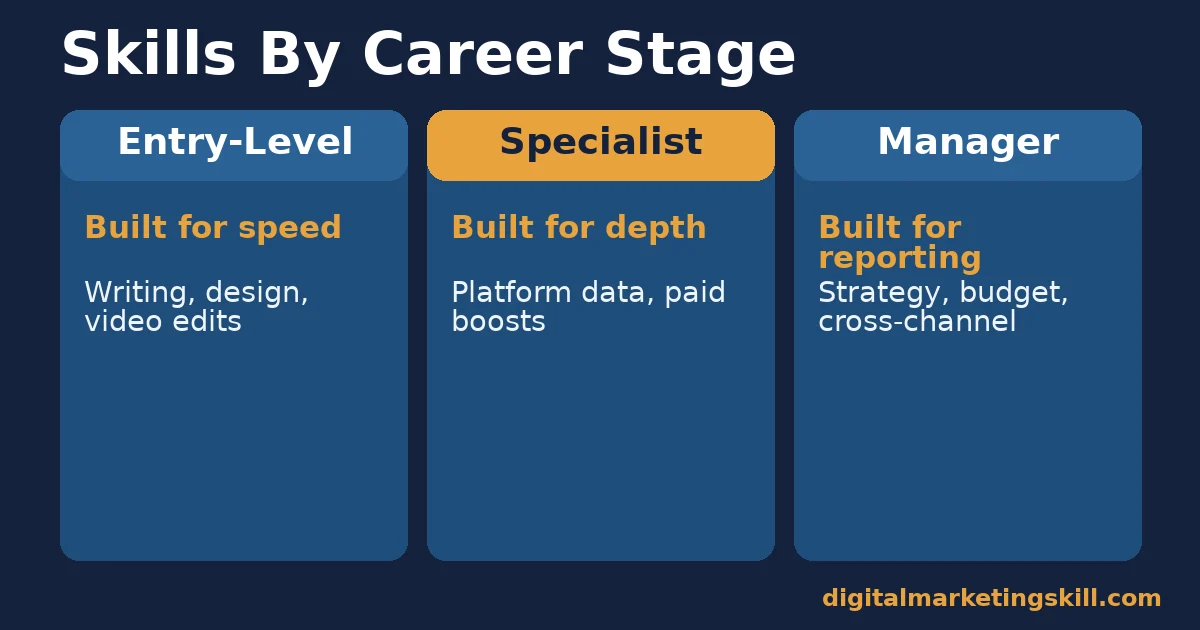
This guide treats social media management skills as a stack, not a checklist. Early in a career, production speed wins. In a specialist role, platform depth wins. In a management role, measurement and reporting win. Some of this is an informed inference from current hiring data, not a settled fact, because the hiring market shifts often. So treat it as a snapshot, not a permanent ranking.
There is also a ground rule worth stating plainly. A long list of social media management skills is not the same as a prioritized one. Most lists online rank skills alphabetically. Others rank by how often a course happens to cover them. Neither ranks by how often an employer actually screens for a skill, or how often a manager needs it that month.
This guide ranks by two things instead: how often a skill shows up as required in real job postings, and which number it moves once someone practices it. That combination beats gut feeling. It is still an approximation, though, not a guarantee for any single job.
What Social Media Management Skills Actually Cover
The Three Skill Groups
Social media management skills split into three working groups. Strategy skills decide what gets posted and why. They cover goal setting, audience research, competitor analysis, and content planning. Production skills turn a plan into a finished post. They cover writing, graphic design, video editing, and platform-specific formatting. Operating skills keep the channel running day to day. They cover scheduling, monitoring, customer response, and reporting.
A hiring manager rarely needs all three groups at full strength from one person. A small brand often wants one person strong in all three. A larger team instead splits strategy, production, and operations across different roles. So the useful question is not “do I have this skill,” but “which group does my current job need this month.”
The Data Behind The Priority
Content creation leads every list for a reason. It appears in 67.6% of 1,958 analyzed social media manager job postings, according to resume-data site Huntr. It is required in nearly every one of those listings, too.
Social media strategy, analytics, and video editing each sit close to 23% of postings. That gap between 67.6% and 23% is the clearest signal in the data: production skill gets you hired, while strategy and analytics skill gets you promoted. Platform usage backs this up. Analysts at Siege Media, citing Statista data, report that Instagram Reels account for roughly 35% of time spent on the app. That is exactly the kind of production-heavy workload an entry-level content creator gets hired to handle.
Overlapping Job Titles Explained
These three groups also explain why so many job titles overlap and confuse candidates. A “Social Media Coordinator,” a “Content Creator,” and a “Social Media Manager” often cover the same production skills. The difference is usually pay grade, plus how much strategy gets attached to the role. So before applying, check which group a posting actually emphasizes in its bullet points, not just its title. The title alone rarely tells you which social media management skills the role will test in an interview.
What Social Media Management Skills Matter By Career Stage
The same ten skills do not matter equally at every stage. Here is how the priority shifts as a role grows.
Entry-Level: Built For Production Speed
An entry-level hire gets judged on speed: how fast a usable post, caption, or short video comes together. A manager or content calendar usually supplies the strategy. So the entry-level stack is narrower: writing and editing, basic graphic design in a tool such as Canva or Photoshop, short-form video editing, and familiarity with two or three platforms.
Specialist: Built For Channel Depth
A specialist owns one or two platforms end to end. The priority shifts toward platform proficiency, paid boosting, ad management, community response, and basic analytics reading. A specialist should explain why a post underperformed using the platform’s own data, instead of simply reposting it elsewhere and hoping.
Manager: Built For Strategy And Reporting
A manager gets judged on outcomes across every channel, not on individual posts. So the priority shifts to strategic planning, cross-platform analytics, advertising budget management, and translating performance data into decisions a non-marketing executive can act on.
B2B marketers back this approach. Content Marketing Institute’s B2B research found that 76% rate LinkedIn effective for thought-leadership content. That is a judgment call, and it only comes from reading a channel’s own reporting closely, not from a single dashboard glance. A manager who cannot explain why one platform earns more budget than another is still missing a core social media management skill, no matter how senior the title reads.
How To Build Social Media Management Skills At Each Stage
Knowing the priority is not the same as building the skill. Here is what to practice at each stage, mirrored against the stages above.
Entry-Level: Lead With Daily Reps
Pick one platform and publish daily for 30 days. Log what you tried and what happened each time. Next, rebuild three posts from a brand you admire, in your own voice, strictly as practice and never as a published copy.
Learn one design tool and one caption-editing habit, such as reading every caption aloud before posting, until both feel automatic. These habits also show up on this broader list of skills that get entry-level marketers hired.
Specialist: Lead With One Platform Mastery
Go deep on the platform’s own analytics dashboard before touching a third-party tool. Then run one small paid boost with a fixed budget, track the result, and write down what you would change next time. Build a response-time habit too: check mentions and comments on a fixed schedule, so replies land inside the 30-to-60-minute window customers actually expect, rather than whenever the queue gets noticed.
Manager: Lead With Measurement Systems
Build one simple reporting template before adding any new tool. Each row should tie a post or campaign to a measurable outcome, not to a vanity metric like follower count.
Practice translating last month’s numbers into one sentence a CEO would understand. Then practice defending next month’s budget using that same sentence. For more on pay and demand at this stage, see this look at what the data says about digital marketing pay and demand.
Tools That Support Each Social Media Management Skill
A tool never replaces a skill. The right tool just makes a weak skill visible faster, and a strong skill scale further. Scheduling platforms such as Hootsuite, Buffer, Sprout Social, SocialPilot, and Agorapulse support the operating-skill group. They queue content, centralize monitoring, and surface basic engagement numbers in one dashboard.
Design tools such as Canva and Adobe Photoshop support the production-skill group, turning a rough idea into a finished, on-brand graphic. Platform-native analytics, plus a general tool such as Google Analytics, support the strategy-skill group by tying social activity back to traffic and conversions.
Pick One Tool Per Group, Not Five
Switching tools constantly feels like progress. It rarely improves the underlying social media management skills, though, because the bottleneck is almost always judgment, not software. So learn one scheduling tool deeply, one design tool deeply, and one analytics view deeply, in that order, before adding a second option in any group. A manager who knows one dashboard cold outperforms one who has dabbled in five.
How To Measure Whether These Skills Are Working
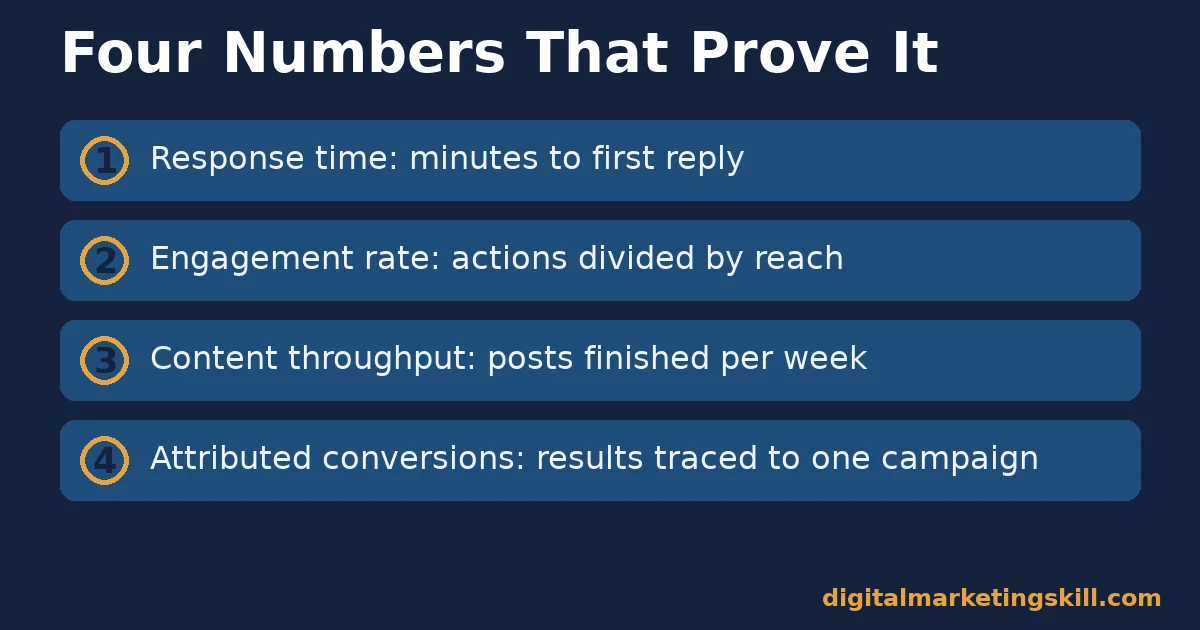
Four numbers show whether a social media skill set is actually paying off. Track them monthly, on the same day, so the trend line means something. A single good or bad month rarely proves anything about someone’s social media management skills on its own. Look for a direction across at least three consecutive months before treating any one of these numbers as a verdict on a person’s skill.
Keep the tracking simple enough that someone actually keeps doing it. A spreadsheet with four rows and twelve monthly columns beats an elaborate dashboard nobody opens after the first week. The goal is a habit, not a report that looks impressive once and then goes stale.
Share The Tracker, Not Just The Headline Number
It also helps to share this simple tracker with whoever reviews the work, whether that is a manager, a client, or a mentor. A shared number ends a lot of arguments that would otherwise stay stuck at “I think engagement is fine.” It also gives a fair way to judge whether new social media management skills are translating into results, instead of relying on anyone’s gut feeling, including the social media manager’s own.
- Response time: the average time between a comment or message arriving and a reply going out. A rising number means community management skill is slipping, not that the audience got ruder.
- Engagement rate: likes, comments, and shares divided by reach or followers, shown as a percentage. It shows whether content creation and strategy skill are producing content people act on, not just see.
- Content throughput: how many finished, on-brand posts one person can produce in a week without quality dropping. It measures production skill directly, and it exposes burnout before it shows up as missed deadlines.
- Attributed conversions: sign-ups, leads, or sales traced back to one specific social campaign through a link, code, or platform pixel. It shows whether analytics skill actually connects to strategy skill, instead of sitting unused in a dashboard.
The One Decision Rule For Choosing What To Learn Next
Learn the skill that your current role’s weakest number depends on, not the skill that is trending online. If response time keeps slipping, learn community management and scheduling tools before learning a new design app. If engagement stays flat while throughput is high, learn strategy and audience research before learning more editing shortcuts.
Here is an illustrative example, with invented numbers: a specialist posting five times a week sees engagement rate stuck at 1.2% for two months straight. Throughput is fine, so the decision rule points to strategy and audience research, not to more content volume. After two months of audience testing, engagement moves to 2.1%, without posting any more often.
The same rule applies in reverse. If engagement and response time both look healthy but content throughput keeps slipping, the honest answer is rarely “learn a new skill.” It is usually workload, tooling, or an unclear content calendar, and no amount of extra graphic-design training fixes a calendar problem. Diagnose before you enroll in anything.
One more scenario worth naming: all four numbers look fine, but the role still feels chaotic day to day. That usually points to time management. This skill rarely shows up in a job posting’s bullet list. It shows up constantly in manager feedback, though. If that is the pattern, the fix is a published weekly schedule for content, monitoring, and reporting, not a new platform skill.
What This Looks Like In Practice
Digital Marketing Skill Institute graduate Kelly Akpomedaye, in a review published on the Institute’s reviews page, described the training as “very practical and detailed.” She added that the program covers everything “from SEO to social media management and marketing.”
The review does not include a specific income figure, so this guide will not invent one. Still, it illustrates a pattern that shows up across the published reviews: practical, hands-on practice across multiple channels, not one skill in isolation, is what graduates credit for being job-ready. That pattern matches the job-posting data above, where breadth across the three skill groups outperforms depth in just one.
Frequently Asked Questions About Social Media Management Skills
What is the single most important social media management skill?
Content creation, based on job-posting data. It appears in more listings than any other skill, and it is almost always marked required. So it is the skill that gets a resume past the first screen.
Do I need graphic design skills if I am not a designer?
Yes, at a basic level. You do not need to be a professional designer, but you should be comfortable building a clean, on-brand graphic without waiting on someone else to do it for you.
How important is analytics compared to creative skills?
Both matter, but at different stages. Creative and production skills get an entry-level hire through the door. Analytics skill is what turns a specialist into a manager, because it proves the creative work is actually working.
What skill should I learn first if I am starting from zero?
Writing and basic content creation. Every other skill on this list, including analytics and paid advertising, becomes easier to learn once you can produce a clean, on-brand post without help.
How fast should a social media manager respond to comments and messages?
Fast enough to beat the audience’s own expectation. Most customers want acknowledgment within 30 to 60 minutes, especially for complaints, even though the average business still takes closer to five hours.
Can these skills transfer to a broader digital marketing role?
Yes. Strategy, analytics, and writing skills transfer directly to email, SEO, and paid search work. Platform-specific production skills transfer less directly, but the habit of testing and measuring content carries over regardless.
How many social media management skills does one person need?
Fewer than a typical list suggests. One strategy skill, one production skill, and one operating skill, each practiced until they are reliable, outperform a scattered list of ten skills practiced once each.
Should I get a certification to prove these skills?
A certification can open a conversation, but it rarely closes a hiring decision on its own. A small portfolio of real posts, with the engagement numbers attached, demonstrates social media management skills far more convincingly than a certificate alone.
How do freelance social media managers prioritize these skills differently?
A freelancer usually needs the full stack from day one, because there is no team to split the work across. Strategy, production, and client reporting all land on the same person, which is why freelance postings often ask for a broader set of social media management skills than an in-house junior role does. Pricing and scope conversations also become a skill of their own, since a freelancer has to explain, in plain terms, which outcomes a given budget can realistically buy.
Build These Skills With Structured, Guided Practice
Reading a skills list is the easy part. Building each skill under real feedback, on real projects, is what actually changes a resume. The Master Diploma in Digital & AI Marketing from Digital Marketing Skill Institute is built around that gap. It includes an AI-Powered Social Media Management and Advertising track, inside four AI-powered tracks that total ten courses, plus a Full Stack option for completing all four.
Every track includes unlimited 1-on-1 coaching and mentoring, a U.S. Project Internship with a verified U.S. Work Reference Letter, and dual US and UK accreditation recognised in more than 100 countries. Because the program runs 100% online, you can build these skills anywhere in your country, wherever you live.
So explore the Master Diploma program structure, browse more guides on the Digital Marketing Skill Institute blog, or read real outcomes on the reviews page. Or go straight to the application page to start building these skills with structured feedback. Learn more about the Institute at Digital Marketing Skill Institute, and come back to digitalmarketingskill.com for more practical guides.
Every figure in this guide was checked against its original source before publication. Figures marked as illustrative are invented examples, not real results.
![9 Amazing Digital Marketing Skills to Make Money Online [With Proof]](https://digitalmarketingskill.com/wp-content/uploads/2019/07/9-Amazing-Digital-Marketing-Skills-to-Make-Money-Online-With-Proof-17.png)






