Conversion funnel optimization usually fails for one simple reason. Most businesses widen the top of the funnel when the real leak sits further down. Baymard Institute’s research puts average cart abandonment at 70.19%, and most of that loss happens at the decision stage, not the discovery stage. This guide shows how to find the stage that is actually leaking and fix that one first.
Key Takeaways
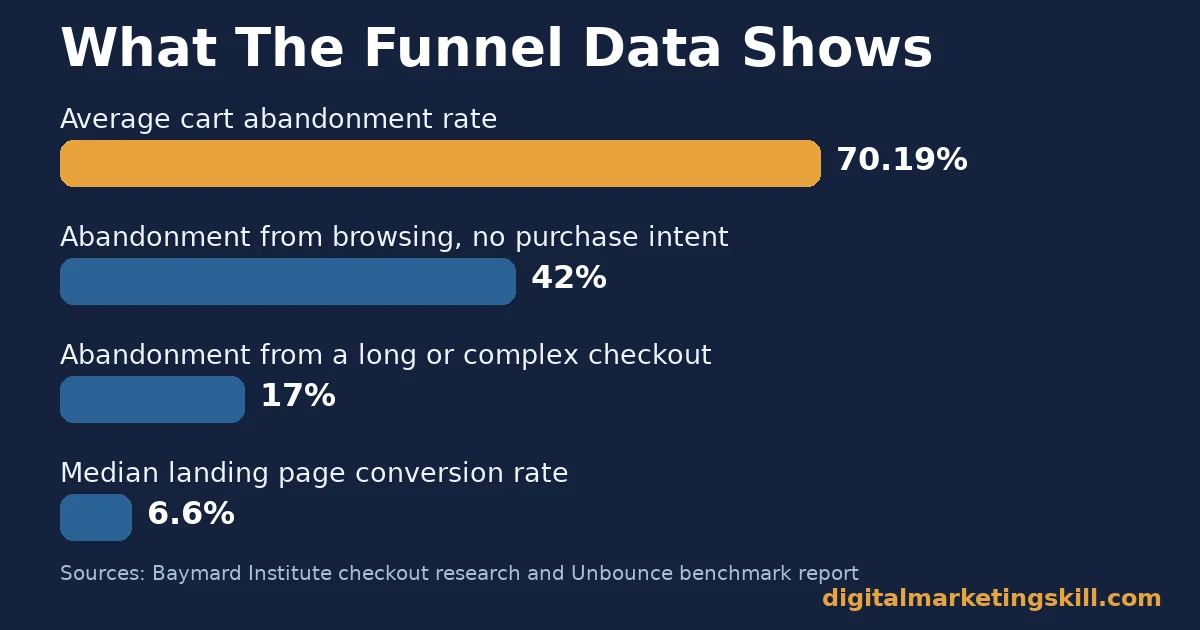
- Most carts get abandoned. Baymard Institute’s aggregate of checkout research puts the average cart abandonment rate at 70.19%, tracked for over a decade.
- Not all abandonment is fixable. Baymard’s own survey found 42% of visitors who abandon a cart were just browsing, with no purchase intent that session. The other 58% is where real fixes pay off.
- Checkout complexity is a top preventable cause. 17% of US online shoppers in Baymard’s research abandoned an order because the checkout process felt too long or complicated.
- Landing pages vary wildly. Unbounce’s benchmark report, built from 41,000 landing pages and 57 million conversions, found a median conversion rate of 6.6%. Rates ranged from 3.8% to 12.3% by industry.
- Channel matters more than most funnels assume. The same Unbounce data found email referrals converting at 19.3%. That is well ahead of paid social at 12% and paid search at 10.9%.
In this guide
- The Conversion Funnel Myth Most Guides Repeat
- How A Conversion Funnel Actually Breaks
- The Four Stages Conversion Funnel Optimization Must Treat Differently
- Conversion Funnel Optimization In Practice: Fixing Each Stage
- Measuring Whether Your Conversion Funnel Is Actually Improving
- Common Mistakes In Conversion Funnel Optimization
- The One Decision Rule: Fix The Biggest Leak First
- A Real Case: Conversion Funnel Optimization Built From Scratch
- Frequently Asked Questions About Conversion Funnel Optimization
- Build This Skill Properly, Wherever You Live
The Conversion Funnel Myth Most Guides Repeat
Most conversion funnel optimization advice treats the funnel as a single pipe. Pour more traffic in the top, and more sales should come out the bottom. That advice ignores where the pipe actually narrows.
Here are the ground rules for this guide. The abandonment and conversion figures below come from Baymard Institute and Unbounce. Both publish their methodology alongside their numbers. Treat every figure as a benchmark from its own dataset, not a universal law for your specific funnel. Your own analytics, not an industry average, should always decide which stage you fix first.
A quick, honest check before you read further: open your analytics and find the single stage where the largest share of visitors leaves. Most businesses have never actually looked. That stage, not the top of the funnel, is where conversion funnel optimization should start. This guide walks through why that stage matters more than any other number on your dashboard. It also covers what to do once you find it.
How A Conversion Funnel Actually Breaks
A funnel breaks at a specific stage, not evenly across all of them. Visitors fall away in uneven amounts. The stage with the steepest drop usually explains most of the lost revenue. That is why conversion funnel optimization has to start with finding that stage, not guessing at it.
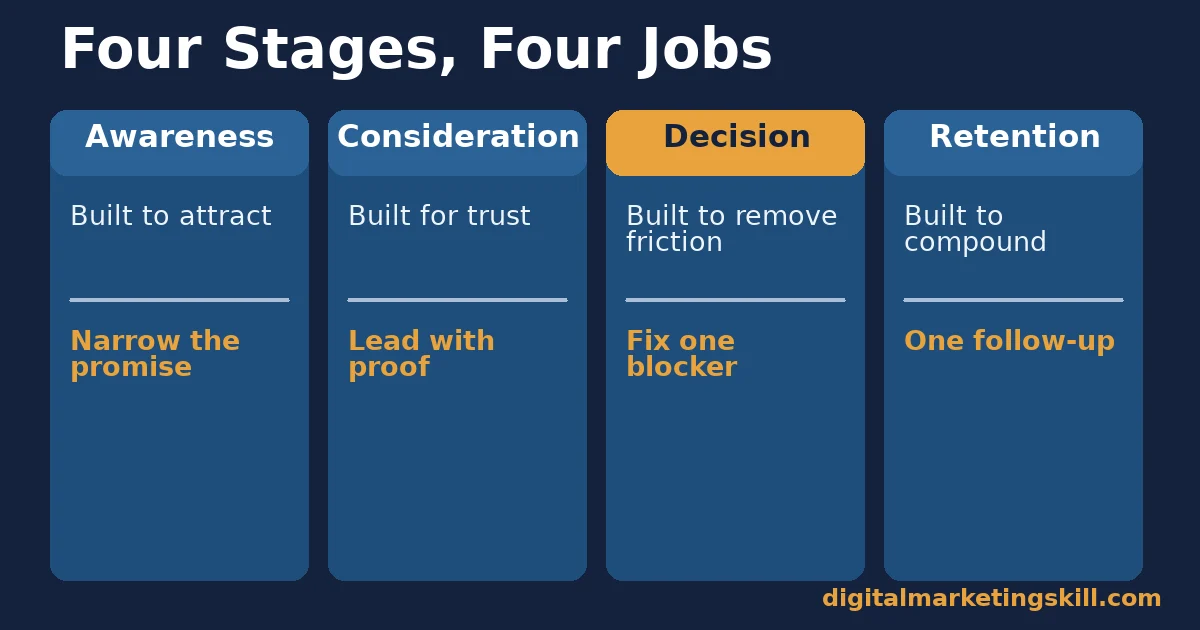
Four stages make up almost every funnel: awareness, consideration, decision and retention. Each stage has its own typical drop-off cause. Awareness loses people who were never a fit. Consideration loses people who are not yet convinced. Decision loses people who got stuck at the last step, often at checkout. Retention loses people who bought once and never came back.
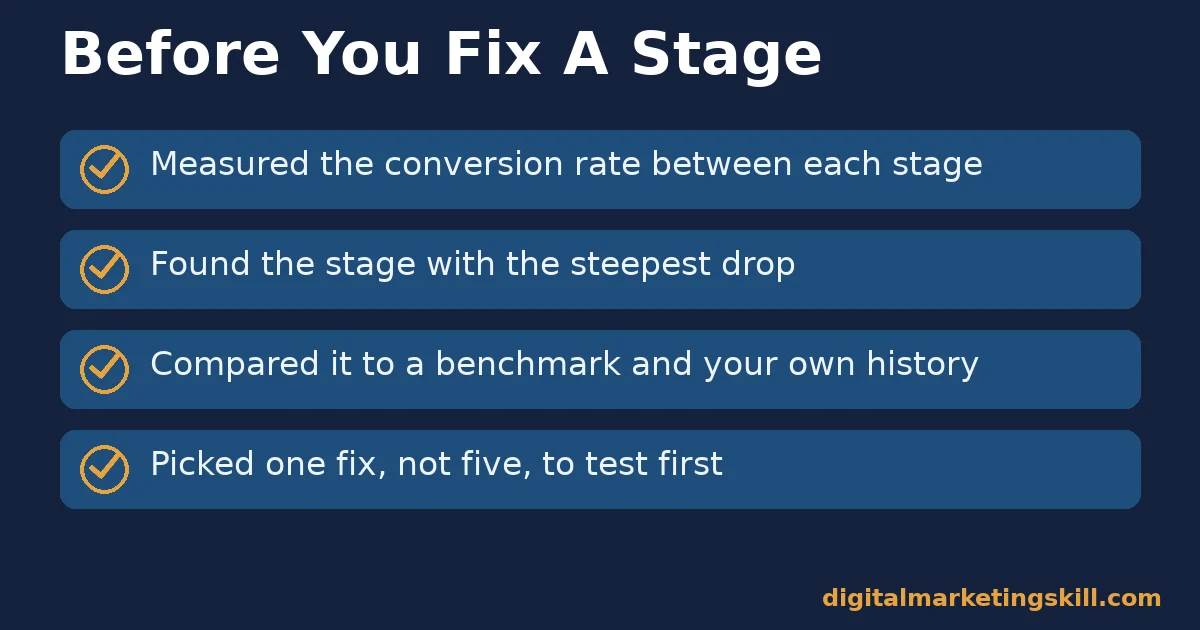
Diagnosing the funnel means measuring the conversion rate between each pair of stages. Then compare those rates against a benchmark and against your own history. A stage that converts far below its usual rate is the leak worth fixing first, regardless of how much traffic sits above it.
This diagnosis step is the part most teams skip. It takes longer than glancing at a total conversion rate. But it is the only way to know whether a redesign, a new offer or a simpler checkout is actually the right next move.
Most analytics platforms already have what you need. A funnel exploration report, or a simple set of goal steps, shows the count of visitors at each stage. Calculate the percentage drop between each pair yourself if your tool does not show it directly.
The Four Stages Conversion Funnel Optimization Must Treat Differently
Each stage of the funnel does a different job. Treating every stage the same way, with the same message and the same offer, is the single most common funnel mistake. Reading the four stages below as four separate small problems, rather than one big funnel problem, makes conversion funnel optimization far less overwhelming to act on.
Awareness: Built To Attract, Not Convert
This stage exists to get the right people to notice you, not to close a sale. A visitor at this stage has a problem but has not yet decided to solve it. Pushing a hard offer here usually wastes both the visitor’s attention and your budget. Our guide to lead generation covers how to attract the right visitor at this stage without overselling too early. The goal is relevance, not volume. A smaller audience that actually has the problem moves through the rest of the funnel far better than a large audience that does not.
Consideration: Built To Build Trust
This stage exists to prove you can solve the problem better than the alternative the visitor is comparing you against. Visitors here want evidence, not more features. A feature list rarely beats a specific example of the result someone else achieved. Our guide to content marketing covers how to build that kind of proof into your pages.
Decision: Built To Remove Friction
This stage exists to get a visitor who already wants to buy across the line without second-guessing. Friction here, unexpected costs, a confusing form, too many steps, is pure loss. Baymard’s data shows 17% of abandoned orders happen for exactly this reason.
Retention: Built To Compound Revenue
This stage exists to turn a single sale into a relationship. A customer who already bought once costs far less to sell to again than a stranger at the top of the funnel. Most conversion funnel optimization plans stop at the first sale and leave this stage empty. That gap is often the cheapest revenue available, since the hardest part, earning initial trust, has already happened.
Conversion Funnel Optimization In Practice: Fixing Each Stage
Once you know which stage is leaking, the fix for each stage is specific, not generic. Applying a decision-stage fix to an awareness problem rarely moves the number.
Awareness: Lead With A Narrower Promise
Narrow the promise to the one problem your best customers actually have, instead of a broad claim meant to appeal to everyone. A narrower promise attracts fewer total visitors, but a higher share of them are the right fit, which improves every stage below it.
Consideration: Lead With Proof, Not More Features
Replace a feature list with one specific, checkable example: a number, a before-and-after, a real customer’s result. Proof answers the question a feature list cannot, which is whether this actually works for someone like the visitor.
Decision: Lead With Removing One Friction Point
Pick the single biggest friction point at checkout or signup, often an unexpected cost or an unnecessary form field, and remove it first. One fixed friction point usually beats five small cosmetic changes, because it addresses the actual reason people were leaving.
Retention: Lead With One Follow-Up Sequence
Build a single, simple follow-up sequence for people who already bought, rather than trying to build a full retention program at once. Even one well-timed message after the first purchase captures value most funnels leave on the table entirely. Our guide to improving email marketing results covers how to build that first sequence.
Measuring Whether Your Conversion Funnel Is Actually Improving
Five numbers show whether conversion funnel optimization is working, and all five come from your own analytics, not an industry average.
- Stage-to-stage conversion rate. The share of visitors who move from one stage to the next. Track each transition separately rather than one blended rate for the whole funnel.
- Cart or form abandonment rate. The share who start the final step but do not finish it. Compare your own rate against the roughly 70% industry average, but treat your own trend over time as the more useful signal.
- Landing page conversion rate. The share of landing page visitors who complete the page’s main goal. A rate near or above the 6.6% median Unbounce measured is a reasonable early benchmark, though your own industry range may differ.
- Repeat purchase rate. The share of customers who buy a second time within a set window. A rising repeat rate shows the retention stage is starting to compound.
- Average order value. The typical spend per completed purchase. A small lift here, combined with a fixed conversion rate, often moves total revenue more than another round of traffic spend would.
Check these monthly, and always look at the stage-to-stage numbers before the blended total. A healthy blended rate can still hide one badly leaking stage. For example, strong awareness and consideration numbers can mask a weak decision stage, simply because so few visitors ever reach it that its poor rate barely moves the overall average.
Common Mistakes In Conversion Funnel Optimization
Four mistakes repeat across most funnels we review. Each one is easy to spot once you know where to look, and each one is a quick fix once named rather than left as a vague feeling that “something isn’t working.”
- Fixing the top because it is easiest to measure. Traffic numbers are visible immediately. Stage-to-stage drop-off takes a few extra minutes to calculate, so it gets skipped, even though it usually matters more.
- Running every traffic source through one landing page. A visitor from an email, a search ad and a social post all arrive with different expectations. One generic page serves none of them well.
- Adding more steps to “qualify” leads. Extra steps feel like quality control, but each one is another place for a willing buyer to drop off. Add a step only when it demonstrably improves what happens after it.
- Never testing the fix. A change made on a hunch, without comparing before and after, teaches you nothing you can reuse on the next funnel.
- Chasing a benchmark instead of your own history. An industry average is a starting reference, not a target. A funnel that improves steadily against its own past numbers is doing its job, even below the industry median.
The One Decision Rule: Fix The Biggest Leak First
When you have more than one weak stage, pick a rule: fix the stage with the largest gap between its actual conversion rate and its expected rate. Do not default to whichever one is quickest or cheapest to change.
Illustrative, invented numbers show why. Imagine a funnel where the awareness-to-consideration rate sits only slightly below benchmark, but the decision-stage rate sits far below what similar checkouts typically achieve. A small headline tweak at the top might be easier to ship this week. But closing the decision-stage gap recovers far more revenue, even with a harder fix like rebuilding a confusing checkout form. Every visitor who reaches that stage already wanted to buy.
A Real Case: Conversion Funnel Optimization Built From Scratch
Olajire Jacob, a graduate of the Digital Marketing Skill Institute, built exactly the kind of system this guide describes: an email flow that moves a new contact from first message to paying client. As published, they started by charging an average of $500 to set up email marketing flows for clients in the US, UK and Canada. They then expanded the service and scaled to $5,000 a month.
An email flow is a conversion funnel in miniature: each message either advances a contact toward a purchase or loses them. The case shows the same principle this guide argues for, fixing and repeating one working sequence, rather than building ten half-finished ones. Results vary by niche, effort and client acquisition; see the Institute’s earnings disclaimer for the limits on any figure mentioned here.
The lesson scales beyond email. Whatever channel carries your funnel, the discipline is the same. Build one sequence, measure where it leaks, then fix that one stage. Repeat the cycle on the next stage once the first is solid.
Frequently Asked Questions About Conversion Funnel Optimization
What is a good conversion rate for a sales funnel?
It depends heavily on industry, traffic source and offer. Unbounce’s benchmark data puts the median landing page conversion rate at 6.6%, with a range from 3.8% to 12.3% across industries. Compare your funnel against your own category rather than a single flat number.
How do I find where my funnel is actually leaking?
Measure the conversion rate between each pair of stages separately, not just the rate from first visit to final sale. The stage with the largest gap between its rate and a reasonable benchmark, or its own past performance, is where the leak is.
Why do people abandon their cart right before buying?
Baymard’s research attributes much of this to avoidable friction: unexpected costs, an overly long checkout, or a form asking for more than it needs. Some abandonment is unavoidable browsing with no purchase intent, which no fix will change.
Should I focus on getting more traffic or fixing my funnel first?
Fix the funnel first in almost every case. More traffic through a leaking funnel mostly produces more lost visitors at the same broken stage, which wastes the extra spend before it has a chance to convert.
How often should I review my conversion funnel?
Review the core stage-to-stage numbers monthly. Review in more depth whenever you change a landing page, checkout flow or ad audience, since that is when a new leak is most likely to appear unnoticed.
Does conversion funnel optimization work the same for services as for products?
The stages and the diagnosis method are the same, awareness, consideration, decision, retention, but the decision-stage friction looks different. A service funnel often loses people at a booking or consultation step instead of a cart, so measure whichever step directly precedes payment.
What tools do I need to start conversion funnel optimization?
A free analytics platform that can track stage-to-stage events is enough to start. You do not need expensive software to find a leak. You need the discipline to measure each stage separately. Track one change at a time, so you know what actually caused an improvement.
How long does it take to see results from fixing a funnel stage?
Changes at the decision stage, such as simplifying a checkout, often show a measurable shift within a few weeks, since that stage usually has steady traffic. Changes further up the funnel, such as a new audience or message, can take longer to show a clear pattern. The effect has to travel through every stage below it first.
Build This Skill Properly, Wherever You Live
If you want structured practice building and fixing a real funnel, consider the Master Diploma in Digital & AI Marketing from the Digital Marketing Skill Institute. It includes the AI-Powered Lead Generation and Email Automation track, one of four AI-powered tracks covering ten courses in total, with a Full Stack option for completing all four.
The program is built around hands-on practice, so you work on a real funnel with real contacts, not a theoretical diagram. It includes unlimited one-on-one coaching and mentoring, a U.S. Project Internship with a verified U.S. Work Reference Letter, and dual US and UK accreditation recognized in more than 100 countries. Everything runs 100% online, so you can build this skill from anywhere in your country.
Start at Digital Marketing Skill Institute. Browse the blog for more funnel and conversion guides. Read real outcomes on the reviews page, and when you are ready, apply here. Wherever you live, fix the stage that is actually leaking before you spend another dollar on traffic. A funnel that converts well at every stage turns the traffic you already have into more revenue, without needing a bigger marketing budget to get there.
Every figure in this guide was checked against its original source before publication. Figures marked as illustrative are invented examples, not real results.