
Lead generation is the process of capturing a stranger’s contact details. It then turns that contact into a qualified prospect a sales team can follow up with. Capturing the contact is only the first half. Qualifying it and responding fast are what actually turn it into a sale.
Key Takeaways
- A Harvard Business Review study tracked 2,241 U.S. companies. Contacting a lead within one hour made a meaningful conversation 7 times more likely than waiting even one hour longer (LeanData, citing HBR).
- The same research found that waiting 24 hours or more makes a lead 60 times less likely to qualify at all.
- MIT and InsideSales research found that responding within 5 minutes makes contact roughly 100 times more likely than waiting 30 minutes (DigitalApplied).
- Companies that respond in under 5 minutes see a 32% close rate, against 12% for those that wait 24 hours or more (Optifai research, via DigitalApplied).
- Reducing a lead form from 11 fields to 4 fields produced a 120% increase in completed submissions in one landing page study (Involve.me).
In this guide
- The Lead Generation Gap Most Guides Skip
- How Lead Generation Actually Works
- What Differs By Lead Source
- Fix Your Lead Generation, By Source
- Measure What Matters For Lead Generation
- The One Decision Rule
- A Real Case, And Its Limits
- Frequently Asked Questions About Lead Generation
- Your Next Step With Lead Generation
The Lead Generation Gap Most Guides Skip
Most lead generation guides stop at the definition. A lead is a prospect who showed interest. That part is true, but it is not the part that decides whether the lead becomes a customer.
This guide is an informed inference built from response-time and form-conversion research, not a settled fact for every business. Results vary by industry, average deal size and how fast a sales team can realistically respond.
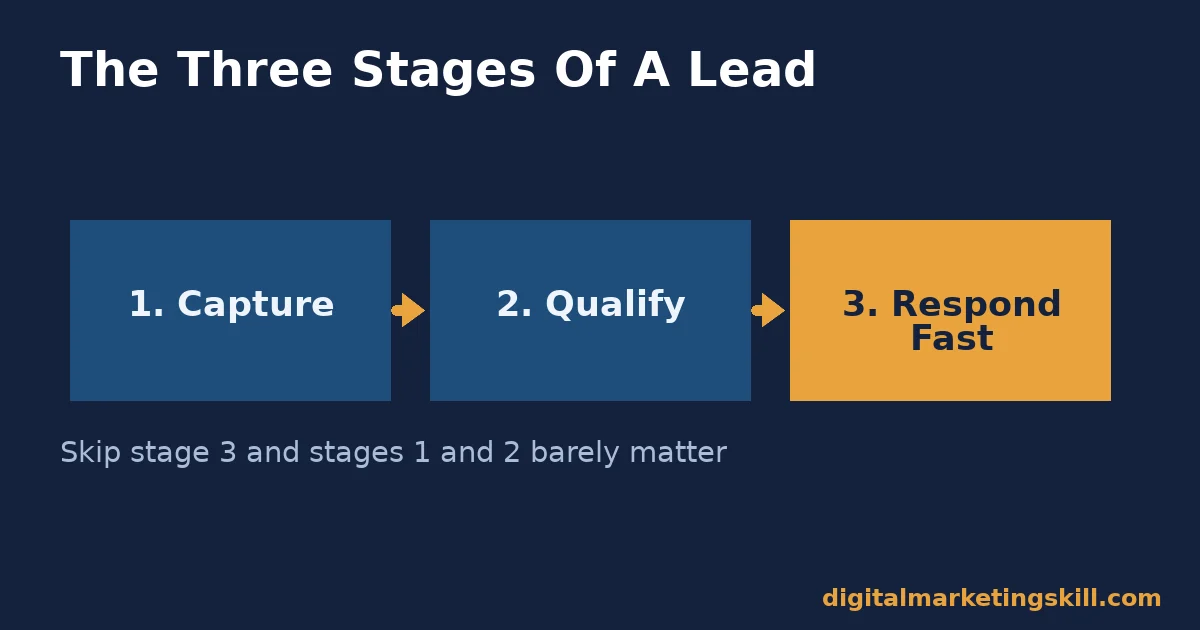
Lead generation only works as a system when three things happen in order. A form or offer captures the contact. A qualification step separates a real buyer from a curious visitor. Then a fast follow-up reaches that buyer before a competitor does.
Skip the third step and the first two barely matter. A perfectly qualified lead that waits 24 hours for a reply is, per the HBR research above, 60 times less likely to ever become a customer.
This is why a business can run excellent ads, write a strong offer, and still underperform. The leak is rarely visible in the marketing numbers. It shows up later, in a sales pipeline that looks full but closes almost nothing. By then it is harder to trace back to the real cause.
How Lead Generation Actually Works
A lead moves through three stages before it becomes revenue. Each stage has its own job, and skipping one breaks the whole chain.
The Three Stages Of A Lead
Capture comes first: a form, a call, or a chat that collects enough information to know who the person is. Qualification comes second: a quick check of whether this person can realistically buy, based on budget, need, or role. Response speed is the third stage: how fast a real human follows up once the first two stages are done.
Most businesses invest heavily in capture. They run ads, build landing pages, and offer downloads. Few invest the same effort in speed. A lead that sits in an inbox for a day has already cooled, no matter how good the capture page was.
This imbalance is easy to understand. Capture is visible: a finished landing page, a published ad, a completed download. Speed is a process, not a deliverable, so it is easier to postpone and harder to notice when it quietly fails.
This gap is common, not rare. Research from RevenueHero found that 635 of 1,000 B2B SaaS companies never responded to a demo request at all (via usecarly). A business that responds to every lead within minutes is already ahead of most competitors before the conversation even starts.
That gap exists for an ordinary reason. Most teams do not lack the desire to respond fast. They lack a clear owner for the first reply, so a lead sits in a shared inbox until someone happens to notice it.
What A Lead Is, And Is Not
A lead is a person who took a specific action that signals interest. Filling a form, booking a call, or starting a chat all count. Someone who merely viewed a page is not yet a lead. A page view and a form submission are not the same signal, and treating them the same wastes a sales team’s limited follow-up time on people who never asked to be contacted.
A qualified lead goes one step further. It also shows a realistic ability to buy: the right budget, the right role, or the right timeline. Chasing every lead equally, qualified or not, is one of the most common reasons a lead generation program produces volume without producing revenue.
Write the qualification bar down. An unwritten bar drifts over time. Different team members end up applying different standards, which makes the lead-to-qualified rate impossible to trust month over month.
Why Response Speed Decides The Outcome
MIT and InsideSales research found that responding within 5 minutes makes contact roughly 100 times more likely than waiting 30 minutes. Optifai’s more recent tracking found a 32% close rate for sub-5-minute responses, against 12% for responses that take 24 hours or longer.
The reason is simple. A person who just filled out a form is still actively thinking about the problem that led them there. An hour later, they have moved on to something else. Your message now has to re-earn attention it already had for free.
What Differs By Lead Source
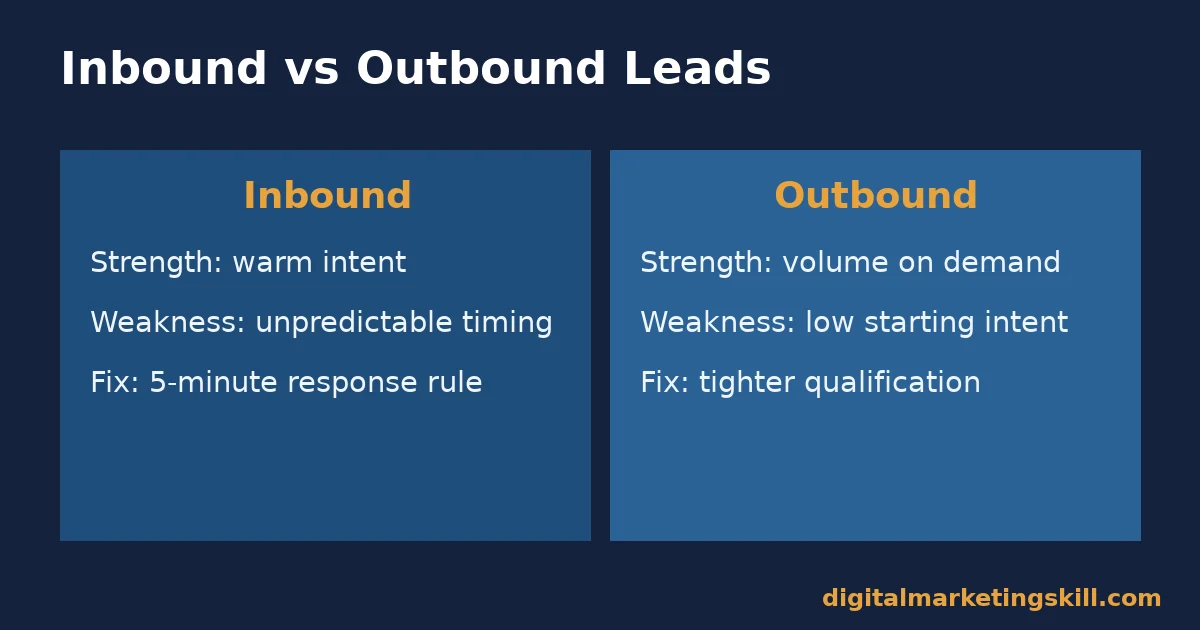
Inbound leads and outbound leads both count as lead generation, but they behave differently once captured. Treating them the same slows down both.
Inbound Leads: Built For Warm Intent
An inbound lead found you: through content, search, or a referral. They already have some interest before the first conversation starts. That is why inbound leads typically need less convincing and more confirming.
The weakness is volume and timing. Inbound leads arrive unpredictably. A team without a fast-response process will miss the narrow window where that interest is highest.
Outbound Leads: Built For Volume On Demand
An outbound lead did not come looking. A sales or marketing team identified them and reached out first, through cold email, cold calling, or targeted ads. This gives a business control over volume and timing that inbound alone cannot offer.
That control is valuable when a business needs predictable pipeline on a schedule, rather than waiting for inbound interest to show up on its own timeline.
The weakness is intent. An outbound contact has not shown interest yet. Qualification has to happen earlier and more carefully, or the team wastes time on people who were never a realistic fit.
Outbound also rewards patience in a way inbound does not. A cold contact rarely replies to the first message, so a short, planned sequence of follow-ups over a few weeks usually outperforms a single outreach attempt by a wide margin.
Fix Your Lead Generation, By Source
The fix for each source targets what that source is naturally weak at, not a generic “do everything faster” instruction.
Inbound: Lead With A Response-Time Rule
Set a hard rule: every inbound form submission gets a human or automated response within 5 minutes, even if the full answer comes later. A fast acknowledgment keeps the lead warm while a real reply gets prepared.
Assign a single clear owner for first response, even if that owner rotates by day or shift. The gap closes faster once one person is accountable, rather than a whole team assuming someone else already replied.
Put the owner’s name somewhere visible, even just a shared calendar block. Accountability that lives only in a verbal agreement tends to quietly erode the first time someone is busy or out sick.
Shorten your forms. Reducing a form from 11 fields to 4 fields produced a 120% increase in completed submissions in one landing page study (Involve.me). Ask only for what you need to qualify and respond, and collect the rest later.
Name, email, and one qualifying question are usually enough to start a conversation. Everything else, company size, exact budget, timeline, can come up naturally once a human is already talking to the lead.
Test the shortened form against the old one for a few weeks before fully switching. A sudden form change can shift lead quality as well as volume, and it is worth confirming the trade is a good one before committing to it permanently.
Outbound: Lead With Tighter Qualification
Build a short qualification checklist before a single outbound message goes out: a realistic budget range, a decision-making role, and a genuine use case. This filters out a large share of poor-fit contacts before they ever cost a sales rep’s time.
Keep the checklist to three or four items. A longer checklist feels thorough, but it usually slows the team down without meaningfully improving who gets contacted. Fewer, sharper questions beat a long form every time.
Track reply rate by list segment, not just overall. A segment with a low reply rate is usually a targeting problem, not a messaging problem. No amount of better copy fixes a list aimed at the wrong audience.
Review the checklist itself every few months. A qualification bar that fit the business a year ago can quietly stop matching who actually buys today, especially after a pricing or product change. Set a reminder. A review nobody schedules rarely happens on its own.
Measure What Matters For Lead Generation
Four numbers show whether a lead generation system is actually working end to end. A good B2B lead generation page typically converts visitors at 2-5%, with top performers reaching 5-10% (LeadSuiteNow, based on over 200 US campaigns). That range is a useful baseline before judging your own numbers.
- Form completion rate: the share of people who start a form and finish it. A low rate usually points to too many fields or an unclear reason to fill it out.
- Median response time: how long between a lead arriving and a human first responding. This is the single number most tied to whether a lead ever becomes a customer, based on the HBR and MIT research above.
- Lead-to-qualified rate: the share of captured leads that pass your qualification check. A rate that is too high often means the bar is too low; too low often means the targeting is off.
- Qualified-to-customer rate: the share of qualified leads that actually buy. This is the number that proves the whole system, not just the top of it, is working.
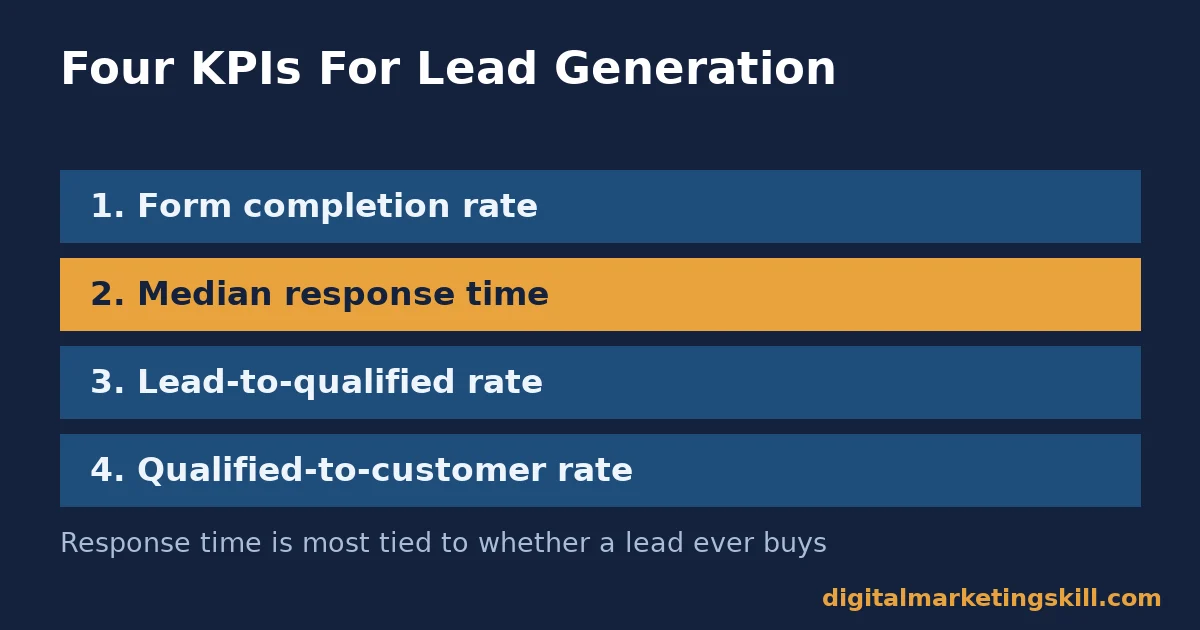
Review all four monthly. A strong form completion rate paired with a weak qualified-to-customer rate usually means the capture step is fine but qualification or follow-up needs the real attention.
Track response time separately for inbound and outbound leads. A single blended average can hide a serious problem in one channel while the other channel’s good numbers pull the overall figure back toward acceptable.
The One Decision Rule
If your lead-to-qualified rate is healthy but your qualified-to-customer rate is weak, the problem is response speed, not lead quality. Fix speed before you touch your targeting.
Illustrative, invented numbers: a business captures 200 leads a month, qualifies 60 of them, but only converts 3 into customers. The instinct is to blame lead quality and tighten targeting further. If the median response time is 18 hours, the real problem is likely the 60-times-less-likely outcome the HBR research describes, not the leads themselves.
Tightening targeting in that scenario would likely reduce the 60 qualified leads to something smaller, while the conversion rate on what remains stays just as weak. The number looks more selective. The underlying problem is untouched.
Cutting the lead volume in that situation would shrink the pipeline without fixing the actual leak. Fixing response time first, then reassessing qualification, is the order that protects the volume you already have.
The reverse case matters too. If response time is already fast and the qualified-to-customer rate is still weak, the qualification bar itself is likely wrong, either too loose or testing for the wrong signal entirely.
A Real Case, And Its Limits
Chinelo E., a Digital Marketing Skill Institute graduate, now manages a $7,000 monthly ad budget for a U.S. client, as published on the Institute’s reviews page.
This case is about managing paid campaign budget, not a specific lead generation funnel with published conversion numbers. One case does not predict another business’s results. It is included because managing that scale of spend requires the same underlying discipline this guide describes: capturing leads properly, qualifying them, and proving which ones turned into revenue.
A median B2B lead generation page converts at 2-5% of visitors (LeadSuiteNow), close to the broader median landing page conversion rate of 6.6% across all industries (Unbounce). Our guide to landing page optimization covers the priority order for fixing a page that is underperforming that benchmark. A $7,000 monthly budget only becomes real leads once the capture step is working at roughly that rate. Budget alone does not fix a weak capture page.
What this case does not show: the specific form, qualification process, or response-time numbers behind that budget. Treat it as evidence of career outcome, not a lead generation benchmark. The skill that connects the two is measurement: knowing which spend produced which result, not guessing. See the earnings disclaimer for how to read student results generally.
Frequently Asked Questions About Lead Generation
What is the difference between a lead and a qualified lead?
A lead is anyone who took an action signaling interest, like filling a form. A qualified lead has also shown a realistic ability to buy: budget, role, or timeline. Treating the two the same wastes follow-up time on people who were never a fit.
How fast should a business respond to a new lead?
As close to immediately as possible, with 5 minutes as a practical target. MIT and InsideSales research found responses within 5 minutes make contact roughly 100 times more likely than waiting 30 minutes.
How many fields should a lead generation form have?
As few as the business can qualify a lead with, often 3 to 5. Reducing a form from 11 fields to 4 fields produced a 120% increase in completed submissions in one landing page study (Involve.me).
Is outbound lead generation still worth doing?
Yes, especially when a business needs predictable volume rather than waiting for inbound interest to arrive. It needs a tighter qualification step than inbound, since the contact has not shown interest first.
What is the biggest sign a lead generation system is broken?
A healthy number of qualified leads that rarely convert to customers. That pattern usually points to slow response time, not poor lead quality, based on the research in this guide.
Should a small business automate the first response to a lead?
Yes, at least a basic acknowledgment. An automated message within minutes, followed by a real human reply, keeps the lead warm without requiring someone to be available around the clock.
What should the first automated reply to a lead actually say?
Confirm the submission was received, set an honest expectation for when a real reply will follow, and give one way to reach a human sooner if the need is urgent. A generic “thanks for your interest” with no next step wastes the window that automation was supposed to protect.
Is it worth qualifying leads before they even fill out a form?
Partially, yes. Targeting the right audience with ads and content reduces the number of poor-fit people who reach the form in the first place, which makes the post-form qualification step faster for everyone involved.
Does lead generation work the same way for every industry?
No. Deal size and sales cycle length change what a realistic qualification bar and response time look like. A longer, high-value sales cycle can tolerate a slower qualification step than a fast, low-cost purchase decision can.
Can a one-person business realistically hit a 5-minute response time?
Not for every lead, every time. A simple automated acknowledgment covers the gap when the owner is unavailable. A short daily schedule for checking and replying to new leads covers the rest without requiring constant attention.
Your Next Step With Lead Generation
Building a complete lead generation system, from capture through qualification to a fast response process, is covered across the Institute’s Master Diploma in Digital & AI Marketing, particularly the AI-Powered Lead Generation and Email Automation track, with a Full Stack option covering all four tracks together.
The program includes unlimited 1-on-1 coaching and mentoring, a U.S. Project Internship with a verified U.S. Work Reference Letter, and dual US and UK accreditation recognised in more than 100 countries. It runs 100% online from anywhere in your country.
Read more student outcomes on the reviews page, browse the blog for more guides like this one, or go straight to apply to start. Wherever you live, the program runs fully online. Explore Digital Marketing Skill Institute to see the full curriculum, and visit digitalmarketingskill.com for the rest of the blog.
For related guides, see our guide to generating leads on LinkedIn, our online marketing strategy framework, and our guide to X lead generation.
Every figure in this guide was checked against its original source before publication. Figures marked as illustrative are invented examples, not real results.
