

Content creation is the process of planning, producing and publishing material such as blog posts, video, infographics and podcasts. Good content creation answers one real question your audience has. Most new content never ranks or gets watched. So the format you pick, and the first few seconds of it, matter as much as the idea itself.
Key Takeaways
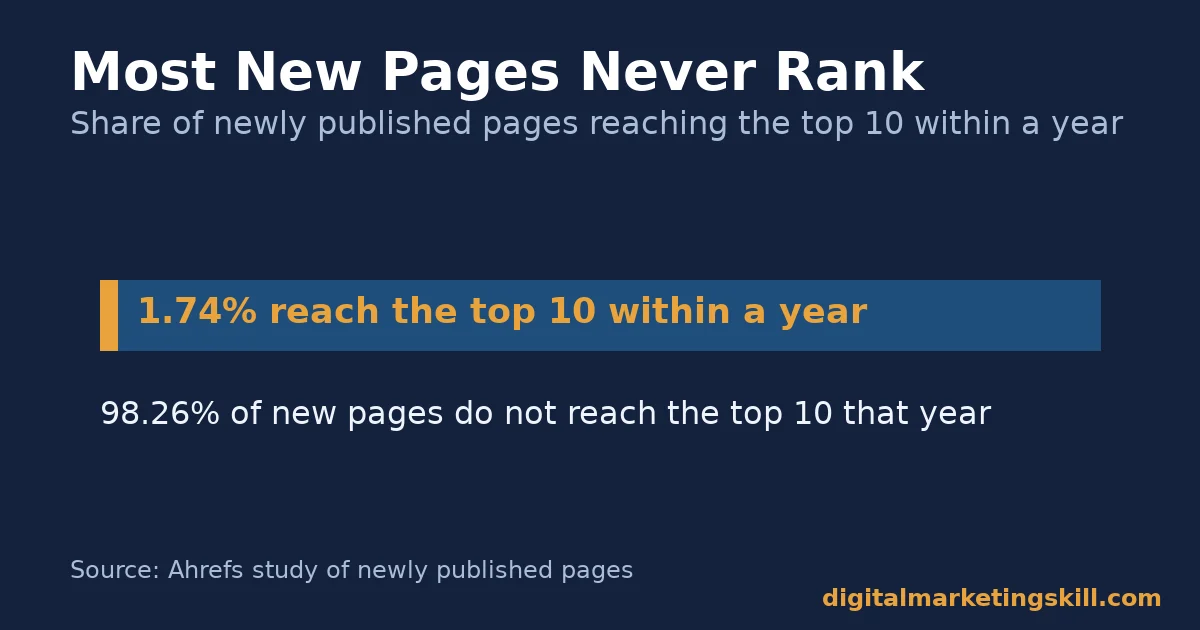
- Only 1.74% of newly published pages reach the top 10 search results within a year, so picking the right format and search intent matters more than publishing volume (Ahrefs).
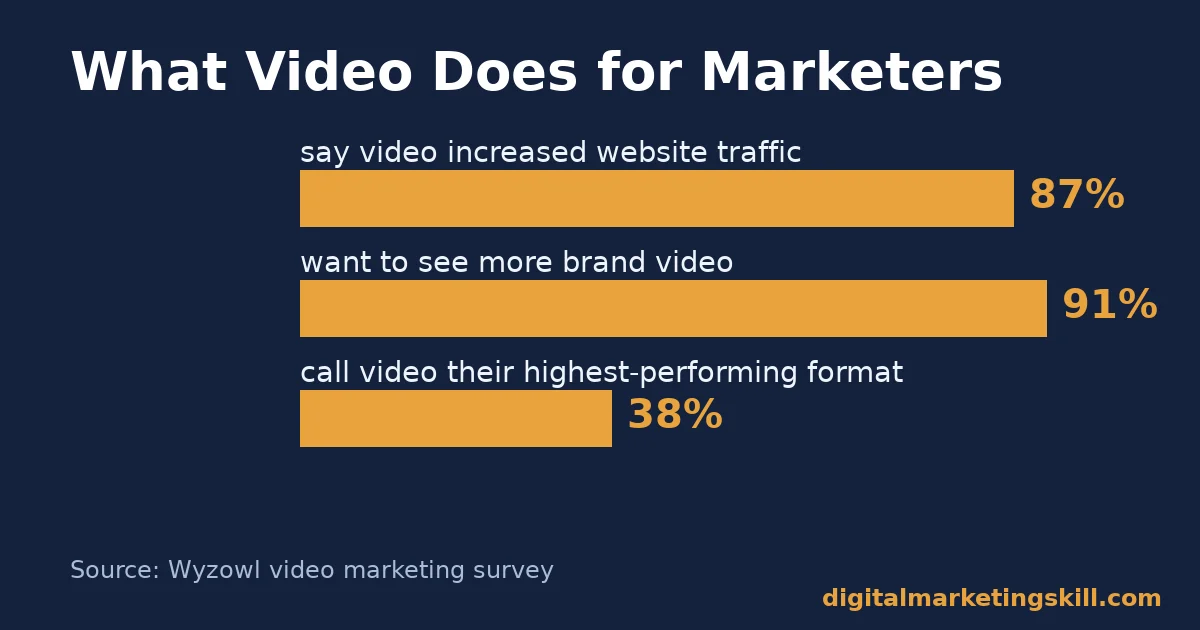
- 87% of marketers say video content directly increased traffic to their website (Wyzowl).
- 91% of people say they want to see more video content from brands they support (Wyzowl).
- 38% of marketers call video their single highest-performing content format (Wyzowl).
- 73% of readers skim a blog post rather than reading it in full, so the first two sentences carry most of the weight (HubSpot).
In this guide
- Why Most Content Creation Still Fails
- How Content Creation Actually Drives Traffic and Trust
- What Differs by Content Format
- How to Lead With Each Format
- How to Measure Whether Content Creation Is Working
- The One Decision Rule for Choosing a Format
- A Real Case: What Changes When Content Matches a Clear Intent
- Frequently Asked Questions About Content Creation
- Build Content Creation Skills With a Structured Program
Why Most Content Creation Still Fails
Search engines and AI answer engines reward content that resolves a question fast. They also reward content that cites real evidence. And they reward content that matches how people actually search. They do not reward content made just because a calendar said “publish today.”
Here is the scale of the problem. Ahrefs studied newly indexed pages and found that only 1.74% reach the top 10 results within a year. So the other 98.26% were written without a clear path to being found. That is not a talent problem. It is usually one of three fixable issues.
First, the format may not match the intent. For example, a long article when the searcher wanted a quick visual answer. Second, the piece may never state its point up front. Third, there may be no evidence a reader, or an AI system, can actually verify.
This guide treats content creation as a matching problem first, and a writing problem second. Think of it as an informed set of working methods, not a guaranteed formula, because audience behaviour keeps shifting. A tactic that works for one niche, or one search engine update, can fade within months, so revisit your assumptions on a regular schedule rather than setting a strategy once and leaving it untouched for years.
Consider two writers covering the same topic. One opens with background history and company context, then finally answers the question in paragraph six. The other states the direct answer in sentence one, then uses the rest of the page to support it with evidence and examples.
Search engines and AI systems increasingly favour the second approach, because it is easier to extract a confident, quotable answer from it. Readers favour it too, since most people decide within the first few lines whether a page is worth their time. The lesson is not to write less. It is to put the most useful sentence first, every time, regardless of format.
How Content Creation Actually Drives Traffic and Trust
Every piece of content works the same way once it goes live. First, a search engine or an AI assistant has to understand what the content covers. Next, it decides whether your content answers the query better than the alternatives. Finally, it decides whether to keep showing your content over time.
Clear structure helps with that first step. Headings, defined terms and a direct opening answer all help a machine parse your page quickly. Named evidence with a source attached builds trust with both machines and readers. And a format that matches how your audience already consumes information, reading, watching, or skimming a chart, keeps them on the page long enough to count as a good result.
So close-but-not-quite content earns very little. Ahrefs also found that pages already ranking in the top 10 capture 96.98% of all clicks from a results page.
In short, the mechanism rewards content that is clearly the best match for one specific question. It does not reward content that is broadly relevant to a wide topic.
Pairing a post with real keyword data, the approach covered in this guide to free keyword research tools, makes that matching step far more reliable than guessing. Guessing which words your audience actually types into a search bar is one of the most expensive mistakes in content creation. It can waste weeks of writing on a question almost nobody is asking.
What Differs by Content Format
Each format is built to win a different kind of attention. Choosing the wrong one for the goal is the single most common, and most fixable, content creation mistake.
Blog Posts: Built for Search Intent and Depth
A blog post is the format search engines parse most easily. Headings, defined terms and internal links all give a crawler clear signal about what the page covers. So it is the right choice when someone is actively searching for an answer.
It also works when that person is willing to read several hundred words to get a full answer, such as “how to,” “what is,” or comparison questions. A blog post is also the easiest format to update later, since editing a paragraph takes minutes, while reshooting a video or redesigning an infographic takes far longer.
Video: Built for Retention and Shareability
Video earns attention through motion, voice and pacing, not through a crawler reading text. Wyzowl surveyed marketers and found that 87% say video increased traffic to their website. Separately, 38% call video their highest-performing format outright. As a result, video suits demonstrations, product walkthroughs, and anything easier to show than to describe in a paragraph.
Infographics: Built for Quick Data Transfer
An infographic compresses a statistic, a process, or a comparison into something a reader absorbs in seconds, without reading full sentences. It works best for content that is mostly numbers, steps, or a before-and-after comparison. It is also highly shareable, because it needs no extra context to make sense on its own. That same shareability makes it effective across the channels covered in this guide to social media content types. Keep the design simple, too. A crowded infographic with ten competing data points is harder to share than one with a single clear headline number, because the person sharing it has to explain less to make the point land.
Podcasts: Built for Passive, Repeat Listening
Podcast content gets consumed while the listener does something else: commuting, exercising, working. And the audience is large. YouTube reported more than 1 billion monthly active podcast viewers worldwide in a recent update. Because a podcast cannot rely on visuals or skimmable structure, it depends on a strong, consistent voice. It also needs a predictable episode structure that rewards people who keep coming back. A fixed publishing rhythm, planned the way this guide to building a content calendar describes, is what keeps a podcast from stalling after the first few episodes.
How to Lead With Each Format
Knowing what a format is built for only helps once it changes how you open the piece. Here are the practical adjustments that actually move the needle for each one.
Blog Posts: Lead With a Clear Search Intent Match
Open with a direct, plain-language answer to the exact question in your title. Do this within the first two sentences. Readers and AI summarisers both reward content that states its conclusion early, instead of building up to it. This directly addresses the fact that 73% of readers skim rather than read a post in full, according to HubSpot’s analysis of reading behaviour. If you cannot summarise your own post in one sentence before you write it, the structure usually needs more work before the prose does.
Video: Lead With the Hook in the First Seconds
State the outcome, or the problem you are solving, in the first five to eight seconds. Do this before any logo, intro music, or scene-setting. Viewers decide whether to keep watching almost immediately. So the strongest piece of information belongs at the very start, not the warm-up. Watch your own drop-off data if your platform shows it, since the exact second viewers leave usually points straight at the weak part of the opening.
Infographics: Lead With One Decision-Worthy Number
Pick the single most surprising, verified statistic in your dataset. Make it the visual focal point, and let every other element support it. An infographic trying to communicate five equally weighted facts communicates none of them well. One number people can repeat to someone else is the real goal. Everything else on the visual, labels, icons, colour, should point back to that one number instead of competing with it for attention.
Podcasts: Lead With a Consistent, Skimmable Structure
Use the same segment order, and roughly the same episode length, every time. Say the segment titles out loud, too, so a listener who tunes in midway can still follow along. Consistency, not novelty, is what turns a one-time listener into a subscriber. A short written summary alongside each episode also gives search engines something to index, since audio alone is still harder for most crawlers to parse.
How to Measure Whether Content Creation Is Working
Pick a small number of KPIs before you publish. Then check them on the same schedule every time, so your comparisons stay fair.
- Organic sessions per piece: the number of visits a page gets from unpaid search results. It tells you whether the format and keyword match actually got the content found. Track it monthly, not daily, since search traffic takes time to settle.
- Average engagement time: how long a visitor actively spends on the page or video before leaving. A format mismatch usually shows up here first, even before rankings move, so treat a sudden drop as an early warning sign.
- Assisted conversions: actions such as a sign-up, a download, or an application, that happened after a visitor read or watched the content. It counts even if the content was not the very last step before converting, which matters because most people do not convert on their first visit.
- Repurposing yield: how many extra formats, for example a video turned into a blog post, you produced from one round of research. It measures efficiency, not quality, and it is a useful number when you are deciding where to spend your next hour of production time.
None of these numbers means much on its own. Compare them against your own past posts, not against a generic industry benchmark, since your audience and niche will always behave differently from an average pulled from thousands of unrelated sites.
The One Decision Rule for Choosing a Format
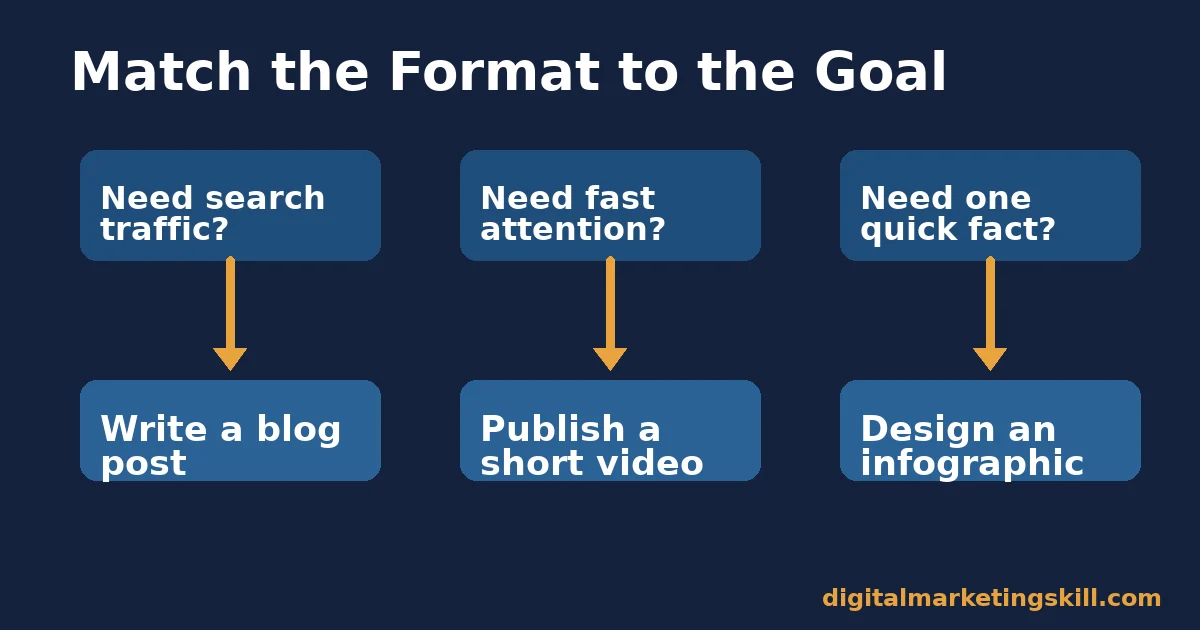
If you only have time for one piece of content this week, write a blog post first. Build it around a single, specific search question. Do this before you create a video, infographic, or podcast on the same topic. Why? A blog post is the only format search engines and AI answer engines can fully read and quote today. That makes it the foundation the other formats get repurposed from later.
Illustrative, invented numbers: picture a team that used to split its time evenly across four formats. Then it switches to this one rule for a quarter. Organic sessions could grow faster simply because every piece now targets one clear, matched intent, instead of four competing goals at once. This is a worked example to show the reasoning, not a reported result. If the blank page, not the format choice, is your real obstacle, this guide on how to overcome writer’s block covers practical ways to get a first draft started.
A Real Case: What Changes When Content Matches a Clear Intent
Content Marketing Institute’s industry research keeps finding the same pattern. Marketers who prioritise quality and audience relevance over raw publishing volume report stronger content performance than marketers who just publish more often. But there is a real limit here: this finding is self-reported by the marketers surveyed about their own programs, not measured independently. It also does not say which specific formats performed best for which specific intents. So treat it as directional evidence that focus beats volume. It is not a guaranteed outcome for any single piece of content.
The practical takeaway is simple, even if the underlying data has limits. A smaller number of carefully matched, well-evidenced pieces tends to outperform a larger pile of generic ones. That is true whether you are a solo creator publishing one post a week or a team running four formats at once. Treat every new piece of content as a bet on one specific question, not a box to check on a content calendar.
Frequently Asked Questions About Content Creation
What is the difference between content creation and content marketing?
Content creation is the act of producing the material itself, such as writing a post or filming a video. Content marketing is the broader strategy: planning, distributing and measuring that content against a business goal. In short, content creation is one step inside a content marketing plan.
How long does it take to see results from content creation?
Blog posts typically take several months to climb in rankings. That is because search engines need to crawl, index and test a page against competing results over time. Video and social content can show engagement signals much faster, often within days, because that feedback loop is immediate.
Do I need video, a blog, and a podcast, or can I pick one?
Start with whichever format matches your audience’s strongest intent. For most topics, that means a blog post for search-driven questions. Expand into other formats once you have evidence the topic is worth the extra production time. Spreading your effort across every format from day one is the most common reason content creation plans stall.
How many words should a blog post be for content creation purposes?
Let the complexity of the question set the length, not a fixed target. A simple definition needs only a few hundred words. A comparison or a step-by-step guide usually needs more space, so it stays genuinely useful instead of padded.
What makes an infographic actually get shared?
One clear, verified, slightly surprising number, shown with almost no competing information on the same visual. Infographics that try to summarise an entire article usually get ignored. That is because no single fact stands out enough for someone to repeat it.
Can AI tools replace the content creation process?
AI tools can speed up research, drafting and formatting. But a human still needs to verify every statistic, confirm the real examples, and judge whether the draft actually answers the reader’s question before it gets published. Skipping that review step is how factual errors and generic, unhelpful pages end up live.
Why does my content rank but still get few clicks?
Ranking measures whether a search engine thinks your page is relevant. Clicks depend on whether your title and snippet convince a human the page is worth opening. These need different fixes: better evidence and structure for ranking, a sharper and more specific title for clicks. Try rewriting only the title first, since that is the fastest change to test.
Should I update old content instead of creating something new?
Often, yes. A page that already ranks on page two can be faster to improve than a brand-new page is to rank from zero. Refreshing the opening paragraph, adding newer evidence, and fixing the format mismatch can lift an existing page without the cost of a full new content creation project.
Build Content Creation Skills With a Structured Program
Content creation gets easier once you work from a system, instead of guessing format by format. The Digital Marketing Skill Institute’s Master Diploma in Digital & AI Marketing is built around four AI-powered tracks, drawn from ten execution-first courses in total. That includes a track in AI-Powered Lead Generation and Email Automation for turning content into leads, and a track in AI-Powered WordPress and SEO Specialist for making that content findable in the first place. Students who want both can take the Full Stack option and complete all four tracks. Each track is built to be practical first, so lessons centre on producing real content and campaigns rather than theory alone.
The program includes unlimited 1-on-1 coaching and mentoring, a U.S. Project Internship with a verified U.S. Work Reference Letter, and dual US and UK accreditation recognised in more than 100 countries. It is delivered 100% online, so you can build a content creation practice from anywhere in your country. Explore real outcomes on the student reviews page, browse more guides on the digital marketing blog, or go straight to the application page to start. Learn more at digitalmarketingskill.com, wherever you live, and see the full curriculum at digitalmarketingskill.com.
Every figure in this guide was checked against its original source before publication. Figures marked as illustrative are invented examples, not real results.
