To overcome writer’s block, match the fix to the real cause: fear, fatigue, or friction. A generic tip rarely works twice, because each of those three causes needs a different first move. This guide separates them, gives each one its own fix, and shows how to tell your block is actually lifting.
Key Takeaways
- Movement genuinely helps. A Stanford study by Oppezzo and Schwartz tested 176 people across four experiments. Walking raised creative output by an average of 60% compared with sitting.
- But not for every task. The same Stanford study found walking slightly hurt convergent thinking, the kind of thinking that needs one correct answer, not many ideas.
- Breaks are not optional. DeskTime’s repeat study of its most productive users found a 112-minute work, 26-minute break pattern, longer than its original 52-17 finding.
- Expressive writing changes how you process a block. In Pennebaker and Beal’s study, students wrote about emotional experiences for 15 minutes a day across four days. It raised short-term distress but was linked to better health over time.
- Time pressure is not the enemy you think it is. Orbit Media surveyed 1,042 content marketers. The average post took 3 hours 20 minutes to write, and writers who spent 6+ hours reported stronger results than those who rushed.
In this guide
- What Most Advice to Overcome Writer’s Block Skips
- Why Writer’s Block Actually Happens
- What Differs by Type of Block
- How to Lead With Each Type
- How to Tell Your Block Is Actually Lifting
- The One Decision Rule: Match the Fix to the Type of Block
- A Real Case: What the Stanford Walking Study Showed
- Frequently Asked Questions About How to Overcome Writer’s Block
- Build Reliable Content Creation Skills With a Structured Program
What Most Advice to Overcome Writer’s Block Skips
Most lists of tips group everything under one label. Take a walk. Change your scenery. Set a timer. Each tip can work. But the lists rarely say which block it fixes.
That gap matters. A fear-based block and a fatigue-based block feel the same from the inside: a blank page, a stuck cursor. But they need opposite fixes. Rest helps fatigue and does nothing for fear. A lower-stakes first draft helps fear and does nothing for fatigue.
Most people who try to overcome writer’s block reach for whichever tip they heard most recently, not the one that matches their actual cause. That is a coin flip at best. Naming the cause first turns the fix into a two-step process instead of a guessing game: identify the cause, then apply its specific fix.
Read the Evidence With Limits in Mind
The Stanford walking study is real and well cited, but it measured creative-thinking tests, not finished articles. Treat the 60% figure as a lab result, not a guarantee for your next draft. The DeskTime figures come from one time-tracking company’s own users, not a controlled study, so read them as a pattern, not a law.
This guide assumes you already have a topic and an audience in mind. If you are still unsure what to write about, our guide on how to generate content ideas is the better starting point.
One more ground rule: none of the fixes below are permanent cures. Writer’s block returns, because the three causes behind it (fear, fatigue, friction) are ordinary parts of creative work, not flaws to eliminate forever. The goal is a faster recovery each time, not a life free of blocks.
Why Writer’s Block Actually Happens
Writer’s block is not one thing. Researchers who study it describe it as the inability to start or continue writing for reasons that are not a lack of skill. That rules out “I don’t know how to write.” It usually leaves three real causes.
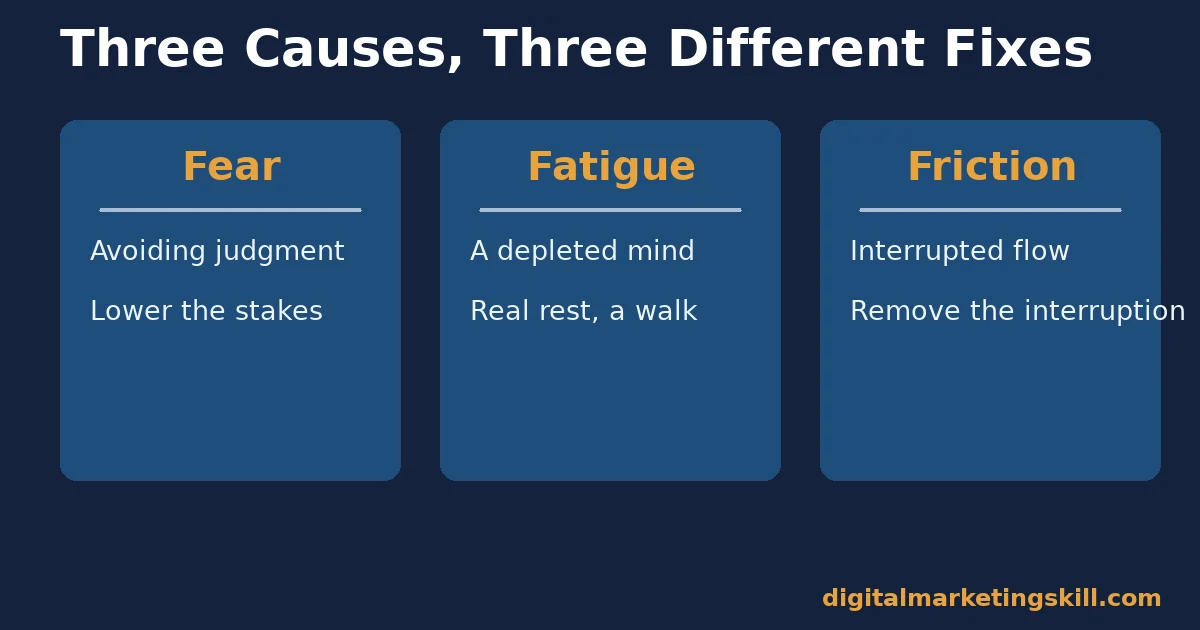
Fear is the first. You worry about judgment, so your mind resists committing words to the page. Fatigue is the second. Your working memory and attention are depleted, often from writing too long without a break. Friction is the third. Something in your environment or your tool keeps interrupting your flow before an idea can form.
All three produce the same surface symptom: a blank page and a stuck feeling. That is why generic advice fails so often. It treats the symptom, not the cause underneath it.
What the Research Actually Says
Writing researchers have studied this gap directly. Work on writer’s block generally defines it as the inability to begin or continue writing for reasons other than a lack of basic skill or commitment, which rules out “I just can’t write well enough” as a real explanation for most blocks. The feeling of being stuck is real; the cause is almost never a lack of ability.
These three causes also compound each other. A fear-based block left unaddressed for days turns into fatigue, because the mental effort of avoiding the page is itself tiring. A friction-based block ignored for too long starts to feel like fear, because repeated failed attempts erode confidence. Naming the original cause early, before it compounds, keeps the fix simple.
What Differs by Type of Block
To overcome writer’s block reliably, treat these three types as separate diagnoses rather than one condition with many symptoms. Each section below names what the block looks like from the inside and what it is actually built on underneath.
Fear-Based Block: Built on Avoiding Judgment
This is the type most people mean when they say they want to overcome writer’s block. Fear-based block shows up as perfectionism. You rewrite the same sentence five times before moving on. You worry about how a draft will be received before it even exists. The fix has to lower the stakes of the page in front of you, not improve your skill.
Fatigue-Based Block: Built on a Depleted Mind
Fatigue-based block shows up as a flat, uninspired feeling, even on a topic you normally enjoy. It often follows a long stretch of writing without a real break. The fix has to restore mental energy, not push through with more effort.
Friction-Based Block: Built on an Interrupted Flow
Friction-based block shows up as constant small interruptions: a notification, a noisy room, a tool that slows you down. Each one breaks your train of thought before an idea can fully form. The fix has to remove the interruption, not motivate you to ignore it.
Friction is often the easiest of the three to confirm. Notice what happens right before you lose your train of thought for a few sessions in a row. If the same interruption shows up each time, you have found your friction point, and the fix is usually mechanical rather than emotional.
How to Lead With Each Type
These three sections mirror the diagnoses above. Find your cause first, then read only the matching section; trying all three fixes at once makes it harder to tell what actually worked when you do overcome writer’s block.
Fear-Based Block: Lead With Lower Stakes
Write a deliberately bad first draft. Give yourself permission to write badly for ten minutes, with no editing allowed. Free writing works here: set a timer, write continuously, and ignore grammar and structure entirely. The goal is volume, not quality.
Fear also drops when you talk before you type. Explain your idea out loud to a colleague, or simply to yourself. Saying it removes some of the weight that typing it carries.
Small, visible goals help too, because fear often grows in proportion to the size of the task. Instead of aiming to finish an article, aim to finish one paragraph. Each small goal you hit is evidence against the fear, which is usually more persuasive than reassurance from someone else.
Reward the attempt, not just the outcome. A short break, a favourite drink, or five minutes on something enjoyable after a focused session builds a positive association with sitting down to write, even on days the draft comes out rough. Over time, this is what makes it easier to overcome writer’s block before it fully sets in.
Fatigue-Based Block: Lead With Real Rest
Step away from the page entirely. A short walk is the best-evidenced option: the Stanford study above found a 60% lift in creative output from walking versus sitting. A walk outdoors or on a treadmill both worked in that research.
Match your writing sessions to DeskTime’s pattern above: long, focused sessions followed by a real break away from the screen, not a scroll through social media. A break spent on another screen rarely restores the same energy as one spent away from it.
Expressive writing can also help you process the fatigue itself, separate from the article you are trying to finish. Pennebaker and Beal’s research, cited above, found that writing honestly about what is wearing you down, even for a few minutes, was linked to better outcomes over time, despite feeling harder in the moment.
This is a different exercise from drafting your actual piece. Treat it as a reset, not a substitute for the work in front of you. Five minutes of honest, unpolished writing about your actual stress often does more than another five minutes spent staring at the article itself.
Protect your most alert hours for writing specifically, and push meetings, email, and admin work into your lower-energy hours instead. Most people have a predictable one- to three-hour window each day when focus is highest; find yours by noticing when ideas come easiest over a week, not by guessing.
Friction-Based Block: Lead With One Changed Variable
Change one thing about your environment at a time, so you know what actually helped. Try a different room, a different app, or writing by hand instead of typing. Turn off notifications before you start, rather than trying to ignore them once they arrive.
If your writing tool itself is the friction, for example a slow editor or a cluttered interface, switch tools before you blame your creativity. The tool is often the easier fix.
Five Tools That Remove Common Friction Points
Each tool below addresses a specific friction point rather than trying to fix every type of block at once.
- Google Docs removes the friction of losing work or switching devices, since it saves automatically and syncs across any device you open it on.
- Notion removes the friction of scattered notes by keeping ideas, outlines and drafts in one searchable workspace.
- Marinara Timer removes the friction of losing track of time, using a free interval timer built on the Pomodoro method of focused work blocks.
- Hemingway Editor removes the friction of over-editing mid-draft by flagging dense or passive sentences after you finish writing, not during.
- A plain voice-to-text app removes the friction of typing itself for writers who think faster out loud than they type; most phone keyboards include one by default.
Pick one tool per friction point, not all five at once. Adding five new tools to your workflow in a single week creates its own friction, which defeats the purpose.
How to Tell Your Block Is Actually Lifting
Four Signals Defined in One Sentence
- Time to first sentence is how long you sit before writing anything usable, and a shrinking number means the block is easing.
- Words per sitting is your output in one focused session, tracked over several sessions rather than judged from a single day.
- Edit-to-write ratio is how much time you spend rewriting versus drafting new material; a high ratio often signals fear-based block specifically.
- Return rate is how often you come back to the page without being forced to, which reflects whether the underlying cause is actually resolved.
Pick one signal to watch first. Trying to track all four at once adds its own friction, and that defeats the point. Add the rest only once the first feels automatic.
How to Read These Signals Together
A rising words-per-sitting number with a flat edit-to-write ratio suggests fatigue is lifting. A flat words-per-sitting number with a falling edit-to-write ratio suggests fear is lifting, even before total output improves. Track more than one signal, because any single number can mislead you on its own.
Keep this simple: a sticky note with today’s date and a rough word count is enough. You are not trying to build a dashboard. You are trying to overcome writer’s block with evidence instead of guesswork, and a week of rough notes gives you more signal than a single good or bad day ever will.
The One Decision Rule: Match the Fix to the Type of Block
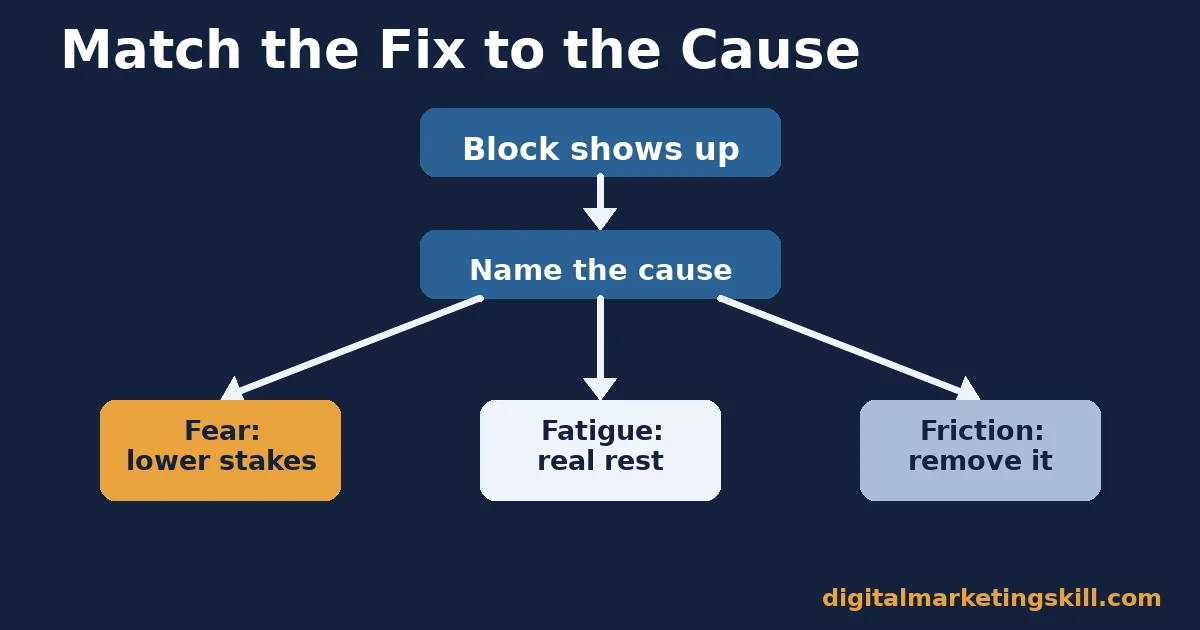
Before trying a new technique, name the type of block first. Fear, fatigue, or friction. A technique built for the wrong type wastes time and can make you doubt techniques that would have worked for a different cause.
Illustrative, invented example: imagine you have tried free writing for a week with no real change. Before concluding that free writing does not work, check whether your block is actually fatigue-based rather than fear-based. Free writing addresses fear. It does nothing for a depleted mind that genuinely needs rest. Matching the fix to the cause, not the popularity of the technique, is what moves the number.
A Real Case: What the Stanford Walking Study Showed
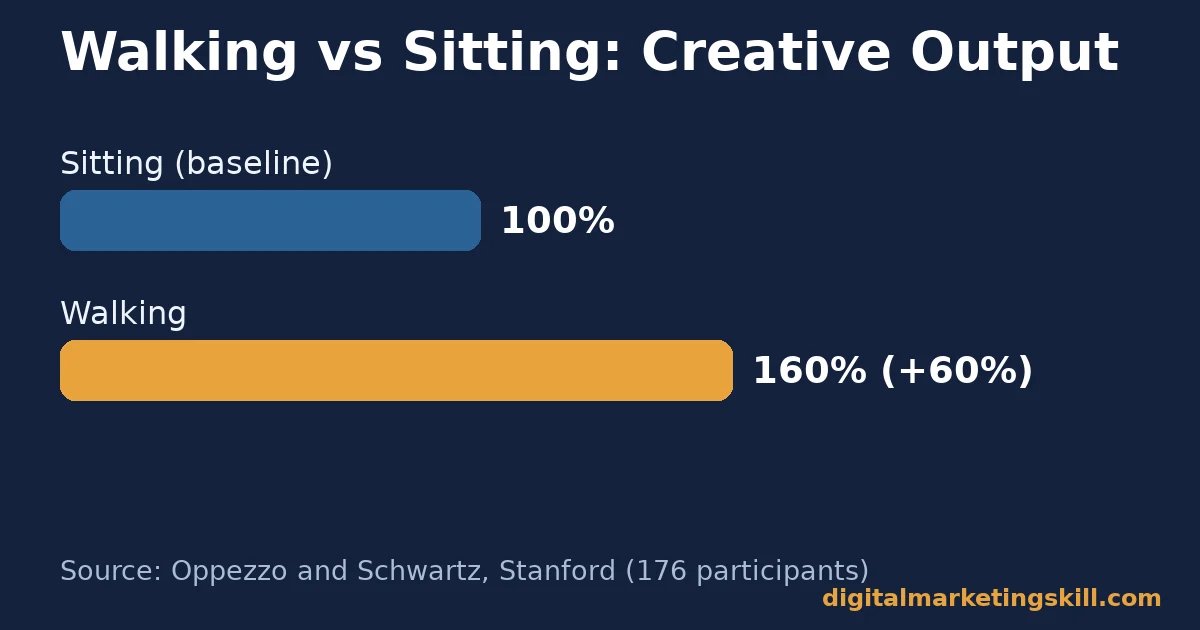
The Oppezzo and Schwartz study, cited above, is useful because it isolated one variable: walking versus sitting. Across four experiments with 176 participants, walking raised creative output by an average of 60%. That effect held whether participants walked outdoors or on an indoor treadmill.
The limit matters just as much. Walking did not help, and slightly hurt, tasks that needed one correct answer rather than many ideas. So treat walking as a tool for idea generation and early drafting, not for the final, careful edit of a piece that is almost done. A short walk before a brainstorm beats a short walk before a deadline-day proofread.
This single case also shows why matching the fix to the cause matters so much when you try to overcome writer’s block. A walk fixes fatigue-driven and idea-generation blocks well. It does nothing for a fear-based block rooted in worry about judgment, and it will not speed up a careful final edit that needs one right answer, not many options.
Frequently Asked Questions About How to Overcome Writer’s Block
What actually causes writer’s block?
Writing researchers describe it as the inability to start or continue writing for reasons other than a lack of skill, usually traced to fear of judgment, mental fatigue, or friction in your environment or tools.
How long does writer’s block usually last?
Duration varies by person and by cause. A friction-based block can clear in minutes once the interruption is removed, while a fatigue-based block may need days of real rest before writing feels possible again. A fear-based block often sits somewhere in between, easing within one or two sessions once the stakes of the page genuinely feel lower.
Does taking a walk really help you overcome writer’s block?
For idea generation, yes: a Stanford study found a 60% average increase in creative output from walking versus sitting. It will not help a task that needs one precise answer rather than new ideas.
Can writing tools help you overcome writer’s block?
Tools that reduce friction, such as distraction-free editors or voice-to-text apps, can help when the block is friction-based. They do little for a block caused by fear or fatigue, because the cause lives in you, not the software.
Is it normal to experience writer’s block regularly?
Yes. It is a common, well-documented experience among writers at every level, not a sign of low talent or a lack of commitment to the work.
What is the fastest way to overcome writer’s block when you are on a deadline?
Diagnose fast: if you are worried about how the draft will look, free write badly for ten minutes with no editing. If you feel flat or exhausted, take a short walk before writing another word; both fixes work faster than forcing more time at the keyboard.
Should you push through writer’s block or stop and rest?
It depends on the cause. Push through gently for a fear-based block with a low-stakes free-writing exercise. Stop and rest for a fatigue-based block, where more effort usually makes the block worse, not better.
How do you know which type of block you actually have?
Ask what the page feels like. A racing worry about judgment points to fear. A flat, low-energy feeling even on a topic you like points to fatigue. Constant small interruptions breaking your focus point to friction.
Can expressive writing help you overcome writer’s block directly?
It helps indirectly, by processing the stress or fatigue sitting underneath the block, rather than by producing the article itself. Treat it as a separate short exercise, not your actual draft.
Does switching writing tools actually help, or is it a distraction?
It helps specifically when the current tool is the source of friction, such as a slow interface or constant autosave errors. It becomes a distraction when the real cause is fear or fatigue, because a new tool cannot fix either one.
Build Reliable Content Creation Skills With a Structured Program
Turning ideas into finished content on a schedule, without relying on inspiration alone, is a core skill inside the Digital Marketing Skill Institute’s Master Diploma in Digital & AI Marketing. The program is built from four AI-powered tracks and ten execution-first courses in total, with a Full Stack option for learners who complete all four.
You also get unlimited one-on-one coaching and mentoring, a U.S. Project Internship, and a verified U.S. Work Reference Letter. The diploma carries dual US and UK accreditation, recognised in more than 100 countries, and runs 100% online, so you can build a real content practice wherever you live.
A structured curriculum, regular feedback from coaches, and a consistent publishing schedule all reduce how often you need to overcome writer’s block in the first place, because much of what causes it (unclear goals, no feedback loop, working in isolation) is designed out of the process from the start.
Read more of our work on the Digital Marketing Skill Institute blog. See outcomes on our reviews page. When you’re ready, apply here. Visit Digital Marketing Skill Institute to start building a writing practice that holds up, wherever you live, at digitalmarketingskill.com.
Every figure in this guide was checked against its original source before publication. Figures marked as illustrative are invented examples, not real results.